
Forget all the soulless AI slop that plagues the internet now. If you want impressive computer animation that has true love and extensive creativity put into it by supremely talented and hard working people, I defy you to do better than the Toy Story films. It’s been over 30 years since the first one warmed our hearts with its stunning visuals, wonderful characters, entertaining storyline, great humour and uplifting music. It achieved that magical balance of appealing to both children and adults alike, and it still holds up as a masterpiece today.
The sequels have proven to be very good as well, and this year we’ve had the 5th instalment in the franchise. I’ve recently bought the Blu-ray for it, despite having never watched it before, purely on the strength of liking the previous films and reading the rave reviews for this new outing. It’s very rare that I buy a sequel I’ve never seen unless there’s very good reason, but that’s how much confidence I have that it will be up to a sufficient standard. I hope I’m right!
So as I’ve got plenty of time to do so, and as it feels like we’ve reached a significant milestone with the franchise, I figured I would rewatch all of the previous films, and then try out the new one for the first time, as well as exploring all the soundtracks and extra features.
There’s so much to look through that it really is like diving into another world, and I’m delighted to see that all of the Blu-rays have audio description available for those who need it. Also note that I’m watching the 2D versions of the Blu-rays, as I don’t have the eyesight or a suitable player to watch the 3D editions. But that’s fine, as the standard versions look amazing anyway.
So let’s get into it all. In this post I’m going to focus on the first 2 films, then in the next part I’ll explore the rest. None of this is sponsored or gifted, I’m just a big fan, and I hope you enjoy looking through it all with me!

Contents
- My Toys
- Toy Story 1 – Movie / Music / Extras
- Toy Story 2 – Movie / Music / Extras
- Ultimate Toy Box
My Toys
The simple idea of toys coming to life is something that we’ve all dreamed about and wished for as children, so it’s no wonder it’s so captivating. As a child I had loads of cuddly animals and toy cars that inspired my imagination in that way.
Even now, as an adult in my 40s caring for my blind mother in her 80s, I still make good use of the two cuddly toys that we own to help me look after her. One is a large lion called Leo that I’ve had since childhood, and according to the label he was made in Wales many years ago by a company called Lefray. He’s still in pretty good condition as well. The other is a teddy bear called Freddie, because he wears a t-shirt with Freddie Mercury’s face on it, who was given to me by my girlfriend 8 years ago (can’t believe it’s that long!). The t-shirt is a bit faded now, but otherwise he’s also in very good nick.

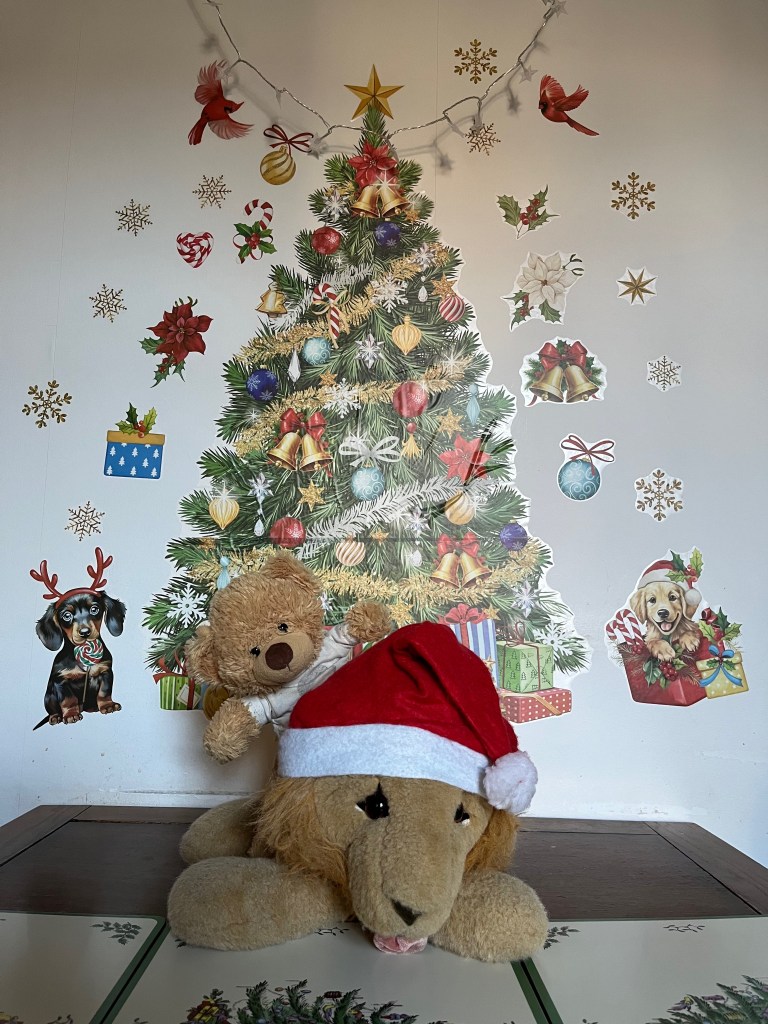
In general, they sit with Mum during the day and watch over her when she sleeps at night, and it gives her some comfort to know that they’re there. They don’t replace me by any means, as she still gets very anxious if I’m not around. But because they both have great sentimental value to me, she treasures them as the special gifts that they are. They’re not just random toys I bought from somewhere, they have real meaning and are thus a reminder that I love her.
But in addition, I also make them act as if they’re alive when they give her strokes and cuddles, fetch little items that she’s asked for, kiss her goodnight, etc. She knows perfectly well that they’re not actually sentient beings, and she’s never been confused about that. But their interactions with her always make her laugh and give her great comfort, so I’ve taken full advantage of that fact.


They also spend some time with me as well, especially when Mum’s upstairs showering and getting dressed first thing in the mornings. Giving them cuddles and talking to them has been of real comfort and help to me during the hardest times in my journey as a carer, because they’re adorable, loyal, friendly, non-judgemental listeners. So it’s good to sound off to them, and sometimes just chatting in that way has actually helped me to think more clearly about things, come to proper conclusions or have fresh ideas. It’s amazing what a difference it can make to have them around.
So to Mum and I, they’re virtually alive in many ways, and we love them to bits. But we know they’re not really alive… right?
Toy Story
Movie
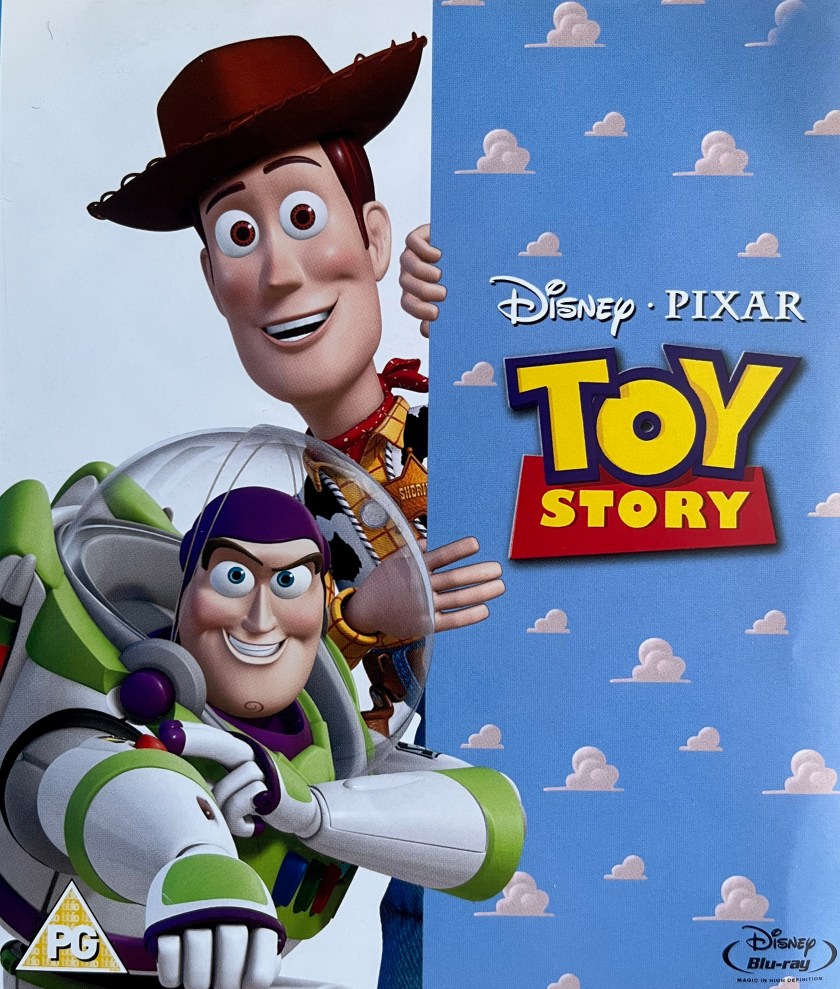
This 1995 classic is where it all began, introducing us to the large collection of toys owned by Andy (John Morris), who are led by the friendly Sheriff Woody (Tom Hanks). There’s a wide selection of characters among the group, including the arrogant Mr Potato Head (Don Rickles), the timid dinosaur Rex (Wallace Shawn), the seductive Bo Beep (Annie Potts), the clever pig Hamm (John Ratzenberger) and the stretchy Slinky Dog (Jim Varney). The fact that they behave and talk like adults, as illustrated by the staff meeting early on, helps to give it universal appeal to people of all ages.
The enjoyable opening really shows what a tight-knit family they are, with the soldiers doing a reconnaissance mission to see what Andy is getting for his birthday, while the rest of the toys anxiously wait for news. And it all seems to be fine, until Andy unwraps a Buzz Lightyear action figure (Tim Allen). Suddenly Woody finds himself cast aside as the child plays with the cool new space ranger, and all of the other toys swoon over Buzz too. Worse still, Woody is then ostracised altogether when a revenge prank goes wrong and causes Buzz to fall out of the window.
Andy is thus unable to find him and has to take Woody out to Pizza Planet instead. But Buzz tags along for the ride and confronts Woody, only for both of them to get separated from Andy. They instead end up in the hands of Sid (Erik von Detten), an evil child who tortures toys for the fun of it. Sid is Andy’s neighbour, but not for long, because Andy and his mother are preparing to move house. So Woody and Buzz have to find a way out fast to get back to their master, otherwise they’ll lose him forever. But will Buzz have the heart to try, when he learns that he’s just a toy and not the real space hero he thought he was?
Altogether It’s a great story packed with excitement, humour and tender moments. Just seeing the toys come alive at the start is a treat, as if we’re gaining access to a secret world we would never normally witness. They’re very creative at using what’s in their environment to get around and do things, and they all have their own personalities, quirks and abilities. The other places that we’re taken to are also interesting, including the imposing gas station, the pizza restaurant with the excited aliens in the claw machine and the terrifying bedroom at Sid’s house.
It’s also lovely to see how Woody and Buzz’s friendship develops during the movie, from the initial animosity they have towards each other, to Woody explaining to Buzz why being a toy is the greatest thing in the world. The way that Woody and the other toys from Sid’s room collaborate to rescue Buzz is very clever, and the pair’s pursuit of the removal van is a brilliant action sequence at the end.
The fact that it was the first ever feature film to be made entirely by computer animation, courtesy of the geniuses at Pixar, just makes it all the more remarkable, especially as it looks so good. It really was pioneering for tis time, deservedly winning many awards including 8 Annie Awards. Even by today’s standards I’d rank it way above the realistic animation we get from generative AI, which will never be able to produce a film anywhere near as perfect as this. All the characters are expressive and feel real, the story is told beautifully with good pacing, there’s an incredible amount of detail everywhere you look, and on the whole you can really feel that a lot of heart and soul has been put into it.
Music
The gorgeous, uplifting music by Randy Newman really cements the special nature of this film, and the others that follow. So I own the Legacy Collection soundtrack album that presents the entire score along with bonus tracks. It’s great because it reveals lots of musical elements that you might not have picked up on while focusing on the action and dialogue in certain moments.
One little bugbear I have with the Blu-ray is that the use of Disney’s later version of the castle logo has replaced the original fanfare music at the very beginning of the film, which makes the opening feel strange when you’re used to how it used to be. It was on the original DVD I had, but it was changed on later releases and on Disney+. So it’s good to hear it retained on this album. You can also hear it underneath the audio commentary on the Blu-ray, as it had been recorded for DVD while that original opening was still in place, making it all the more strange that they changed it for the main presentation. it’s not the end of the world, I know, but it still feels off.
The song at the heart of the film, and indeed the entire franchise, is of course You’ve Got A Friend In Me, a wonderful, positive track that plays over the opening credits, with the melody reappearing throughout the score. It was nominated for an Oscar and a Golden Globe for Best Original Song. A duet version with Lyle Lovett also plays at the end of the film. The Legacy Collection album also includes an instrumental of the first version, and it’s nice to appreciate the underlying arrangement more that way.
Randy has performed the song live on stage, including with Taylor Swift at the Toy Story 5 premiere. It’s also been covered by the likes of Meghan Trainor, Michael Bublé, Donny Osmond with Rosie O’Donnell and Christina Perri. One of the most popular versions on Youtube, however, is a really cute rendition by 4-year-old Claire Ryann and her father, which has over 42 million views and went viral around the world, earning them an appearance on The Ellen Degeneres Show.
Meanwhile Strange Things and I Will Go Sailing No More are lovely thought-provoking songs, about Woody and Buzz trying to process their respective life-changing realisations. The former has a lovely rhythm and a sing-along chorus to it, while the other song is much slower and quite moving, particularly with the defiant moment of hope near the end that is quickly dashed.
The Legacy Collection album includes instrumentals of both songs, and the one for I Will Go Sailing No More is a beautiful orchestral piece. There are demos for both songs too, with great piano playing by Randy, which is pretty catchy on Strange Things. There are demos of a couple of other songs as well – Plastic Spaceman, which clearly became I Will Go Sailing No More as it contains a recognisable section from that track, and The Fool. Neither song is as good as the ones in the film, but they’re interesting to hear.
The snippet of Hakuna Matata from The Lion King in the film, that the baby is listening to in the car, is also a fun little bonus.
Beyond that, the rest of the score is really nice as well. As a rock fan I like the sudden bursts of guitar we get with Pizza Planet Rock and in the Buzz Lightyear Commercial. And the trilogy of tracks that accompany them chasing the removal van evoke the moments of danger, speed and triumph in that set piece very well. The Together Again track wraps things up nicely too. And the final track on the album is a well deserved thank you to the orchestra.
Extras
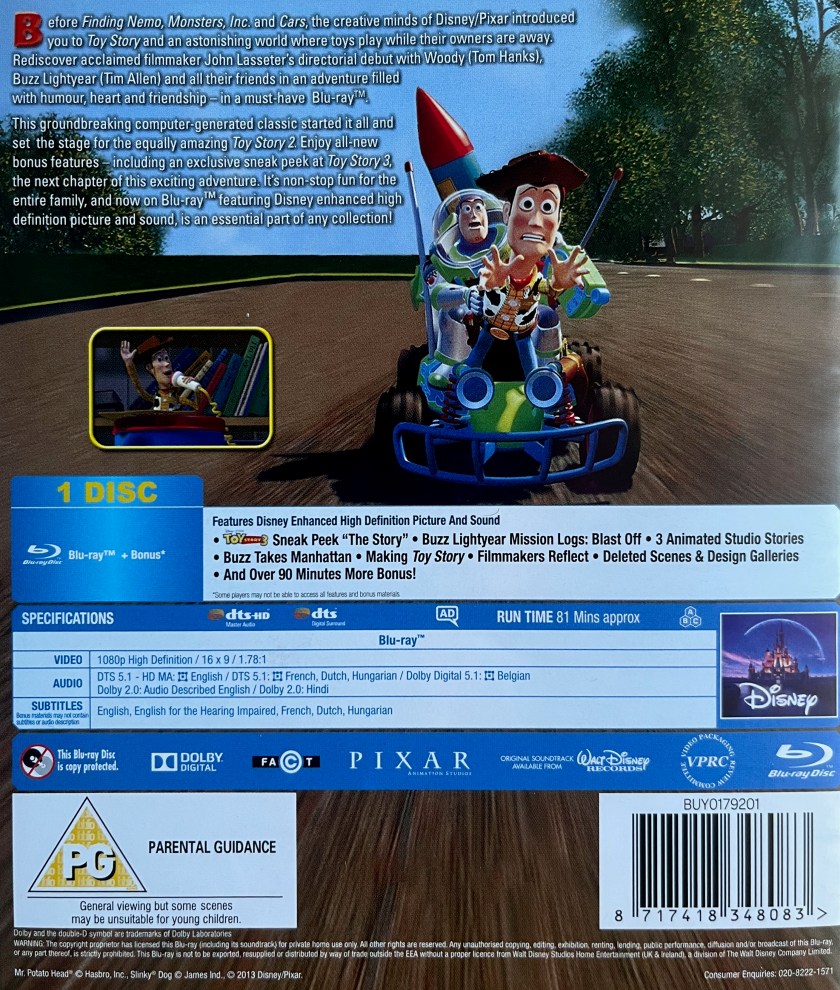
There are a lot of extras on the special edition Blu-ray I own, adding up to nearly 5 hours, which are an absolute delight to look through. The menu is really nice too, with lots of drawings and conceptual artwork scrolling around the screen. It’s easy to forget that everything started on paper, but there were true artists working by hand as well as on machines throughout this production, so it’s wonderful that their hard graft is highlighted and celebrated in many of the features on this disc.
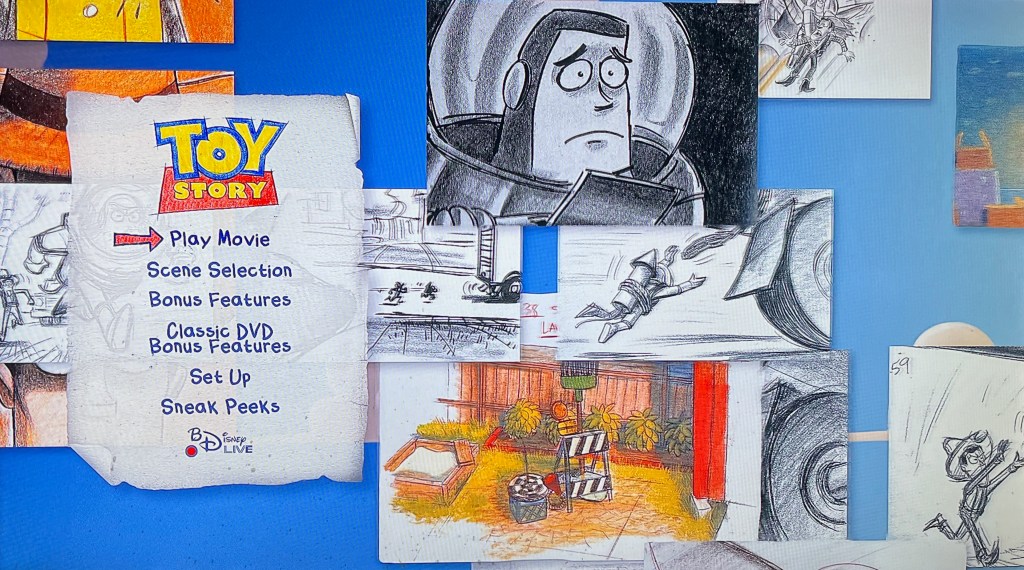
The first section of bonus features contains the following:
- Audio Commentary – Director John Lasseter is joined by Co-Writer Andrew Stanton, Supervising Animator Pete Docter, Art Director Ralph Eggleston, Supervising Technical Director Bill Reeves and Producers Ralph Guggenheim & Bonnie Arnold on this engaging commentary. They talk about writing the story, developing the characters, casting the actors, producing the animation, the inspirations and references for certain moments, ideas that were changed or dropped, and more. So it’s very insightful and well worth a listen.
- Paths To Pixar: Artists (4:47) – Some of the artists explain how they got into animation and why they love their jobs at Pixar.
- Studio Stories (5:26) – A trio of amusing tales by members of the production team, accompanied by animated drawings, about John Lasseter’s death trap of a car, one guy’s extreme attempt to win a Halloween contest, and the scooter races they held in the corridors of their new building.
- Buzz Lightyear Mission Logs: Blast Off (3:28) – The first of 3 educational features produced with NASA, spread across the Blu-rays for films 1-3, where Buzz tells Rex and Hamm about his trip into space. They combine computer animation of the toys and spacecraft with real life footage of a model of Buzz doing the journey with astronauts, so it’s pretty cool. This first episode describes his journey to the International Space Station and gives an introduction to life on board.
- Buzz Takes Manhattan (2:12) – A look at the amazing Buzz Lightyear balloon they had flying over the crowds in the Macy’s Thanksgiving Day Parade in New York City.
- Black Friday: The Toy Story You Never Saw (7:36) – A fascinating insight into how Disney executives interfered with the early stages of production so much that the film was nearly cancelled. The notes they bombarded Pixar with led to a storyboarded scene – shown here in full – that portrayed Woody as a really nasty character, so it just didn’t work. It was only when Pixar decided to ignore Disney’s input, and produce the film they wanted to make, that things got infinitely better. It was a valuable lesson for them to trust their own instincts.
- Toy Story 3 Sneak Peek (2:06) – Some teasing hints about the storyline for the third film.
And then there’s a whopping 3 hours of material carried over from the old DVDs:
- Filmmakers Reflect (16:35) – John Lasseter, Andrew Stanton, Pete Docter and Joe Ranft chat happily about making the film on its 10th anniversary, from developing the story and the problems they had to overcome along the way, to how well it was received by audiences. They clearly had a lot of fun doing it, and they even include some funny outtakes from their discussion at the end.
- Making Toy Story (20:20) – A great behind the scenes feature about the origins of the film and plotline, the design of the characters and sets, the animation, the voice actors, the songs, the sound design and more. It’s rightfully made clear that the computer was just a tool – it was the people that actually created the film, and the key priority was on creating a great story and characters before the animation was produced.
- The Legacy Of Toy Story (11:44) – A variety of people including actors, animators and directors recall how they felt when they saw the first ever computer animated film, and explain why it had such a huge impact on the cultural landscape. Contributors include the voice actors for Woody and Buzz (Tom Hanks and Tim Allen), as well as directors George Lucas and Peter Jackson, and even astronaut Buzz Aldrin.
- Designing Toy Story (6:13) – Some of the animators talk about how they designed the characters, sets and the overall look of the film, with lots of their sketches shown on screen. It’s fascinating to see the development of Woody and Buzz in particular.
- Deleted Scenes (19:01) – Here we get extended versions of a couple of animated scenes in Sid’s room, including Woody trying to persuade Buzz to help him. Then there are storyboards of other ideas that were abandoned, including alternate openings to the film with a Buzz Lightyear TV show and Andy staging a shootout with Woody. There are introductions by the filmmakers to explain why things were removed too.
- Design (28:09) – This section includes big slideshows of sketches, coloured drawings and physical models for the characters and sets, 3D rendered models of the main characters, 3D rendered fly-throughs of some of the sets with audio commentary, an interview about the colour palettes used in the film, and further slideshows of concept art and the colour script. It really gives a thorough insight into how it all came together, literally illustrating the extensive work involved. The slideshows are accompanied by relevant music from the film, including an instrumental version of You’ve Got A Friend In Me.
- Story (14:01) – After a short introduction about the purpose of storyboards, we see Joe Ranft pitching the scene with the soldiers at Andy’s birthday party to his colleagues, the original storyboards for Buzz Lightyear’s introduction voiced by the actors (including bits of dialogue cut from the final film), and a side-by-side comparison of the story reel with the film footage for the final chase scene.
- Production (11:20) – Here we get a demonstration of the sequence of events involved in production, with storyboards, basic 3D layout, animation, and the addition of shading and lighting. Then we learn some tricks of the trade when building the layout foundations, and see how the animation is built up in stages from there. Finally, we see how the introduction of Buzz Lightyear is translated around the world, with the audio cycling through 25 different languages as the scene plays.
- Music & Sound (26:20) – In this section you can watch the music video for You’ve Got A Friend In Me (the Randy Newman & Lyle Lovett duet from the end of the film), see an interesting feature about the sound design (where you can hear the noises made by many of the characters in isolation), and listen to a set of Randy’s demos of the songs (some of which were included on the Legacy Collection album, but not all).
- Publicity (24:11) – In this section, there’s an amusing on-set interview with Woody and Buzz, a collection of trailers and TV adverts (some of which use the classic song The Boys Are Back In Town by Thin Lizzy), and slideshows of movie posters, toys and other merchandise. Finally, there’s a collection of 15 special mini-scenes called “Toy Story Treats”, lasting from 10 seconds to 2 minutes each. They’re quite funny, as the toys try to get into hobbies, be Space Rangers, play games, tell scary stories, watch TV, and more. Plus there’s the full Buzz Lightyear commercial that he sees on the TV.
So altogether it’s a delightfully comprehensive set of features, giving you lots of insights about every step of making the movie, and demonstrating the real passion they had for making it as good as possible.
Toy Story 2
Movie
The first sequel came out in 1999, and it’s naturally more ambitious and epic in scale, which is immediately made clear by the mini-adventure with Buzz Lightyear and Emperor Zurg (Andrew Stanton) that opens the film, ending with a fun twist that takes us into Andy’s bedroom. The movie also flips the underlying narrative, as this time it’s Buzz’s turn to try and rescue Woody, who discovers a surprising truth about himself.
Woody’s fortunes go from bad to worse, as he’s first relegated to a shelf after his arm is torn, where he meets the discarded penguin Wheezy (played by Joe Ranft, who was also the Story Supervisor). But after he saves Wheezy from a yard sale, he’s then stolen by local toy collector Al McWhiggin (Wayne Knight).
Once in Al’s apartment, he then discovers that he’s from a popular 50’s TV show called Woody’s Roundup. Cowgirl Jessie (Joan Cusack), prospector Stinky Pete (Kelsey Grammer) and horse Bullseye are thus delighted to see him, because they’re all together at long last. Once Woody has been repaired, it means they can be sold as a complete collection to a museum in Tokyo, rather than being tucked away in storage. Woody is very resistant to this of course, feeling a strong love and loyalty towards Andy and his toy friends. But after learning Jessie’s heartbreaking story of how her original owner gave her away, and realising that Andy won’t want him forever, he eventually comes round to the idea.
Meanwhile Buzz and some of the other toys set out to find Woody, which includes crossing a dangerous road to get to Al’s toy shop, encountering a new Buzz action figure, and confronting Zurg, who provides an amusing Star Wars-style revelation. They use a lot of innovative ways to get around too.
They’re sad to learn that Woody is going to stay with his new friends, but Buzz is able to remind him what’s most important, bringing the cowboy back to his senses. Woody then invites Jessie, Bullseye and Pete to join them, so that Andy can play with them all. But Al packs the gang up and takes them away, leading to a big rescue mission in the airport.
Altogether it’s another fantastic movie that’s clearly made with love. It shows how fragile the toys are both physically and emotionally, and how they support one another as a result, so it does have some moving and thoughtful moments. The big adventure they go on is also very entertaining, with some great set pieces including the toy shop and airport scenes. And it’s very funny throughout, with jokes for both children and adults. I love how they went to the effort of animating outtakes that play alongside the credits too, including new character Mrs Potato Head (Estelle Harris) packing all sorts of things into her husband’s back for his journey, pranks played on Buzz, and a cameo from characters in A Bug’s Life.
Music
Randy Newman’s soundtrack is another great selection of music, which won an Outstanding Achievement Annie award. It includes a new showstopping big band version of You’ve Got A Friend In Me by Robert Goulet that I like even more than the original, sung by Wheezy at the end of the film. There’s also an instrumental version by Tom Scott at the end of the album, with a great saxophone melody.
Another nice song about friends bonding together is the new track Woody’s Roundup by Riders In The Sky, which is the jovial theme tune for Woody’s TV show.
But the big new song is the stunningly beautiful and heartbreaking ballad When She Loved Me by Sarah McLachlan, which plays when Jessie is mourning her former life with her child owner Emily. I defy anyone not to be moved by it. It won a Grammy Award for Best Song Written For Visual Media, and Sarah performed it with Randy at the Oscars in March 2000, where it had also been nominated. Randy included a brief piano instrumental on his Songbook Volume 1 album as well.
There have been lots of cover versions of the song too. Several artists have performed it on their Disney-themed albums or compilations, including:
- Michael Crawford backed by piano and strings on The Disney Album, which also includes I Will Go Sailing No More from the first film. The star of Some Mothers Do ‘Ave ‘Em and Phantom Of The Opera is one of my favourite singers, so I adore his rendition.
- Steve Tyrrell with guitar and piano on The Disney Standards, which has You’ve Got A Friend In Me among the other tracks.
- Kerry Butler backed by strings on Faith, Trust And Pixie Dust.
- Jordan Pruitt with piano and strings on the compilation Disneymania 5.
- Bridgit Mendler with a more upbeat sound on Disneymania 7, which doesn’t have the same feel to it.
Other than those, a particularly surprising cover here in the UK is by Steps on their 2012 Christmas album Light Up The World. Considering they’re known for their cheery pop songs, I never realised they did this until now, but they do it justice. It’s a strange choice for a festive record though.
But once again it takes a child to score the most popular rendition, as a cover by 6-year-old Claire Crosby and her mother has had over 6½ million views!
Beyond all of that, the rest of the score is a delight as usual, including the dramatic opening with Zurg’s Planet, the contrasting moods in Woody’s Dream, the cheery meeting with Jessie And The Round Up Gang, the whimsical work of The Cleaner, and the triumphant ending with Ride Like The Wind.
Extras
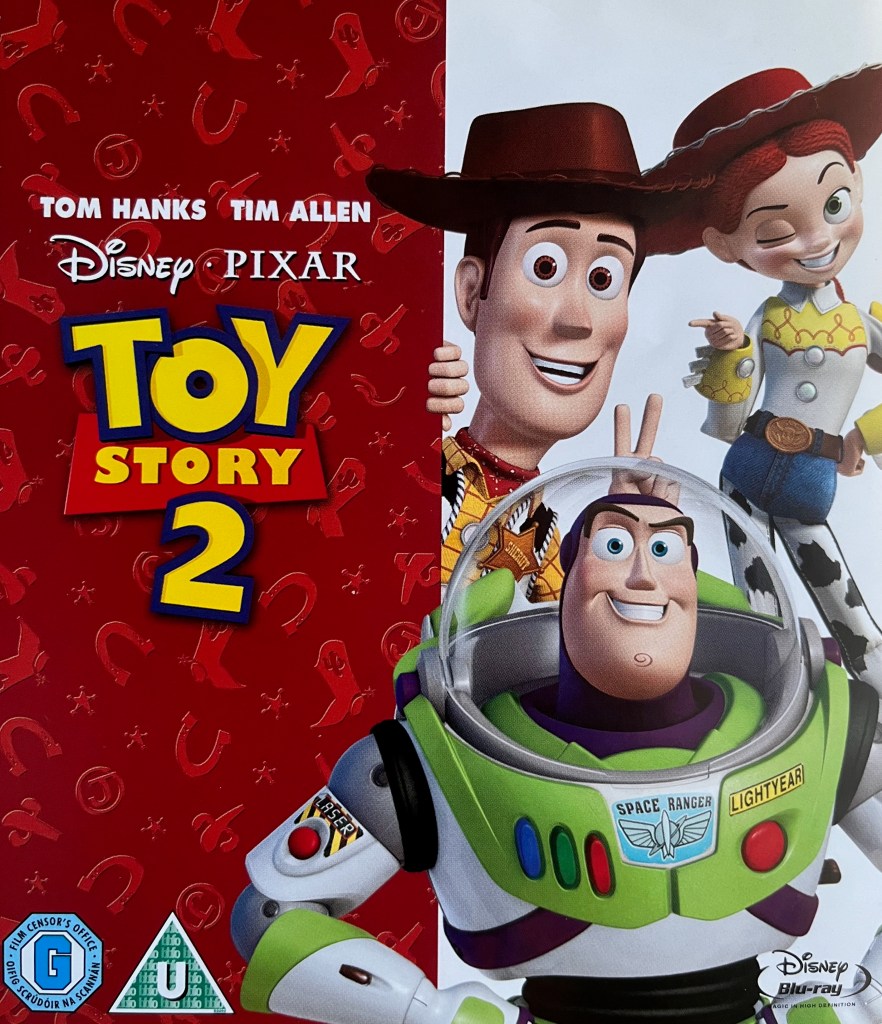
The menu system on the special edition Blu-ray is in the same style as for the first film, which is good for consistency. I also like how the army men carry in the screen for the main feature. Altogether there are approximately 3 hours 45 minutes of extras.
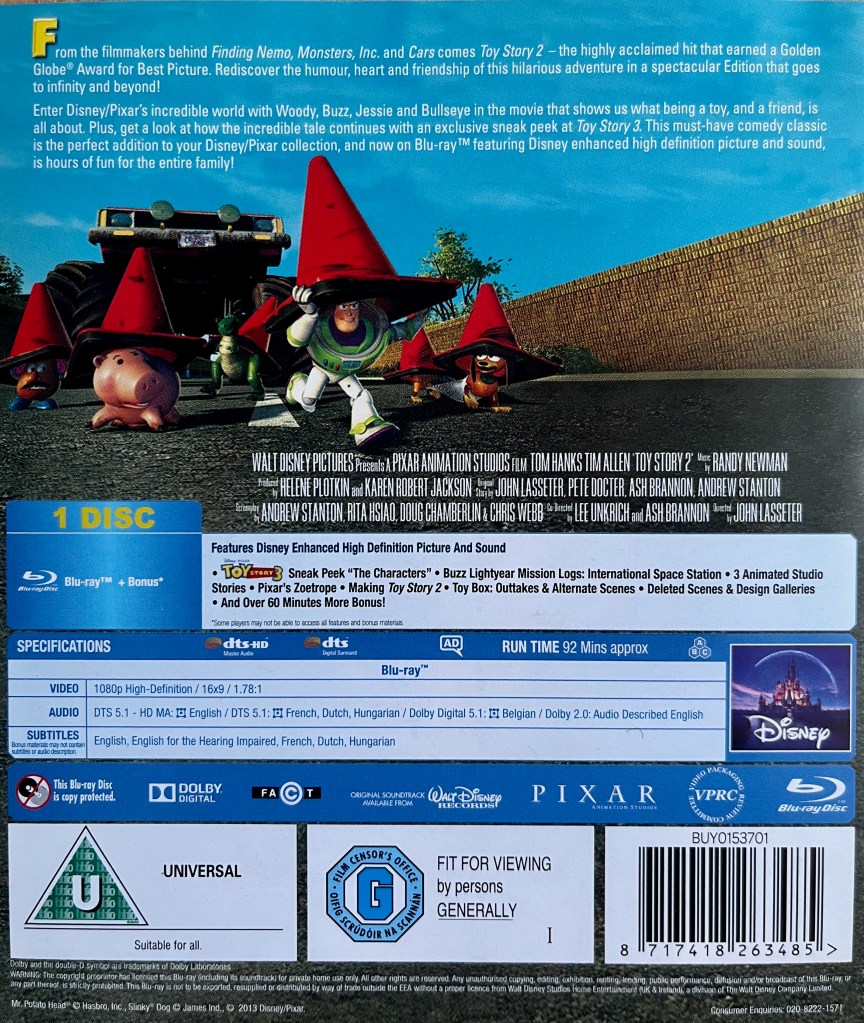
The first section of bonus features contains:
- Audio Commentary – Director John Lasseter, Co-Writer Andrew Stanton, and Co-Directors Lee Unkrich & Ash Brannon deliver another entertaining commentary. They talk about how they approached the sequel, how they set up different aspects of the story, why certain moments were particularly important, the ideas they rejected, the technological advancements they used to improve the animation, the callbacks to the first film, the references to other films, and so on. They also point out little details that I wouldn’t have picked up on otherwise, such as the sun going behind the clouds when Andy tears Woody’s arm, just subtly changing the lighting in that significant moment.
- Paths To Pixar: Technical Artists (4:24) – Some of the technical artists recall why they got into their careers, as well as explaining the importance of maths in their job and what shading is.
- Studio Stories (6:17) – More animated stories about the Pixar team, including the effects of working very long hours, a game that involved throwing toys into the insulation in the ceiling, and how the movie was accidentally deleted from their server but miraculously recovered.
- Buzz Lightyear Mission Logs: International Space Station (3:45) – Continuing from the first instalment with the previous film, here we see how the ISS works and how the astronauts live on board.
- Pixar’s Zoetrope (2:00) – A brief look at how they built a modern version of this old device to show the public how animation works, using sculptures of the characters instead of drawings.
- Celebrating Our Friend Joe Ranft (12:47) – A loving tribute to story writer and voice actor Joe, who died in a tragic car accident in 2005 at the age of just 45. It includes archive interview footage of Joe talking about his life and career, as well as clips of his work and reflections from his colleagues. He was clearly very caring, entertaining and talented.
- Toy Story 3 Sneak Peek: The Characters (3:12) – An introduction to the characters in the third film.
And then there’s another bumper collection of extras that used to be on the old DVDs, lasting just over 1 hour 40 minutes:
- Making Toy Story 2 (8:11) – A short documentary about developing the new storyline, characters and locations, including a few ideas cut from the first film that were used in this one.
- John Lasseter Profile (3:03) – Actors and colleagues celebrate the driving force leading the Pixar team, and John explains why he loves his job.
- Cast Of Characters (3:30) – A featurette honouring the voice actors behind the characters.
- Toy Box (14:05) – A fun selection of videos, including the full screen version of the outtakes shown alongside the credits, a gag slipped into Jessie’s sad song by one of the animators to surprise their colleagues, opinions by the cast and crew as to which toy is the coolest, a slideshow of autographed pictures by each of the toys, and a medley of music performed by Riders In The Sky, including Woody’s Roundup, You’ve Got A Friend In Me, and a song about Jessie that isn’t in the film.
- Deleted Scenes (4:11) – A clip of Rex pretending to be Godzilla with unintended consequences, and the road crossing scene presented in its original location before it was moved for the final film.
- Design (32:37) – Here you can see lots of sketches, coloured drawings and 3D visualisations for the characters and sets (including commentaries on the rendered locations), plus colour scripts and colour key images for various scenes and places. The slideshows are accompanied by instrumental versions of Woody’s Roundup and You’ve Got A Friend In Me, along with other music from the soundtrack.
- Production (13:52) – 6 featurettes looking at the Woody’s Roundup merchandise they designed, how they did the 1950s-style animation for the TV show, a demonstration of the different stages of production from storyboards to final animation, a look at early animation tests for some of the characters, how they did the big explosion sequence on Zurg’s planet, and the international version of the scene transition after Buzz’s pep talk that uses a globe (as in my UK edition) rather than the US flag in the American release.
- Music & Sound (14:11) – Here you’ll find featurettes about designing the sound (presenting the effects and music for the road crossing scene in isolation) and making the songs. Then there’s the Woody’s Roundup music video and Randy’s demo of Jessie’s sad song.
- Publicity (8:38) – Finally, this section contains another short interview with Woody and Buzz, a selection of trailers and TV spots (including the use of the song Hold On, I’m Coming by The Neville Brothers), a slideshow of movie posters, and a fleeting clip of Woody pitching a baseball that used to be a DVD Easter egg.
Ultimate Toy Box
The Ultimate Toy Box was a DVD set of the first two films that was released in 2000. There was a later Blu-ray box set of the same name containing the first 3 films, released in 2010, but that was very different. The DVD box set is the one I owned, and I wanted to give it a mention because it was rather special, to the extent that I’ve kept a few elements from it, including the bonus disc.
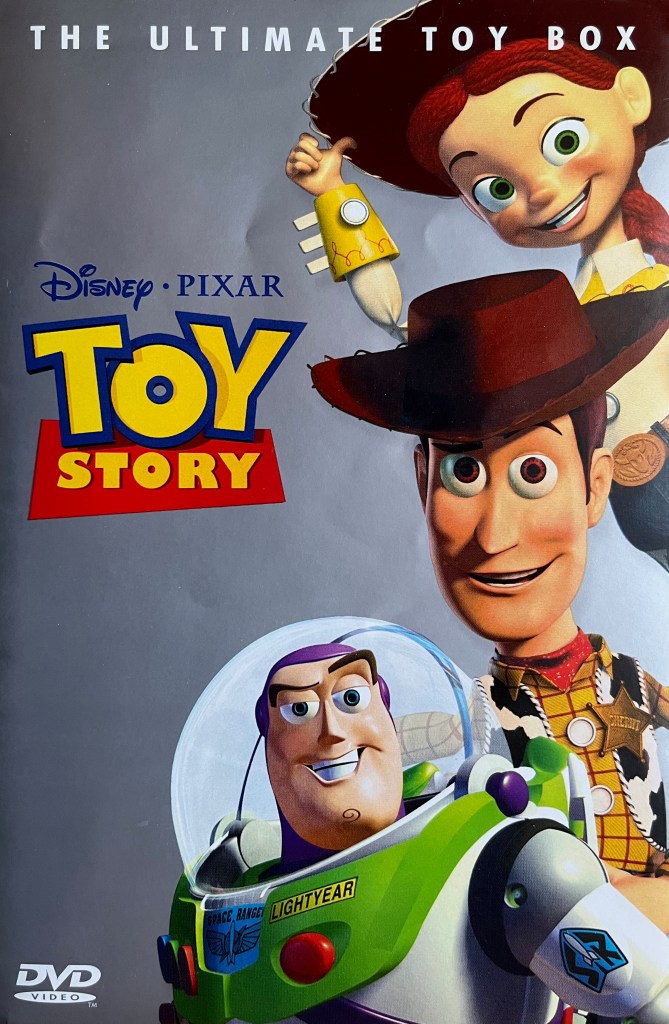
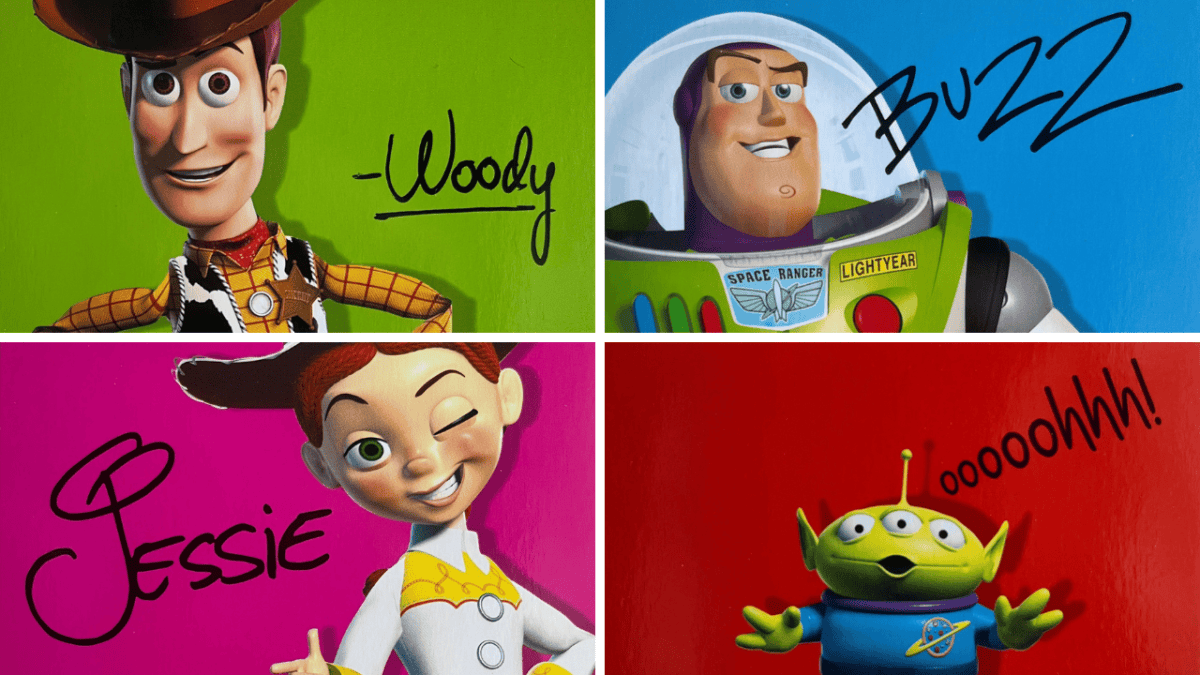
For a start, it came with a nice set of art cards that I’ve kept, featuring signed images of Woody, Buzz and Jessie, plus another featuring a three-eyed alien.
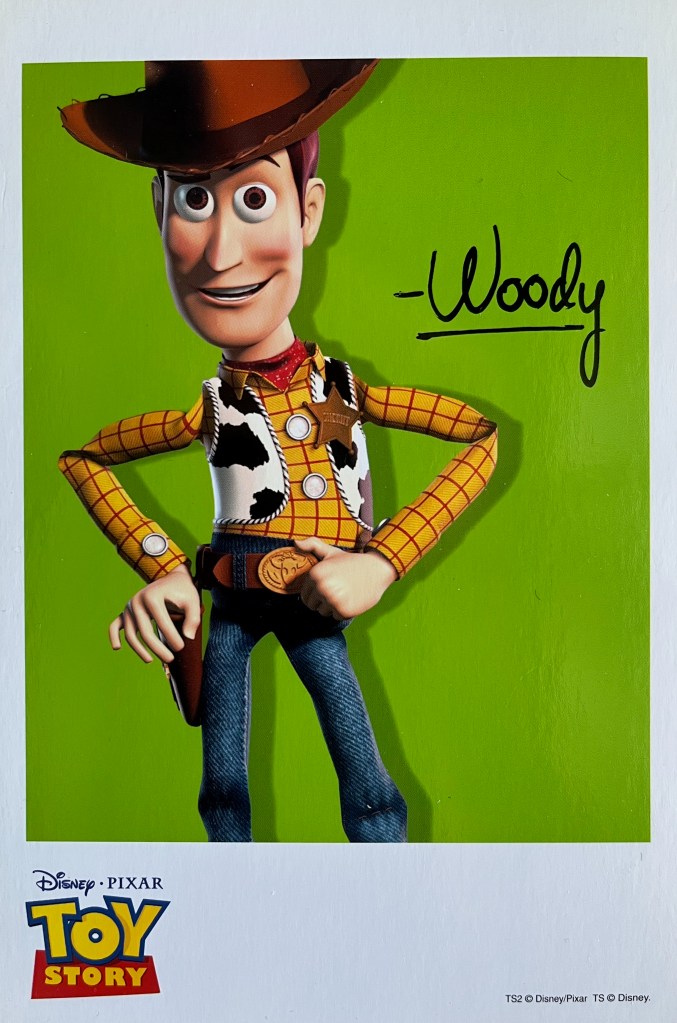
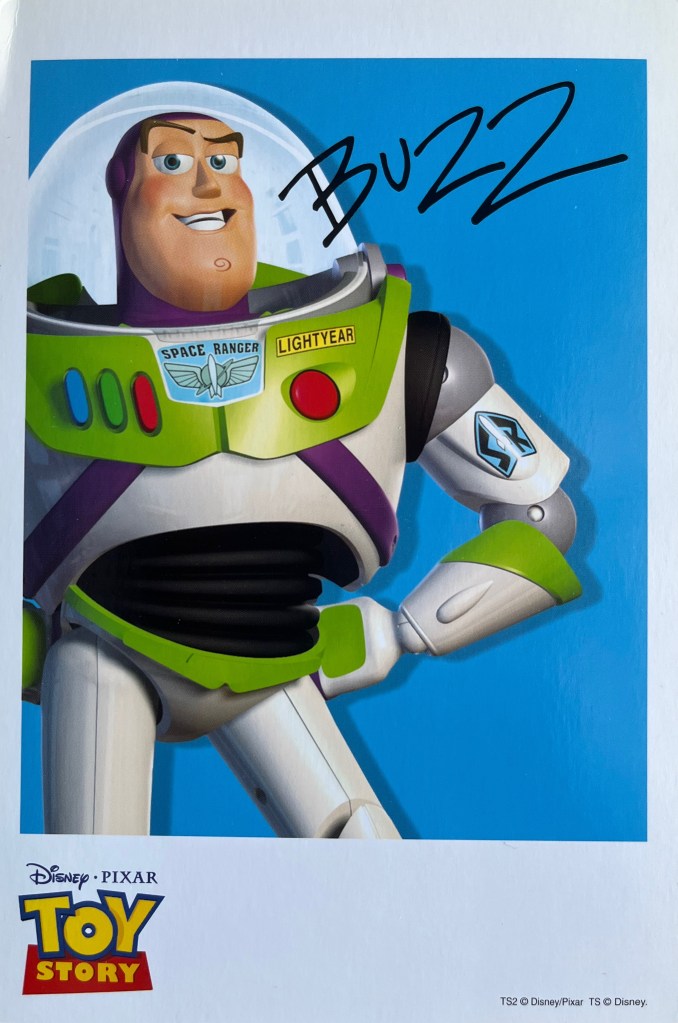
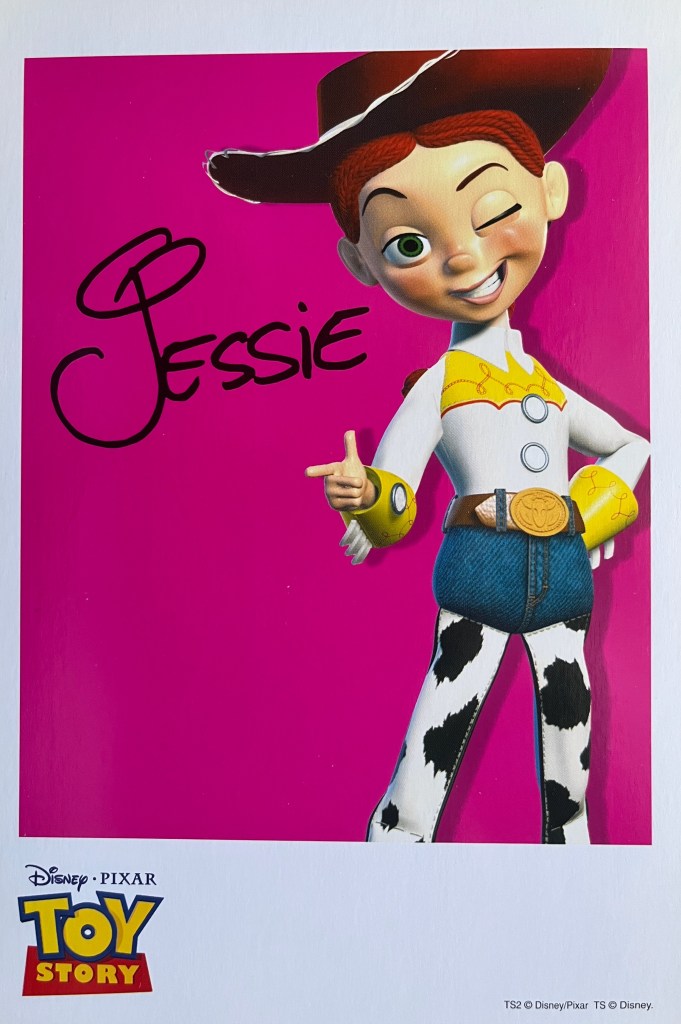
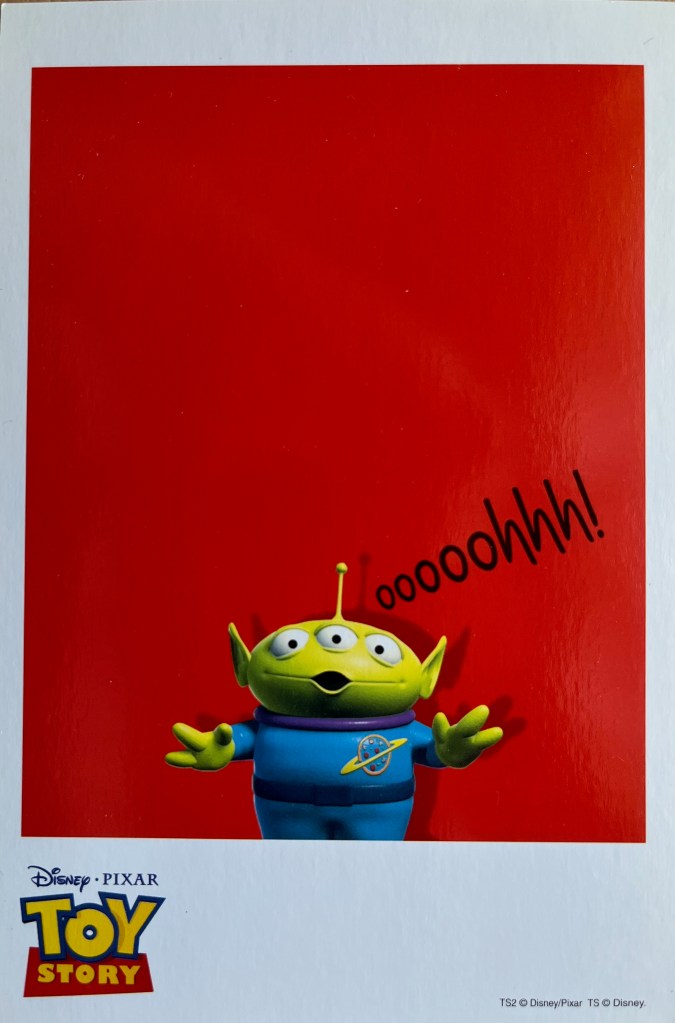
There was also a leaflet, explaining how the DVD format was enabling the team to provide a fully comprehensive insight into the making of both films for the first time. By combining them into one set, it allowed them to demonstrate how they were connected, including the fact that many ideas rejected from the first film were used in the second.
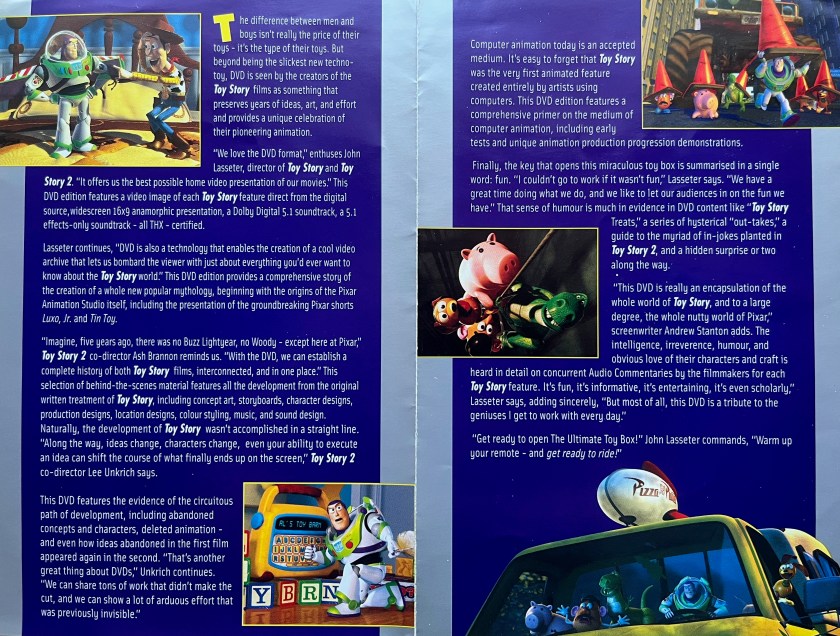
There were three discs in the set. The first two (one for each film) contained a minimal selection of extras, even less so than the American edition, because the PAL format required more space for the movie. So we didn’t get the audio commentaries in particular, hence I’m glad they’re on the Blu-rays. Here in the UK, we got the following:
- DVD 1:
- Tin Toy – Pixar Animated Short
- The Making Of Toy Story
- Monsters Inc. – Sneak Peek Trailer
- DVD 2:
- Luxo Junior – Pixar Animated Short
- Character Featurette
- Woody’s Round-Up – Music Video
- Coolest Toy Feature
- Out-takes
- Monsters Inc. – Sneak Preview
Tin Toy, Luxo Junior and the Monsters Inc. previews didn’t make the cut for the Blu-rays, but that’s fine, as they can now be found online easily. It’s not worth retaining the discs just for those.
However, I have kept the third disc with all the supplemental features, because it pretty much takes you to infinity and beyond with its huge collection of treasures, which are extremely well organised and great fun to dig through. A lot of the material has been copied over to the Blu-rays of course, using a much-simplified menu system and slideshows instead of galleries, but there’s still quite a bit that hasn’t been transferred, including some of the images, video clips and interactive features, and none of the text information screens.
The disc is introduced by a special message from John Lasseter and his team (lasting 2:14). It then has dedicated sections for each film, with submenus dedicated to the history, story, design, animation, music, sound and publicity, along with a few extra bits and pieces. Each topic has its own unique animated menu with music, using characters and locations from the film.
To this day it’s still the most elaborate and fun DVD presentation I’ve ever seen, and it’s so extensive that the leaflet includes a huge map of the menu system. They really did push the DVD format to its limits here. The only close equivalent I’ve seen since then is in the Lord Of The Rings extended editions. It was really exciting to see a DVD filled with so much stuff, and it goes to prove the dedication and generosity of the production team that they went to such extraordinary lengths to release so much of their work like this.
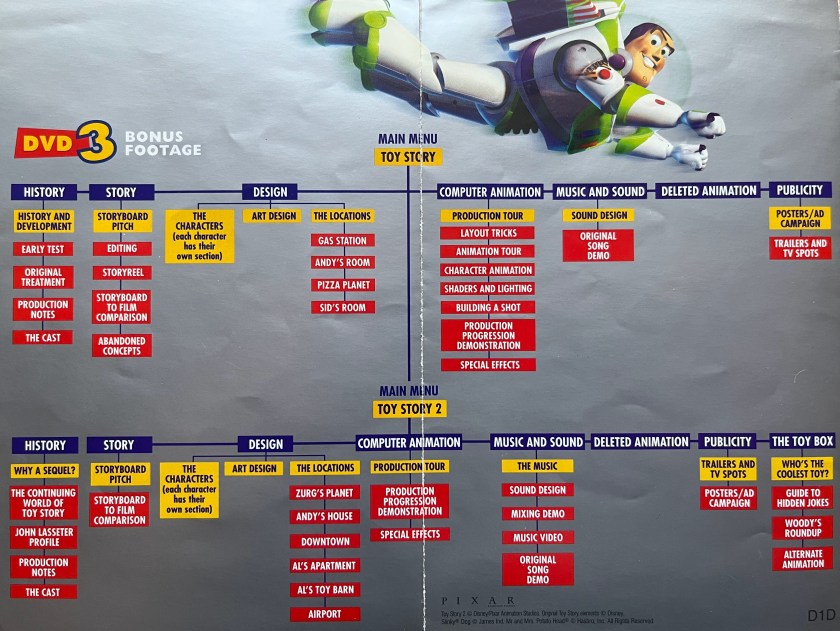
So here’s a full list of all the bonus features on the disc, just to show how massive it is. By my reckoning, there’s just over 3 hours of video and audio material and over 2,400 frames of text and images to look through. Thankfully the text screens are in large, clear print, so they’re very easy for me to read.
Toy Story
This section contains 1 hour 50 minutes of video & audio features plus 1,514 frames of text and images.
- History (4:40 video + 145 frames)
- History and Development (3:38) – A featurette about the origins of the project to create Toy Story.
- Early Animation Test (0:35) – The test originally shown to Disney to give them a sense of how the animated world would look. It features a very mean version of Woody pranking Buzz. Both characters look and feel very different to the finished film. The sequence is explained by an introductory frame of text.
- Original Treatments (0:27 video + 55 frames) – After an introduction by John Lasseter, you can read the text from 2 of the original pitches for the film, illustrated with a few sketches. The first is the initial document they wrote for Disney, while the second shows the refinements that were made as it became more of a buddy movie than a road movie. Both are very different to the final film, especially the main character being Tinny from Tin Toy. But there are many elements that are very recognisable, not only from Toy Story but also Toy Story 2 and later films in the franchise.
- Production Notes (44 frames) – Information and photos relating to the film including the origins of Pixar (which date back to George Lucas and Lucasfilm), the arrival of John Lasseter and other key personnel, Pixar’s early animated short films, their collaboration with Disney, the story development and building a studio.
- Cast Biographies (43 frames) – Text information about the stars, including how they got into acting, other productions they’ve been in, and interview quotes about working on Toy Story. You can read about Tom Hanks (Woody), Tim Allen (Buzz), Don Rickles (Mr. Potato Head), Jim Varney (Slinky Dog), Wallace Shawn (Rex), John Ratzenberger (Hamm), Annie Potts (Bo Peep), John Morris (Andy), Erik Von Detten (Sid), Laurie Metcalf (Andy’s Mom) and (R. Lee Ermey (Sarge).
- DVD Credits (2 frames) – Highlight the button to return to the Main Menu and click left to reveal this link.
- Design (20:27 video + 1,094 frames)
- Note: Galleries present the images in a pinboard format that you can scroll through and click to enlarge. Turnarounds are 20-second clips where the characters spin twice so you can see them from all sides. Animation tests have commentary by animator Glenn McQueen.
- Character Design Introduction (32 frames) – An explanation of all the steps in the design process, finishing with size comparison images to show how the characters relate to each other, and the modifications made to the main humans to create background characters.
- Woody (4:11 video + 132 frames) – Galleries for the character design, early model, final model pack and final maquette, plus features on the early animation tests and modelling Woody in the computer, as well as the character turnaround.
- Buzz Lightyear (4:17 video + 185 frames) – Galleries for the character design, model pack, model construction, digitizing maquette, insignia, decals and merchandise, plus features on the early animation tests, digitizing his maquette into the computer and modelling his box in the computer, as well as the character turnaround.
- Other Character Design Galleries (418 frames) – Mr. Potato Head, Rex, Hamm, Slinky Dog, Bo Peep, Green Army Men, Alien, Andy’s other toys, Sid’s mutant toys, Andy, Sid, Scud, Hannah, Andy’s Mom and Molly.
- Other Character Turnarounds (1:40) – Rex, Hamm, Slinky Dog, Bo Peep and Alien.
- Other Animation Tests (1:41) – Andy’s head, Sid’s face, Scud running, and the movement and hair for Andy’s Mom.
- Designing Scud (1:49) – A feature about digitizing & animating Sid’s dog.
- Art Design (3:36 video + 213 frames) – A feature on designing the film, plus galleries for concept art, colour scripts and colour keys.
- Environmental Design (3:13 video + 104 frames) – Design galleries for Andy’s room, the gas station, Pizza Planet and Sid’s room, plus location tours for all of those places except Pizza Planet. Location tours are fly-throughs or camera turnarounds to show a 360-degree view, and have commentary by Art Director Ralph Eggleston.
- Story (30:39 video + 15 frames)
- Storyboard Pitch: Green Army Men (5:55) – After an introduction to explain the process, Joe Ranft pitches the idea for the birthday party sequence with the army men to his team, using the storyboard images he’s drawn.
- Editing (8 frames) – An explanation of the editing process for the story reel, which is created when the story pitch has been approved.
- Story Reel (4:41) – The hand-drawn story reel for Buzz’s introduction.
- Storyboard To Film (3:21) – A side-by-side comparison of the storyboard and the movie for the final chase sequence.
- Abandoned Concepts (16:42 video & 7 frames) – An introduction by the filmmakers is followed by storyboards for a Buzz Lightyear cartoon, a western shootout, Woody’s nightmare, the eastern gate, a character called Shakes The Rattle, an alternate version of Sid’s comeuppance and a variation of the final chase sequence. Each scene is preceded by a frame of text to explain why it was dropped.
- Computer Animation (18:35 video + 117 frames)
- Production Tour (1:52) – A demonstration of the different stages in the production process for Buzz’s introductory scene.
- Layout Tricks (3:25) – An explanation of how layout works, and some of the tricks they use to overcome problems.
- Animation Tour (1:23) – A demonstration of the progression of animation, using a shot of Woody dusting himself off as an example.
- Character Animation (4:42) – A demonstration of how movement is animated on the computer.
- Shaders & Lighting (2:19 video + 38 frames) – Demonstrations in video and gallery form to show how colour, texture and lighting is added to the characters and their surroundings, using scenes from Andy and Sid’s bedrooms as examples.
- Building A Shot (1:21) – A demonstration of all the stages, from storyboard to final animation, for a clip of the army men.
- Production Progression (2:08) – Here you can watch part of the final chase scene while using the Angle button on your remote to switch between the storyboard, layout and final animation.
- Motion Blur & Reflections (11 frames) – An explanation of these 2 concepts, using stills of the chase scene and Buzz’s helmet as examples.
- Rain Effects (0:40 video + 16 frames) – A look at how realistic rain was added to Sid’s window using different stages and innovative techniques, including rain reference footage, the moving “bump-map’ pattern, a close-up of the rain on the window, rain shadow effects and the final scene.
- Particle Systems (0:45 video + 4 frames) – A demonstration of how smoke is added to the animation, when Woody uses water to stop his head burning in Sid’s room.
- Rendering and Compositing (48 frames) – An explanation of the final rendering and compositing process, showing how different layers were combined and how the frames were transferred to film. One of the frames talks about outtakes from rendering that are sometimes quite humorous, but these are actually found in the Deleted Animation section of the disc.
- Music and Sound (24:01 video & audio + 9 frames)
- Sound Design (6:35 video) – A feature about the design of the sound effects in the film, and a demonstration of how the dialogue, effects and music are put together.
- Randy Newman Biography (9 frames) – Information about the composer.
- Randy Newman Demos (17:26 audio) – Plastic Spaceman x2, Strange Things, The Fool, I Will Go Sailing No More & You’ve Got A Friend In Me.
- Deleted Animation (5:13 video + 7 frames) – After an editor’s introduction you can watch 2 scenes from Sid’s room, involving torture of the toys and Woody talking to Buzz, that were heavily trimmed in the final movie. Then there’s a selection of 7 amusing errors that occurred during the rendering process, each introduced by a frame of text.
- Publicity (6:45 video + 127 frames) – A teaser, theatrical trailer and 4 TV spots, plus galleries of ad campaigns and merchandise.
Toy Story 2
This part of the disc includes links to some of the content above for the first film to show how they connect. The timings and frame counts below therefore ignore those duplicated features. In terms of unique material, therefore, this section contains 1 hour 18 minutes of video features and 920 frames of text and images.
- History (14:09 video + 56 frames)
- Why A Sequel? (2:43) – An explanation of why the sequel was made and how they approached it.
- The Continuing World Of Toy Story (4:41) – A look at the ideas abandoned for the first film that were revisited for the sequel. When this feature ends (or if you skip to the end).
- Easter Egg: Hidden Links Menu – At the end of the Continuing World feature, you’re taken to a bonus menu that links to content elsewhere on the disc, with one exception:
- Original Treatments – From Toy Story 1 above.
- Abandoned Story Reels – Buzz Lightyear’s cartoon and Woody’s nightmare, as presented for Toy Story 1 above.
- Woody’s Nightmare: Story Pitch – From the Story section below.
- Woody’s Nightmare: Toy Story Treat (0:12) – An alternate nightmare for Woody that was released as one of the treats.
- John Lasseter Profile (3:03) – A featurette about the leader of the team.
- Production Notes (32 frames) – Information about the success of the first film and the creation of the sequel, including new and returning members of the production team.
- Cast Of Characters (3:30) – A celebration of the voice actors in the film.
- Cast Biographies (24 frames) – The biographies for the returning actors have been repeated from the first film. However, there is new information here about Joan Cusack (Jessie), Kelsey Grammer (Prospector), Wayne Knight (Al McWhiggin), Estelle Harris (Mrs. Potato Head), Jodi Benson (Barbie) and Jonathan Harris (The Cleaner).
- DVD Credits – Same 2 screens as for Toy Story 1, but accessed slightly differently. This time, highlight the button to return to the Main Menu and click up to reveal the link on Al’s chicken suit
- Design (11:41 video + 730 frames)
- Note: This section has the same content for Woody, Buzz and most of the other returning characters. The new additions are as follows.
- Character Design Galleries (290 frames) – Ultra Buzz Lightyear, Mr. & Mrs. Potato Head, Jessie, Bullseye, Prospector, Al, Zurg, Wheezy, Tour Guide Barbie and Buster.
- Character Turnarounds (2:40) – Mr. & Mrs. Potato Head, Jessie, Bullseye, Prospector, Al, Zurg, Wheezy and Tour Guide Barbie.
- Animation Tests (2:36) – Jessie’s hair & walk, Bullseye’s movements, Al walking & running, and Zurg attacking Buzz. All have commentary by animator Glenn McQueen, except Zurg which has voice acting and music.
- Art Design (0:33 video + 108 frames) – A short explanation of colour scripts, plus galleries for the colour script and master lighting guide.
- Environmental Design (5:52 video + 332 frames) – Design galleries and location tours for Zurg’s planet, Andy’s new house, Al’s apartment, Al’s Toy Barn and the airport. The location tours are camera turnarounds to show a 360-degree view and have commentary by Art Director Jim Pearson.
- Story (8:14)
- Woody’s Nightmare (3:01) – After a short introduction, there’s the story pitch for this sequence in the film. You can use the Angle button to switch between the pitch presentation and full screen versions of the storyboards being referred to.
- Jessie’s Song (4:03) – After a short introduction, you can see the storyboards for the full song. You can use the Angle button to switch between a side by side comparison with the film or full screen versions of the storyboards on their own.
- Easter Egg: Out Of Control Car (1:10) – In the menu for Jessie’s Song, hit left from any option to reveal a question mark. Selecting that will show the animator’s gag ending for Jessie’s song.
- Computer Animation (5:06)
- Production Progression (3:28) – After a short introduction you’re able to watch the opening Buzz Lightyear adventure, for which you can use the Angle button to switch between the story reel, the layout, the basic animation, and the final version with all the shaders and lighting added.
- Special Effects (1:38) – A look at how the big explosion in Buzz’s opening adventure was built up in stages.
- Music and Sound (16:56)
- The Music (3:25) – A featurette about the 3 songs in the movie.
- Sound Design (5:38) – An insight into designing the film’s sound effects.
- Mixing Demo (1:52) – After a brief introduction, you can play with a simplified mixing desk to watch the elevator fight scene between Buzz and Zurg with just dialogue, music or effects, or any combination of the three. If you try every possible combination, you’ll be in this section for a good 13 minutes.
- Music Video (3:11) – Music medley by Riders In The Sky, beginning with Woody’s Roundup.
- Jessie’s Song Demo (2:50) – Randy Newman’s demo of the song.
- Deleted Animation (4:11) – The road crossing scene in its original location, and Rex pretending to be Godzilla, along with an introduction explaining why they were changed.
- Publicity (5:30 video + 36 frames) – A teaser, theatrical trailer and 4 TV spots, plus galleries of ad campaigns and autographed pictures by the characters.
- The Toy Box (12:13 video + 98 frames)
- Who’s The Coolest Toy? (3:18) – A feature where the cast and crew debate the best toy from the film.
- Hidden Jokes (18 frames) – A guide to many of the inside jokes that the team slipped into the film to amuse themselves, many of which you would never notice without being told they were there.
- Woody’s Roundup (7:07 video + 80 frames) – Featurettes about the Woody’s roundup merchandise in the film and how the TV show was animated to make it look old, plus a design gallery and the music video for the theme song by Riders In The Sky.
- International Scene (1:48) – The transition at the end of Buzz’s pep talk as it was shown outside America, using the globe instead of the American flag).
Conclusion
That’s it for the first 2 films, which to this day remain an absolute delight to watch. They’ll never grow old, and I love all the extensive behind the scenes material. So I hope you enjoyed reading about them, and join me again soon for my thoughts on the other films in the franchise.
Share this:


