
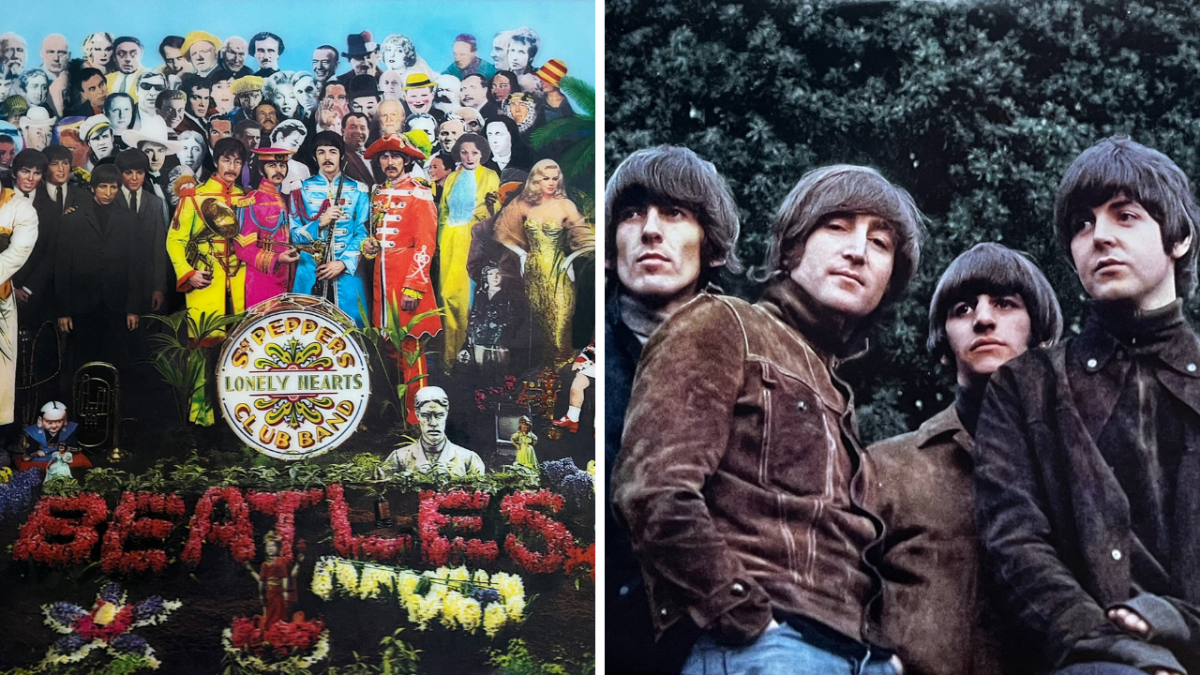
Over the last decade, The Beatles have released big box sets of some of their classic albums, each containing a lot of fascinating extra material, the most recent being for Rubber Soul this month. Smaller and cheaper versions have also been available with fewer tracks, but I’ve shelled out for the biggest super deluxe box sets with everything in, as I love their music. They were such an iconic group, who produced countless classic songs and experimented in ways that others had never done before, inspiring many artists that followed.
Each set comes with a big hardback book full of insightful information about the genesis of the album, the music scene and the world in general at the time, the writing and production of the tracks, the story behind the album cover, and much more, along with loads of photos. Most of the text is by former radio producer and author Kevin Howlett, but there are introductions from Paul McCartney in all of the sets, additional forewords by Giles Martin (son of George Martin) in some cases, and input from other people here and there too. The print is small and occasionally poorly contrasted (e.g. black text on a red background), but I’m able to use my phone to take photos of the pages and then use my computer to enlarge the text on my big monitor, adjust the colours, and even have it spoken to me if I wish. So I still get to enjoy it.
As for the music, it goes without saying that it sounds fantastic now it’s been remastered, with great clarity to everything, and there’s plenty of variety to keep things interesting. The discs, which are housed in cardboard sleeves, include the remastered stereo and original mono versions of each album, a Blu-ray Audio disc in most cases (one of which also contains videos), alternate mixes for a couple of albums, and 4-track EPs in a couple of cases.
But the most interesting and important CDs in each set are the sessions discs, featuring demos, rehearsals, alternate takes, studio banter and so on. They present the songs in brand new ways, making you feel like a fly on the wall in the studio as you get to hear how they developed. Those discs should be listened to in conjunction with the track by track discussions in each book, which provide a detailed analysis of every song, including the stories and inspirations behind them, the recording dates, the instruments played, the tracks and overdubs on the master tapes, the relevant tracks on the sessions discs and in the Anthology sets, notable live performances and cover versions, and more.
I don’t have the equipment to play the Blu-ray audio discs in surround sound, so I’m only listening to the audio from the CDs, but I’m happy with that. There have also been separate sets for those who want vinyl instead, and while I’m pleased it’s still a popular format, I’m glad they’ve kept it separate, because I don’t buy or play music that way. It irks me when box sets force you to pay a lot extra for a vinyl record in order to get everything on CD, so I’m glad the Beatles haven’t gone down that route.
I therefore want to do a comprehensive review of all their box sets, and mention their other albums along the way for completeness. And because there’s so much material, I’m going to split it across 2 posts. So in this first post I’m going to cover their box sets for Rubber Soul, Revolver and Sgt. Pepper, and take a quick look at the albums that preceded them. None of this is sponsored or gifted, as I bought all the box sets myself, and I hope you enjoy!
Contents
The albums in this post are presented in order of their original release. However, the box sets were issued in a different sequence. The sets for Sgt Pepper to Let It Be were released in order between 2017 and 2021, followed by Revolver in 2022 and Rubber Soul in 2026.
Early Albums
The first 5 albums by the band don’t have box sets associated with them, and it seems unlikely that they will. But here are my brief thoughts on them.
- Please Please Me – The Beatles’ record-breaking debut album from March 1963, which stayed in the Top 10 for more than a year, contains a fairly even mixture of original Lennon-McCartney songs and cover versions. They’re all in a typically 60s style, and that’s not a bad thing at all. it’s a great start for the band in fact, especially as it contains so many tracks they’ve written themselves. As is the case with all their albums, narrowing down favourites isn’t easy, but I would say my top 5 tracks are I Saw Her Standing There, Please Please Me, Love Me Do, Do You Want To Know A Secret? and Twist And Shout, as they’re all fun to sing along with.
- With The Beatles – 8 months after their first album, the band followed it up with this LP in November 1963. Again it’s a nice mixture of originals and covers, including the first recording of a song by George Harrison. It was only the second album to have sold over a million copies in the UK, and it topped the chart for 21 weeks, taking over from Please Please Me. It meant the band spent a total of 51 consecutive weeks at number 1 in the album chart, which has never been beaten by any group or singer since then. The only album to have beaten them prior to that was the South Pacific soundtrack, which was the first album to sell over a million and it had 70 consecutive weeks at number 1. Anyway, I would say my favourite songs on this Beatles album are All My Loving, Till There Was You, Roll Over Beethoven, Hold Me Tight and Money (That’s What I Want).
- A Hard Day’s Night – Their third album came out in July 1964. It was the first to consist entirely of original material, and is the only album where all of the songs are by John & Paul. Side 1 includes music from the band’s film of the same name, while Side 2 has songs that were also written for the film but were unused. I’ve tried their movies in the past but have never got into them, so I won’t be reviewing them here. But the music’s great, and it went to number 1 in the charts again, where it stayed for 21 consecutive weeks out of a total of 39 in the top 40. My favourite songs are the title track, I Should Have Known Better, Can’t Buy Me Love, You Can’t Do That and I’ll Be Back.
- Beatles For Sale – The fourth album was released in December 1964, and spent 11 weeks at number 1, 7 of them consecutive. This album returns to a mixture of original and cover songs, necessitated by the demands on their time. There’s a country air to the music too. The songs I would nominate for my top 5 this time are No Reply, Rock ‘n’ Roll Music, Eight Days A Week, Words Of Love and Everybody’s Trying To Be My Baby.
- Help! – The fifth album, again serving as a film soundtrack, was released in August 1965, beginning a 36-week run in the top 20 with 9 weeks at number 1. It was also the first album by a rock group to be nominated for a Grammy award. The major highlight of the album is of course Yesterday, one of the most beautiful tracks ever written by any artist, and one of the most covered songs of all time. Meanwhile the title track’s a rocking singalong banger, and a few other favourites of mine include You’re Going To Lose That Girl, Ticket To Ride and You Like Me Too Much.
Rubber Soul
The Box
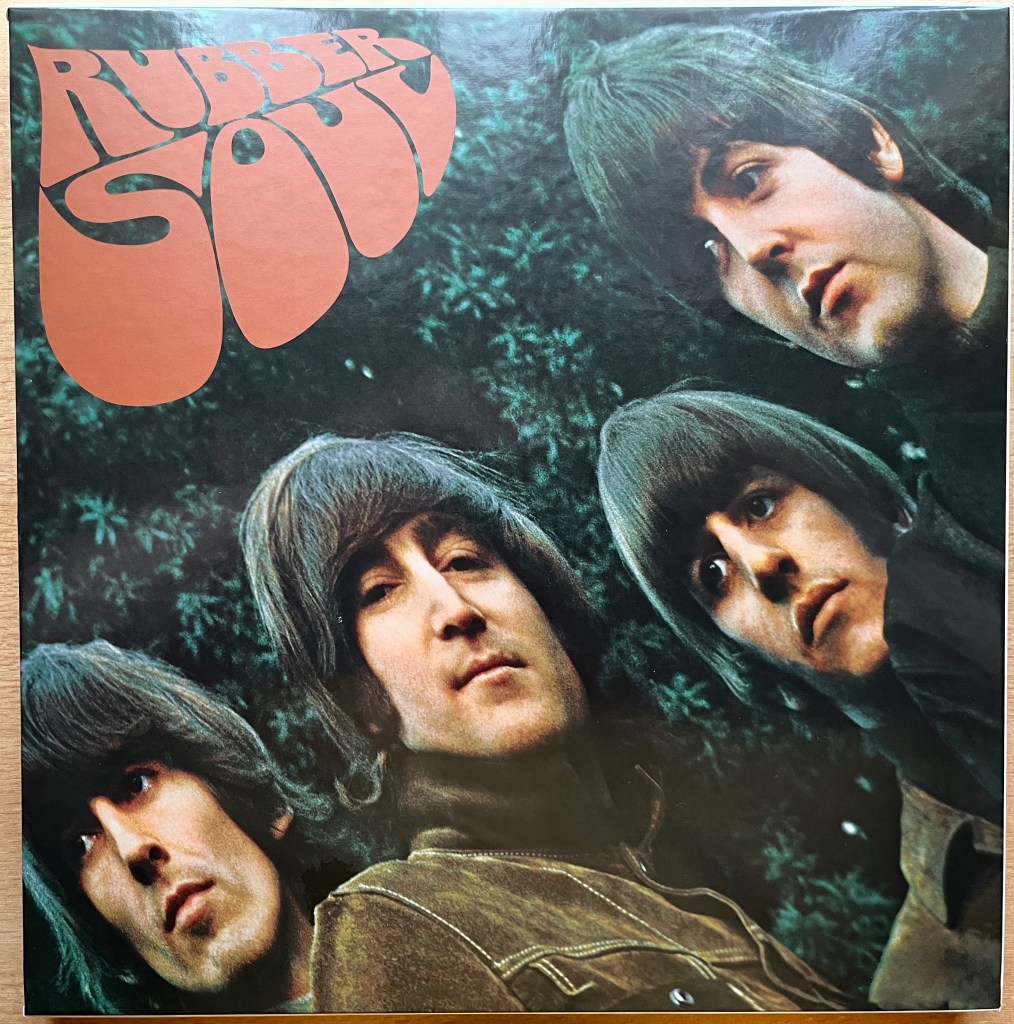
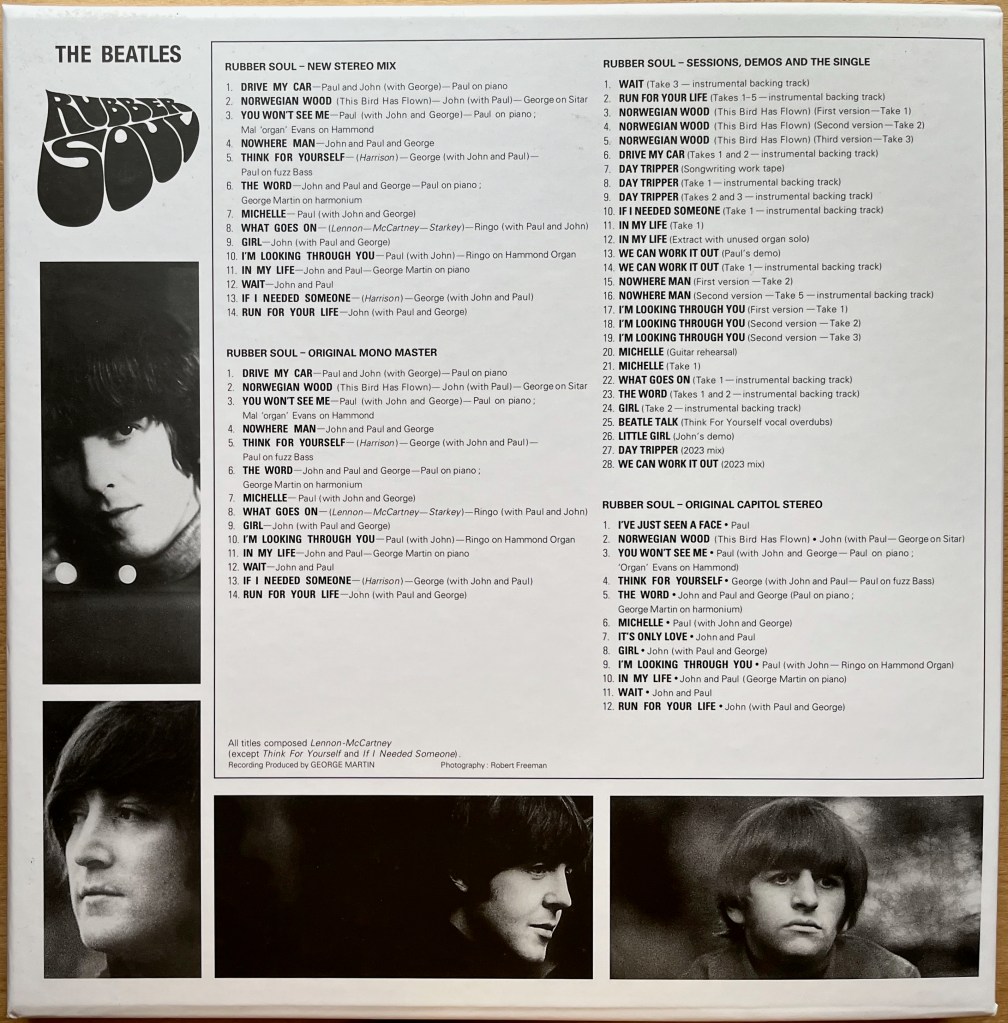
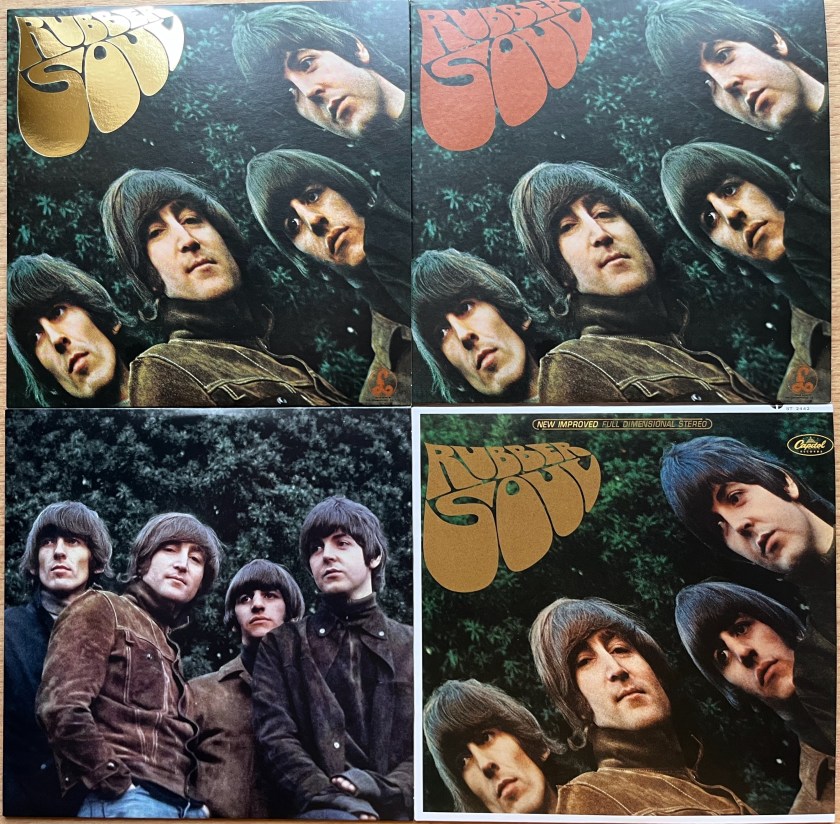
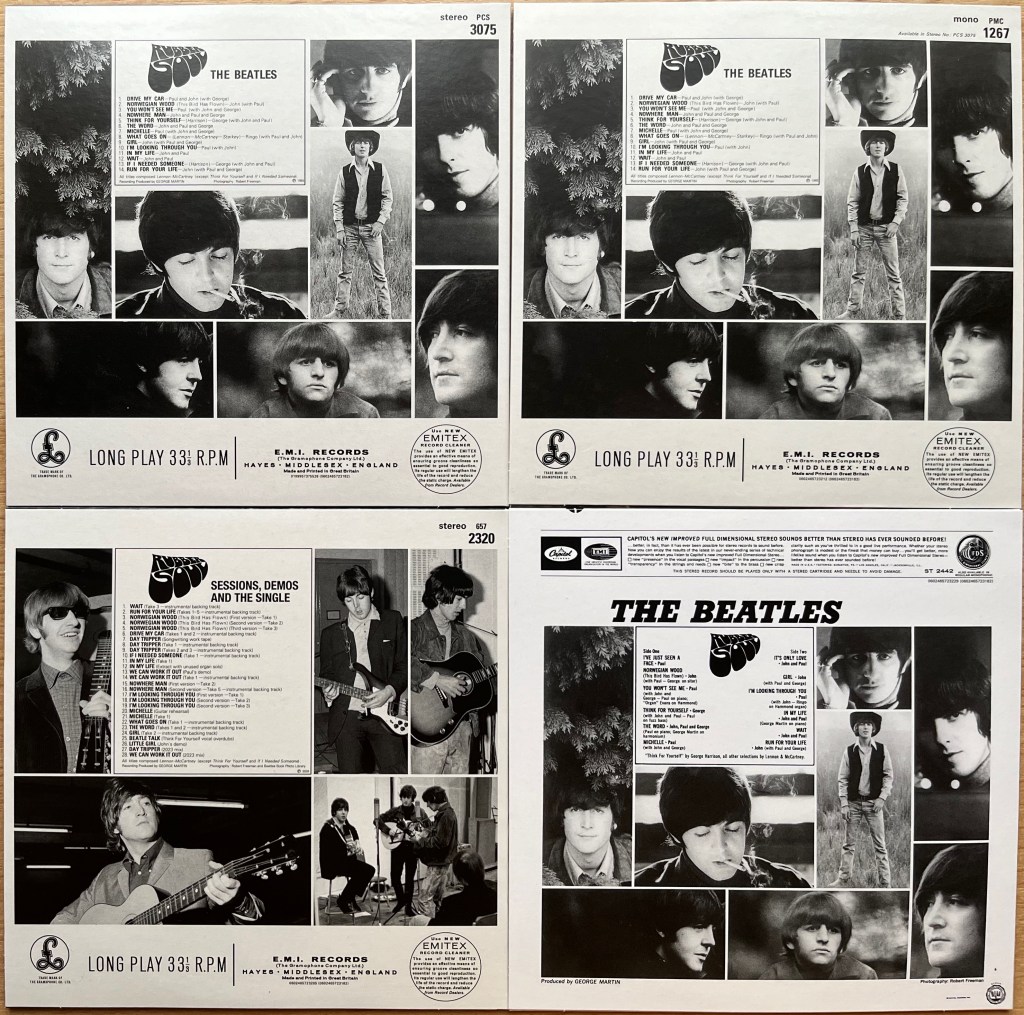
The Rubber Soul album was originally released in December 1965, spending 8 weeks at number 1, and the box set came out most recently, in October 2026, belatedly celebrating its 60th anniversary. The simple front cover is a nice photo of the band members against a leafy background, and I like the bulging of the logo, as if the letters are balloons being inflated. The faces of the band members are also slightly stretched, as explained in the book, though with my eyesight I must admit I didn’t notice that anomaly until it was pointed out. The back cover is simple as well, being entirely in black and white, with photos of the band members around the edge, and the track listings for the 4 discs taking up the rest of the space.
The Book
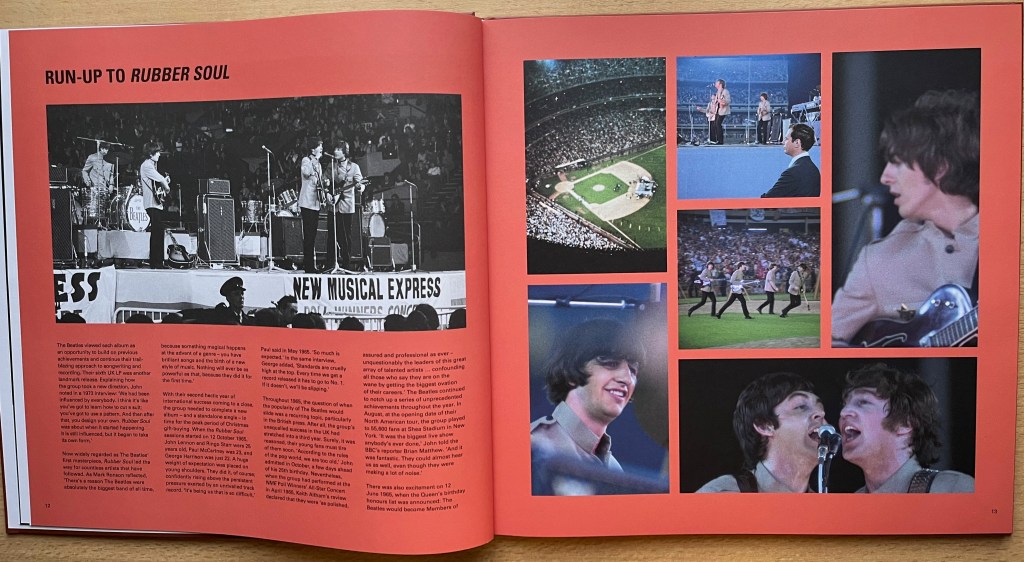
The hardback book has a very basic cover design, with a light brown background. On the front, the Rubber Soul logo sits large in the centre in white glossy lettering, while the back cover has nothing except a small image of the Apple logo at the bottom. It would have been overkill to replicate the album cover yet again, so I can see why they’ve done it this way, and it does give it a simple, smart appearance.
But its simplicity on the outside belies the sheer amount of detail on the inside, with 87 pages full of interesting text and nice photographs. It includes:
- Foreword by John Lennon – He reflects on the theme of love and how the band had improved by the time they got to this album, taking more control over the studio and their music.
- Introduction by Paul McCartney – He talks about how the band evolved from performing lots of cover versions to producing an increasing amount of their own music, recalls how they came up with the album’s name, and explains why their faces are a bit stretched out on the album cover.
- Run-Up To Rubber Soul – A look at how Rubber Soul marked the transition of the Beatles from being largely influenced by others to being very influential themselves. There was a lot of pressure and expectations on their shoulders for various reasons, but they pulled it off, and the album is hailed as their first masterpiece. They had strong connections with The Byrds and Bob Dylan too, and a love of American soul music.
- Track By Track – A detailed analysis of every song on the album. The chapter opens with an essay about how much their creativity had improved in the space of just a few years, the work of sound engineer Norman Smith (who later had hits as Hurricane Smith), the recording equipment used, the attempts to have more volume and bass in the final mixes, and the Little Girl demo that’s also on the sessions disc.
- An Adventure In Group Sound – This looks at the aftermath of the album’s release, including reviews, cover versions, the American version of the album, and the influence it’s had on artists from Brian Wilson to Dave Grohl and more modern acts.
- The Cover – A discussion about the album’s name and the unusual font it was printed in, plus the production of the cover photo and the mixed reactions to it.
- The Capitol US Rubber Soul – A look at how Capitol were persuaded to release the Beatles albums in America, their insistence on changing the track listings, and the specific differences between the UK & US editions of Rubber Soul.
- Rubber Soul In Mono – An explanation as to why it took so long for stereo records to take over from mono releases, and why the band preferred to work on the mono mix for Rubber Soul.
The Music
There are 68 tracks across 4 CDs in the set, lasting 2 hours 54 minutes. There’s no Blu-ray disc in this set.
The CDs are in cardboard sleeves, held within a large fold-out cardboard insert. The front of the insert is a copy of the album cover, while the rear is a copy of the original back cover, showing how the tracks were split across 2 discs, and the tracklisting is surrounded by black and white photos of the band.
The cardboard sleeves for the CDs are in a similar format. The cases for 3 of the discs, which are all different variants of the album, have the regular cover on the front, with the tracks listed on the back using the same layout as the original album. The logo on the front of each case is a different colour, with the first one having a reflective gold finish, which is nice. The case for the sessions disc, meanwhile, removes the logo and uses different photos of the band on the front and back, to set it apart from the rest. It still retains the same general style though, so it feels consistent.
CDs 1 & 3 – New Stereo Mix & Original Mono Mix
As explained in the book, the new mix for this box set spreads the sound more evenly than previous stereo editions, which had the instruments mainly on the left and the vocals on the right (as can be heard on the Capitol disc). There is inevitably some separation on this new remaster as well, but to nowhere near the same degree, and the vocals are centralised, which sounds a lot better.
The mono mix, meanwhile, is how the band originally intended the album to be heard, and it does have a nice sound to it. The songs don’t have the same degree of clarity as the new stereo mixes, hence I prefer those, but without the distribution between two speakers everything forms a cohesive whole, which sounds good in itself. So I’m happy listening to these versions as well, they still very much have their place.
It’s a solid collection of tracks in any case, focused on the themes of falling in or out of love, with a mixture of upbeat songs and sweet ballads. There’s some lovely instrumentation, nice harmonies, poetic lyrics and moments of humour throughout, and it’s all just a pleasure to listen to.
If I had to pick a top 5, I would probably say Drive My Car with its great guitar playing and the twist in the tale in the final verse, the sweet story told in Norwegian Wood, the classic ballad Michelle including its use of French lyrics, Girl with its gentle rhythm and backing harmonies, and the beautifully mature and reflective In My Life (with its intricate piano solo that the book reveals was recorded in an inventive and influential way). It’s very hard to narrow it down though.
CD 2 – Sessions, Demos & The Single
This disc contains 1 hour 12 minutes of material across 28 tracks. It’s really interesting to hear how songs like Norwegian Wood and I’m Looking Through You evolved over multiple versions. And there are several takes of instrumental backing tracks, so you can more fully appreciate the music played on songs such as Drive My Car and Girl. The studio chat while they record overdubs for Think For Yourself is also quite fun. Nearly all of the songs are represented here, except for You Won’t See Me.
The songs Day Tripper and We Can Work It Out, originally released as a separate double A-side, are also included at the end of Disc 2, as well as their session recordings earlier on. They ought to have put the final versions on the end of Disc 1 really, where there’s plenty of room, to keep the second disc reserved for work-in-progress tracks, but I appreciate they want to preserve the album’s running order. They’re both great songs anyway.
The other track on the disc is a home demo by John on acoustic guitar called Little Girl, a song that never came to fruition in the end. It’s very basic and incomplete, but it has nice sentiments to it, and had potential to be fleshed out.
CD 4 – Original Capitol Stereo Version
As with previous albums up to that point, the Capitol record company in America took it upon themselves to change the track listing, by removing 4 of the songs, rearranging the others, and adding in a couple that they’d previously omitted from Help! It’s confusing, I know.
These are the original stereo mixes, which often concentrate the vocals and some of the instruments into one channel or the other. So as someone who has always been used to stereo, the new mixes on Disc 1 seem better to me, as it sounds strange to hear the vocals or certain instruments predominantly in one ear.
Nevertheless, it’s still interesting to hear these alternate mixes out of curiosity, and indeed two of them have further slight differences to the UK version. The Capitol album uses an earlier stereo mix of The Word with double-tracking on John’s vocals, and there are a couple of false starts in I’m Looking Through You that were mistaken for being intentional but should have been removed.
All in all, therefore, it’s a great collection of tracks. The first 2 discs are the real essentials, and I probably won’t listen to the others so often, but the mono and Capitol versions of the album are still good to have for comparison and historical value.
Revolver
The Box
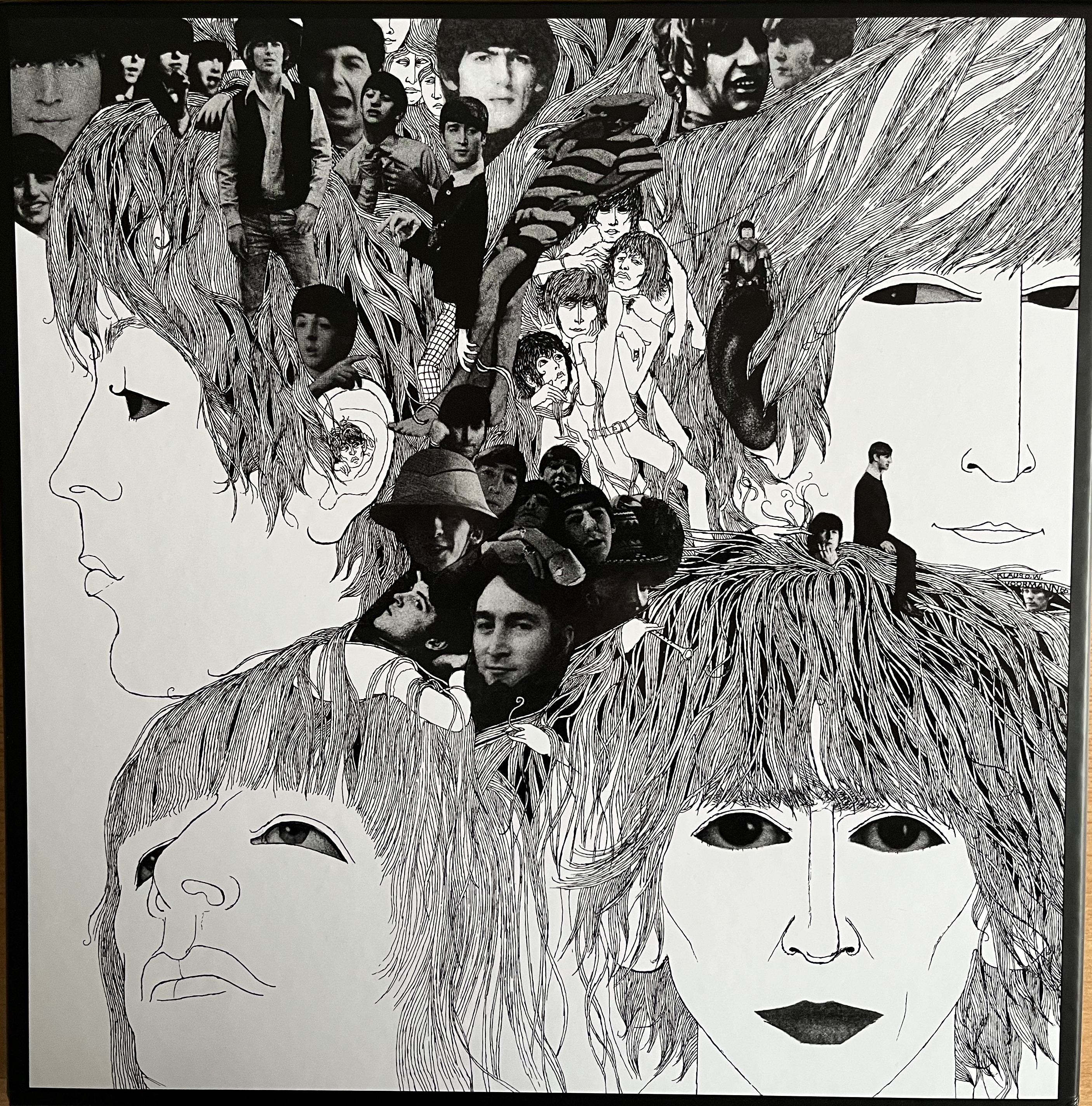
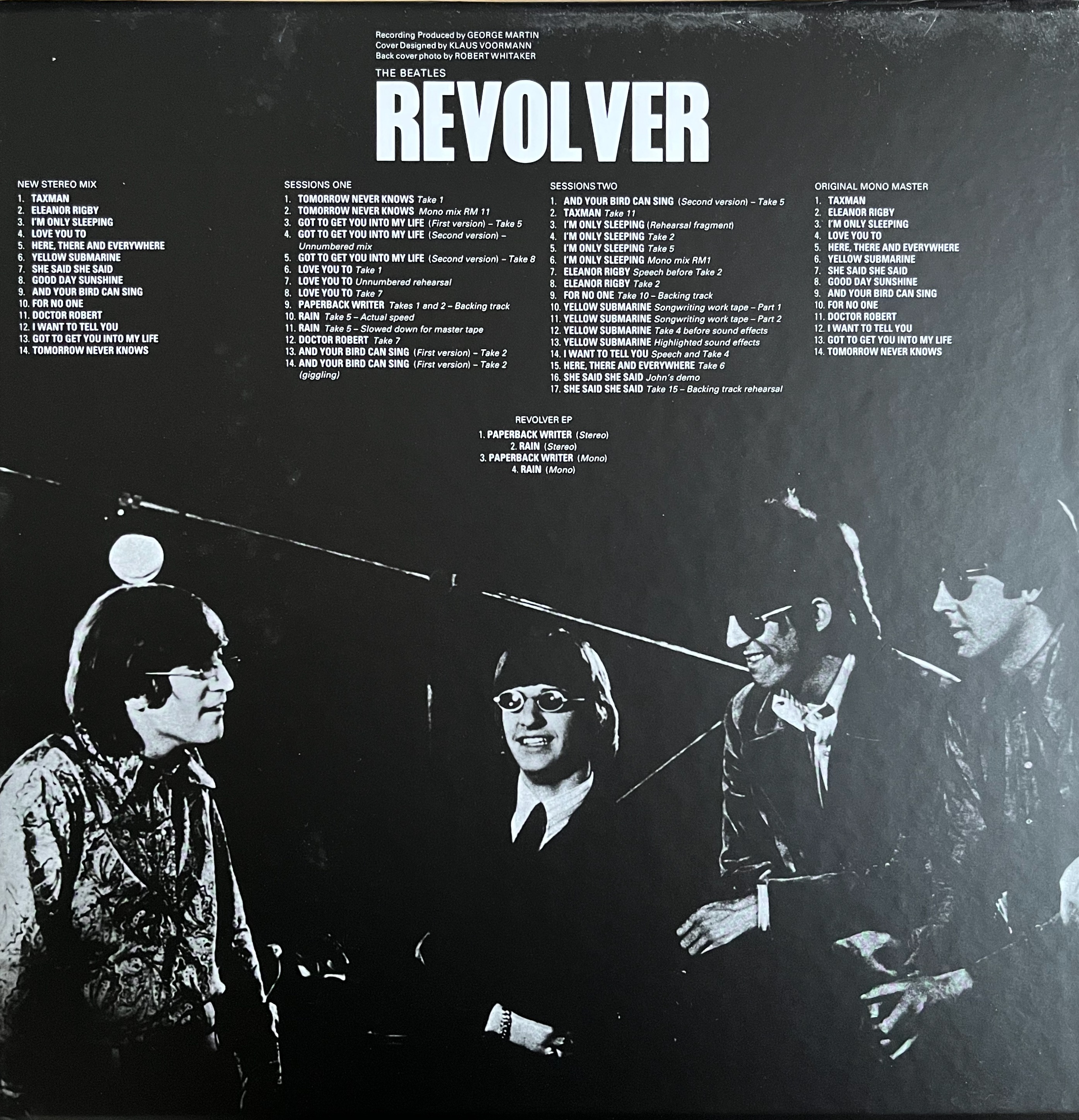
The Revolver album was originally released in August 1966, going straight in at number 1 for 7 weeks, and the box set came out in October 2022. The box has the album cover on the front, which combines black and white artwork with headshots of the band members, giving it a very unique and interesting appearance. The back cover has the tracklisting in white on a black background above a black and white photo of the band together.
The Book
The cover of the hardback book is plain and simple, consisting of a white background with the album title in large, black glossy letters on the front, while on the back there’s just a small black silhouette of the Apple logo at the bottom.
Inside it’s anything but simple though, with 100 pages full of absorbing information and great photos, written by Kevin Howlett unless otherwise stated:
- Foreword by Paul McCartney – He talks about how the band were experimenting with different sounds and styles of music rather than sticking to a formula.
- Introduction by Giles Martin – This is opposite a funny photo of his father George Martin with a trumpet on his head. He talks about how they approached remastering the album, including the new technology that allows them to ‘de-mix’ tracks to separate them into their separate elements.
- Evolver – This chapter is by Questlove, the drummer and co-founder of hip-hop band The Roots. He recalls how he used to resist the Beatles, assuming they were just a band for old people (a trap I also fell into when I was a child), but he was eventually won over and became obsessed with them. He then explains why Revolver became his favourite album of theirs, going into quite a bit of detail about his love for the songs, many of which he had first heard as cover versions or samples. He also talks about the Get Back documentary as well, which relates to their Let It Be album.
- The Road To Revolver – This looks at how the failed attempts to make a third film led to an extended period of welcome relaxation for the band. They were also interviewed by Brian Matthew and Maureen Cleave, from which there are several extracts here. In particular, it’s the period of time when George Harrison got into Indian music and sitar playing, inspired by Ravi Shankar, who he met and formed a close bond with. Paul was also exploring lots of different types of music as well as books and art. They all enjoyed hanging out at clubs in the “swinging city” of London as well, including the use of drugs.
- Track By Track – Before the detailed analysis of every song, the first part of this chapter talks about the band’s keen desire to keep experimenting and pushing the limits in the studio, the arrival of Geoff Emerick as the new sound engineer, the invention of Automatic Double Tracking by engineer Ken Townsend, overcoming the limited amount of tape tracks with bouncing down and overdubs, and the length of the recording sessions. Compared to the digital technology that artists use now, a lot more physical effort and manual precision was required back in those days, which makes the songs even more impressive.
- The Cover – A look at the band’s relationship with German artist and musician Klaus Voormann, and the beautiful award-winning artwork he produced for the album. There are also 7 pages of illustrations by Klaus from his graphic novel to celebrate the album’s 50th anniversary in 2016, called Revolver 50: Birth Of An Icon, which is laid out a bit like a comic strip. They’re difficult for me to fully read and appreciate with my partial sight, but what I can make out looks nice. This chapter also explains the spiralled images on the covers for the sessions discs, produced at the time by Robert Freeman, who had shot all of their album cover photos up to that point.
- Revolver Reception – Despite the creative competition from other big artists, the Beatles blew most people away with the revolutionary sound of this album, as explained in this chapter. And once again, various people leapt on the opportunity to do cover versions. Things were trickier in America though, where Capitol Records rearranged the tracks as usual, a controversial photo for the cover had to be scrapped (very sensibly I think), and John’s comment in an interview that “We’re more popular than Jesus” caused a huge backlash, ultimately leading to their last ever ticketed concert.
- Mono & Stereo In 1966 – Finally, this is a brief discussion about the development of stereo sound, why mono was still the most popular format when Revolver came out, and the key differences between the mono and stereo mixes on this album.

The Music
There are 63 tracks across 5 CDs in the set, lasting 2 hours 42 minutes. There’s no Blu-ray disc in this set.
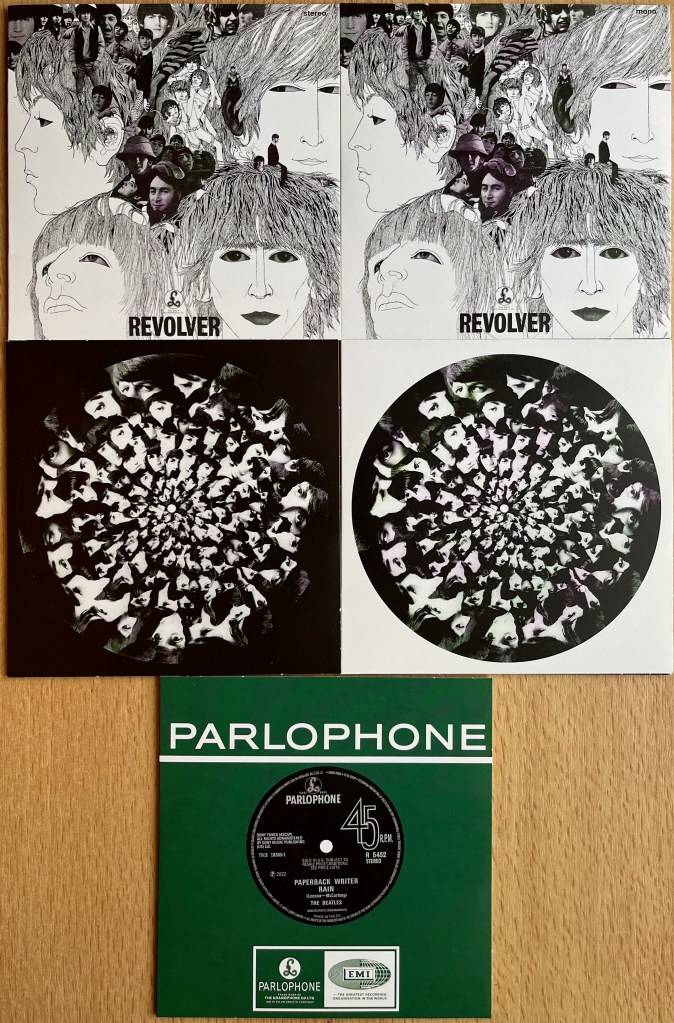
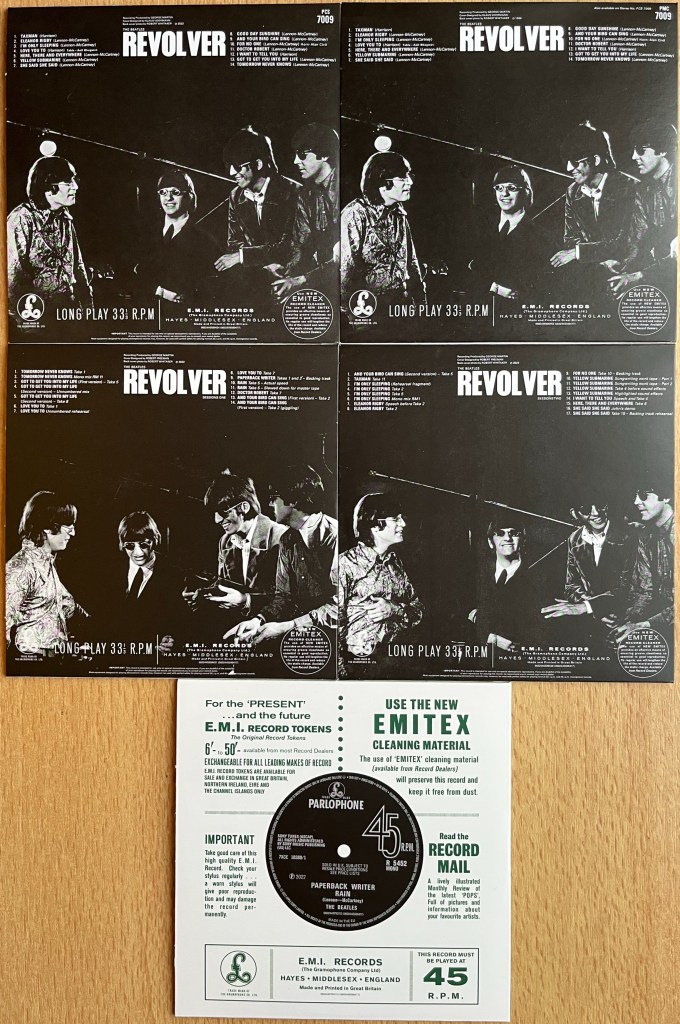
The CDs are in cardboard sleeves held within a large fold-out cardboard insert, the front and back of which replicates the original album cover. So the front is the same as on the box, while the back has a black background with the tracks listed at the top in white, above a large black and white photograph of the band. Interestingly, the tracks each have the lead singer listed beside them.
The front covers for the first 2 discs are also the same as the album cover, with the back using the same style and photo, just with different track listings. The next 2 cases for the sessions discs have a spiralling image of the band’s faces on the front, while the backs have a similar design to the original album but with slightly different images from the photoshoot. The final case then looks like an old EP sleeve on both sides.
CDs 1 & 4 – New Stereo Mix & Original Mono Mix
This feels like the first really transformative album for the band, with its mixture of textures, instruments, effects, etc, as a result of their increased confidence, time and experimentation in the studio. Yet despite offering up some very different sounds to before, their fanbase still stuck with them, because of the creativity and talent that shone through. The band weren’t just doing new things for the sake of it. Everything was carefully planned, and indeed had to be, given the limitations of the recording technology at the time.
In this box set I like the new mixes best, as I’ve been used to stereo ever since I grew up, and I prefer the improved clarity they have. But the band recorded and mixed the songs for mono originally, so it’s interesting to have those versions for comparison, especially as there are a few significant differences for some of the tracks, as explained in the book.
The album kicks off with Taxman, a song written by George in response to the extortionate amount of money the band were losing to the government. it has some nice backing harmonies and a fabulous guitar solo by Paul. That’s followed by the beautifully poetic number 1 hit about loneliness, Eleanor Rigby, backed by a lovely arrangement of strings and guitar. It’s so different to the Beatles songs that have come before, yet works perfectly, telling a sad story that really resonates.
Soon after, George’s influential playing of sitar on Love You To is another marked departure from the band’s tunes of old. It’s not a style of music that hugely appeals to me personally, but it’s nice enough, and I still appreciate the creativity and maturity that has gone into it, especially when you consider that he was only 23 at the time.
There are some big shifts in tone during the album as well, including a run of three tracks that take us from the enjoyably silly Yellow Submarine that I had fun singing as a kid, to the paranoid sentiments in She Said She Said, to the warm summer love song Good Day Sunshine with its cool piano parts. And a bit later there’s a song about a break up with For No One, which makes nice use of a clavichord and a french horn.
For many years in my earlier life, after I’d got into 60s music via my parents, I had never realised that the top ten hit Got To Get You Into My Life by Cliff Bennett & The Rebel Rousers was a cover. But the original Beatles version is the penultimate song here, as I discovered when I first got the standard editions of their albums. And it was only when reading the book from this box set that I discovered it was about drugs, rather than a love song about a girl. So the double meaning of an already great track is really interesting. Drugs were much more blatantly the inspiration for the closing track though, the trippy but strangely interesting Tomorrow Never Knows with its single chord structure and looping tape effects.
Overall, therefore, I would say that my top 5 tracks are Taxman, Eleanor Rigby, Yellow Submarine, Good Day Sunshine and Got To Get You Into My Life. But the other songs on the album are all good too. It’s quite the mixture, offering something for everybody, and it gels together well.
CDs 2 & 3 – Sessions
There’s approximately 1 hour 20 minutes of sessions material across 31 tracks on these two discs. It’s a great collection of rehearsals, early takes, alternate versions, backing tracks, etc, relating to nearly all of the songs (except Good Day Sunshine). They include additional vocals and a definitive ending for Taxman, an early take of the strings for Eleanor Rigby, the first take of Love You To using acoustic guitar rather than sitar, the original lyrics that were adapted for Yellow Submarine, John and Paul breaking down in giggles while recording And Your Bird Can Sing, and the early organ arrangement for Got To Get You Into My Life.
CD 5 – eP
This CD has the new stereo mixes and original mono mixes of the non-album single Paperback Writer and its B-side Rain. The former is a great song in particular, with its neat guitar riff, bass sound and echoed vocals, while the other track is more unusual but still interesting, including some nice drumming. And I’m very pleased we have them both for completeness. But it’s unnecessary to have a disc for 10 minutes of music, when these tracks could have been included on the stereo and mono discs in the set.
Sgt. Pepper
The Box
The album Sgt. Pepper’s Lonely Hearts Club Band originally came out in May 1967, spending a whopping 28 weeks at number 1, and the box set was released for its 50th anniversary in May 2017, making it the first of these super deluxe editions to be issued.
It comes in an LP-sized box with a lenticular cover, giving the colourful image of all the different people a 3D-type effect, meaning you can tilt it from side to side to see it change slightly. On the back of the box there’s an overview of what’s on the discs in the set, although most of the text is black on a red background, making it very hard to read.
When you take off the outer sleeve, the inner box is a large version of an EMI tape case with notes scribbled on it. Inside that box is a cardboard sleeve housing each of the discs, a big red hardback book, a poster of the band in their Sgt. Pepper costumes, a copy of the poster that inspired Being For The Benefit Of Mr Kite, and a copy of the original card insert from the album with cutout figures.
Of all the box sets issued to date, the design of this one is easily my favourite, given the use of colour throughout the set, as well as the inclusion of the videos and posters alongside the book and the discs.


The Book
The book has a red cover, and at first with my eyes it appears to be plain on the front. But by moving it around in the light I can see that it has the album’s logo in the centre on the front and a border around the edge. The back cover also has a border, but is otherwise empty apart from the small green Apple logo at the bottom.
The 144 pages inside the book have very colourful backgrounds and photos, as befits the album, but it also means that the text is easier to read on some pages than others. When I photograph the pages to read them on my computer though, I’m able to invert or adjust the colours to suit my needs.
The chapters are written by Kevin Howlett unless otherwise noted:
- Introductions – Paul McCartney summarises how the name, concept and characters of Sgt. Pepper’s Lonely Hearts Club band came into being. Then Giles Martin talks about how he approached remastering the album.
- The Path To Pepper – This looks at how the band became more focused on studio work rather than live performances, the concerns of their fans and the media about the band’s future, how their use of drugs may have influenced their music, how they nearly ended up recording the album in America, the innovative recording methods in the studio and the use of classical instruments. As it includes references to earlier years and the previous couple of albums for context, several details in this chapter are repeated in the Rubber Soul and Revolver box sets. However, those box sets hadn’t yet been released when this book was written, otherwise it might have referred back to them for simplicity. In any case, when going through the box sets in album order, like I’m doing for this post, the repetition does help to keep the story connected and reminds you of important points.
- The London Underground – Sadly this isn’t about London’s Tube train system. However, it’s still an interesting essay by music producer Joe Boyd, who reflects on the cultural explosion that took place in the second half of the 60s, including bands like The Beatles and Pink Floyd, the availability of psychedelic drugs, the Swinging London scene, the fashion and art of the time, his own UFO Club that he ran, the response of the authorities, and of course the impact of the release of Sgt. Pepper. As someone who wasn’t born until a couple of decades later, I find this really interesting, as it puts everything into perspective nicely.
- The World In 1967 – Journalist Ed Vulliamy discusses the wars, politics, race relations, pop culture and music of the time, and explains why the Sgt. Pepper album had such a huge impact in amongst it all. The chapter then ends with a 4-page timeline of key events in world culture and the Beatles’ lives, from the band’s last ever paid concert in August 1966 to the release of Sgt. Pepper in June 1967. It’s presented in the form of spotlights – but the text is so small and poorly contrasted in the white circles that it’s extremely difficult for me to read it, even if I take photos of sections of the pages. It only becomes somewhat legible if I open the images in my Mac’s Preview tool and set the colour contrast to maximum, and even then it’s far from ideal.
- Songs And Recording Details – The short introduction to this chapter talks about why there are no gaps between the tracks, the range of music styles on the album, the use of sound effects, the long recording sessions, and the success of the album when it was released. Then there’s an in-depth look at every track, even including the run-out groove at the end.
- Sgt. Pepper’s Musical Revolution – This chapter is written by legendary composer Howard Goodall, well known for the music in TV shows like Red Dwarf, Blackadder, Mr. Bean and The Vicar Of Dibley, as well as theatre and choir music. He comprehensively argues the case for why Sgt. Pepper (including its associated single) is the most influential record ever released, thanks to the creativity of the band members coupled with the innovative use of musical techniques, instruments, sound effects and technology. They did many things that had rarely or never been done before in pop music. You can tell he’s an experienced composer given his detailed analysis of how some of the songs were put together.
- The Cover Story – A look at how the incredible cover art was put together, designed by Peter Blake and Jann Haworth, using suggestions from each band member for which of their heroes should appear on it. There were various issues to resolve with EMI before it was finalised as well. The chapter includes a list and reference map of everybody who appears on the cover (even those who are painted out). It concludes with some recollections by Marijke Koger-Dunham from the Dutch art collective The Fool, whose artwork for the inner cover wasn’t approved, but their inner paper sleeve design was used.
- Sgt. Pepper Arrives – A look at how advance airplay of the album in America and on UK pirate radio forced EMI to release the album as soon as possible, why the BBC banned A Day In The Life, the press reviews and other reactions to the album.
- Sgt. Pepper In America – Jeff Slate writes about the huge impact that the album had across the pond, where nothing like it had ever been heard before, and it was very different to anything in the charts at that time.
- Lyrics – The words to all the songs on the album.

The Music
There are 65 tracks across 4 CDs in the set, lasting 3 hours 24 minutes. The album tracks are also presented in high definition audio on the DVD and Blu-ray discs.
All of the discs come in a large cardboard insert that has the album cover on the front, while on the back are the lyrics to all the songs in small black text on a red background, which is practically impossible for me to read even with the aid of technology. They’re much easier to read in the final chapter of the book, although I still have to magnify them, and it’s even easier online of course.
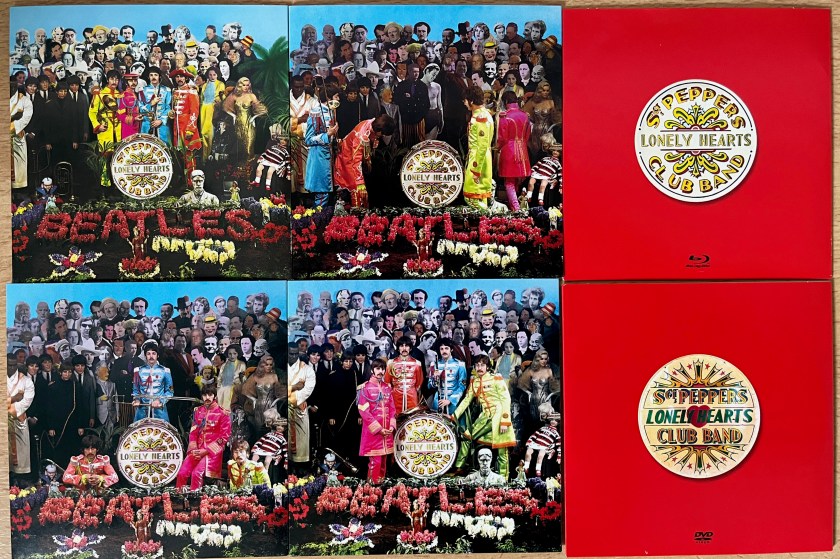
Inside, the first CD case also has the album cover artwork on the front, but the other 3 CDs carry a different version of the image, with the band members in different positions each time. The back covers have the track listings in black text above an image of the band in their colourful outfits – against a red background for CDs 1 & 4, and a yellow background for the other 2 CDs.
The DVD & Blu-ray cases have different versions of the Sgt. Pepper logo against a red background on the front. The back covers in both cases have black text on a red background.
CD 1 & 4 – New Stereo mix & Original Mono Mix
All the praise lavished upon this album in the book and elsewhere is certainly warranted. It’s easily one of their very best, because of the range of themes and styles on offer. As usual, given the modern sound that I’m accustomed to, I’m very happy with the new stereo mixes, but it’s important to have the mono ones as well, as that’s how the band produced the LP originally.
Sgt. Pepper’s Lonely Hearts Club Band is a cool uplifting rock opener. The actual concept of this alias group only crops up in the first song and the reprise near the end, and doesn’t really have much relevance anywhere else, yet both songs tie the album together nicely. It feels like we’ve been invited to a variety show, and that’s exactly what we get. It was suitably apt for the same reason when Paul performed it with U2 to launch Live 8 in 2005 as well.
The second song, With A Little Help From My Friends, is a singalong classic of course. Ringo and Paul have performed it live since then, including at the induction ceremony for the Rock & Roll Hall Of Fame in 2015. It’s been covered widely too, most notably by Joe Cocker, whose wonderful version I have in my collection, along with live performances from Woodstock in 1969 and at Buckingham Palace in 2002 for the Queen’s Golden Jubilee Party. I also have the version by Young Idea from a 60s compilation.
Then comes the song that people mistakenly think is about drugs – the beautifully whimsical Lucy In The Sky With Diamonds, which can be shortened to LSD. And sure, it does evoke unusual imagery in the lyrics. But in truth, it was inspired by a drawing by Julian Lennon (John’s 3-year-old son) of his classmate Lucy O’Donnell, and further influenced by Alice’s Adventures In Wonderland by Lewis Carroll.
That’s followed by two upbeat optimistic songs in the form of Getting Better and Fixing A Hole, the latter having a nice guitar solo. The idea of ‘fixing a hole where the rain gets in, to stop my mind from wandering” resonates with me a bit as a carer, as my head was flooded with thoughts and fears of how to look after my mother when her physical and mental health declined last year. But making the effort to reach out for support allowed me to relax a bit and think more clearly, thereby allowing my mind to enjoy more pleasurable distractions. It’s still a battle sometimes, of course, but things have been getting better, and I’ve been getting by with a little bit of help from my friends.
While I have to spend a lot of my time at home, however, the next song is about a lonely girl running away from hers, much to the distress of her parents. She’s Leaving Home has a beautiful orchestral arrangement and very touching lyrics. The book tells the story of Paul’s connection with the girl who inspired it, which was a surprise even to him many years later.
She hadn’t run away to join the circus, but that’s where the next song takes us – Being For The Benefit Of Mr. Kite! – providing another change in tone with its jolly arrangement and sound effects evoking the feel of a Victorian fair.
George then indulges his love of Indian music again in the song Within You Without You, which at over 5 minutes is unusually long for a Beatles track. As with Love You To on the previous album, it’s not a style of music that particularly grabs me if I’m honest, so it’s not one of my favourite songs here. But it’s not weak by any means either. It does have a nice arrangement, with lyrics that are very spiritual and philosophical. It just doesn’t sustain my interest over its length in the same way that many of their other songs do.
I very much like the next song though – When I’m Sixty-Four – because it’s a jaunty earworm with a rose-tinted view of what it might be like to get old. I also have the Bernard Cribbins cover that’s very good too. Lovely Rita then continues the fun and upbeat theme, with a great honky-tonk style piano solo and nice harmonies. Good Morning Good Morning is also fairly catchy, with its interesting alternating rhythms and animal noises, but the lyrics make it clear that it’s about boredom, reflecting John’s life at the time, living in a beautiful house but in the wrong location.
And then finally we get the epic A Day In The Life, a 5-minute track that subverted the traditional rules of musical structure and combined multiple ideas a full 8 years before Queen took it even further with Bohemian Rhapsody. Whether it inspired Freddie Mercury’s masterpiece isn’t known, but we do know that Queen were huge fans of the Beatles, describing them as “their bible”. And it’s also clear that the release and success of Sgt. Pepper, including this song in particular, gave licence to other artists to experiment, by sending a clear message that rules and traditions in music can be broken, meaning anything is possible. Sure, other artists were experimenting too – and Pet Sounds by The Beach Boys was a huge influence on Sgt. Pepper – but when you’re the biggest band in the country, and arguably on the planet, people can’t help but notice when you do things differently and get away with it. When the Beatles sang, everybody listened, even if they weren’t a fan. They were unavoidable, and in many ways still are, having become embedded in our cultural DNA because of albums like this.
So here we get a song about reading news stories on topics from a car crash to potholes, coupled with a middle section about catching the bus, which doesn’t sound very interesting when described like that. In that sense it is literally about a day in someone’s life. But it’s written and sung very poetically and arranged beautifully, with the sections joined together by a huge orchestral sound. It also contains a line that forced the BBC and American radio stations to ban it (“I’d love to turn you on”, which was interpreted as a drugs reference). And it concludes with that big elongated chord, made up of multiple pianos and keyboards. Finally, there’s a high pitched tone and a loop of garbled speech from the run-out groove of the original vinyl record, which even gets its own page in the book just like all the songs.
It’s a striking finish to an incredible album, from which it’s really hard to pick a top 5, but if forced to choose I think I would say Sgt. Pepper’s Lonely Hearts Club Band, With A Little Help From My Friends, Lucy In The Sky With Diamonds, When I’m Sixty-Four and A Day In The Life.
CD 2 & 3 – Sessions
These 2 CDs, running for 1 hour 42 minutes, grant us access to 31 tracks of behind the scenes material, plus the full stereo mixes for the non-album single Strawberry Fields Forever and Penny Lane (both wonderful songs which ought to be on the same disc as the stereo album, seeing as the mono versions are on the mono disc). So there’s a lot of good stuff to look through, including early takes, instrumental performances, false starts, breakdowns and studio chat. Highlights include the orchestral instrumental takes for She’s Leaving Home, George coaching the musicians by singing the melody and explaining the rhythm for Within You Without You, the orchestral overdub and the attempts to produce the closing chord for A Day In The Life, and the varied takes for Strawberry Fields Forever.
The Videos
As well as high definition surround sound audio of the album tracks, the DVD & Blu-ray discs in this set also include an hour’s worth of video material.
The main feature is The Making Of Sgt. Pepper, an excellent 50-minute 25th anniversary documentary from 1992 about the making of the album. It features interviews with Paul, George and Ringo from the band, producer George Martin, and other musicians including Ravi Shankar, Brian Wilson and Phil Collins. It provides a great insight into the creation of the songs, including demonstrations of isolated vocals and instruments at the mixing desk, along with recollections about their decision to quit touring, their use of drugs and the album cover art.
Then there are promo videos for 3 of the songs:
- A Day In The Life – This is a montage of footage recorded during the orchestra’s recording session for the song, where they’re even wearing a few joke shop accessories, along with some other visuals mixed in as well.
- Strawberry Fields Forever – This shows the band playing around in a field, where they find a piano-harp style instrument and cover it in paint. It has lots of unexpected effects including sudden jumps from day to night, action played in reverse, big close-ups and so on. It was filmed in Knole Park in Sevenoaks, which I visited with my friend Emily back in 2017.
- Penny Lane – This combines footage from the location in the title, some of which is relevant to the lyrics, with scenes of the band riding through Knole Park on horses to a table with candles where they sit and have tea.
Conclusion
And that’s it for this first post. These box sets have really opened my eyes as to how the band recorded their music, the stories behind the songs, how they evolved over time and the impact they had on the world. And I think it says a lot that I’ve written an increasing amount about each album in turn in this post, as I’ve felt compelled to say more each time.
So it’s a lot of fun to delve into their work, and I hope you’ve enjoyed my reviews so far. Keep an eye out for my thoughts on their other box sets coming soon!
Share this:


One thought on “The Beatles – Box Set Reviews – Part 1”