
Well, I never thought I’d want a summer to end, but I’m glad that one’s out of the way! Occasional spells of hot weather are welcome, but to have 6 intense heatwaves in close succession over the last few months has been quite exceptional, and ultimately it got too much for my mother and I. So it has set us back a bit, but it also led to an important realisation about being a carer, which is helping me to move forward. You can see the blog post I made yesterday for more about that, it’s been good to get it off my chest.
It means I still haven’t been anywhere exciting for a while, but at least I’m getting out of the house again for local walks and shopping, which I’m happy about. And when I’ve been at home, I’ve been enjoying plenty of entertainment as usual, with a few TV shows, a couple of audiobooks and an addictive game. So I hope you find this latest roundup interesting as usual.
Contents
TV
Good Omens
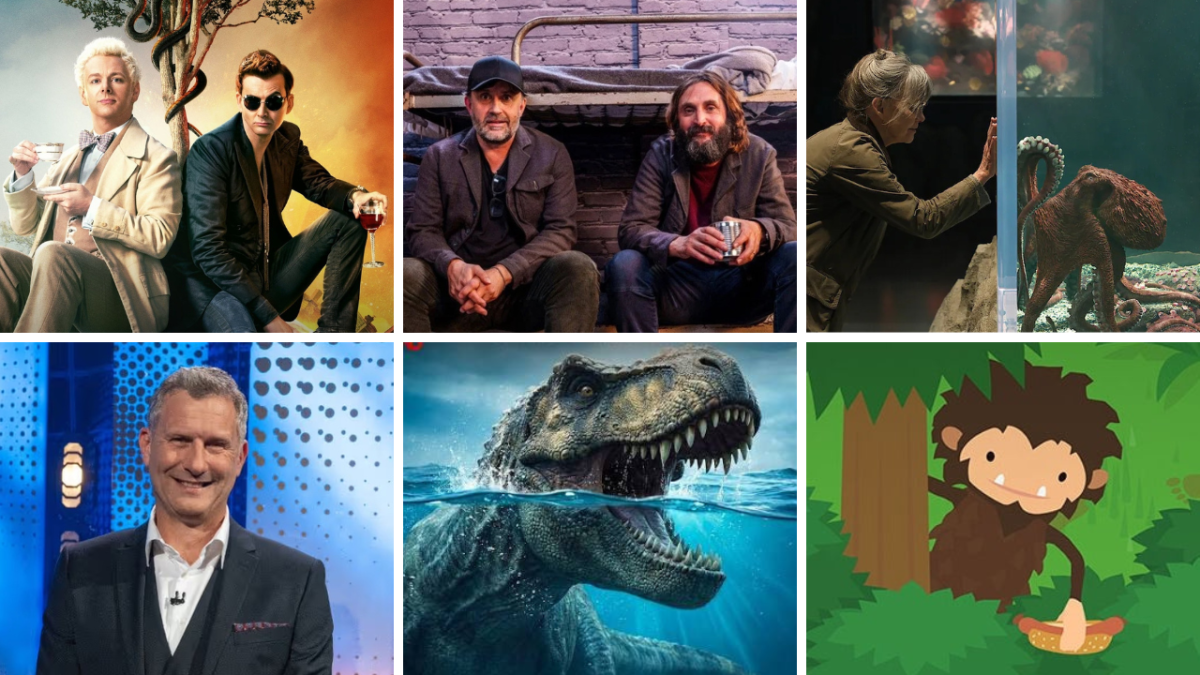
This month I’ve watched the fantasy comedy-drama Good Omens in its entirety on Amazon Prime Video, in light of the fact that the finale was released earlier this year. I’ve seen the first two series before, but obviously it was best to watch those again as well. And it’s been great to see it all, including the use of audio description, which was extremely useful.
Based on the novel by Terry Pratchett and Neil Gaiman, it’s about an angel called Aziraphale (Michael Sheen) and a demon called Crowley (David Tennant). Michael and David have amazing chemistry, as also proven by Staged in the Covid pandemic, so they’re brilliant here.
They’ve developed an unusual friendship since the dawn of the universe, and we’re shown interesting slices of their backstory in the form of minisodes within some of the main episodes, one even forming a half-hour prequel before the impressively animated title sequence (which changes every series). They don’t always see eye to eye, but each is able to persuade the other to help them with things if necessary. And neither of them must let their masters be aware of what they’re up to, although naturally it gets figured out anyway.
In the first series, released in 2019, they become aware that Armageddon is approaching, but they’re not keen on it happening as they like hanging out on Earth with all the luxuries it offers, including the variety of nice food and Aziraphale’s antique bookshop. So they try to figure out how to stop it, only for things to go immediately awry when a mix-up causes them to lose the child who is set to be the Antichrist. The child in question, Adam (Sam Taylor Buck), has no idea of what is about to befall him either, and thinks nothing of it when a cute little dog, secretly a hellhound, becomes his loving companion.
So Aziraphale and Crowley have to try and establish who the child is, where he is and how to stop him, before it’s too late and without their commanders getting in the way. Meanwhile Adam and his mates get to know Anathema (Adria Arjona), the descendant of a witch, whose path in turn crosses with Newton Pulsifer (a surprising role for comedian Jack Whitehall), the descendant of a witchfinder. The story becomes quite complex with its various subplots, but it’s still fun and easy to follow, and comes together nicely at the end.
After a special online lockdown sketch in 2020, the second series then dropped in 2023. This time our two heroes are surprised by the reappearance of the angel Gabriel (Jon Hamm), who has completely lost his memory, and is being hunted by people from both Heaven and Hell. So they have to try and hide him, whilst also trying to figure out why he’s in that state. The song Everyday by Buddy Holly plays a key part in the story, and among the guest stars are three members of The League Of Gentlemen, who first appeared in Series 1 but have a much more prominent role here. It’s another good series overall, with very difficult decisions to be made by our heroes at the end.
Series 3 then arrived earlier this year, although in reality it’s just a single feature length special. It was originally intended to be a full series, but Neil Gaiman stepped away from the show following allegations of sexual assault that he strongly denies. It does suffer as a result, because some aspects of the plot clearly had the potential to be fleshed out much more, but were rushed through or brushed aside a bit in the end.
Nevertheless, it is a good finale, and ensures that the story isn’t left hanging in the way that it was at the end of the previous series. Aziraphale has now been given a heavenly promotion, in order to oversee the Second Coming of Jesus (Bilal Hasna). But Jesus goes missing, as does the Metatron (Derek Jacobi) and the Book Of Life. Aziraphale then has to rope in Crowley to help him figure out the conspiracy at the heart of it all, so they can try and put things right. The twist at the end was a surprise to me, but it works really well, bringing the show to a sweet and satisfying conclusion.
So I enjoyed watching it altogether. It’s very tongue-in-cheek, with lots of amusement to be had, but there’s also action and tension, and even a few moving moments. Visually it’s beautifully shot too, including the scenery, costumes, fancy camera moves and special effects. I also love the fact that Crowley enjoys blasting out Queen songs in his car. And the music for the series by David Arnold is wonderfully atmospheric, including different variations of the theme tune and a guest appearance by singer Tori Amos, so I have the soundtrack albums for Series 1, 2 & 3.
Joe & David’s Magical Sitcom Tour
Comedians Joe Wilkinson & David Earl have been best friends and have worked together for a long time, and currently host a podcast called Chatabix, which I’ve never listened to. And now, in this new 3-part series on Gold, they’re exploring iconic locations and meeting key people from some of their favourite sitcoms. It’s good fun, as they have great camaraderie and it’s very interesting to learn more about the shows, or at least the two that I’m a fan of.
The first episode is all about Joe’s favourite sitcom, Porridge, as David takes him on a mystery tour with various surprises. They spend time in a faithful recreation of Fletcher’s jail cell, where they meet Christopher Biggins (who played Lukewarm), before Joe is taken to see Ronnie Barker’s living room. They then have a tour of Ealing Studios where the show was made, and have a nice chat with writers Dick Clement and Ian La Frenais, before finally having a special moment outside the building that represented the exterior of Slade Prison (a former Victorian jail that is now St Albans Registry Office).
Joe then returns the gesture in the second episode, when he takes David on a Fawlty Towers tour. They can’t rebuild a set or visit the long-lost building used for the exterior shots this time, but they do go to a studio in TV Centre where it was filmed, and a floor manager helps them map out where the set would have been so they can act out parts of an episode. They also chat with a fan who had been in the audience. But then things get particularly enlightening as they visit the site of the former Gleneagles Hotel in Torquay that inspired the show, where they have a great laugh talking to a lady who worked there, before interviewing John Cleese himself on Zoom. They then read through some fascinating documents from the BBC archives, before visiting a couple of locations from the Gourmet Night episode. In particular they find the site of the famous car thrashing scene, complete with a red mini in exactly the same spot that they can use to recreate the hilarious moment. So that’s really fun.
The last episode is all about The Office, but I didn’t bother watching that one. I’ve tried watching that particular sitcom in the past, but have never got into it, so I’m not interested in learning more about it. I know Ricky Gervais has been celebrating its 25th anniversary on Youtube though.
Life On Our Planet & The Dinosaurs
Last month I reviewed two crime dramas that I had been introduced to on BBC Radio 4’s In Touch back in May, when I joined in a round-table discussion about audio description on streaming services.
However, we had also talked about the first episode of The Dinosaurs, which first dropped on Netflix in March this year. We hadn’t been overly impressed with the audio description, but the programme itself still seemed to be interesting. And it’s actually a sequel to an earlier series from 2023 called Life On Our Planet, which is also still available at the time of writing. So I decided to try both of those programmes this month.
Steven Spielberg is the executive producer of both shows, and they’re narrated by Morgan Freeman, with his magnificent, distinctive voice. The episodes are visually stunning as well, mixing modern day filming with very photo-realistic CGI for the prehistoric creatures. Plus there’s beautiful music by esteemed composer Lorne Balfe, which further helps to make it feel cinematic.
And yet, despite all of that, they’re still not as good as other nature shows I’ve seen, and overall it feels like a case of style over substance.
Life On Our Planet opens with an overview of evolution, right back to the first single-celled organisms 4 billion years ago, which puts everything into perspective. The subsequent 7 episodes then hone in on particular time periods in order, looking at the earliest species of creatures and plants to rule the oceans, the land and the skies, and the mass extinction events that wiped out the vast majority of life along the way. Similarly, The Dinosaurs tracks the lifespan of these iconic creatures through different periods of time, with episodes entitled Rise, Conquest, Empire and Fall giving you a pretty good sense of how it’s structured. In both series, the enormous timescales are unimaginable, and it’s a stark reminder of how tiny humanity really is in the history of Earth.
It was easy for me to watch both shows without audio description, because of the detailed close-up imagery that I could see well enough on my big TV screen. I did try the AD out of curiosity though, but I didn’t feel like I needed it. For Life On Our Planet it seemed to be alright, but for The Dinosaurs it became quite frustrating, because it often just named the dinosaurs without actually describing what they looked like. Occasionally they did give a nice little description, but it was very hit and miss.
Ultimately, both shows are somewhat interesting, as they do include things I hadn’t known before, as well as looking amazing. But they also pale in comparison to documentaries by David Attenborough and others. They feel more like natural history programmes for people who are new to the genre, such as younger viewers, keeping things simple and sometimes stating the obvious, rather than going too in depth about any of the animals being mentioned. There were times when I really wanted to know more, and there was ample opportunity for further detail, but it never came.
The narration is also a bit repetitive sometimes, for example when Morgan constantly tells you that every big event has changed the world forever, just phrasing it in a slightly different way each time. And the pacing feels very slow, even when there’s danger or animals fighting. Morgan’s voice is wonderfully calm and relaxing, but it can sometimes feel at odds with the dramatic action on screen.
All of which meant I found my attention drifting away from both series, because it felt like there was a lot of potential that wasn’t being tapped into. I know they wanted to keep it all accessible by not making things too complicated, and when you’re trying to cover the entirety of evolution or the history of the dinosaurs in a limited number of episodes, I appreciate that you have to take quite a broad brush approach. In that sense they do work well. And it is to their credit that they sparked my curiosity enough to Google a few things I hadn’t been aware of to delve a bit deeper. But it just felt like the impressive visuals and a famous voice doing the narration were the main selling points, rather than a really compelling script. So they were worth a look, but they’re not shows I would revisit. There are far superior nature documentaries out there, and I will be watching some of David Attenborough’s soon.
Incidentally, talking of In Touch on BBC Radio 4, I’ve also just appeared on the show again, although much more briefly this time. In the episode from Tuesday 1st September, I was one of a few listeners who had been invited to record my thoughts on the accessibility of food packaging, as they were reporting on a campaign for braille labelling.
Audiobooks
Adam Hills: Best Foot Forward
I’m currently working my way through a few autobiographies by some of my favourite comedy stars, and this month I listened to Best Foot Forward by Adam Hills, which he reads wonderfully himself. I had previously listened to it 8 years ago this month, shortly after it was released, and briefly mentioned it on my blog at the time. So I wanted to give it a fresh listen and a more thorough review. I’ve also reviewed his stand-up comedy shows previously as well.
He starts the book by reflecting fondly on his childhood in some beautiful-sounding locations in Australia. And he of course mentions growing up with one leg and having to wear a prosthetic, although it didn’t prove to be a major issue, because fortunately the right decisions were made and the right support was provided for him early on. So it doesn’t have a major impact on his life for quite a while, and that’s good. Just because it’s there doesn’t mean he has to talk about it all the time, in the same way that I don’t always mention my visual impairment. He doesn’t even address it in his stand-up act until he becomes well established.
So it was comedy that had a far bigger impact on him, and it’s interesting to hear about how he got into it, the encouragement and advice he received, his perseverance despite some difficult and strange gigs, and the important lessons he learned. He also recalls a few incidents he witnessed with other acts, ranging from the amusing to the sinister.
He then got into a radio career for a while, starting out as a comedy writer and eventually hosting his own breakfast show. So he has plenty of great stories from that period, including a few stunts and jokes that you’d never get away with on radio here in the UK, and his interviews with big guests like Barry Manilow, Alexei Sayle and Los Del Mar. It kind of makes me wish we could hear some of those shows out of curiosity, even if they’re bad.
it’s also interesting to hear how he and his team dealt with a celebrity death and a terrorist attack (narrowly escaping an on-air blunder in the latter case). The skillset he developed about covering tragic news sensitively while still providing humorous entertainment is something he still uses to great effect on The Last Leg. It’s not an easy balance to get right, but he has very good judgement and respect, which is one of the many reasons I admire him.
Stand-up comedy was always his big dream though, and he got the push he needed to quit radio and go professional full time by one of his comedy idols, Billy Connolly, who he would later meet again and exchange messages with during his career. I know a little bit of Billy’s material, but I’ve never tried any of his stand-up shows, and I probably ought to at some point. He’s certainly an amazing guy off-stage judging by Adam’s anecdotes.
Years of work in Australia, the UK, Ireland, America and other countries have since followed for Adam, including the important comedy festivals and occasional disastrous gigs. And along the way he’s made many new friends and had lots of surprising encounters. I particularly enjoyed hearing about his road trip with Ross Noble, another of my favourite comedians, as a result of which they became best mates. He also has fun stories about meeting The Drifters, Mel Smith, Robin Williams, Chris Rock, Lady Gaga, Whoopi Goldberg, The Queen, The Dalai Lama, The Muppets and Dame Edna Everage, some of whom had a big impact on him.
Meanwhile, he landed his first job as a TV host on the Australian music quiz Spicks & Specks in 2005. It was another big learning experience for him, and again he has some funny stories to share, including moments that were never broadcast. For instance, I liked hearing about Rick and Francis from Status Quo, one of my favourite bands, appearing on the show. He and his team brought the series to an end in 2011, but they later returned in 2018 after this book was published, and he’s still hosting it today.
His disability has also become a much more prominent part of his life and career during the 21st century, beginning with the aftermath of 9/11, which led to him talking about his artificial foot in his act. It’s a story he’s told on stage many times since, but he expands upon it here. 7 years later he then became absorbed in the Paralympics, when he was invited to host the opening and closing ceremonies of the 2008 Beijing Games on Australian TV. That was a pivotal moment, as he got to meet many of the disabled athletes and witness their astonishing achievements for the first time. I can very much empathise with his sentiments here, because discovering other people with the same condition as you, leading a similar life and facing similar challenges, is a huge deal. It really makes you feel more connected and less alone, even more so when you then realise you’re part of the wider disability community in general.
Consequently he then explains how The Last Leg, one of my favourite TV shows that I’ve been in the audience for, was born out of the London 2012 Paralympics, and has become a long-running hit ever since. In amongst it all he recalls the challenge of discussing Oscar Pistorius murdering his girlfriend, and the surreal thrill of going to a Prince concert with Deputy PM Nick Clegg.
He then concludes by talking about disabled rugby, and reflects on why he doesn’t regret being born with one foot, because it’s made him the person he is today and he’s proud to be different. It’s a very thoughtful and positive ending that wraps up the story nicely. So all in all it was very enjoyable to listen to, and given how much time has already passed since it was published, he’ll easily have scope for a second book at some stage in the future.
Shelby Van Pelt: Remarkably Bright Creatures
For my birthday this month, my friend Claire very kindly gifted me the audiobook of Remarkably Bright Creatures, the debut novel by Shelby Van Pelt. It originally came out in 2022, but has recently come to people’s attention again because it’s been adapted into a film, which was released on Netflix in May this year and has been nominated for 3 Emmy awards.
I’d never heard of the book or the film before, but ended up enjoying both of them, because the story is fun and very moving. The writing in the book is nicely descriptive and really draws you in, while the Netflix version is beautifully filmed and acted.
The story revolves around Marcellus, an intelligent octopus living out his final days in an aquarium. He’s learned how to escape his tank, so he likes to get out every night to explore the building and acquire more interesting items of food than what he is normally fed.
Marcellus talks to us as the audience directly, explaining his thoughts and actions throughout the story from his own perspective. I therefore really like the fact that he’s given his own voice in the audiobook (Michael Urie) and the film (Alfred Molina). He isn’t able to talk to the humans in the story though (who are narrated in the audiobook by Marin Ireland), so we have privileged access to his mind here.
He isn’t generally fond of humans anyway, but he does form a bond with the aquarium’s elderly night cleaner Tova (played by Sally Field in the film). The job is one of the ways that she keeps busy now that she has no family. Her son Erik was lost at sea 30 years ago, although she’s never believed all the theories about him taking his own life, plus she’s also been a widow since her husband died, and the death of her estranged brother occurs early on in the book. She’s not entirely lonely though, as apart from Marcellus she’s also part of a group of friends who affectionally call themselves the Knitwits, and there are a few other people who know her as well.
There’s a shock for Marcellus, however, when Tova falls and injures herself one night, and is replaced by a young, inexperienced man called Cameron (portrayed by Lewis Pullman on screen). Tova can’t stay away though, and soon teaches Cameron how to clean properly. It causes a bit of initial tension between them, but they warm to each other as they get more acquainted, and Tova learns that Cameron is on a mission that has brought him to the area.
Marcellus, however, sees more with his enhanced perception, and once we learn what Cameron is searching for, it’s easy to join the dots. Otherwise Cameron’s prominent involvement in the story would be rather pointless. But it’s fine that we know that, it’s not meant to be a mystery. What keeps you invested is whether Marcellus can get the message through to Tova and Cameron before they move on with their lives and his own comes to an end. I won’t spoil things beyond that, but the conclusion of the story is very moving.
So I can see why it’s so popular, it’s a very sweet story. Although I will add that, despite the concept of a sort-of talking octopus, it’s not a book for young kids, as there are very occasional uses of strong language. But for everyone else I can definitely recommend it if you like heartfelt stories.
Other Posts
Added on 4 October 2026, to move my game review to a separate post.
If you want even more to read, then you can check out these in-depth reviews as well:
- Sneaky Sasquatch – I’ve continued my look at Apple Arcade this month by playing this game. It was one of the original launch titles for the service back in 2019, and is still getting updates and high ratings now. So I thought I’d take a look to see what all the fuss is about, and it is indeed very addictive and a lot of fun. I originally wrote a short review of the game in this post, but have now created a separate post to share my progress in detail, as there’s so much to do.
- Queen: A Kind Of Magic – This is the latest in my extensive series about Queen’s albums, including my thoughts on the Highlander movie that uses several of the songs.
Conclusion
And that’s all for this roundup, I hope you found things of interest in there as usual. Given my current situation as a carer, I don’t have plans to go out anywhere special during September, although I am hoping to meet up with a friend, which will be nice. But there are various things I’m planning to watch and listen to as usual, so there will always be plenty for me to write about. In the meantime, I hope you have a good month, and stay tuned for more posts very soon!
Share this:


