

Here we go again, on what is proving to be a very special day. As part of their celebrations of the 60th anniversary of Doctor Who, the BBC have just launched a massive Whoniverse collection of episodes and extras on iPlayer – including audio description, subtitles and sign language for the Classic series, New era and spin-offs, which is a huge win for accessibility. The extra features include the full-length episodes of Doctor Who Confidential and other documentaries, plus there’s an extensive archive of behind the scenes material as well. So I’m really looking forward to digging through all of that.
And with the anniversary specials now fast approaching, here’s the latest in my personal series of lengthy reviews about the modern era of the show. This time I’m looking through Series 4, using the Blu-ray steelbook edition that I own, following on from my previous deep dives into Series 1, 2 & 3. All opinions are my own of course, none of these posts are sponsored by the BBC, I’m just a big fan.
Russell T Davies is still showrunner and David Tennant is still the Doctor for this series, which is great news of course. And this time the companion is Donna Noble, played by Catherine Tate, returning after her guest role in The Runaway Bride. I’m not a fan of her sketch show, but her appearance in that previous Christmas special of Doctor Who had swayed my opinion a bit more in her favour. And now, in this fourth series, she gets a proper chance to demonstrate what she’s really capable of, both comedically and dramatically, doing a superb job in the process.
Donna is down to earth and isn’t afraid to stand up for herself or others, even if that means putting the Doctor in his place occasionally. But she still has fears and vulnerabilities like every human being, she’s keen to learn, and she also loves to have a good laugh. And she doesn’t fall in love with the Doctor, unlike Rose and Martha before her (who reappear in this series, along with a couple of other companions), so she has a much more relaxed connection with him. They’re just good friends exploring the universe together, and it works really well that way, especially as actors David and Catherine have such great chemistry too. So Donna’s a very well-developed character, who goes on a big personal journey throughout this series, in addition to her trips across time and space, until it all comes to a shocking conclusion.
So we’re treated to another fantastic set of stories in this series, with all the usual action, drama, humour, emotions, visual effects, music and everything else it throws at you. And therefore, alongside a big playlist of clips I’ve put together on Youtube, here’s my lengthy review of it all!
[Note: This post was edited in November 2023 to mention the new Whoniverse collection on iPlayer and the Series 1-4 & Specials box set.]
Contents
- Packaging
- Episodes
- Overview
- Children In Need: Time Crash
- Special: Voyage Of The Damned
- 1. Partners In Crime
- 2. The Fires Of Pompeii
- 3. Planet Of The Ood
- 4 & 5. The Sontaran Stratagem / The Poison Sky
- 6. The Doctor’s Daughter
- 7. The Unicorn And The Wasp
- 8 & 9. Silence In The Library / Forest Of The Dead
- 10. Midnight
- 11. Turn Left
- 12 & 13. The Stolen Earth / Journey’s End
- Blu-ray Extras
- Other Content
Packaging
Blu-ray Steelbook
The Blu-ray steelbook for this series was released in 2019, four years after the standard Blu-ray release. It used the same layout for its beautiful artwork as the previous steelbooks, with the Doctor and his companion on the front, and his biggest enemies on the back.


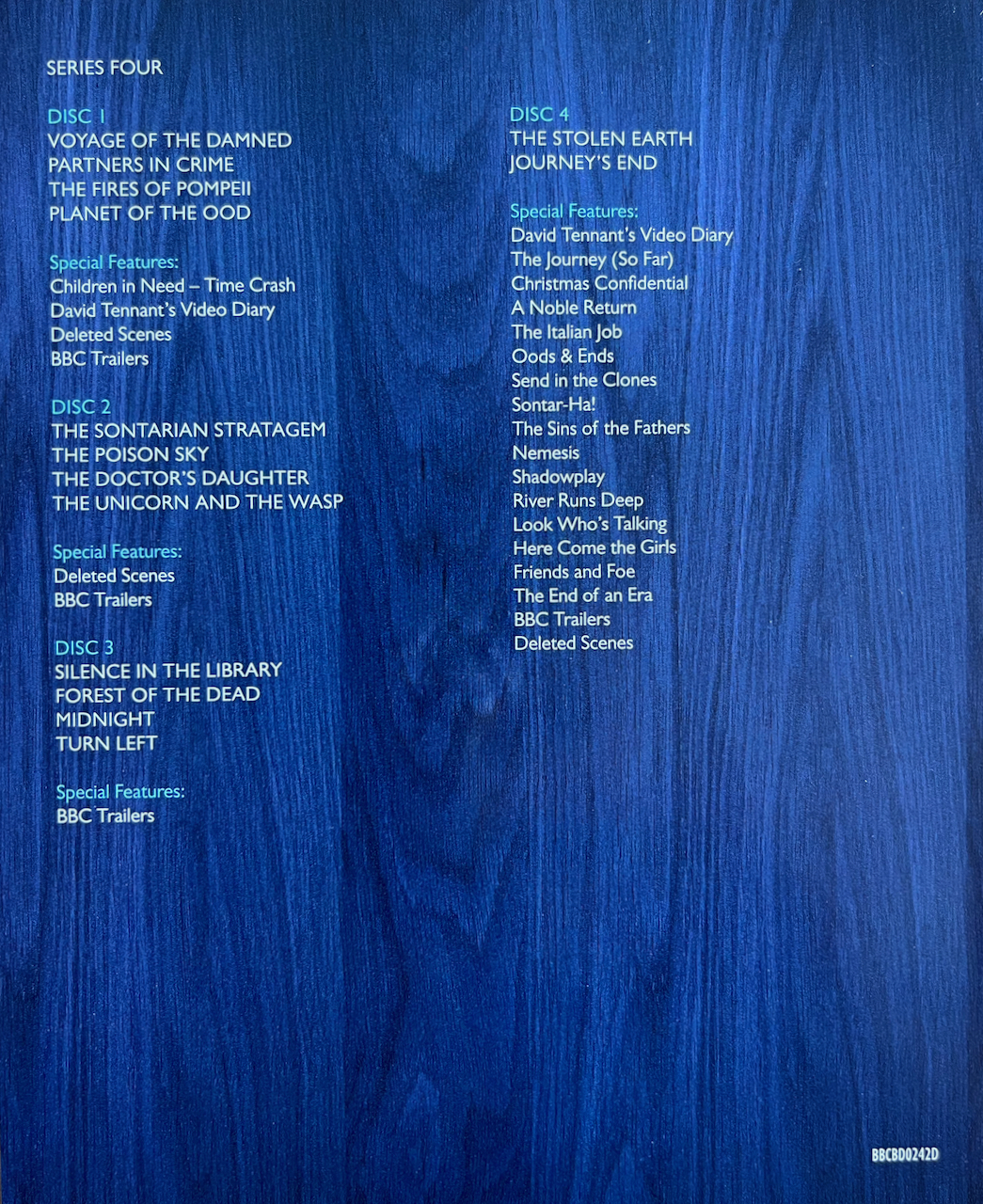
The interior of the steelbook shows a photo of the Doctor and Donna running urgently. And there are 4 discs rather than 3 for a change, carrying pictures of Kylie Minogue as Astrid the waitress, Sontaran General Staal, River Song and Mickey Smith. Each disc is held in its own convenient ‘hub’, including a double-sided swing tray in the centre, unlike some later releases that awkwardly pile more than one disc on top of each other. The contents of the discs are written out on a thin flyer as usual too.


The menu is very nicely animated, rotating a full 360 degrees around the burning Tardis interior, with the console in the centre and the Doctor’s old hand visible in its container on the floor, while we hear the menacing voice of Davros alongside a few explosions. The preceding animation that takes us into the Tardis, however, still uses the old version of the title sequence and theme music from Series 1-3, rather than bringing it up to date, which seems strange and a bit lazy, but never mind.

Old DVD Release
The old DVD set I used to own for this series didn’t have anything fancy about it design-wise, compared to the Tardis box I had for Series 1 and the lenticular covers for Series 2 & 3. But it was nice that it featured all of the major companions who appeared alongside the Doctor in this series – Donna, Jack, Rose, Martha and Sarah Jane.


It also had a great booklet, with a lovely foreword by Russell T Davies heaping well-earned praise on the many actors in the series, nice pieces of artwork, photos from some of the stories (some of which I’ll include during this post), information about each episode (synopses, writer and director credits, commentary participants and chapter points), and a list of the extras on each disc.


The omission of such booklets from the Blu-rays has always been a pity, as is the continued absence of audio navigation and audio description, which we have to wait until Series 6 to get (whereas audio description was available from Series 1 on the DVDs, plus audio navigation from Series 2). Still, audio description is available for every episode on BBC iPlayer, so if you don’t have the DVDs you can watch it that way if need be.
[November 2023 Update: The new Series 1-4 & specials box set includes audio description on every episode, but not audio navigation. It also corrects the conversion issue that causes the episodes to run 4% slower here, which I don’t notice anyway so I haven’t bought that new set.]
Episodes

Overview
The series consists of a Christmas special lasting over 70 minutes, followed by 12 episodes of around 45-50 minutes each, and a finale lasting 65 minutes, all spread across 4 Blu-ray discs.
Despite spin-off show Torchwood being filmed in HD since its launch in 2006, Doctor Who was still being produced in standard definition at this point in 2007 & 2008. Torchwood was the test bed for filming a full-length drama in HD, and because of the difficulties involved Russell T Davies was against using the format on its parent show. It would also require considerable time and money to make the transition to new equipment across the whole BBC, train people to use it correctly, and test it fully with the viewing audience, which forced the corporation to be selective about where it was used at first. Doctor Who eventually switched to HD in 2009, during the 10th Doctor’s final specials.
All of which means the episodes on the Series 4 Blu-ray are upscaled from SD, and they look and sound very good to me. But I don’t have the eyesight or general expertise to analyse that side of things closely, so I won’t be delving into the technicalities here.
Altogether the episodes cover 11 stories (8 single episodes and 3 two-parters), of which the first 2 and final 3 stories are written by showrunner Russell T Davies, and the other 6 have a different writer for each one. The series is also preceded by a Children In Need minisode written by Steven Moffat.
Once again there’s also a little story arc that ticks away in the background, this time including references to missing planets and bees, appearances by Rose, and mentions of the so-called ‘DoctorDonna’, all of which comes together in the big finale along with several former companions.
Murray Gold continues to be the musical master of course. He updated the theme tune for this series, making it punchier and a bit faster, in part because the BBC were insisting on shorter credits at the end lasting only 30 seconds, meaning the names had to scroll by incredibly fast to cram them all in! But of all his iterations of the theme over the years, this one is my favourite, because it’s got such power behind it. The theme used for Series 1-3 is a very close second though. Later versions were still great, but a very high bar had already been set this early on that was hard to match.
The rest of the score is also marvellous, as if that needs saying, and as usual there’s an album to accompany the series featuring a selection of tracks, which I’ll mention as I go along. Compared to the last few series, there aren’t quite as many tracks that are memorable enough to have become earworms running around my head, but they’re all still a great delight to listen to, as they often remind me of the key moments they relate to. There’s also a limit on how much can be included on a single disc of course, so unfortunately some episodes only get 1 or 2 tracks included from them. But some fans have also posted other unreleased parts of the score on Youtube that they’ve extracted from the episode soundtracks, with variable quality, and I’ve included a selection on my Series 4 playlist, along with all sorts of other related clips.
Children In Need: Time Crash
- Writer – Steven Moffat
- First Broadcast – 16 November 2007
- Links – Youtube / Wikipedia / Tardis Wiki
Although it’s included in the box set as an extra feature, it’s worth quickly mentioning this 8-minute sketch first, because it forms a direct bridge in the story between Martha’s exit and the Titanic crashing into the Tardis, explaining the latter as a result. It’s also significant for being the first multi-doctor story in New Who.
It features the 10th Doctor meeting his fifth incarnation, with Peter Davison reprising his role, as their two Tardises accidentally merge with one another. What results is a very amusing exchange, as the 10th Doctor observes his previous version’s appearance and mannerisms, while the 5th Doctor takes a while to work out that he’s talking to his future self.
David and Peter are clearly having a lot of fun here, and the mutual respect between them becomes abundantly obvious at the end, with David effectively dropping out of character for a moment to tell Peter that “you were my Doctor”. It’s really heartwarming.
There was also a short episode of Confidential that went behind the scenes of this charity special, and it was also covered in the full-length Confidential episode covering Series 4 Episode 6, but neither are on the Blu-ray, as only the cut-down editions of that behind-the-scenes series are included.
And in the years since then, David and Peter have formed an even closer connection, as noted later for the episode The Doctor’s Daughter.
Special: Voyage Of The Damned
- Writer – Russell T Davies
- First Broadcast – 25 December 2007
- Links – BBC / Wikipedia / Tardis Wiki
This extended Christmas special, lasting just over 70 minutes, is basically a fun disaster movie. It’s set on a massive cruise ship, with the unfortunate name of the Titanic, that is flying high above Earth with lots of space tourists on board. The owner of the vessel, Max Capricorn (George Costigan), deliberately allows it to be hit by huge meteors, killing most of the passengers, with the aim of it plummeting into the Earth and destroying the planet, as revenge against the business he was forcibly ousted from.


But he hadn’t bargained on a certain blue box also crashing into the ship, bringing the Doctor on board as a stowaway – which, incidentally, is the title of a great song written for the episode and performed by Yamit Mamo, that was included as a teaser on the Series 3 soundtrack album. Meanwhile a beautiful 10-minute suite of music from the episode features on the Series 4 album where it belongs, much of which is recognisable from the dramatic and emotional closing stages of the episode, including a callback to the Stowaway melody. Murray Gold gives a few interesting insights into the score during the commentary on the Blu-ray, and he also makes a blink-and-you’ll-miss-it cameo in the band during the episode (as does orchestrator Ben Foster).
The Doctor is unable to stop the meteor strike, but he is able to gather the surviving passengers together. And then – after a rousing, spark-inducing speech where he explains that he’s a 903-year-old Time Lord from Gallifrey in the Constellation of Kasterborous – he does his best to help them clamber through the ship to safety, while being chased by killer android angels. Not always successfully however, much to his fury and frustration, and he’s reminded of his limits in this story. Even with his extraordinary capabilities he cannot always save everybody, and being able to decide who gets to live or die would make him a monster, as much as part of him is tempted by the thought of such power. It’s been an undercurrent throughout the show since its return, and becomes quite a prominent theme in this particular series. The Doctor isn’t perfect and isn’t always in control, and that makes him a much more interesting character.
The supporting cast is played by an impressive roster of guest stars, as the show can attract big names with ease. The excellent Geoffrey Palmer is great as the sabotaging Captain Hardaker, alongside Russell Tovey playing Midshipman Alonso Frame, who helps the Doctor from the bridge of the ship (and the Doctor is delighted to be able to use his catchphrase to say “Allons-y Alonso!”). I also love seeing Clive Swift (best known as Richard Bucket… sorry, Bouquet… in Keeping Up Appearances) playing Mr Copper, with the so-called ‘facts’ he’s acquired about Earth via a fraudulent qualification, his wise words of advice to the Doctor, and his unbridled joy at being given a new life on Earth at the end.
This is also the first time we meet Wilfred Mott (played by the legendary Bernard Cribbins), though we don’t find out that he’s Donna’s grandfather until Episode 1. The Doctor encounters him during a quick visit to Earth, where Wilfred points out that the attempted alien invasions at Christmas in recent years have caused everyone to flee London for the festive season to be safe, and you can’t blame them! It’s not the only time those events get mentioned either, as The Doctor’s previous visits to Earth are examined more closely later in the series as well.
Palmer, Swift and Cribbins have all appeared in the Classic era of the show in the past as well, and of course it’s very sad that they have all since passed away. It’s also very poignant that the episode is dedicated to the show’s founding producer, Verity Lambert, who had died on 22 November 2007, a day before Doctor Who’s 44th anniversary.
But aside from all of those amazing people, the biggest name in this particular episode is the gorgeous pop star Kylie Minogue, who is great in the role of the friendly, kind and brave waitress Astrid Peth (and whose first name is an anagram of Tardis, which caused some speculation at the time as to her role). It’s adorable when she gets so excited during her fleeting visit to Earth, it’s lovely to see the close bond she forms with the Doctor (with sparks quite literally flying when she kisses him), and it’s moving when she makes the ultimate sacrifice to save him, the remaining passengers, the ship and the planet below. The Doctor is devastated to lose her, and gets angry when he can’t bring her back to life despite his best efforts. But he does give her a very sweet send-off, enabling her to fulfil her dream of exploring the universe by turning her into glittering stardust.
Kylie clearly enjoyed being in the show, as is evident from the episode and the obligatory Confidential documentary. And it was also discussed when David Tennant interviewed her on Radio 2 for a programme called X-Amining Kylie, to promote her new album X, which was first broadcast in November followed by an extended repeat on Boxing Day. David then presented her with a Brit Award for Best International Female the following year. As for the character of Astrid, she’s later recalled during a flashback of people the Doctor has lost in the series finale, and is later referenced in a novel called Shroud of Sorrow in 2013, where the Shroud takes on Astrid’s form in an attempt to entrap the Eleventh Doctor.
And then just recently, in September this year, Youtuber Peter Miles inventively remixed the vocal riff from Kylie’s Padam Padam song, from her latest album Tension, into a Voyage Of The Padamned version of the Doctor Who theme, which she then praised in a Hits Radio interview. So it’s lovely that she’s still proud of her role in the show, as she should be.
1. Partners In Crime
- Writer – Russell T Davies
- First Broadcast – 5 April 2008
- Links – BBC / Wikipedia / Tardis Wiki
This is an enjoyably light-hearted episode to ease us into the series. The villain of the piece is a lady called Ms Foster (Sarah Lancashire), who claims to have invented a weight loss pill that a million people are taking with great success, but it’s actually converting the fat in their bodies into strange but cute little creatures called Adipose that pop out of them. She’s basically using the human race as surrogate parents against their will. And while these ‘children’ are collected by a spaceship, so they can be adopted and brought up by parents of their own species elsewhere in the universe, Ms Foster doesn’t come out of it so well in the end, and not because of the Doctor. He manages to stop her from killing a colossal number of people, but he also tries to warn her about the fate that’s set to befall her, which she ignores and thus pays the price.
But the main purpose of the episode is to bring the Doctor and Donna back together again, and it does so with great humour. To start with, they keep missing each other by a short distance as they each investigate Adipose Industries in the company offices and at the homes of customers. The Doctor’s checking things out because it’s what he always does – and there’s a lovely little moment where he’s talking in the Tardis about what he’s discovered until he realises there’s nobody there to listen to him, at which point the music cuts out so we just hear the ambient noise of the Tardis while he stands alone. Meanwhile Donna’s got into a routine of looking into any strange happenings and conspiracies, in the hope that she’ll once again meet the Doctor, as she regrets not joining him before.
And they are eventually reunited, in a hilarious scene where they’re mouthing words at each other through a couple of windows, the Doctor clearly baffled as to why she’s there while she’s absolutely over the moon. It’s a classic moment where audio description would be vital for people with worse vision than myself, so it’s a shame that’s not on the disc. But luckily I can see it well enough, so I’m able to understand what they’re saying, because the way they exaggerate their words and gestures for each other’s benefit means the audience can keep up with it as well. It’s a brilliantly improvised performance by both of them, as they weren’t given specific lines, and the music accompanying it is great too. They then get to run around together, and the Doctor has to save her life when they get into a precarious situation, before he stops Ms Foster from carrying out the full extent of her plan.
When the two of them then return to the Tardis, not only is Donna parked nearby purely by chance, but she’s already packed several cases and bags for travelling with him, which she’s kept in the boot of the car for the right moment, such is her keen desire to go. The Doctor, however is anxious in case things get complicated again. Donna had already heard about Rose from the last time they met, whilst during this episode the Doctor openly admits that Martha fancied him and that he feels guilty over what her family had to go through because of his involvement in her life. So after all the upheaval with Rose and Martha he just wants a simple mate to travel with, and that’s exactly the sort of role Donna’s envisaging. There’s no emotional baggage with her, just physical baggage given the amount of stuff she’s taking! So it’s a relief for both of them when they get on board, ready to fly away for the adventures that lie ahead.

There are several other details in the episode that are important as well. For example, Donna has noticed people claiming that the bees are disappearing, and we learn that the Adipose children were conceived on Earth because their breeding planet has mysteriously disappeared. Plus there’s the sudden brief appearance of Rose Tyler (with a snatch of the Doomsday theme). That was remarkably kept a complete secret before the episode was originally transmitted, even being left out of the preview screenings, so it came as a massive and wonderful shock to all of the fans. All of those aspects are explained towards the end of the series, while the appearance of an ATMOS sticker on a taxi becomes relevant in Episodes 4 & 5.
Bernard Cribbins also makes his first proper appearance as Donna’s grandfather Wilfred Mott, after his guest scenes in Voyage Of The Damned. It’s a really nice introduction, and I love how he dances with glee at the sight of Donna and the Doctor waving at him from the Tardis at the end. He really is such a joy to watch throughout this series, with his pride and support for Donna’s travels with the Doctor, mixed with his concerns for her safety, and anyone would adore him as their own grandad. Bernard Cribbins is one of the great all-rounders who can turn his hand to anything, from hilarious comedy to heartbreaking emotion, and his scenes with Catherine Tate and David Tennant are always fabulous. Online you can see a lovely BBC Breakfast interview with him from that year as well.
Bernard would later return to the role of Wilfred in the 10th Doctor’s final specials and some Big Finish audiobooks, and he was also involved in filming for the upcoming 60th anniversary specials before he passed away last year (which is logical as we know Donna’s returning). So it’ll be very poignant to see his final scenes as Wilf soon.
This isn’t the only time he’s been part of the franchise either. He also played the Doctor’s companion Tom Campbell alongside Peter Cushing in the 1966 film Daleks’ Invasion Earth 2150 A.D. (which is adapted from an episode of the TV series and thus isn’t strictly canonical). And in 2007 he had a guest role in an earlier Big Finish audio drama called Horror Of Glam Rock alongside Paul McGann as the Eighth Doctor.
His involvement in the modern series was therefore an incredible way to cap off an amazing career, during which he was also famously the voice of The Wombles, released amusing songs like Right Said Fred and Hole In The Ground, and played the pretentious Mr Hutchinson in the Hotel Inspectors episode of Fawlty Towers, to name just a few highlights. So he’s very sadly missed, and his life was celebrated very recently with a memorial service in October 2023, including a reading from former Doctor Who star Paul McGann.
But Bernard’s not the only person we need to pay tribute to, as he wasn’t meant to be involved originally. A few scenes in this episode were originally shot with Donna talking to her father Geoff instead, played by Howard Attfield, who we had seen in The Runaway Bride. But Howard became too ill to complete filming, and sadly passed away some months later, so his scenes were reshot with Bernard as the grandfather instead, and a dedication was included in the credits. Howard’s scenes are included among the Blu-ray extras though, so it’s lovely that we still get to see them.
Finally, there are a few nice pieces of music on the soundtrack album relating to this episode, some of which also reappear later in the series in some form. A Noble Girl About Town is cheerful and catchy, Corridors And Fire Escape is suitably fast-paced and dramatic for chase sequences, Life Among The Distant Stars is a lovely calm track with a triumphant conclusion, and the episode gives us our first taste of the updated and gloriously majestic version of The Doctor’s Theme.
2. The Fires Of Pompeii
- Writer – James Moran
- First Broadcast – 12 April 2008
- Links – BBC / Wikipedia / Tardis Wiki
This episode cements the connection between the Doctor and Donna when he has to make a terrible choice. David and Catherine both give excellent performances here, especially in the heavy emotional scenes, handling the distressing aspects of the story very accurately and respectfully given the real-life events they relate to.
As with the previous story, the alien visitors are from a planet that has mysteriously vanished, and they’ve selected the Earth for their new home. But in this case the Pyroviles have opted to settle in ancient Pompeii. They’re mainly hiding in Mount Vesuvius, but have been harnessing the energy from the volcano to convert and enslave some of the locals. In particular, they’ve taken control of the Sybelline Sisterhood – one of whom is played by an unrecognisable Karen Gillan, who would later star as companion Amy Pond with the 11th Doctor.
The Sisterhood have helped to convince the locals that a powerful god resides in the mountain, while a man called Lucius Petrus Dextrus (Phil Davis) has unwittingly been forced to build an energy converter which the Pyroviles can then use to fully invade. However, the leading prophet of the Sisterhood – whose conversion has an incredible appearance given the prosthetics used – has also predicted the arrival of a mysterious blue box, bringing with it fire and death.
When the Doctor and Donna arrive, therefore, they discover what’s going on as they get to know one particular family (based on a real family referenced in the Cambridge Latin Course textbooks). They include mother Metella (Tracey Childs), son Quintus (Francois Pandolfo) and daughter Evelina (Francesca Fowler). And the head of the household is father and husband Lobus Caecilius, played marvellously by Peter Capaldi, who of course later went on to be the 12th Doctor (and in between he also played a civil servant called John Frobisher in the spin-off Torchwood: Children of Earth in 2009, just a year after this episode).
There’s another rather big problem, however, apart from the alien invaders. The year is AD 79, and it’s the day before Mount Vesuvius erupts, wiping out the city. To the Doctor, this is a fixed point in history that must never change, whereas Donna cannot understand why he won’t stop it, or at least tell people to run away. But nobody believes her anyway when she tries to tell them, because they believe strongly in the mountain gods – and the truth is that Vesuvius isn’t due to explode at all, because the Pyroviles are using all of its energy for their own needs.
Which leads to the Doctor’s deeply painful dilemma. If he allows the Pyroviles to carry out their mission, they’ll slaughter millions of people and take over the world. But the only way to stop them is by reversing the process of their energy converter so it overloads, destroying the Pyroviles in a volcanic eruption, with the residents of Pompeii and surrounding areas sacrificed as a result. The latter is, on balance, the lesser of two evils, but it’s still an extreme and devastating loss of 20,000 people, and you really feel the distress of the Doctor and Donna as they push the lever together. It’s an unimaginably huge weight for both of them to carry, knowing that they were forced into killing that many people to save the planet, causing one of the most famous tragedies in history.
And this is where Donna really makes her mark on the Doctor. When he tries to leave as quickly as possible, to get away from the horrors he has inflicted on an innocent population – which painfully reminds him of his own planet he was unable to save – a distraught Donna begs him to save someone. She knows he can’t rescue the whole town, but anyone will do. And her pleading works, as he saves the family they had become acquainted with, before admitting to Donna that he does need someone, so he’s grateful for her being there. Meanwhile the family end up revering Donna and the Doctor as gods, instead of the Pyroviles they’d worshipped before.
Years later, in the Series 9 episode The Girl Who Died, Peter Capaldi’s Doctor recalls the events of Pompeii, as he comes to the realisation that he chose the face of Caecilius for his regeneration to remind himself that he saves people. It’s a lovely callback to explain why Peter has played two big roles in the show. They could have just ignored it, as it doesn’t really matter, but it was clever of them to integrate it into the story.
As for other miscellaneous details, there’s a lot of good humour in the episode early on, before the story turns darker, such as the Tardis translating attempts at speaking Latin into Celtic, the Doctor and Donna calling themselves Spartacus and people mistaking them for a married couple (as happens on a few other occasions in the series).
Further seeds are also planted for later in the series, in addition to Pyrovilia’s disappearance, with Donna being told that there is something on her back, the Doctor being informed that “she is returning”, his reference to the Shadow Proclamation (which he’s mentioned before), and Evelina’s mention of the Medusa Cascade, all of which are explained during the final few episodes.
The soundtrack album, meanwhile, represents this story with just one track, for The Sybelline Sisterhood. It’s not one of the more exciting pieces, but it still feels very haunting and apt for the characters in question and has a dramatic ending
It’s also interesting to note that this was the first time in the modern era of the show that an episode had been filmed abroad. A few background pick-up shots had been captured in New York for Daleks In Manhattan in Series 3, but this was the first time that actual scenes with the cast had been filmed overseas. They used the Cinecittà studios in Rome (which David and Catherine have a laugh trying to pronounce in the Blu-ray commentary), where realistic recreations of Roman streets were already in place, having recently been used in the BBC & HBO series Rome, so the production team just had to dress the sets accordingly. Hence the episode does feel very authentic. And David Tennant even got to visit the real Pompeii for Doctor Who Confidential.
Finally, writer James Moran has returned to this story in recent years. In particular, he adapted it into a Target novel in July 2022, and you can hear interviews with him about it with The Sirens Of Audio and Bad Wilf. And before that, in May 2020, he also wrote the script for a special lockdown video to accompany a worldwide tweetalong of the episode, starring Tracey Childs and Francesca Fowler talking about having a guardian angel, and featuring music by Murray Gold, including a nice version of The Doctor’s Theme.
3. Planet Of The Ood
- Writer – Keith Temple
- First Broadcast – 19 April 2008
- Links – BBC / Wikipedia / Tardis Wiki
As if Donna hasn’t had enough to wrap her head around, with the unavoidable destruction of a entire city in the previous episode, her emotions take another spin as she encounters the Ood, a race of creatures with spaghetti-like entrails hanging from their faces, who are being processed, used and sold as slaves.
The Doctor had previously encountered them in the second series, in the Impossible Planet 2-parter. But this time he learns more about them on their home planet Ood-Sphere, where a company called Ood Operations has been in control for a couple of centuries. As he and Donna discover to their horror, the processing of an Ood includes the surgical removal of the secondary brain that they hold in their hands, which is replaced by a translator ball to enable them to communicate with the humans they are enslaved to. However, something is starting to possess and control the Ood, turning their eyes red, making them use their translator balls to kill people, and altering their minds so they become rabid beasts. And so the company sets out to destroy them, believing they’ve got a rogue batch, as well as attacking the Doctor to try and stop him investigating what’s going on.

But the truth lies in the telepathic method of communication used by the Ood. They’re normally able to do this powerfully and over a wide range thanks to a huge independent brain, but the company have imprisoned it in a warehouse and dampened its abilities with an electric forcefield, allowing them to control the Ood more easily – or so they think. Little do they realise that an infiltrator supporting the Ood has weakened the forcefield enough for the brain to adapt and re-establish full contact with the Ood, enabling them to fight back.
But their ultimate revenge comes at the end, much to the Doctor’s amusement and Donna’s bewilderment. The company is led by Mr Halpen, played by Tim McInnerny – who is great in this episode, and I love him in Blackadder as well – and it transpires that the ‘hair tonic’ he’s been regularly dosed with by Ood Sigma (Paul Kasey) is something rather different. Not only is it making him lose more hair rather than gain it, but it actually transforms him into an Ood, which is shown on screen in a way that looks cool without being too graphic (unlike their first attempt that they had to reshoot!). It’s a nice twist and a very apt punishment.
The Doctor then switches off the barrier so that the Ood can sing in beautifully uplifting harmony together at long last. The soundtrack album includes a nice track for this episode called Songs Of Captivity And Freedom, which presents their sombre and joyful melodies in turn, the first of which breaks Donna’s heart in the episode, and the latter is used again in the series finale for the powerful Song Of Freedom. The Ood therefore sing to the Doctor and Donna as they depart – though only after telling him that his song will be ending soon, and that the Ood will sing of the DoctorDonna. Those references, along with another mention of the bees disappearing early on in the episode, are further building blocks for the series finale and, in one sense, the specials that follow.
Finally, just like the previous episode, this was also adapted into a Target novel by its writer, in this case Keith Temple. This was a very recent release, in July 2023, and you can hear an interview with Keith about it on WHO Corner To Corner.
4 & 5. The Sontaran Stratagem / The Poison Sky
- Writer – Helen Raynor
- First Broadcast – 26 April & 3 May 2008
- Links (4) – BBC / Wikipedia / Tardis Wiki
- Links (5) – BBC / Wikipedia / Tardis Wiki
It’s great to see Freema Agyeman reprising her role as Martha Jones in this action-packed two-parter (following her recent appearances in 3 episodes of spin-off Torchwood), with the titles updated to add her name in as well. She summons the Doctor back to Earth in her new role as a doctor in UNIT – which means she’s not a soldier for them, to the Doctor’s relief, as he makes clear throughout the story that he hates people using guns. She’s also engaged to Thomas Milligan, who she met in the finale of the previous series, but that ultimately doesn’t last, as we later learn in the 10th Doctor’s final special.
She gets on well with Donna too, and gives her a wise warning to be careful, given the impact her travels with the Doctor had on her own family. That in turn leads to a very amusing scene where Donna tells the Doctor she’s going home, and he sadly gives a grateful farewell speech (mentioning the Medusa Cascade again, significantly), before realising she only meant a brief visit rather than a permanent departure. It also means we get to meet grandad Wilf (Bernard Cribbins) and her mother Sylvia (Jacqueline King) again.
UNIT, who investigate and fight back against other-worldly threats to the planet, are therefore central to the plot. They had previously been known as the United Nations Intelligence Taskforce since the Classic Era of the show, but the creation of a fictional UNIT website for the first series of New Who drew the disapproving attention of the real UN and they took legal action. So the name was changed to the Unified Intelligence Taskforce from this episode onwards – for which the acronym is technically UIT, but UNIT continues to be used as it sounds better and keeps things consistent. Writer Helen Raynor recalls the extensive discussions they had for the new name in the podcast commentary. And it’s noted during the story that the UN still provides funding for UNIT, so there is still a connection.
We’re also reminded that the Doctor worked for UNIT for a while, though he’s unsure if it was the 70s or 80s, as the dates in older stories became rather contradictory. He also gives a fleeting mention to Brigadier Sir Alistair Gordon Lethbridge-Stewart, one of UNIT’s founders who appeared many times in the Classic series. The Valiant aircraft carrier from the Series 3 finale also reappears with some very powerful weaponry, and while they’re waiting for it to appear among the clouds of gas, the Doctor jokes through a gas mask “Are you my mummy?”, a nice callback to the Empty Child 2-parter from Series 1. And UNIT gets a great rocking update to their theme tune in this story as well.
Also returning from the Classic Era as the villains are the short-statured, war-loving Sontarans. They have heads like baked potatoes, as soldier Ross Jenkins (Christian Cooke) observes, but they’re also ruthless with no fear of death, and their huge spaceship is a very impressive bit of CGI by The Mill. They’re also able to stop the UNIT soldiers firing at them by using a Cordolaine signal that expands the copper atoms in the bullets, rendering their normal guns useless.
They’re led by General Staal who, brilliantly, is played by Christopher Ryan, best known as Mike from The Young Ones, as well as Dave Hedgehog in Bottom and Tony Driscoll in Only Fools and Horses, to name a few things. But you wouldn’t recognise him unless you listen closely to the voice of course, given the incredible prosthetics. You can even see footage of Christopher being interviewed at a couple of Doctor Who conventions as well – Whooverville 11 in 2019 (with Keith Barnfield) and Bedford Who Charity Con 8 in 2023 (a villains panel with David Gooderson, who played Davros in 1979).
Mind you, Catherine Tate has admitted that she spent several days acting alongside ten of the Sontarans before she was shocked to discover that there were people inside them, having assumed they were robots that ran on electricity! She’s mentioned this in the audio commentary for Journey’s End, in various interviews (including one with Jonathan Ross) and at conventions, while Executive Producer Julie Gardner also brings it up in the Blu-ray commentary for this episode. It’s one of several amusing misinterpretations that Catherine’s been open about in relation to the series, and she’s a really good sport about it.
The Sontarans have recruited a young genius called Luke Rattigan (Ryan Sampson) to get ATMOS systems installed in hundreds of millions of cars worldwide, which ostensibly claim to be sat navs that also eliminate any carbon emissions. But the devices can actually be used to remotely control the cars, and they contain a toxic gas designed to create Sontaran warrior clones out of the human race when it’s released. And they prove they can make a clone by capturing Martha and replicating her, so they have someone inside UNIT to help their plan succeed. Freema and movement artist Ruari Mears talk about going under the green gloop in the cloning tank on the podcast commentary, and it doesn’t sound pleasant, though Ruari managed much better than Freema. You have to admire what the actors are prepared to put themselves through for this show!
The Doctor isn’t fooled for a moment though, so is able to play them at their own game. He tricks them into capturing the Tardis with a scared Donna hidden inside (where Rose flashes up on the console screen silently shouting “Doctor!” without Donna noticing), so he can instruct her on how to reopen the teleport link with the spaceship, before he later burns off the poisonous gas in the atmosphere, which looks really cool.
He then teleports on to the Sontaran spaceship to give them a chance to flee or be destroyed, knowing that he’ll be killed in the explosion as well. But Luke Rattigan uses the teleport to switch places with him and he blows them up instead, having learned that he was conned by the Sontarans into doing their bidding without the promised reward of a new world to live on.
However, it turns out that a Sontaran called Commander Kaagh manages to survive after crashing on Earth, when he later appears in a couple of episodes of spin-off show The Sarah Jane Adventures – namely The Last Sontaran (which Executive Producer & Showrunner Russell T Davies mentions in the Blu-ray commentary), and Enemy Of The Bane (which also features the last appearance in the Doctor Who franchise of Nicholas Courtney as UNIT co-founder The Brigadier, prior to the actor’s death in 2011).
The Doctor and Donna then return to the Tardis, where Martha turns down an offer to join them as she has enough to do on Earth – only to get stuck with them anyway as the Tardis doors slam shut and it takes off all by itself…
6. The Doctor’s Daughter
- Writer – Stephen Greenhorn
- First Broadcast – 10 May 2008
- Links – BBC / Wikipedia / Tardis Wiki
The Doctor and Donna, with a surprised Martha in tow, are taken on an unexpected journey, seemingly triggered by the Doctor’s chopped-off hand from The Christmas Invasion that still resides in a case in the Tardis (and it becomes even more significant in the series finale). They crash on to the planet Messaline, where a group of soldiers grab the Doctor and place his hand in a machine that takes a tissue sample. It then extrapolates the information to produce a young blonde female soldier (accompanied by a good music score that’s also on the soundtrack album), who is nameless until Donna christens her Jenny (short for ‘genetic anomaly’). Therefore, as she’s come from the Doctor’s DNA, Jenny is officially his daughter.
Jenny is played by Georgia Moffett – the daughter of Peter Davison (the Fifth Doctor) and Sandra Dickinson (Trillian in the TV version of The Hitchhiker’s Guide To The Galaxy), who both wrote and performed the theme tune to the children’s TV show Button Moon. So they’re very cool parents to have! Peter had briefly returned to his role as the Doctor in the previous year’s Children In Need episode Time Crash, as mentioned above. His real surname is Moffett, but he chose to go by Davison professionally to avoid confusion with director Peter Moffatt, who he went on to work with. And nowadays Georgia goes by another surname as well, as she and David Tennant started dating after meeting on this episode, and later got married on 30 December 2011. So she became Georgia Tennant, and it means the 5th Doctor is now father-in-law to the 10th!
Russell T Davies explains in the podcast commentary that Georgia wasn’t cast because of who her father was. In fact, she had actually auditioned for the next episode, but ended up being cast in this one, and had even auditioned for the part of Rose way back in the first series. But I’m glad she ended up with this role, as she suits it perfectly.

Like all of the other soldiers who had been ‘grown’ in the same way, Jenny has already had the relevant physical skills and important knowledge ingrained within her, so she can help to fight the ongoing war against the Hath, as they race to be the first to get to the planet’s mythical ‘Source’. The Hath are strange creatures that appear to be half fish and half human, with bubbling jars of liquid attached to their faces that they communicate with. They look freaky but, when Martha is kidnapped by one of them, she’s able to use her medical skills to endear herself to them, and forms a close bond with one in particular who is keen to help her, so it’s very upsetting for her when he saves her life but drowns in the process. Martha’s inclusion in the episode doesn’t really add much in the grand scheme of things, but it’s still good to see her and she has a nice little B-story with the Hath alongside the central plot.
Anyway, the Doctor doesn’t accept or approve of Jenny at first, and not just because she was created without his consent in such an unusual way. As is now well established from earlier episodes, the Doctor hates people who have weapons and are readily prepared to use them to kill, yet that’s the attitude that Jenny has been pre-programmed with. She thinks it’s normal, acceptable and necessary in the circumstances, as she doesn’t know any different, and even accuses the Doctor of acting like a soldier in the way he plans things. He has a furious disagreement with General Cobb (Nigel Terry) as well, who’s determined to commit genocide against the Hath.
But also – as he reveals to Donna – the Doctor has actually been a father before. He had briefly noted this to Rose in the Series 2 episode Fear Her, plus we know he had a granddaughter (Susan Foreman, the companion of the First Doctor), and there have been various other references over the years. So Jenny only serves to remind him of what he’s lost. However, he warms to her when she gets him and Donna out of a prison cell, takes his advice on board about having the power to choose how to fight, and acrobatically evades a grid of lasers. From then on they become pretty close, even with talk of her joining him and Donna as an extra companion.
However, after they all find the ‘Source’ (which turns out to be a terraforming device), Cobb tries to shoot the Doctor, and Jenny takes a fatal hit while moving to shield him, leaving the Time Lord deeply distressed. He then lets his rage show to Cobb by pointing the gun back at him in a very tense moment, before clearly telling him he “never would”, and imploring both the Hath and humans to base their new society on “a man who never would”. It’s such powerful acting by David Tennant during the whole of that death scene (underscored by some nice music that’s included on the soundtrack album), capping a great performance throughout the episode as usual. He really does make you feel sad and concerned about the Doctor in the darker and sadder moments.
But what the Doctor doesn’t realise, as he takes Martha home and prepares for another adventure with Donna, is that Jenny has inherited regenerative abilities from him, as well as two hearts. So she wakes up, steals a space shuttle and flies away to explore. It’s an ending that Steven Moffat had suggested, as the original intention was to just kill her off. There’s also a really sweet deleted scene in the Tardis where Donna comforts the Doctor before they set off on their travels again, which would have worked really nicely if the episode had ended that way.
And that’s the last we see of Jenny. It’s a real shame that she hasn’t reappeared in the TV series or any spin-offs since then, because she was a wonderful character and it would be a lot of fun to see her again. Still, the door is always open, and she has returned in some Big Finish audiobooks. Plus, Georgia has also voiced a character in the animated episode Dreamland (more on that in my next post about the specials), produced a comedy homage called The Five(ish) Doctors for the show’s 50th anniversary, and hosted a charity Doctor Who quiz with husband David Tennant online during lockdown. So Georgia has continued to be involved with the show here and there, which is cool.
7. The Unicorn And The Wasp
- Writer – Gareth Roberts
- First Broadcast – 17 May 2008
- Links – BBC / Wikipedia / Tardis Wiki
This story offers a nice breather from the heavier issues that the Doctor and Donna contend with in this series, when they meet Agatha Christie (played splendidly by Fenella Woolgar) at a dinner party in 1926. So naturally the episode takes the form of a murder mystery, rather like one that you’d find in her books, and with good reason as becomes clear by the end. Indeed, there are many amusing and appropriate references to her novels scattered throughout the episode, which are so famous that they’re easily recognisable even to people like myself who have never read, watched or listened to her stories. The only thing I’ve seen is the theatre show The Mousetrap, which I saw during my first year living in London, and that was very good. It’s always possible that I might try out her stories in the future, but I don’t have any plans to do so at the moment.
Of course, being Doctor Who, there is an obligatory sci-fi spin on the concept. The ‘Unicorn’ in the title of the episode is the nickname of a jewellery thief, but the ‘Wasp’ is actually a wasp… well, a Vespiform that can change its appearance to look and act like a wasp… and it’s a giant one at that! So there are naturally some scenes with the mammoth insect chasing or killing people, and it does look terrifying yet impressive, another example of excellent CGI in action. The Vespiform spends most of its time disguised as a human though.
So everyone at the party is under suspicion, including the host Lady Eddison (played by the fabulous Felicity Kendal, who I love in the classic 70s sitcom The Good Life). She’s married to Colonel Hugh Curbishley, who has been using a wheelchair since becoming severely ill during the 1918 flu pandemic (and he’s played by Christopher Benjamin, who had made a couple of guest appearance during the Classic Era of Doctor Who as well). The two of them have a son called Roger (Adam Rayner), while the party is also attended by Reverend Golightly (Tom Goodman-Hill) and a young lady called Robina Redmond (Felicity Jones).

Agatha Christie isn’t very confident about her ability to solve such a bizarre case though, and she doesn’t have faith in her writing either, believing her books will soon be forgotten. But the Doctor and Donna persuade her otherwise, and she does get to the bottom of it, aided by the Doctor’s help for the extraterrestrial side of things. I’m not going to give away ‘whodunnit’ here, as that wouldn’t be appropriate when writing about the greatest crime novelist of all time, suffice to say everyone in the group is hiding some kind of secret, each of which is revealed as Agatha and the Doctor demonstrate how they reached their conclusions.
The story provides a possible solution for another mystery as well though, because it takes place on the exact date that Agatha Christie disappeared for over a week – which actually happened in real life and made headline news worldwide. She never revealed the truth, claiming loss of memory, and didn’t mention it at all in her autobiography, so it’s fun to see the show’s explanation for it. There’s even a touching alternate ending to the episode where the Doctor and Donna visit her in a care home 50 years later to jog her memory, after she had tried to remember the day in a deleted opening scene, and both of those moments are among the extras on the Blu-ray of course.
So it’s a very well put-together episode, and there’s also a short piece of music on the soundtrack album relating to it. Plus there are a few other nice little details as well. There’s yet another reference to the bees disappearing in the present day, as Donna observes that they still have them in 1926. Then there’s the Doctor’s unusual method of dealing with cyanide poisoning, which is a funny scene. And lastly, there’s a rare instance of a flashback to a previous, and hitherto unseen, moment in the Doctor’s life, when we briefly see him in Belgium hunting for the kidnapped Charlemagne. We don’t see whether he succeeds, but it is explained in a short story on the BBC website called The Lonely Computer, written by Rupert Laight.
8 & 9. Silence In The Library / Forest Of The Dead
- Writer – Steven Moffat
- First Broadcast – 31 May & 7 June 2008
- Links (8) – BBC / Wikipedia / Tardis Wiki
- Links (9) – BBC / Wikipedia / Tardis Wiki
For this story, the Doctor and Donna visit a library in the 51st century that contains every book ever written, which is so huge that it’s literally a planet of its own. And it’s also very quiet – too quiet, even for a library, because everyone suddenly disappeared when it mysteriously closed a century ago. The Doctor and Donna aren’t the only ones who have turned up to investigate either, having been summoned by an anonymous message, as a group of archaeologists appear in white spacesuits, led by Strackman Lux (played by Steve Pemberton, best known from The League Of Gentlemen).
It turns out that the library has been infested by a swarm of Vashta Nerada. Once again, like he did with the statues in Blink last year, writer Steven Moffat has taken something ordinary from everyday life and made it scary – in this case the shadows, where these invisible entities hide. The Doctor describes them as “the dust in sunbeams”. So if you’ve got 2 shadows when you should only have one, you’re in serious trouble, as it means they’ve got a grip on you and are about to consume your flesh rapidly, and there’s no chance of escape.
As a result, there are moving death scenes in this story, where the voices of the ill-fated archaeologists can still be heard in the form of ‘data ghosts’ on their communication devices, even after they’ve been turned into skeletons. Donna is particularly moved when it happens to Miss Evangelista (Talulah Riley), having formed a sympathetic bond with her after discovering the disdain in which she’s held by her colleagues.

Donna soon gets into some trouble of her own though. When the Doctor uses a teleport device to send her back to the Tardis for her own safety, something goes wrong, and she instead finds herself in a strange new world where time keeps jumping. So she suddenly finds herself in different places whenever they get mentioned, and then meets a handsome man who she happily marries and has kids with. The cutting between such moments would normally represent time passing in a TV show, but to Donna it’s all happening instantly. Yet she’s being led to believe that everything has actually happened as normal, thanks to a friendly psychiatrist called Dr Moon (Colin Salmon) who’s keeping an eye on her. It also gives us a glimpse into the perfect life that she dreams of, hence she’s very distressed when it’s all taken away, and it’s not the last tragedy that befalls her in this series.
Meanwhile the only thing that our usual Doctor knows to begin with is that Donna’s face is on an information point in the library, saying that she’s left the building and has been saved. It’s horrifying for him and a big cliffhanger for us when her face appears like that at the end of the first part.
The key to it all ultimately lies with a little girl (captivatingly played by Eve Newton in her only known acting role), who has been having visions of the library, firstly in her head and then on her TV, which her family don’t understand because they can’t see it. But Dr Moon believes her, and even gives her a warning about the events taking place in the library. It turns out that she’s a crucial part of the computer’s core, which resides at the heart of the planet, and Dr Moon is the virus-checker. And Donna has ended up in their virtual world, which is where all of the people who disappeared from the library have also been, as the computer had tried to teleport them for safety, but had nowhere to send them to, so just stored them all in its memory. So the Doctor has to figure out how to stop the Vashta Nerada killing people and also rescue Donna. Which he does, of course.
But after all that there’s still one big mystery that remains…
Depending on how you look at it, this is both the first and last of many stories featuring the mysterious River Song (played by Alex Kingston, best known prior to this as Dr. Elizabeth Corday in American drama ER). She knows the Doctor extremely well, and proves it by telling him his real name (which we don’t hear), yet he’s never encountered her before. And that’s because she’s also a time traveller, meaning their lives aren’t running in parallel, and they keep meeting out of sequence. She has a blue Tardis-style diary in which she keeps track of everything she’s done with him, but she won’t show it to him as it would give away spoilers. She also refuses to tell Donna what happens to her, which is an ominous foreshadowing of the series finale. And she has a much more advanced sonic screwdriver that the Doctor gave her in his future (which we eventually see happen after the conclusion of Series 9, in the 2015 Christmas special The Husbands Of River Song).
So when River gives her life to save everyone else in the library at the end, it’s another major blow for the Doctor, but he does find a way to keep her alive in the repaired computer world at least. And he has many more adventures to come with her. She continues to be a fascinating and exciting character in future series, and when we do eventually learn who she is, it’s really clever. In the audio commentaries for these episodes, Steven Moffat states that he does know her real identity, so he was very good at playing the long game before it finally came to light.
Also, in addition to The Doctor’s Theme that features quite prominently on a few occasions, these two episodes are particularly well represented by a set of 5 lovely pieces of music on the soundtrack album, called The Girl With No Name, The Song Of Song, All In The Mind (short and sweet, but with the most memorable melody out of these tracks), Silence In The Library & The Greatest Story Never Told (a 6-minute masterpiece that builds to a majestic crescendo, incorporating elements from All The Strange, Strange Creatures and The Doctor Forever along the way).
Finally, these episodes had further relevance when it came to some interactive video games that the BBC released between 2010 and 2012, featuring the 11th Doctor. The 4th instalment of the Doctor Who Adventure Games, called Shadows Of The Vashta Nerada, was released as a free download just before Christmas in 2010. And the later game The Eternity Clock in 2012, which you could buy for the PlayStation 3 or Vita consoles, or as a digital download, is set just before the events of these 2 episodes in River Song’s timeline (but later in the Doctor’s).
10. Midnight
- Writer – Russell T Davies
- First Broadcast – 14 June 2008
- Links – BBC / Wikipedia / Tardis Wiki
Episodes 10 & 11 were double banked during production, meaning they were filmed at the same time. In the last couple of series, this resulted in the Doctor lite episodes Love & Monsters and Blink, where the Doctor and his companion had very little involvement because they were busy filming together elsewhere. This time, however, the Doctor and Donna have each been given a separate adventure of their own, resulting in this companion-lite story followed by what I feel is a more exciting Doctor-lite one.
This first story still has many merits though, and is particularly unusual in style, given that it’s mainly set in a single, small room. While Donna relaxes in a spa resort, the Doctor boards a shuttle to see a beautiful sapphire waterfall. But it doesn’t get there, because a mysterious unseen presence on the supposedly uninhabitable terrain starts knocking on the vehicle. It then possesses one of the passengers – Sky Silvestry (played by Lesley Sharp) – who starts repeating what everyone is saying, firstly after they’ve said it, and then remarkably at the same time.
The episode is therefore a psychological horror drama about a group of people who are trapped in a small space together, surrounded by danger, and the increasingly paranoid interactions that result from it. Tensions rise as the situation worsens, with the passengers becoming convinced that they need to do whatever it takes to survive, even if that means killing Sky because she’s possessed. The Doctor’s attempts at diplomacy fall on deaf ears with most of them, which makes him angry, and they then turn on him with suspicion as well, given their fear-impaired judgement and their lack of knowledge about him.
It means that the passengers become quite frustrating and unlikeable as they’re driven mad by the situation, which adds a further level of discomfort to the episode, because we as viewers know that the Doctor can be trusted and is doing his best to help. But that’s the whole point, it’s supposed to make you feel uneasy. These people are simply exhibiting natural human responses that any of us could make in such a desperate scenario. The episode shines a light on humanity that deep down we know is true, no matter how much we’d like to deny it to ourselves. In the right circumstances we can all potentially behave just as badly as those we fear or despise, due to our clouded judgement telling us it’s the only way to survive, when simply respecting and cooperating with one another would actually resolve so much and make everyone’s lives easier. As has been shown throughout history, and sadly continues to be proven today, us humans are often our own worst enemy.
So the possessed Sky takes advantage of all the fighting and finger-pointing by solely focusing her attentions on the Doctor, recognising him as the cleverest person in the room. This results in a very impressive scene where they talk in sync, even reciting pi to several decimal places, before she then starts speaking his words ahead of him, and he becomes possessed as well. She then persuades the other passengers to throw the Doctor out.
The Doctor therefore seems rather powerless, given that he couldn’t convince most of the passengers to believe him before and now can’t speak freely at all. It’s very unusual to see him unable to talk his way out of a situation, and not to know what the enemy is, which again is why the episode has such an impact. Fellow passenger Dee Dee Blasco (Ayesha Antoine) does at least see sense and tries to stop the others throwing him out, but gets shouted down. And we see that the Doctor is still desperately trying to exert some control, by grabbing on to seats as he’s dragged down the aisle, so a little bit of consciousness is attempting to break through.
But it’s only when Sky starts to use some of the Doctor’s stock phrases that she catches the attention of the unnamed hostess (played by Rakie Ayola, who I also saw as Hermione Granger in the stage play Harry Potter and the Cursed Child in October 2017). She then realises that Sky is still the primary enemy, and so sacrifices herself to save everyone by forcibly ejecting Sky from the shuttle. The others then feel suitably guilty and awkward when they understand how wrong they had been. And the Doctor is left shellshocked by it all, while the unseen entity remains a mystery, even to him.
Something else the Doctor doesn’t see is Rose appearing on a monitor behind him at one point, silently shouting “Doctor!” (and the same clip was used in Episode 5), while Dee Dee mentions the lost moon of Poosh, all of which adds to the collection of hints for the finale. There’s also an eerie track relating to the episode on the soundtrack album, with a dramatic ending, and the catchy song that plays on the TV screen in the episode is Do It, Do It Again by Raffaella Carrà. And another interesting detail is that Professor Hobbes is played by David Troughton, the son of Patrick Troughton (the second Doctor). David took on a variety of roles during the Classic Era as well.
So it’s a disconcerting story, which was even adapted into a stage play, and I know that some people rank it among their all-time favourites. I wouldn’t go quite that far in my personal rankings, but it is very well written and performed, it gets its message across perfectly, and it’s great to see the show trying something different. The audio commentaries and Confidential documentary do give very interesting insights into how it was made, particularly with the focus on the sound team. So I have a great admiration and appreciation for it, and I do like watching it.
It just doesn’t seem to stick in my mind as vividly as other stories that I find much more enthralling. Coming into this rewatch of the series, it was the episode that I had the least memory of, relatively speaking, in terms of some of the finer details beyond the general storyline, whereas most of the other episodes have somehow lodged themselves in my head a lot more firmly over the years. I think it’s because I don’t feel very attached to most of the characters really, as we don’t have time to get to know them well before they get nasty, though I do like Dee Dee as she retains some common sense and decency. And I think I just naturally gravitate towards the episodes that have more action, energy, humour, visuals, etc. Consequently, there are other stories in the series that I’m much more hooked on, meaning this one gets dwarfed by those a bit in my memory, that’s all. But as I say, it is still a good episode nonetheless.
11. Turn Left
- Writer – Russell T Davies
- First Broadcast – 21 June 2008
- Links – BBC / Wikipedia / Tardis Wiki
This Doctor-lite adventure is the second (and to my mind the better) of the two double banked episodes in the series, as this was filmed alongside the companion-lite episode Midnight above. So while David Tennant was busy on a space shuttle, Catherine Tate got a much more juicy and eventful story here. It also includes the welcome return of Billie Piper as Rose Tyler, who had been teased a few times during the series – and, just like Freema’s return as Martha Jones in Episode 4, she is rightly honoured with her name in the opening titles.
While exploring a Chinese-style market on another planet with the Doctor, Donna is persuaded to have a free reading from a fortune teller (played by Chipo Chung, who also played Professor Yana’s assistant Chantho in the Series 3 episode Utopia, a very different role to this one). But as Donna is questioned about her past and how she encountered the Doctor, the fortune teller hones in on a very specific moment in her life, when she was driving in a car with her mum beside her, and they were arguing over the career she ought to have as they approached a junction.
Donna’s decision to turn left brought her to the offices where she worked as a temp and met the Doctor. But what if she had taken her mother’s advice to go the other way for a different job instead? As a large beetle (part of the Trickster’s Brigade) creeps up behind Donna, she’s transported back to that moment, and is persuaded to turn right.
Entering a different job means she doesn’t then cross paths with the Doctor (as in The Runaway Bride), and thus has no memory of him. Consequently, he faces the Empress of the Racnoss alone and, without Donna there to stop him taking things too far, he dies, with events taking place too quickly for him to regenerate.
The fallout from that is globally catastrophic, as he’s not around to stop the Judoon stealing a hospital and killing everyone inside (Smith & Jones), the Titanic spaceship razing London to the ground in a nuclear explosion (Voyage Of The Damned), people being turned into fat-based Adipose creatures (Partners In Crime), or the Atmos system emitting toxic gases from people’s cars (The Sontaran Stratagem). Martha Jones, Sarah Jane Smith and the Torchwood team all perish in heroic circumstances as they try to put things right in the Doctor’s absence. All of those previous events from Series 3 & 4 are really cleverly integrated into the plot. And in amongst it all, Donna loses her job and her home, the family end up as refugees in Leeds, and they’re horrified to learn that immigrants are being sent to labour camps. Even the bees are still disappearing, which is one thing that hasn’t changed.
But Rose keeps appearing to Donna, as she’s jumping into this alternate universe from her own to try and fix things, given that their version of the Torchwood Institute is monitoring the timelines and can see a little bit into the future. She therefore knows how important and special Donna is, because she’s the only one who can save the universe and bring the Doctor back. The difficult part is persuading her to do what’s necessary, as Donna has no desire to help this complete stranger, refusing to believe that things could possibly get any worse than they already are. But when Donna and her grandfather see the stars going out in the night sky, she finally accepts the grave reality of the situation and agrees to help, even if she still doesn’t understand why she’s so special.
She’s then taken to a time machine that Rose and a few colleagues from UNIT have built, using some of the surface technology from the Tardis, which looks like it died along with the Doctor. Donna’s shocked face when she enters the police box is very amusing here, especially when she realises her mouth is agape and closes it. It’s a little moment but it really tickles me (and the contributors in the Blu-ray commentary as well).
But things take a dark turn again as Donna is shown the disturbing creature that’s been clinging on to her, and then she’s sent back in time again with a warning that she’s going to die – which she comes to realise is the only way to ensure her earlier self is forced to turn left. Rose is then able to give her a final message just before she passes away, at which point time resets, destroying the parallel world that had been created around Donna, so that she’s reunited with the Doctor at the market – the fortune teller having run off in fear at the power Donna seems to have.
So it’s a really interesting and powerful “What if?” storyline, which is complex yet still easy enough to follow. Catherine Tate’s performance is an incredible tour de force of drama and emotion, interspersed with little moments of humour as well, she’s brilliant. Plus she has great support from Jacqueline King as her mother and Bernard Cribbins as her grandfather, in addition to Rose, all of whom are on top of their game as always.
Murray Gold’s music is also lovely, and there are three relevant pieces on the soundtrack album, with Turn Left (a mystical track incorporating a variant of The Doctor’s Theme at the end), A Dazzling End (which steadily builds as it goes along) and The Rueful Fate Of Donna Noble (which marks her sacrifice at the end of the episode). During the story there’s also a snatch of the Torchwood theme when Rose mentions their demise, and it’s fun to see Donna’s family and their new Italian friends singing The Wild Rover and Bohemian Rhapsody in the refugee house.
I also really like the music during the final scene where Donna tells the Doctor about what happened and recalls the message from Rose. He has such a wide-eyed look of shock and terror on his face when he hears “Bad Wolf” – and I love the fact that they’ve included that reference as Rose’s ‘call sign’, it sends a shiver through me whenever I hear it in the show. He then races outside to see the phrase plastered everywhere, even on the Tardis, accompanied by a pounding version of All The Strange, Strange Creatures. It’s a brilliant cliffhanger to take us into the finale.
12 & 13. The Stolen Earth / Journey’s End
- Writer – Russell T Davies
- First Broadcast – 28 June & 5 July 2008
- Links (12) – BBC / Wikipedia / Tardis Wiki
- Links (13) – BBC / Wikipedia / Tardis Wiki
- Episode 12 is the usual 45 minutes, but the final episode is 65 minutes.
At the time of broadcast, this amazing 2-parter marked the end of Russell T Davies’ last full series as showrunner and David Tennant’s as the Doctor, before they said farewell with their final few specials. So Russell’s thrown absolutely everything at it, with an epic scheme by Davros and the Daleks to destroy the universe, the return of several previous companions and friends of the Doctor (with updates and resolutions to their story arcs in the process), very clever incorporation of all the little details that have been slipped into every episode of this series, and references to earlier series as well. So it works brilliantly enough as a finale if you’ve only seen Series 4, but it’s even more satisfying and rewarding if, like me, you’ve watched every episode since the 2005 reboot.
As Russell calls it in the booklet for the old DVD set, this is a “massive Companion Smackdown”, bringing back Rose Tyler, Martha Jones, Captain Jack Harkness and Sarah Jane Smith, with the latter two joined by characters from their respective spin-off shows Torchwood and The Sarah Jane Adventures. The opening titles are even updated accordingly, squeezing in 6 names instead of just 2 or 3 (David Tennant, Catherine Tate, Freema Agyeman, John Barrowman, Elisabeth Sladen & Billie Piper). It was certainly something very special, and the audience agreed, with Russell noting in his DVD foreword that the closing episode drew in 10.5 million viewers, “making Doctor Who the Number One Programme of that week for the first time in the show’s 45-year history; no, I’ll never tire of saying it.“
The story sees the Daleks transferring Earth, along with 26 other planets, to another part of the universe, where they proceed to relentlessly attack and enslave the human race, mercilessly killing anyone who shows resistance. And the Doctor is nowhere to be found, because he can’t locate the planet. It’s only when he and Donna pay a visit to the Shadow Proclamation (who he terms “the Outer Space Police”) that they learn of the 27 missing planets (including Adipose 3, Pyrovillia and the lost moon of Poosh that were mentioned in earlier episodes). And he also figures out why the bees have been disappearing. But when the Doctor follows the trail that the bees have been using, he comes to a dead end at the Medusa Cascade, which has also been referenced a few times in the series. So with no other options, he’s forced to give up, which is exceptionally rare for him and very distressing for Donna.
As Earth reluctantly and fearfully surrenders to the Daleks, it seems that all hope of reaching the Doctor is lost, even for Rose, Martha, Jack and Sarah Jane. That is, until former Prime Minister Harriet Jones (in a wonderful return by Penelope Wilton) brings Martha, Sarah Jane and Torchwood together via a specially developed sub-wave network. Rose is also watching from the Nobles’ house, but can’t join in as they don’t have a webcam – because, as grandfather Wilfred (Bernard Cribbins) explains, Donna’s mum Sylvia (Jacqueline King) won’t let him have one because she says they’re naughty. So that’s an amusing moment, as is Wilf’s attempt at using a paintball gun to blind a Dalek (which, as Russell explains in the Blu-ray commentary, was Bernard’s idea), and a separate scene with Martha where she encounters Daleks speaking in German. We also get characters saying they know who Harriet is whenever she introduces herself, which is a funny reference to her earlier appearances. So there are plenty of light-hearted moments like those amongst all of the drama.
So with Martha supplying the mobile number to call (as it was the phone she had given him), Sarah Jane’s computer Mr Smith (voiced by Alexander Armstrong) combining all of the world’s telephone exchanges, and Torchwood harnessing the power of the rift in Cardiff, the phone signal is boosted through time and space, reaching the Doctor so that he can trace it and join them. Harriet is located and killed by the Daleks for enabling this to happen, but it means she’s earned her redemption after the falling out she had with the Doctor in The Christmas Invasion. It nicely wraps up her 3-part story, albeit in a sad way, as she first appeared in Aliens Of London back in Series 1.
The number – 07700 900461, which was later used again in The Day Of The Doctor – is one of the fake numbers reserved by Ofcom for drama programmes, though there were inevitably some people who tried to ring it (I didn’t). It’s claimed in the audio commentary on the Blu-ray that it was a real number used by a member of staff, who got lots of messages, and David Tennant suggests to Russell T Davies and Julie Gardner that they ring it, but it disappears off screen too quickly before they can remember it. But as the number falls into the mobile range reserved by Ofcom (07700 numbers between 900000 & 900999), it seems unlikely, especially as there’s a BBC article explaining that it’s fake – unless they made a special arrangement to have a phone with that number for a little while to see what happened, which isn’t entirely beyond possibility I guess. So who knows? In any case, as mentioned by a commenter on that latter article, the digits 9, 4, 6 and 1 can be used to spell “Who!” on a mobile phone keypad, so that’s a potential reason for the number being chosen.
Anyway, the Doctor discovers that Davros has returned (played with insane malevolence by Julian Bleach). Dalek Caan (voiced, like all the other Daleks, by Nicholas Briggs) had used his emergency temporal shift to break back into the locked-away Time War to rescue him – which drove Dalek Caan gleefully mad as a result, and having seen the future he makes a few prophecies, including “everlasting death for the most faithful companion”.
Rose’s return is also of great concern to the Doctor, because it indicates that the barriers between parallel worlds are collapsing. Nevertheless, he is overjoyed when he finally sees her – only for their reunion to be disrupted by a Dalek firing at him as he runs with haste towards her. Having the Doctor regenerating in the cliffhanger, with a powerful version of the Doomsday theme and the words “To Be Continued” instead of a trailer for the next episode, was a huge surprise when the first part was originally aired, because the production team had worked so hard to keep everything secret. So it led to a lot of speculation, and it was a long week before we got to see the next episode. But even now, knowing what happens in hindsight, it’s still a great scene.
It’s quickly dealt with at the start of the next episode, because the Doctor doesn’t need to do a full regeneration, as the Dalek had only caught him with a glancing blow on the side – though if it weren’t for Jack arriving in the nick of time and destroying it, it would have had another go. So once the Doctor has used enough regeneration energy to repair himself, he expels the rest into the hand that was chopped off way back in The Christmas invasion.
That then pays off later when, after the Doctor is taken on to the huge Crucible spaceship, Davros attempts to destroy the Tardis with Donna trapped inside. But, with loud heartbeats drawing her towards it, Donna touches the hand, triggering the generation of a Doctor clone who saves her. But this new Doctor is partly based on her – meaning he’s half human, with only one heart, so he’ll grow old and die like a regular person, without regenerating. And he’s also picked up some of Donna’s mannerisms, so it’s very funny when they first try talking to each other.
The proper Doctor, however, is completely unaware that the Tardis and Donna have survived. And Davros takes enormous glee in getting into his head, by forcing him to recall all of the people who have died in his name – and we see flashbacks of many victims from all 4 series to date, even daughter Jenny who he doesn’t realise survived. And then Davros shows how the Doctor, a man who claims to abhor violence, has turned ordinary people into weapons on his behalf, as a couple of his companions threaten the Daleks with explosive deterrents. Throughout all of this, David Tennant conveys so much with just the expressions on his face, as the hard truths hit home for the Doctor, while openly voicing his anger at other moments too. His performance in this story, as both variants of the Doctor, is nothing short of first-rate.
But there seems to be no way of stopping Davros from destroying the entire universe with his reality bomb, as the Daleks bring Martha, Captain Jack and Sarah Jane to join the Doctor and Rose in captivity, along with Jackie Tyler (Camille Coduri) and Mickey Smith (Noel Clarke) who had also appeared after the Doctor’s partial regeneration. Sarah Jane had previously met Davros during the Classic Era (in Genesis Of The Daleks), so there’s a nice moment between the two of them here that acknowledges that.
Even when Donna and the second Doctor turn up and try to intervene, they too are zapped by Davros, and the new Doctor is restrained while Donna is left slumped on the floor. But the spark from Davros triggers a change in Donna, as the biological meta-crisis triggered by her touching the hand didn’t just produce a human version of him. It had also backfired into her, creating the DoctorDonna that the Ood had predicted – part human and part Time Lord.
So Donna regains consciousness and stops the bomb from detonating, before disabling the Dalek weaponry and releasing her friends. Catherine Tate really shines throughout this series, more than I had originally expected based on what I knew of her comedy shows, and here she peaks in spectacular fashion, effectively becoming the first female Doctor, still with a very human side to her. She utters some really complex dialogue and embodies the Doctor very impressively.
The planets are then able to be teleported back to their original positions, except for the Earth. So the 2 Doctors, Donna and all the companions work together – aided by Torchwood, Mr Smith and a surprise appearance from K9 (voiced by John Leeson) – to tow the Earth back across the cosmos to its rightful home. Seeing the gang working together around the Tardis console is glorious, made all the more so by the magnificently uplifting Song Of Freedom that accompanies it, one of my absolute favourite tracks from the soundtrack album.
These 2 episodes use many music cues from across the series to great effect, but the other themes on the album that are most closely connected to this finale are Davros (which is suitably creepy), The Dark And Endless Dalek Night (very dramatic), A Pressing Need To Save The World (a near 5-minute masterpiece incorporating parts of All The Strange, Strange Creatures), and Hanging On The Tablaphone (an even more urgent piece that I also really like, used when the gang are calling the Doctor and when Donna stops the Daleks, plus it was later used by the 2015 Lego Dimensions video game in an area called Doctor Who Adventure World).
Of course, having so many characters involved also means a whole bunch of goodbyes. Sarah Jane, Martha and Jack all have pretty simple exits as they return to their lives, while Mickey decides to stay on the original Earth instead of joining Jackie and Rose back in the alternate dimension. The Doctor and Donna then take the cloned Doctor back to Bad Wolf Bay in the parallel world to live with Rose, because he cannot be left alone, given that he was born in battle and committed genocide, even though it was against the Daleks. Rose is sceptical, because he’s not the original Doctor, but when she asks both Doctors what his final words were going to be before he disappeared at the end of Doomsday, the new Doctor gives the answer she was hoping for. It’s really lovely that Rose finally gets a happy ending of sorts, after waiting so long and trying so hard to find him again. Sure, it’s not the original Doctor she still loves and will always pine after, but it’s the next best thing, and he’ll care for her in the same way that she does for both versions of him. That secondary Doctor has never reappeared in the show, and neither has that version of Rose (but she has popped up in a couple of other ways).
On the flip side, Donna isn’t so lucky. A Time Lord’s consciousness is too much for a human brain to handle, as she quickly discovers, and so the Doctor has no choice but to wipe it from her mind, erasing her memory of any traces of him or any of the adventures they had in the process. And if she’s reminded of any of it, she could fatally burn up, so nobody’s allowed to tell her. It’s devastatingly unfair that the woman who had so much fun, learnt so much about herself, and gave the Doctor such vital support, before saving the entire universe from extinction, is forced to forget all about it, and will never know how special she was.
It means her exit is even more heartbreaking than Rose’s was 2 series ago, because at least Rose can still remember everything. But then it’s also testament to the quality of Catherine’s acting and, as she’s rightly stated herself when asked about it since then, the powerful writing by Russell T Davies, as it all meant we became very attached to Donna while watching her development across the episodes. If we didn’t care about her so much, it wouldn’t feel so gutting. But she’s not gone for good. We do briefly see her again in David Tennant’s final special as the 10th Doctor and it’ll be interesting to see how Russell incorporates her into the 60th anniversary specials.
And so, after grandfather Wilfred gives him a respectful and admiring farewell, the Doctor is left on his own in the Tardis once more, grieving over the loss of Donna and, for the second time, the departure of Rose. The original ending for the episode had Donna glancing around as she hears the Tardis flying away, as if briefly remembering it, and then 2 Cybermen appearing behind the Doctor inside the Tardis, as they’re in the Christmas special. But thankfully Russell was persuaded not to do any of that, as it would have spoilt the mood and not made a lot of sense. It was such an intense and incredible story that reunited a huge cast of brilliant characters from the previous few series, and saw the universe being saved at a huge cost, so adding anything new at that moment would have felt like an anticlimax.
The ending may therefore be sad, but it’s undoubtedly the most appropriate and impactful way to draw another stunning finale and fantastic series to a close. New Who was really at its ultimate peak at this point, with so many strands from all 4 series being brought together so effectively. And while there have still been spectacular stories since then, that I’ll get to in later reviews, I’m not sure that anything has ever quite matched this since (with the possible exception of the 10th Doctor’s final special), if only because the bar was set so impossibly high.
Blu-ray Extras
Audio Commentaries
Yet again we’re treated to entertaining and informative commentaries for every episode on the Blu-ray, plus a bonus set of podcast commentaries online. David Tennant and Catherine Tate appear on several occasions, sometimes together, and they’re always a lot of fun to listen to. The top production trio of Russell T Davies, Julie Gardner & Phil Collinson are also back to talk about some episodes, either together or with other people, and always with great insights and banter. And there’s a nice mixture of other personnel from the cast and production team along the way.
Thankfully the podcasts are still available on the BBC’s website, on the pages for Voyage Of The Damned and the main episodes of Series 4. They’re hidden away under the Clips section in each case, so you’ll usually have to go to “See all clips” to reveal them, but I’ve also linked to them below as well. Half-hour edits of all the podcasts (from Partners In Crime right through to David’s final End Of Time specials) were broadcast on radio station BBC7, after each episode’s TV transmission on BBC One, in a programme called Doctor Who: The Commentaries.
As explained for the previous few series, playing the full podcasts alongside the Blu-ray episodes will mean they drift out of sync, as the slightly reduced frame rate resulting from the upscaling process (25fps to 24fps) causes the episodes to run 4% slower. I don’t notice that slowdown when watching the series, as it all still looks and sounds amazing to me, so it’s not a problem. But if listening to the podcasts at the same time, you’ll need to briefly pause them now and again, to give the relevant episode on screen a few seconds to catch up. I’m quite happy listening to the podcasts on their own though, to be honest, as it’s usually pretty clear what they’re referring to.
[November 2023 Update: The new Series 1-4 & specials box set has fixed the slowdown issue, so the episodes run at the correct speed. But as I don’t notice the slowdown anyway, I haven’t bothered upgrading to that new set.]
So, with all that said, here are the participants in this batch of commentaries…
- Voyage Of The Damned:
- Blu-ray – Actor Russell Tovey (Midshipman Alonso Frame), Composer Murray Gold & First Assistant Director Peter Bennett.
- Podcast – Writer Russell T Davies, Producer Phil Collinson & Executive Producer Julie Gardner. This is the first time that a Christmas special podcast commentary has differed to the DVD & Blu-ray release.
- Partners In Crime:
- Blu-ray – Writer Russell T Davies, Director James Strong & Executive Producer Julie Gardner.
- Podcast – Actors David Tennant (The Doctor) & Catherine Tate (Donna Noble) with Producer Phil Collinson.
- The Fires Of Pompeii:
- Blu-ray – Actors David Tennant (The Doctor) & Catherine Tate (Donna Noble) with Production Manager Tracie Simpson.
- Podcast – Actor Francois Pandolfo (Quintus), Writer James Moran & Associate Designer James North.
- Planet Of The Ood:
- Blu-ray – Actor Roger Griffiths (Commander Kess) & Director Graeme Harper.
- Podcast – Actor Paul Kasey (Ood Sigma), Writer Keith Temple & Producer Susie Liggat.
- The Sontaran Stratagem:
- Blu-ray – Actor Dan Starkey (Commander Skorr), Prosthetics Designer Neill Gorton & Executive Producer Julie Gardner.
- Podcast – Actor Freema Agyeman (Martha Jones), Movement Artist Ruari Mears (playing the unprocessed clone) & Writer Helen Raynor.
- The Poison Sky:
- Blu-ray – Actor David Tennant (The Doctor), Producer Susie Liggat & Executive Producer Russell T Davies.
- Podcast – Actors Catherine Tate (Donna Noble) & Ryan Sampson (Luke Rattigan) with Executive Producer Julie Gardner.
- The Doctor’s Daughter:
- Blu-ray – Actors Catherine Tate (Donna Noble) & Georgia Moffett (Jenny) with Orchestrator Ben Foster. The old DVD booklet incorrectly says that Ben is with David & Russell here, when they’re both in the podcast instead. Ben doesn’t get to say a huge amount anyway really – he offers a few nice tidbits of information, but Catherine and Georgia fill the time very well themselves. They have a good laugh while reminiscing about filming the episode, including a very funny game called “I’ve got a new business” that they learned from Assistant Director Paul Bennett. Georgia says she took it on to her next job, while David and Catherine later played it during a show they hosted on BBC Radio 2 and she’s introduced audiences to it at conventions (extra things like that are noted later in this post).
- Podcast – Actor David Tennant (The Doctor), Director Alice Troughton & Executive Producer Russell T Davies.
- The Unicorn And The Wasp:
- Blu-ray – Actors Felicity Kendal (Lady Eddison) & Fenella Woolgar (Agatha Christie).
- Podcast – Actor Tom Goodman-Hill (Reverend Golightly), Writer Gareth Roberts & Director Graeme Harper.
- Silence In The Library:
- Blu-ray – Actor David Tennant (The Doctor), Writer Steven Moffat & Executive Producer Julie Gardner.
- Podcast – Director Euros Lyn & Producer Phil Collinson.
- Forest Of The Dead:
- Blu-ray – Director Euros Lyn, Costume Designer Louise Page & Script Editor Helen Raynor.
- Podcast – Actor David Tennant (The Doctor), Writer Steven Moffat & Showrunner Russell T Davies. In addition to the making of this story, the fact that Steven is taking over as showrunner from Series 5 is also discussed here, as well as in the Blu-ray commentary for the previous episode. He doesn’t give anything away of course, but it’s interesting to hear his reactions to the news coming out in the press, and he gets a bit of friendly teasing from Russell about stepping into his shoes.
- Midnight:
- Blu-ray – Actor David Tennant (The Doctor), Writer Russell T Davies & Director Alice Troughton. Given the unusual nature of this episode, being all set in one room, with fewer but longer scenes and with people having to talk in sync, this is quite an interesting insight into how they achieved that.
- Podcast – Sound Recordist Julian Howarth, Supervising Sound Editor Paul McFadden & Boom Operator Bryn Thomas. As the episode relies heavily on audio for maximum impact, it’s great that the sound team are able to take the spotlight here and in the related Confidential episode to explain their work.
- Turn Left:
- Blu-ray – Actors Catherine Tate (Donna Noble), Bernard Cribbins (Wilfred Mott) & Jacqueline King (Sylvia Noble). It’s lovely to have these three together, especially as it’s the only commentary Bernard and Jacqueline appear on.
- Podcast – Director Graeme Harper, Production Manager Tracie Simpson & Standby Art Director Nick Murray.
- The Stolen Earth:
- Blu-ray – Actor David Tennant (The Doctor), Writer Russell T Davies & Executive Producer Julie Gardner.
- Podcast – Dalek Voice Artist Nicholas Briggs with Dalek Operators Barnaby Edwards & Nick Pegg.
- Journey’s End:
- Blu-ray – Actors David Tennant (The Doctor) & Catherine Tate (Donna Noble) with Writer Russell T Davies. I love the fact that we get these three together for the final episode, because it feels so appropriate, and they have a great laugh together. It’s Catherine’s first time seeing the episode, so she’s really enjoying it, and she expresses her deep gratitude for being part of the show (as do David and Russell towards her of course). There’s also a brief reference to the 2005 vote-rigging scandal where Ant & Dec had to return their People’s Choice award from the British Comedy Awards, because Catherine should have won it, and Ofcom fined ITV £80,000 over the issue.
- Podcast – Producer Phil Collinson & Executive Producer Julie Gardner. It’s nice to hear some closing commentary from these two as well, especially as it’s Phil’s last episode, and it’s Julie’s final full series before she works on the 10th Doctor’s closing specials.
Bonus Features
As with the previous few series, in addition to the commentaries there’s another generous spread of extras in this set, with 5 hours of material to look through:
- Doctor Who Confidential – 3 hours of fascinating behind the scenes documentaries for every episode. As before, these have been trimmed down from the original 45-minute versions (which I’m delighted are now available on BBC iPlayer as part of the new Whoniverse collection). But they still cram in all the key stuff anyway, and the other extras on the set make up for the shortfall.
- The Journey (So Far) – A half-hour feature where Russell T Davies, David Tennant, Julie Gardner and Phil Collinson reflect on the first 4 years of the show, talking briefly about each story from Christopher Eccleston’s debut onwards. It’s not an essential feature, as we know the stories already, but as they’re all about to leave the programme, it’s nice to see them looking back with such pride, and with a lot of respect for everyone they’ve worked with. And if anyone is jumping into the show from Series 4, it will give them a sense of what they’ve missed so far.
- Time Crash – This was a very amusing 8-minute Children In Need special, featuring the return of Peter Davison as the 5th Doctor as he meets the current incarnation. See my review above, before the Christmas special.
- David Tennant’s Video Diary – Unlike the extensive diaries from the previous 2 series, we only get a couple of 15-minute videos here as, by his own admission, David didn’t have many new stories to tell this time around. They’re both a lot of fun though. The first sees David travelling to Blackpool to turn on the illuminations, accompanied by Executive Producer Julie Gardner, and they become very giddy with excitement and laughter as a police escort is provided to get them through the traffic on time. The other diary is from the series finale, where David chats and has fun with his co-stars and members of the production team during studio filming, a photo session and a night shoot. There really does seem to be a great atmosphere, as they all clearly get on so well.
- Deleted Scenes – A substantial 40 minutes of material cut from the show, usually with the original raw sound and incomplete effects. This time they include explanatory introductions by Russell T Davies, which he didn’t do for previous series, so it’s great to have that extra context. Highlights include the scenes from Partners In Crime that featured Howard Attfield as Donna’s father Geoff before the actor passed away (as explained earlier), an extended version of Jenny’s death scene and Donna later comforting the Doctor in The Doctor’s Daughter, the scenes with an elderly Agatha Christie that bookended The Unicorn And The Wasp, a scene from Journey’s End on Bad Wolf Bay where the cloned Doctor is given a piece of coral to grow a new Tardis, and the alternative ending to that final episode with Donna hearing the Tardis fly off and Cybermen appearing behind the Doctor (giving us another triple “What?” moment).
- Trailers – Nearly 13 minutes of promos, including the cinema trailers for the Christmas special and series launch, as well as TV trails for the series and each episode. They’re well edited and a few have specially recorded visuals or voiceovers.
Other Content
Apart from a few bits and pieces I’ve mentioned in my episode reviews above, when directly relevant to particular stories or guest actors, here’s a selection of other items that might be of interest. Many of them feature David Tennant and Catherine Tate collaborating together, as they’ve continued to get on very well since meeting on Doctor Who.
You can also check out my Series 4 playlist for other videos I haven’t mentioned here. I haven’t included absolutely everything that’s out there by any means, just some things that I feel are most relevant or that I’ve enjoyed looking at the most.
Behind The Scenes
- Episode Extras – This series introduced a couple of new recurring features on the BBC website for each episode, with David & Catherine by the Tardis set answering a variety of Big Questions (which are light-hearted and amusing discussions), and Captain Jack giving brief recaps about the aliens in the Monster Files (from which we don’t learn anything new, but they’re nicely visualised and might be of interest to younger viewers). They’re only very short clips, and they haven’t been released on DVD or Blu-ray, but you can still find them on the BBC pages for each episode, if you look under Clips, and go to “See all clips”. There are several other little videos on those pages that haven’t been released as extras on the box sets either, as was also the case for the previous few series, so it’s worth looking through them.
- Mark Lawson Talks To Russell T Davies – First broadcast on BBC Four in January 2008, this is a very engaging hour-long interview by Mark Lawson with Russell T Davies in the Tardis set. Russell discusses his TV career (including a lengthy chat about Doctor Who of course) and his thoughts on the broadcasting landscape, along with his childhood, family and sexuality. It’s not currently available on the BBC website, but there is a copy on Youtube at the time of writing. I’ve never seen any of Russell’s other famous shows, like Casanova (featuring David Tennant), Queer As Folk and The Second Coming, to name just a few, but I’ve long had it in mind to try one or two, as he is a very clever writer, so I might get around to that one day.
Audiobooks
- BBC Audiobooks – Since the reboot of the series in 2005, BBC Books have released several novels as part of their New Series Adventures, many of which have been adapted into audiobooks. But in 2008 they also started releasing a range of audio-only titles as CDs and downloads, the first 3 of which were about the 10th Doctor and Donna. Pest Control was solely narrated by David Tennant, followed by Catherine Tate reading The Forever Trap & The Nemonite Invasion. They’re available on Audible in the 10th Doctor Tales box set, which is far better value than buying them individually.
- Big Finish Audiobooks – Catherine has reprised her role as Donna in the stories produced by Big Finish, particularly the dramatised Tenth Doctor Adventures alongside David, as well as Donna Noble: Kidnapped! with Jacqueline King & Niky Wardley, and she’s narrated Death’s Deal with Duncan Wisbey.
Shakespeare
- Much Ado About Nothing – In 2011 David & Catherine performed on stage together for the first time, in a production of Much Ado About Nothing at Wyndham’s Theatre in the West End, with David as Benedick and Catherine as Beatrice. You can still rent or download a full recording on the Digital Theatre website, plus you can get a flavour of it from the short Youtube playlists on the Digital Theatre & Digital Theatre+ channels. They also promoted the show in media interviews, including The Telegraph, BBC Breakfast & The Graham Norton Show. And they even performed a couple of great songs together as bonus tracks on the soundtrack album, with the catchy Sigh No More and the amusing We Go Together.
- Shakespeare Live! – In 2016, five years on from Much Ado About Nothing, they returned to the stage to host a celebration called Shakespeare Live!, on the 400th anniversary of the Bard’s death, opening with Catherine performing The Seven Ages Of Man from As You Like It. As I write this post it’s still available on BBC iPlayer, having recently been repeated on BBC Four.
TV Comedy
- Never Mind The Buzzcocks – A Doctor Who special of this comedy music quiz was first broadcast on 16 December 2009, with David as the guest host. Catherine was on Noel Fielding’s team, alongside jazz singer Jamie Cullum, while opposing team captain Phill Jupitus was joined by Bernard Cribbins and Radio 1 DJ Jo Whiley. It’s a very funny episode that I still have a copy of, as it was repeated during Doctor Who’s 50th anniversary a few years later, so I recorded it on to a DVD I made of shows being broadcast to mark the occasion. There are a couple of official clips online from the first round, showing the panel making a few digs at Coldplay followed by a brief Doctor Who quiz (where Catherine reveals it took her a long time to realise that the Time Lord was just called the Doctor and not Doctor Who!). In the next round, Jo and Catherine had to guess the song intros being performed by their team mates, with the Tardis offering a bit of help from an Ood and a brass band. Then the Identity Parade involved former members of Doctor & The Medics and Dr. Feelgood, before the quick-fire Next Lines round had some Doctor-themed lyrics and jokes to end the show.
- Educating Lauren – David has played the English teacher for Catherine’s “Am I bovvered?” schoolgirl character Lauren on a couple of charity programmes. The first and most memorable was for Comic Relief in 2007, where she taunted him for looking like the Doctor and recited some Shakespeare. They were then reunited for a video call on The Big Night In during the first Covid lockdown in 2020, with a TikTok-style ending. I’m not into Catherine’s sketch show particularly, but as one-off scenes these are amusing enough because I enjoy seeing David and Catherine perform together.
- Meeting Nan – David appeared as a Scottish Ghost Of Christmas Present in a festive spin-off from the sketch show called Nan’s Christmas Carol in 2008, and as himself he met Nan at a special screening of her movie in 2022. Again, I’m not a fan of the Nan character generally, but it’s still reasonably fun to see the interactions between them.
- Top Gear – 2 days before the Christmas Day broadcast of Voyage Of The Damned, David appeared on the motoring show Top Gear, where he was interviewed by Jeremy Clarkson and had a go at the speed lap, after damaging the first car they’d given him. So while it’s not actually a comedy show, it’s still very light-hearted and funny. He then appeared on the show again 10 years later, in March 2017, when he damaged another car!
- Extras – On December 27th, a couple of days after Voyage Of The Damned, David had a cameo in the Christmas finale of Extras with Ricky Gervais, where Ricky’s character Andy was given an alien role in Doctor Who.
Children’s TV
- DuckTales – David and Catherine lent their voices to the characters of Scrooge McDuck and Magica De Spell respectively in the Disney reboot of DuckTales, which ran from 2017 to 2021. I’ve never watched it and I’m not interested in doing so, but I loved the original version as a kid, so it deserves a mention.
- Blue Peter – Among her appearances to promote the Series 4 finale, Freema Agyeman was in an episode of Blue Peter on 24th June 2008.
Radio Comedy
- BBC Radio 2 – David & Catherine have stood in for Jonathan Ross on his radio show on a few occasions, where they’ve interviewed guests, played phone-in quizzes with convoluted rules, struggled with the technology, and generally had a good laugh without taking it seriously. At the time of writing, on Youtube you can hear their shows from 11 April 2009 (Easter special with The Proclaimers, Paul Merton & John Barrowman as the guests), 26 December 2009 (Christmas special with Bernard Cribbins, Peter Davison & the rock band Codeine Velvet Club, plus several amusing rounds of their “I’ve got a new business” game) and 30 January 2010 (where they’re unprepared last-minute stand-ins while Jonathan’s off sick, with Ricky Gervais, Anthony Head and synth-pop band La Roux).
- BBC Radio 4 – In 2008 Catherine interviewed David for a show called Chain Reaction, where the guest from the previous episode becomes the interviewer on the next. This episode is still available on BBC Sounds, and it’s a lot of fun. There’s naturally plenty of chat about Doctor Who, but they also talk about David’s love of theatre, an old play at the Edinburgh Festival that he filmed a cameo for, Shakespeare, meeting famous faces from The West Wing and Star Wars, his disdain for astrology, reading reviews, and guest starring in The Bill. Catherine hadn’t been interviewed previously, as this was the first episode of a new series, where they always start afresh. But David went on to interview Richard Wilson, who had been a guest in the Empty Child 2-part story from the first series of Doctor Who just a few years earlier.
- Capital Radio – Among the many interviews that David & Catherine did to launch Series 4 of Doctor Who, their appearance on Capital Radio is notable as it features John Barrowman as one of the hosts. They naturally don’t give anything away, but they have a good laugh and even get Catherine to sing a bit of Islands In The Stream.
Conventions
After being persuaded to attend by John Barrowman in particular, as well as other people, Catherine Tate has appeared at many conventions since 2017 to talk about her involvement with Doctor Who, although there are naturally also a few questions about her sketch show, Much Ado About Nothing, her role as Nellie Bertram in the US version of the Office, and more.
She clearly finds it a lot of fun to interact with the adoring crowds at her panel sessions, even coming off stage to mingle amongst them sometimes or inviting people up on stage to be next to her, because they’ve given her a great insight into the huge impact she’s had on the fanbase, which she wasn’t aware of before and now really appreciates. So the moderators are often happy to sit back and let her do as she pleases. There are inevitably some questions, stories and jokes that are repeated if you watch multiple sessions, but they’re all great fun.
There are loads of examples of her panels online, which you can see at the end of my Series 4 playlist.
David has of course appeared on lots of panels as well, but I’ll mention some of those in my next post about his final specials as the 10th Doctor.
Conclusion
And that’s it. Whether you read all of it or just little bits, thanks for sharing in my nerdy obsession and I hope you enjoyed it. Series 4 really was fantastic and is widely regarded as a period when New Who was at its peak. It is a shame that we only had one series with Donna, because she made a huge impact and to this day is still one of the best companions the Doctor’s had. He needed someone like her, and she came along at just the right time, with the right personality and attitude and sense of fun. Her life changed for the better and she achieved so much, so it’s a real shame that she can’t remember any of it.
Later that year, on 29 October 2008, David Tennant announced his departure from the show when receiving a National Television Award for his performance in the series (one of several accolades the show picked up yet again). He then made a few more specials to conclude his reign as the 10th Doctor, before reappearing in the 50th anniversary special. And both he and Catherine are set to be reunited in the 60th anniversary specials that are tantalisingly close now, with Russell T Davies back at the helm as showrunner, so I’m really looking forward to those.
But before those new episodes, I’m going to try and squeeze in a review of David’s final specials in 2008-2010, as there’s only a few of them, they are a lot of fun, and it makes sense to get them out of the way, plus there are some nice extras in the steelbook set as well.
In the meantime, you can check out my Series 4 playlist for the various clips and music tracks I’ve mentioned above, along with other bits and pieces too. Plus, as I said earlier, the new Whoniverse collection on BBC iPlayer has all of the episodes in accessible formats, accompanied by the full-length episodes of Confidential, hundreds of episodes from the Classic era, various spin-offs and other extras, which looks very impressive. So I’ll see you soon for my next review!
Share this:


 Well Eye Never
13 thoughts on “Doctor Who Review – Series 4”