

Updated in November 2024 to include the newly released deleted scenes.
Happy 60th anniversary to Doctor Who! The BBC have quite rightly been celebrating one of their biggest, best and longest-running shows in style recently, and I’ve been very much enjoying the various ways they’ve marked the occasion.
In particular, we’ve had a new trilogy of hour-long specials, featuring the wonderful return of David Tennant as the Doctor (designated Number 14 rather than 10 this time), Catherine Tate as Donna Noble, the late great Bernard Cribbins in his final appearance as grandfather Wilfred Mott, and some other important characters, plus the introduction of Ncuti Gatwa as the 15th Doctor. And behind the scenes we also warmly welcome back composer Murray Gold, executive producers Julie Gardner, Jane Tranter & Phil Collinson (along with new arrival Joel Collins), and showrunner Russell T Davies.
It really is wonderful that the old team have been reunited, and that they’ve been given a bigger budget too, partly thanks to the BBC’s new global streaming deal with Disney+, so the show looks even more impressive than it already did. And there’s greater representation of diversity, in ways that are genuinely inclusive rather than just ticking boxes, which is fantastic.
So it does feel like we’re entering a fresh new era, which has been given its own section on BBC iPlayer (alongside others for the earlier Classic and Modern eras as part of the wider Whoniverse). It is rather a shame that Disney+ viewers won’t have access to older episodes – hence the numbering is being reset to Season 1 for Ncuti Gatwa’s debut, instead of confusing their users by calling it Series 14 – but hopefully these latest episodes will tempt new Whovians overseas to find ways of looking back at previous adventures.
So, much like my deep dives into the TV adventures of the 9th and 10th Doctors (in Series 1, 2, 3 & 4 and the specials), in this post I’m going to review the 60th anniversary episodes and the extras in the latest Blu-ray steelbook. Unlike my older reviews however, of episodes that I’ve seen countless times before, these are my first reactions to seeing these new adventures.
Later on there will then be additional posts to review some of the other goodies I’ve been enjoying on the BBC website, that have been generously made available for free. It really does feel like they recognise what a valuable and significant asset they have in this show, given the attention they’re lavishing upon it – which sounds obvious, but that hasn’t always been the case.
As with all of my Doctor Who reviews, this isn’t sponsored by or affiliated with the BBC or anyone else involved with the show. I’m just a keen fan who enjoys exploring the series and writing about it, and as a result there will be lots of spoilers ahead as well. So I hope you enjoy!
Contents
Blu-ray Steelbook
Artwork & Discs
As with previous steelbooks, the artwork on this release is beautifully rendered, showing The Doctor and Donna running together on the front, with the Tardis flying through the universe behind them, while the back cover features a Wrarth Warrior, the Meep and the Toymaker.
The text on the spine is bigger than on previous releases, which is great for me as a visually impaired person, as I can read it a lot more easily, but I know it’s upset some of those who want consistency on their shelves, and there are even magnetic spines available from an Etsy seller to work around it.
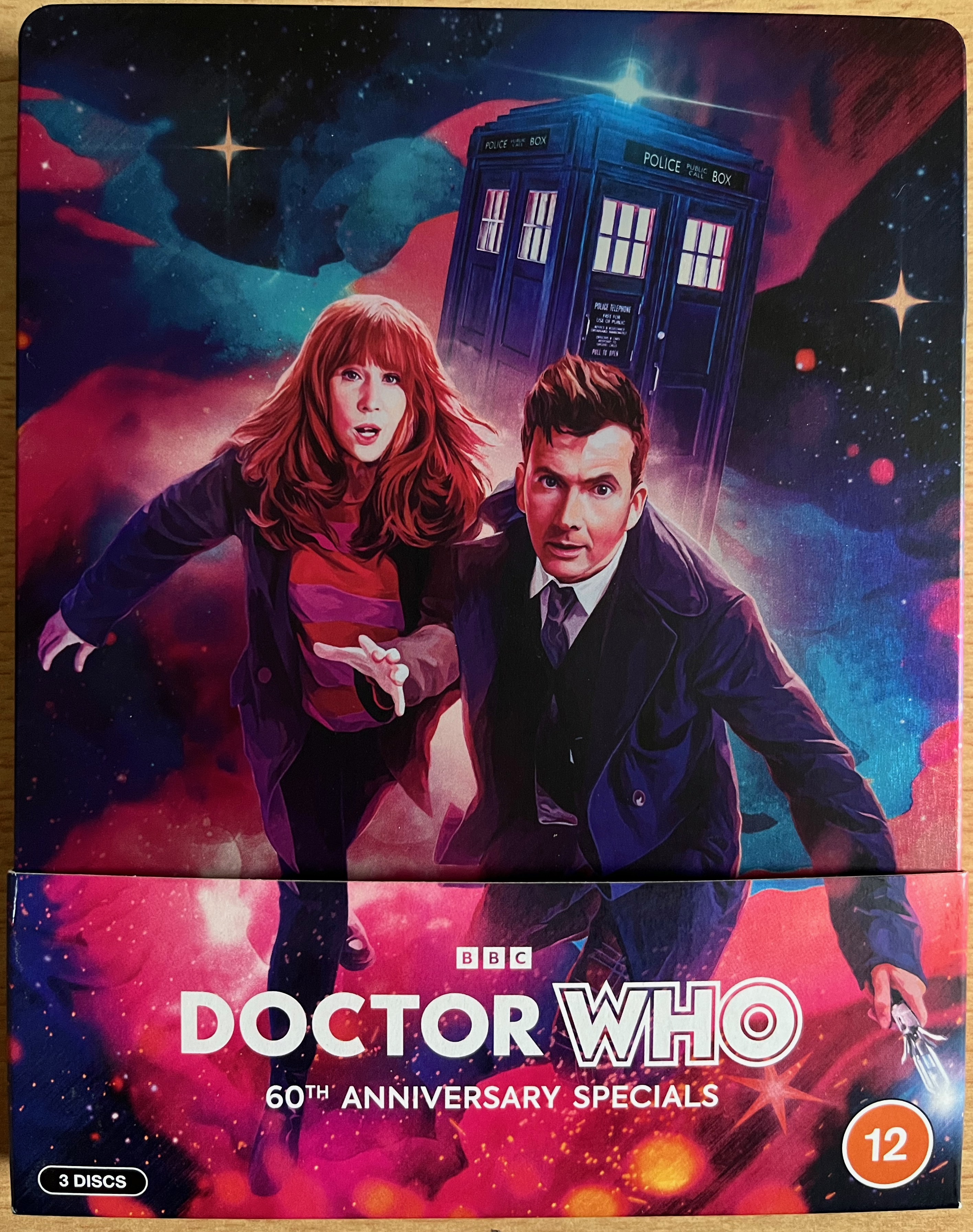
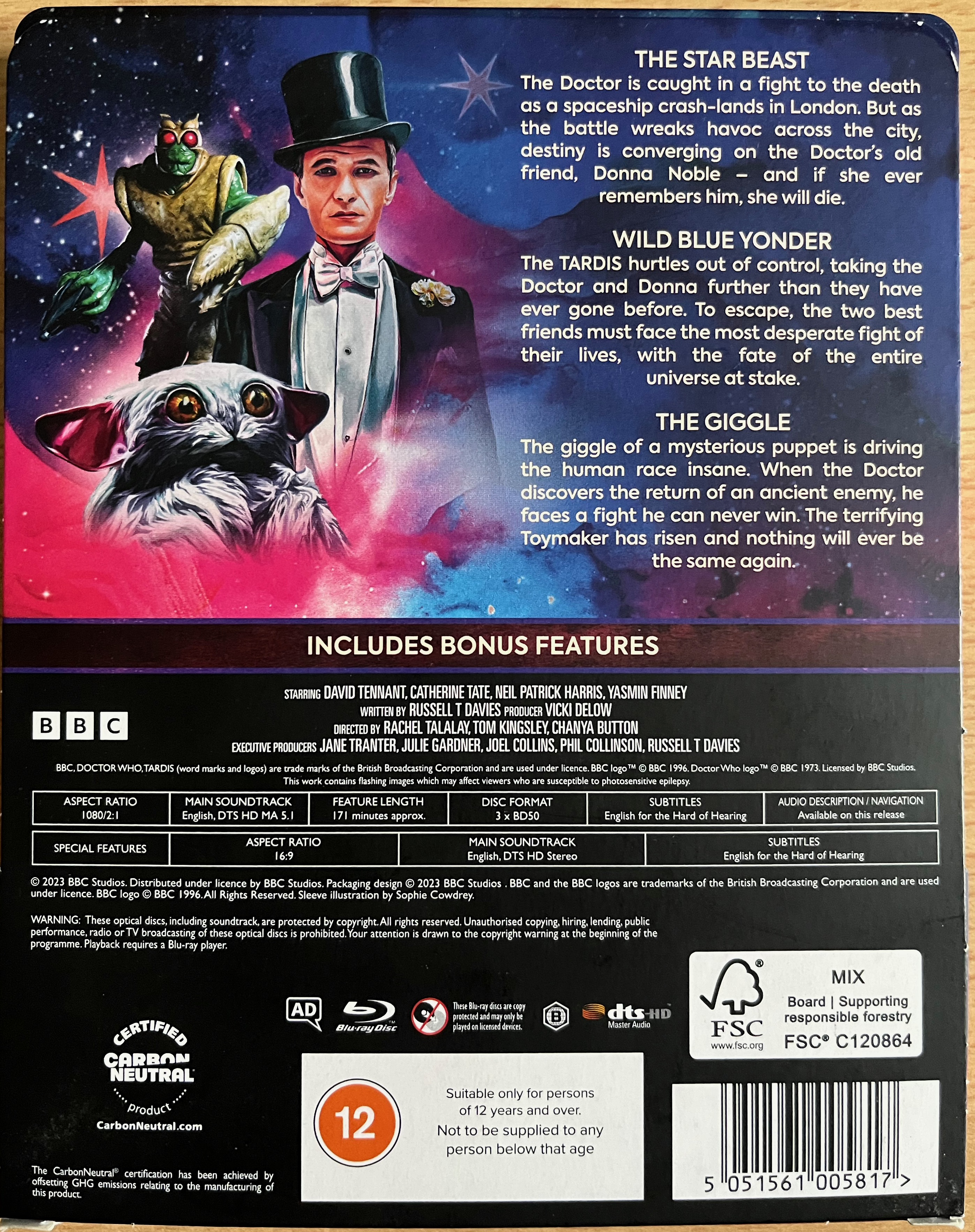
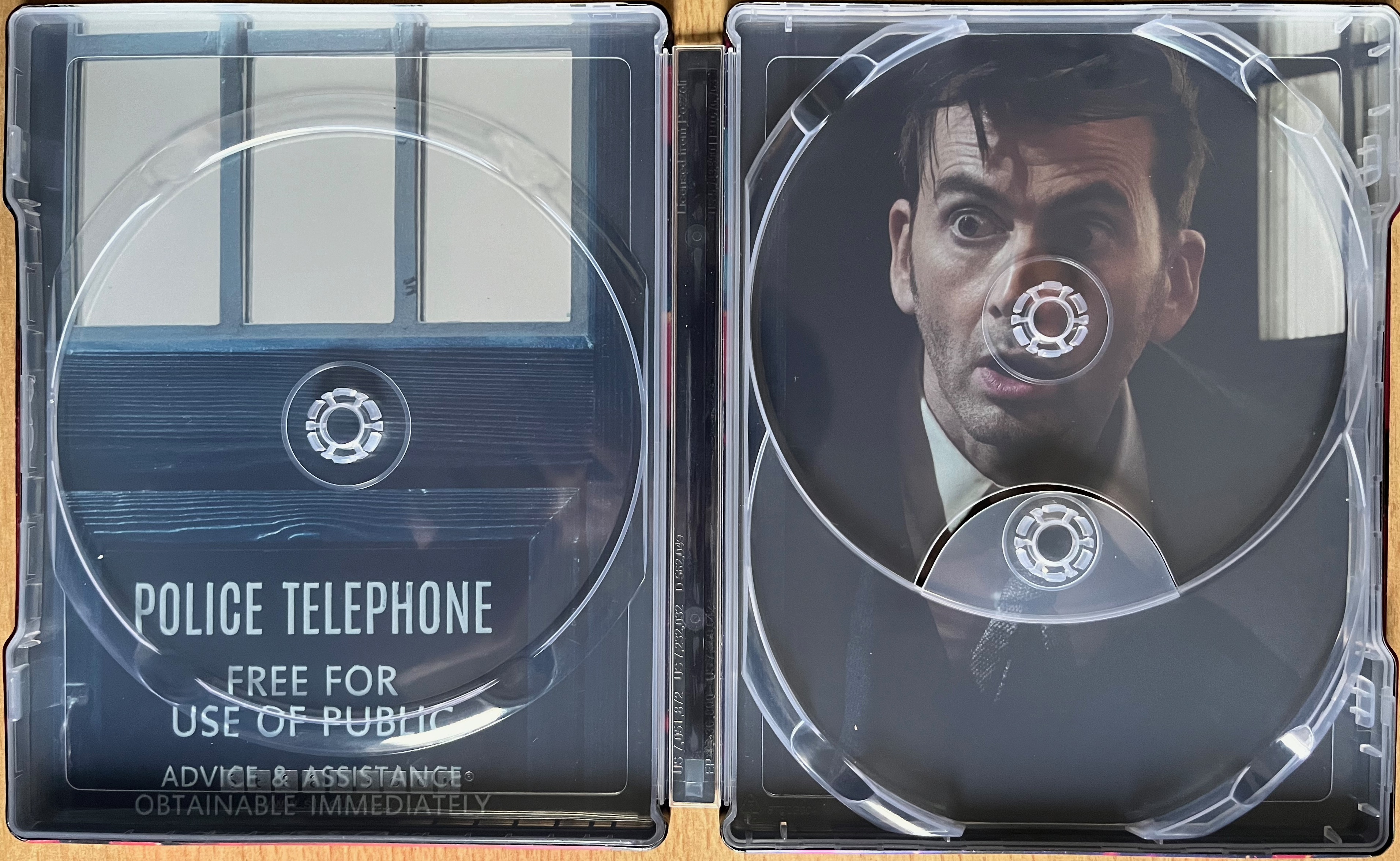
Inside the steelbook are 3 Blu-ray discs, each containing one of the specials with its related extra features. These extras aren’t listed on the outer cardboard sleeve, and there’s no flyer inside telling you the contents of each disc either, which there used to be for previous series. But the unique artwork and titles for each disc make it clear which specials they contain.
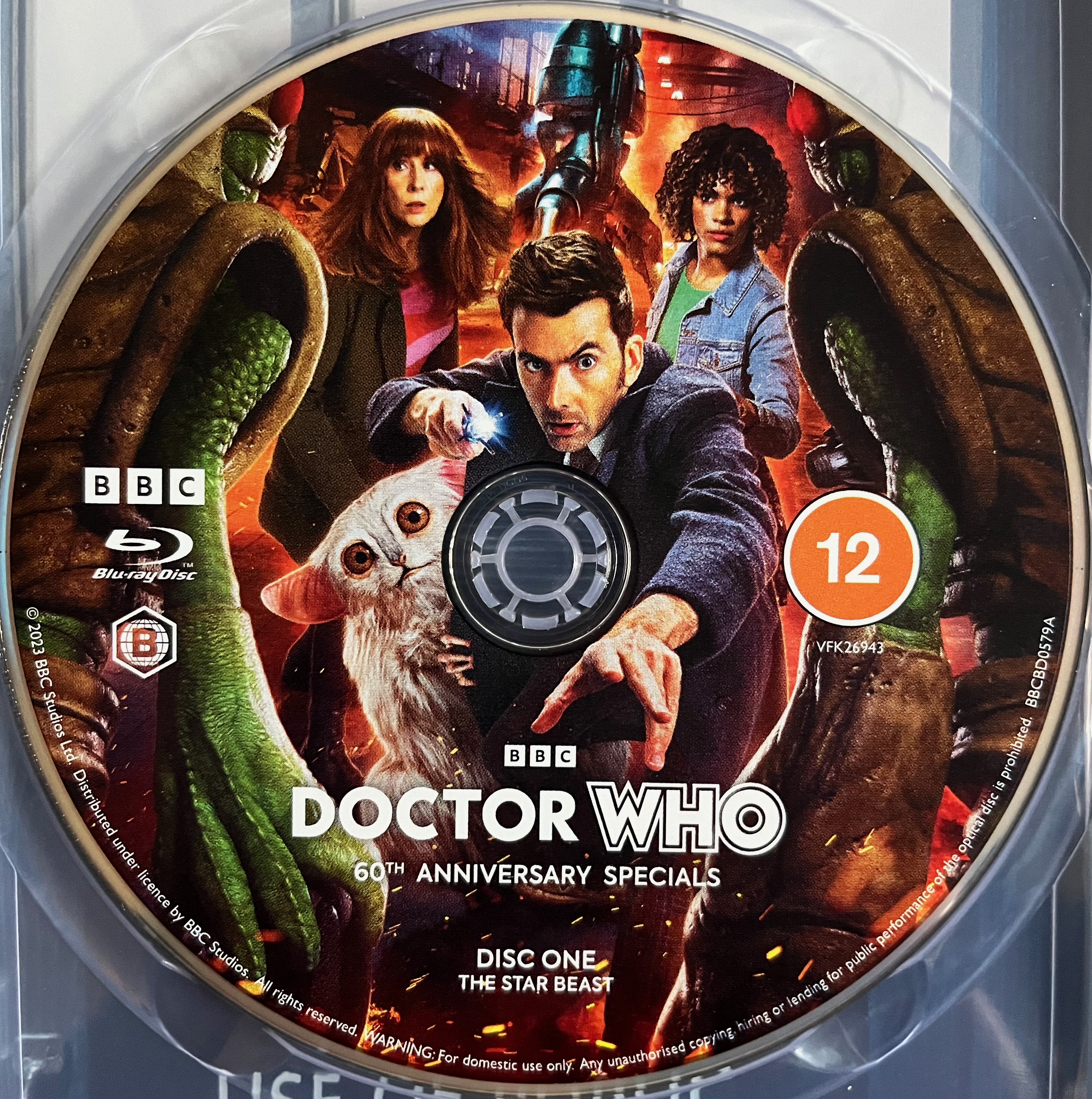
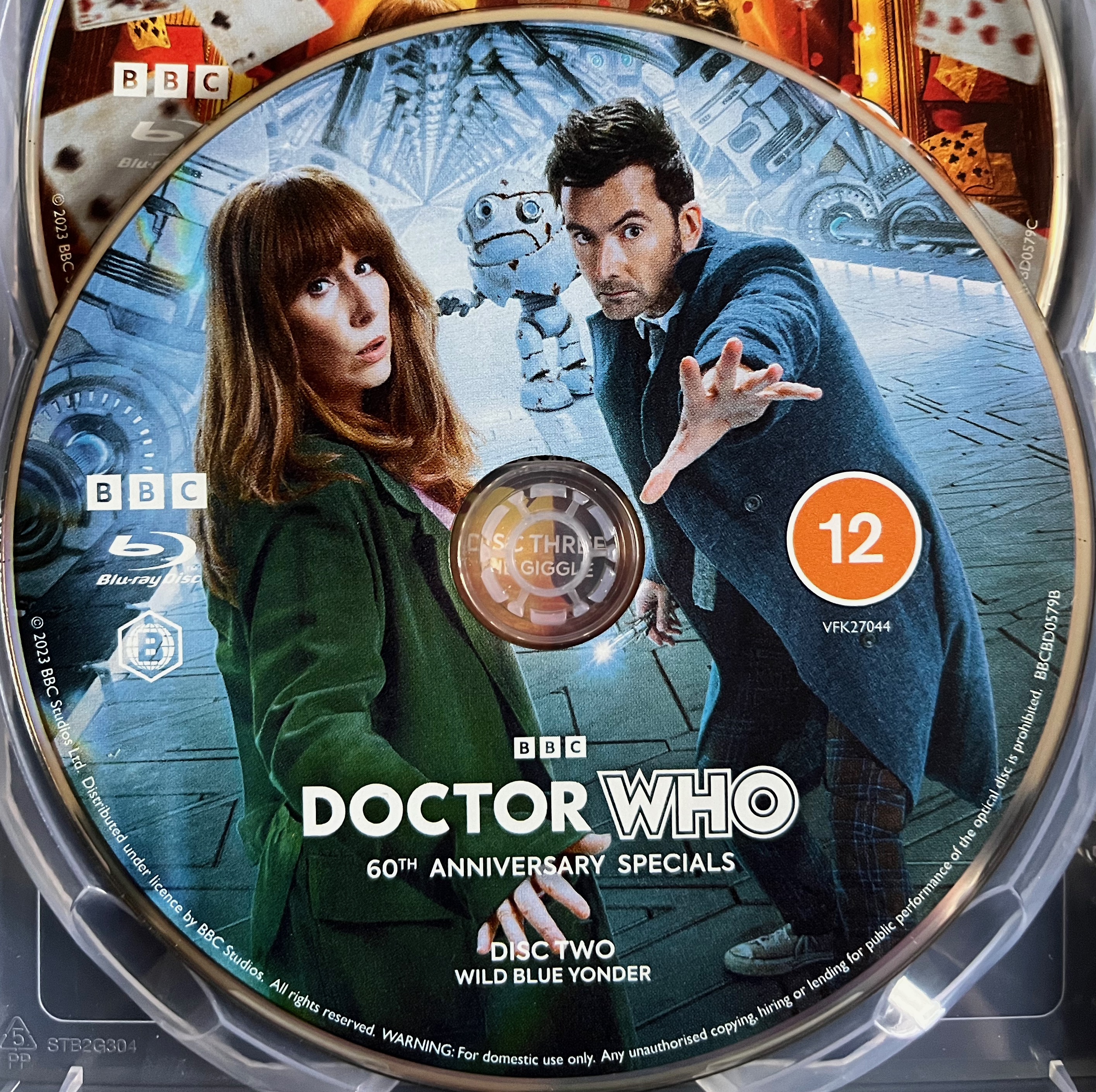
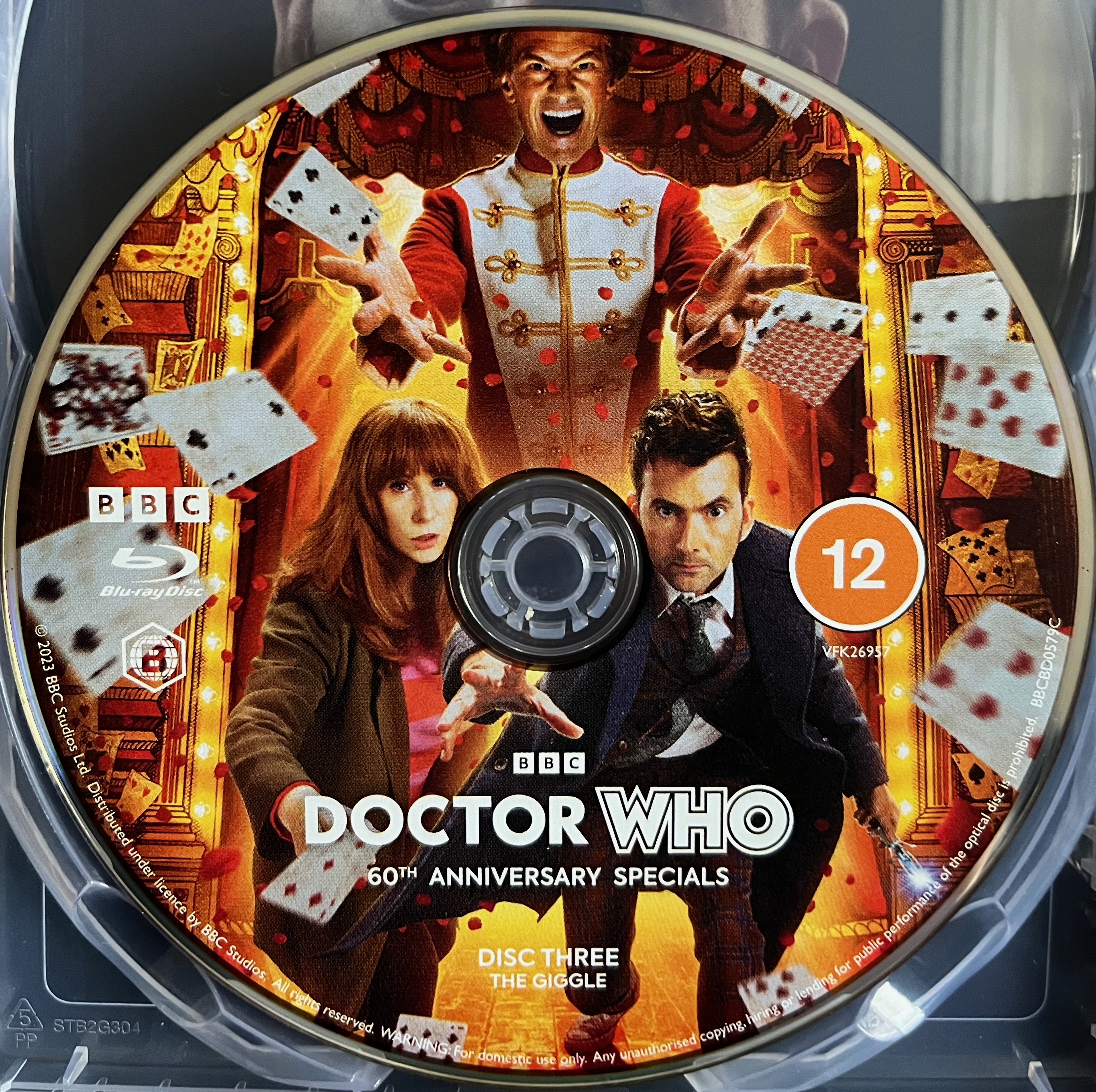
The main menu on each disc uses the same artwork as on the front cover of the steelbook, with a little bit of subtle background animation and the theme tune playing. And apart from the Play link, which does what you’d expect, the other options across the bottom launch separate screens with their own imagery rather than summoning pop-up menus. You can see the extras menus later in this post.

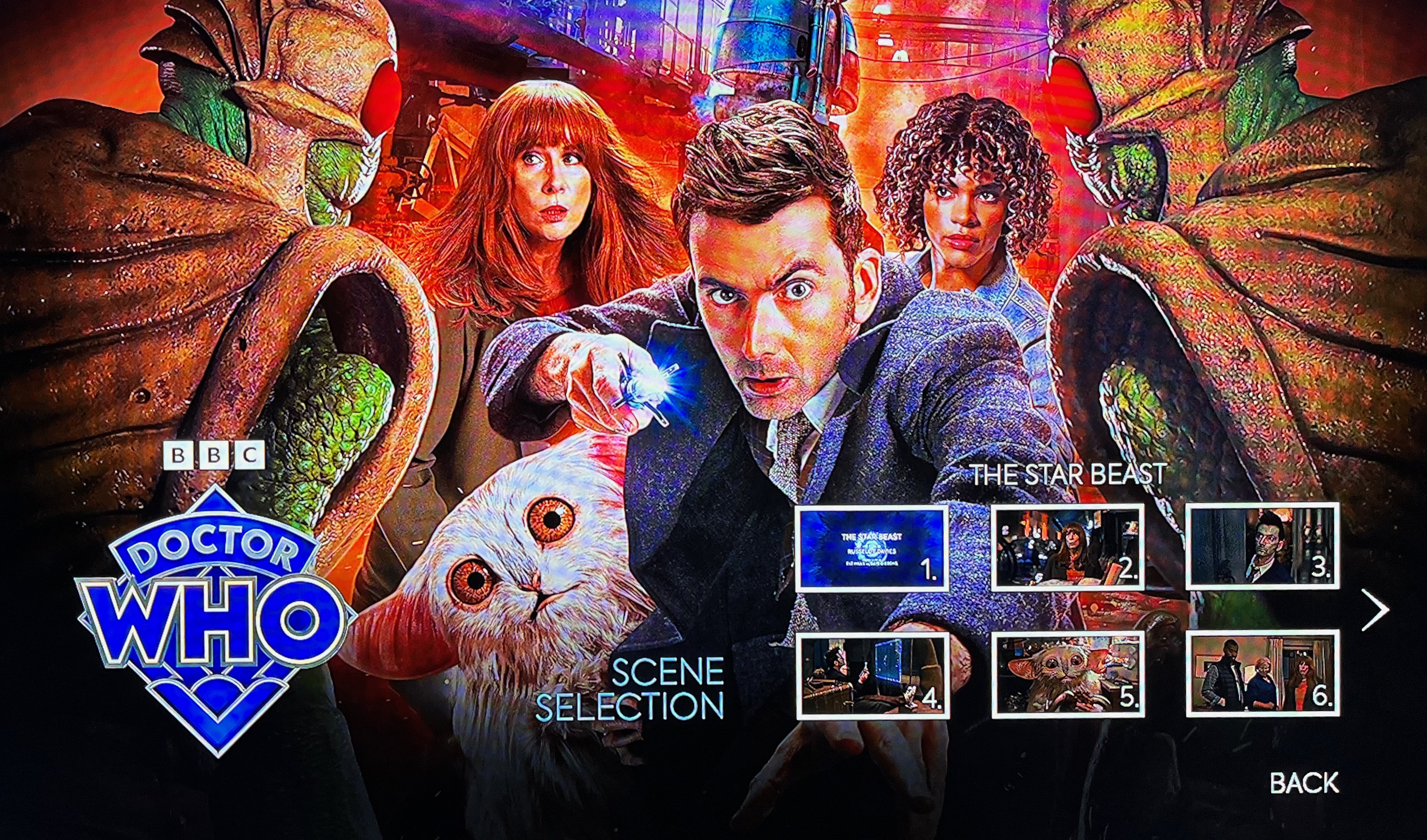


It looks nice enough, but I do miss the more fully animated menus from older series. For the Series 1, 2, 3 & 4 releases, for instance, there were nice animations set inside the Tardis, and given the sheer scale and capabilities of the new model, that could have looked very exciting here. Perhaps there could have been a fly-through that takes you around the console and along the gangways, with the lights on the walls changing colour. Or if the Main Menu remains centred around the console, the Special Features menu could have taken you along a gangway to one of the new interior doors, revealing the secret options behind it. Or on the menus we have been given here, they could have had the Tardis flying around in the background, a bit like it does in the opening titles. There are lots of possibilities, that’s all I’m saying, and it just feels like a missed opportunity to have a bit of fun with it and give a little nod back to the menus from Russell’s earlier series, given the big milestone and increased budget. Still, all that said, the menus are nicely colourful and functional as they are, so it’s not a problem by any means.
Audio Navigation
The discs also offer audio versions of the menus and audio description (AD) for the episodes, which is fantastic for visually impaired viewers. These accessibility features have been a standard part of the Blu-rays for New Who since Series 6 (with Series 1-4 since getting AD in the recent box set), and AD was available on all the old DVD releases (along with audio navigation from Series 2).
It works pretty simply, with very large bold text on each of the screens that have audio prompts, over a blurred background of the Doctor standing next to the Tardis. Firstly, there’s an announcement when the disc loads, to tell you what it is. Then later, just before the regular menu loads, a voice prompt invites you to press Enter on your remote for the audio navigation. If you do so, it instructs you to use the arrow keys and press Enter for each option you want, before taking you to the main menu, from where you can play the episode or go into the sub-menus.
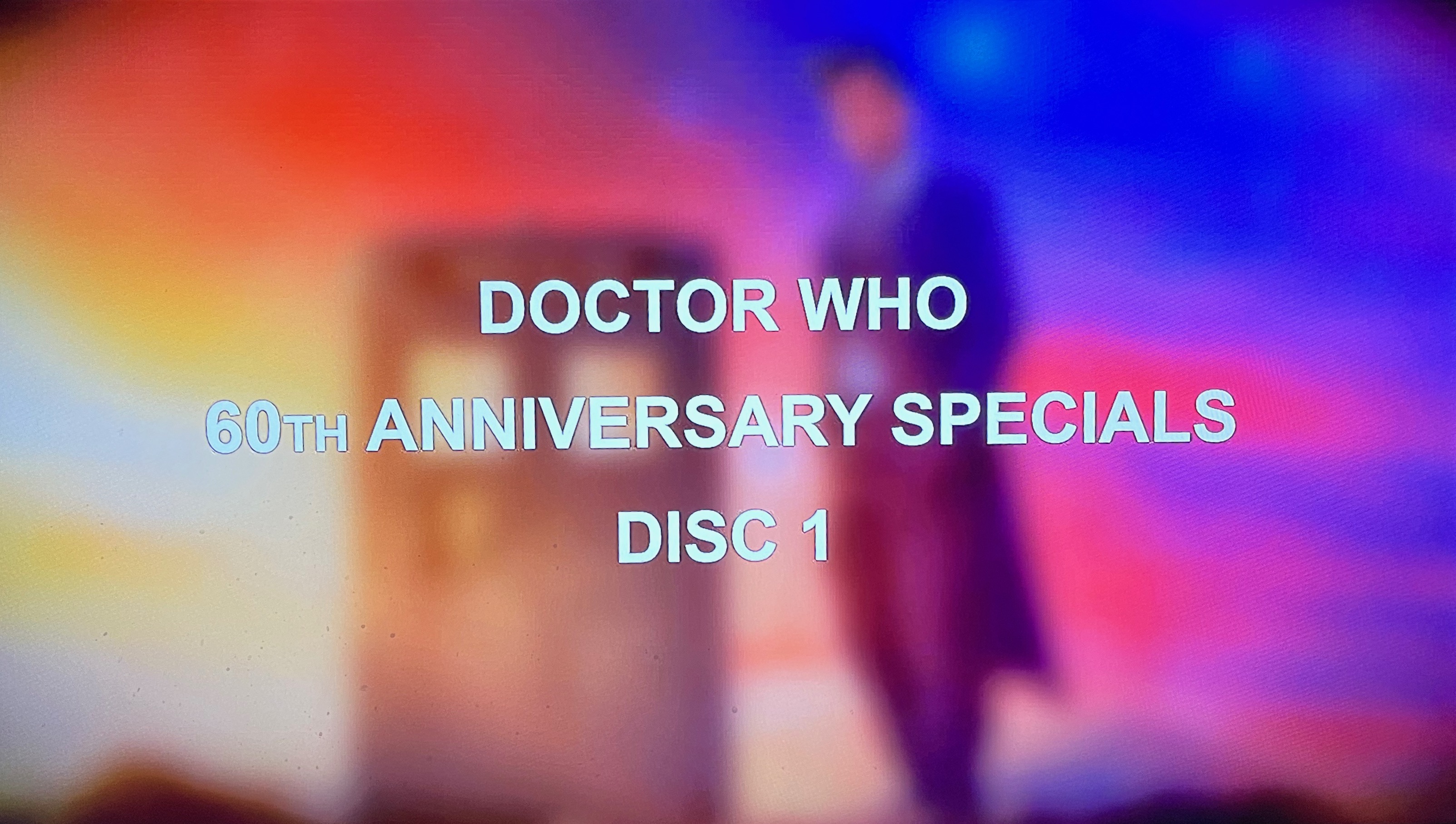
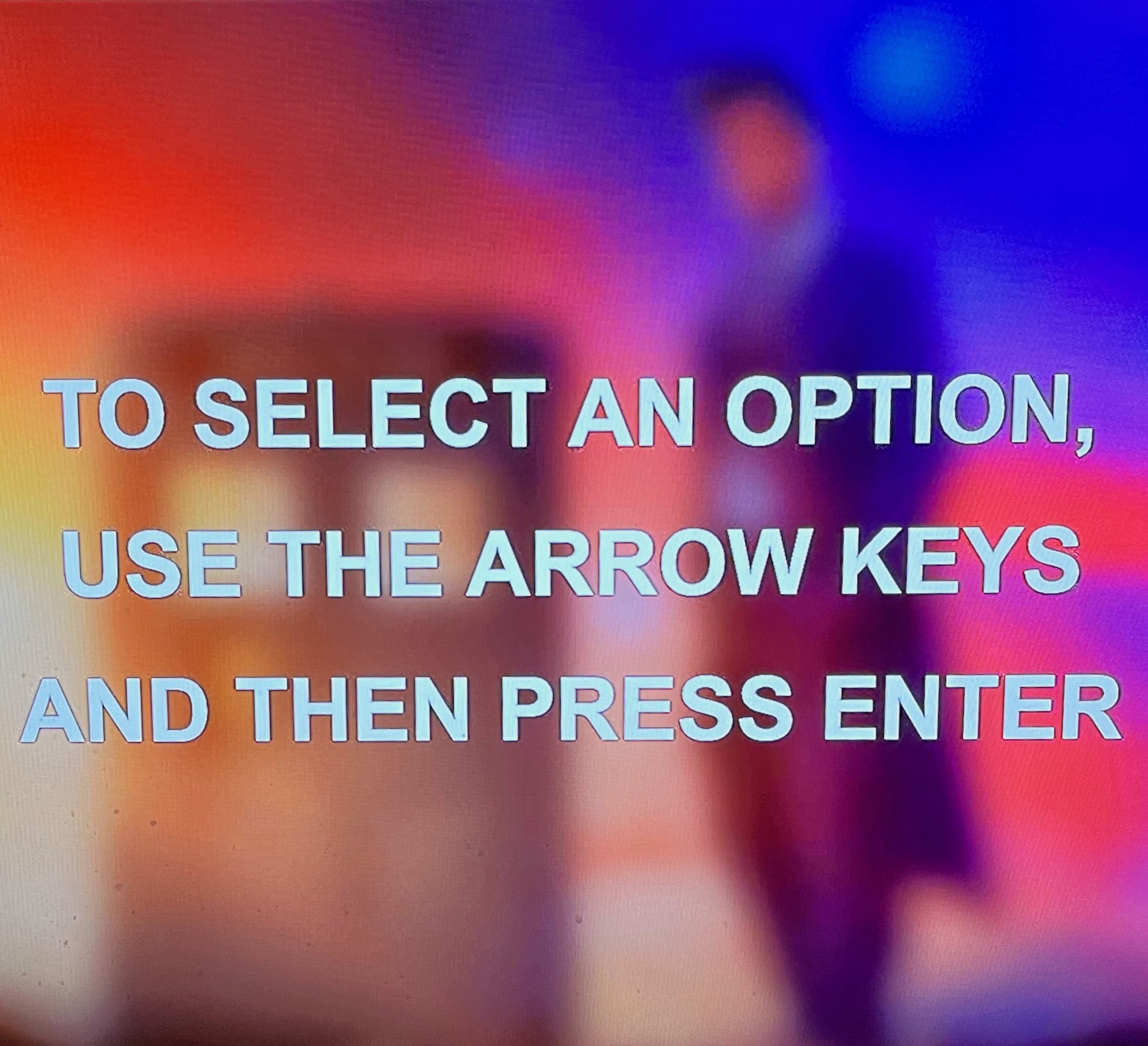
Each menu begins with a quick mention of its title and how many options it contains, and then you can move up and down to hear each of the choices you have available. It’s very useful, although some of the options are generic rather than explicitly stated – i.e. when looking through the bonus material, the voiceover lady calls the options “Special Feature 1”, “Special Feature 2”, etc, despite the actual title of each feature appearing on screen, which is a pity. There’s no Scene Selection menu within the audio navigation area, but you can easily use the forward and back buttons on your remote to skip through the episode anyway.
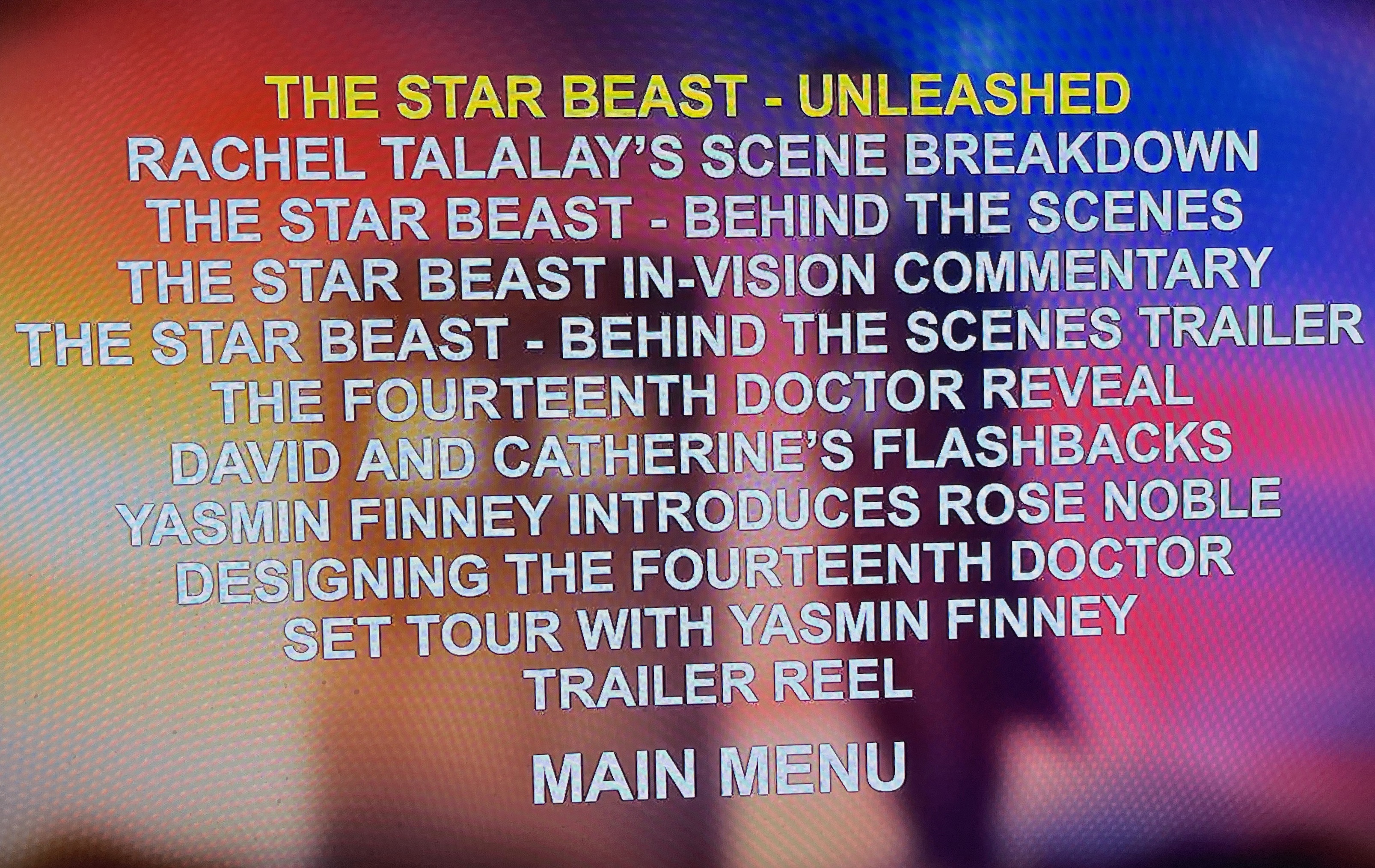
The Blu-ray also contains English subtitles. And in the Whoniverse on iPlayer, the episodes from the Classic and New eras have audio description, subtitles and sign language available. The spin-offs and extra features on iPlayer also have subtitles, and in some cases they even have audio description and/or sign language too. So it’s amazing that the BBC have put in so much effort to make the world of Doctor Who accessible.
Products Booklet
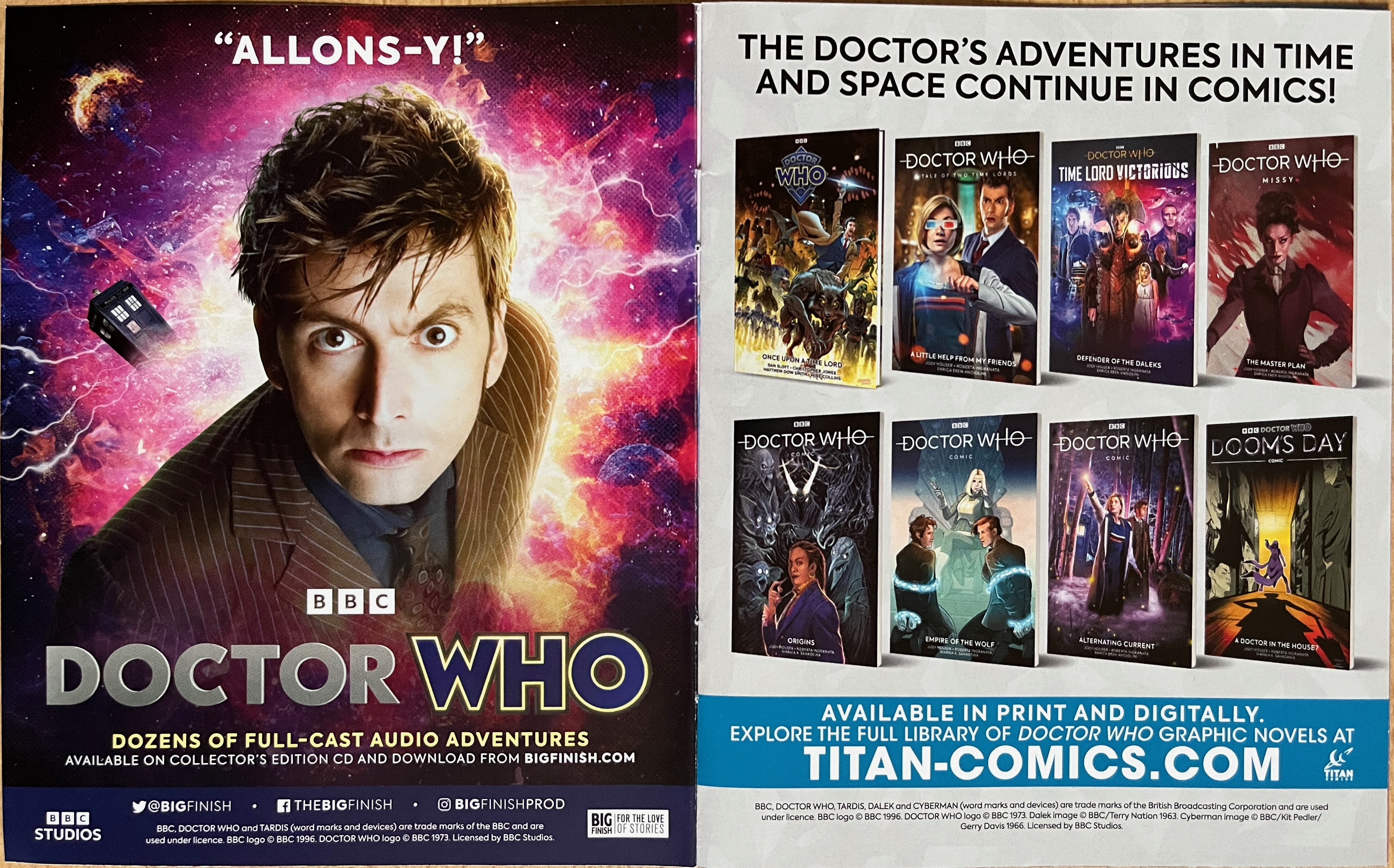
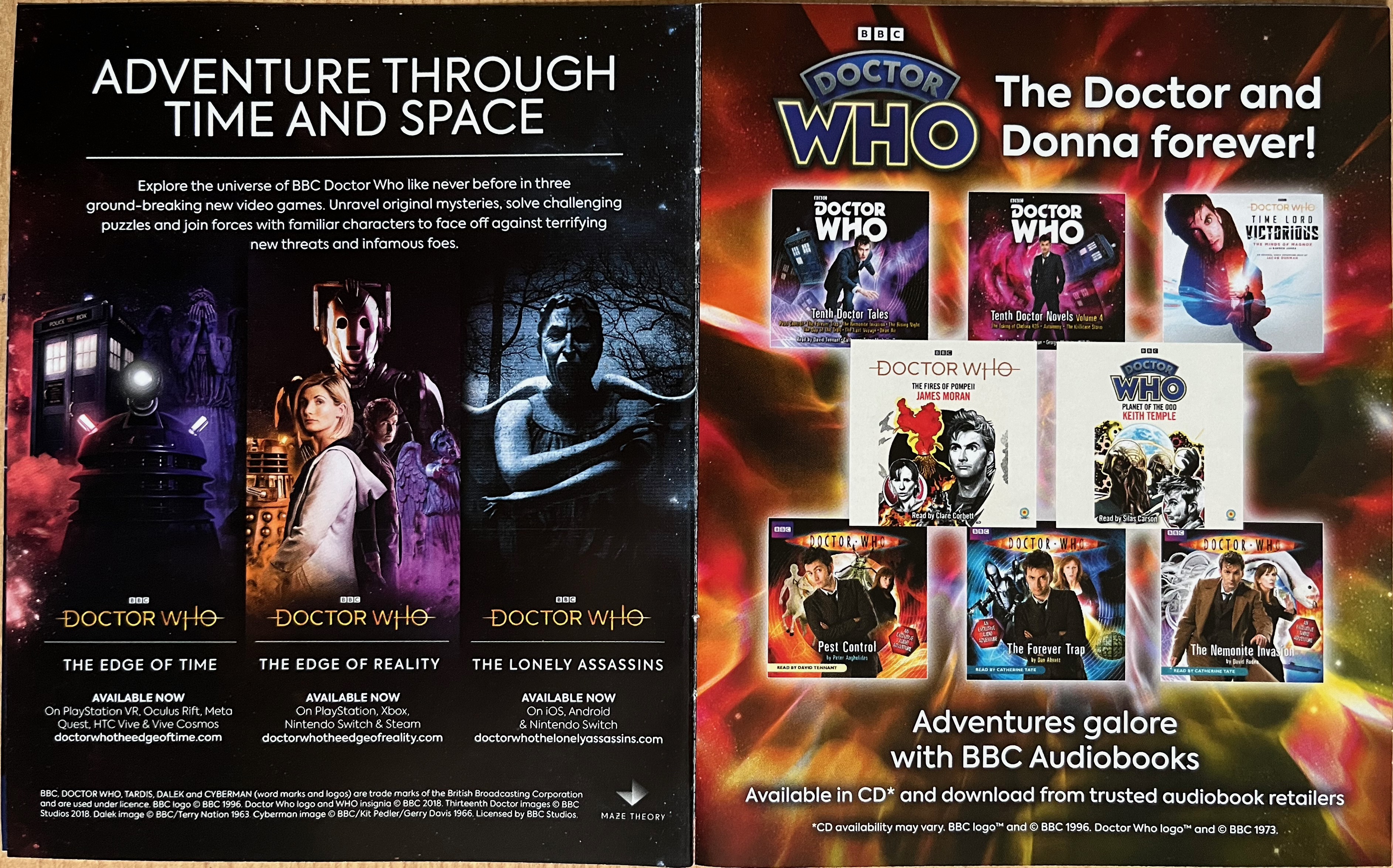
Finally, there’s a small booklet inside the set, advertising a range of Doctor Who products:
- Audiobooks, including full-cast adventures from Big Finish, the Doctor & Donna in a collection of BBC titles, the Decades Collection of novels covering the 1960s-1980s & 1990s-2010s, and vinyl LPs from Demon Music Group.
- Graphic novels from Titan Comics.
- Computer games, including VR title The Edge Of Time, its platform equivalent The Edge Of Reality, and mystery game The Lonely Assassins (based on the episode Blink).
- A huge book celebrating the 60th anniversary called Whotopia: The Ultimate Guide To The Whoniverse.
- The live escape game A Dalek Awakens.
- The regularly published Doctor Who Magazine.
- A limited edition set of Tardis enamel pin badges from Forbidden Planet.
I’m not personally interested in buying any of those at the moment, although one day I do hope to find time to dig into the vast world of the audiobooks. But it’s great that there’s so much choice out there for fans of all tastes, and of course this booklet is only lightly scratching the surface when it comes to the vast array of merchandise that exists.
Episodes
1. The Star Beast
- Writer – Russell T Davies (based on a comic strip story originally published in Doctor Who Magazine by Pat Mills & Dave Gibbons)
- First Broadcast – 25 November 2023
- Links – BBC / Wikipedia / Tardis Wiki
- Target Novelisation by Gary Russell – Ebook / Paperback / Audiobook (read by Jacqueline King)
Wow, talk about making an entrance! I did wonder if the show would spend some time re-establishing who The Doctor and Donna were to bring new viewers up to speed, a bit like they had to do (and did very well) with the first episode of the 2005 reboot. But, as usual, Russell credits the viewers with more intelligence than that, and doesn’t want to waste the time of existing fans who know everything already. And even people who don’t know anything about Doctor Who will grasp at least some of the basics easily from these specials. It’s very likely that the early episodes of Ncuti’s run will more fully explain who the Doctor is anyway, as he introduces himself and his lifestyle to his new companion.
So we just get a short recap of Donna’s metacrisis at the top of the episode, to remind people (and warn newcomers) that her mind will burn up and kill her if she remembers the Doctor (and there’s a bit of exposition from him later on to further assert the importance of this plot point). Then we’re thrown straight into the glorious, massive, bright and colourful, effects-laden title sequence, with a nice new logo too. It’s accompanied by a brilliant update of the theme tune by Murray Gold, which is a busy bit of music with all sorts of little details in the mix that nod to the show’s history. We get to hear a longer version during the minute-long credits of each episode as well, including the middle eight. So it all looks and sounds very modern and suitably epic. Old motifs like The Doctor’s Theme are also recognisable in the score during the specials, as a nod back to earlier series. Hopefully there will be a soundtrack album for the specials in due course, as the music really is fabulous.
There’s no hanging around after that either, as the Doctor immediately meets Donna with an amusing scene between them, there’s a reference to Rose that isn’t what the Doctor expects it to be, a spaceship crashes on London, and the Doctor discovers his psychic paper hasn’t caught up with his gender change when he gets into a taxi with Donna’s husband Shaun (Karl Collins). That’s all just within one short scene, and from there the pace doesn’t drop, as the Doctor joins up with UNIT to investigate the crash, while Donna and her family discover a cute little alien called the Meep.
The Doctor then finds himself at Donna’s house anyway – much to the fury of Donna’s mother, who is desperately trying to convince Donna that all of this isn’t real for her own protection – and he has to save the family from the Wrarth Warriors that are after the Meep, in the midst of the biggest shoot-out the show has ever staged. And during that scene we discover that the new sonic screwdriver has added yet another string to its vast bow, with the ability to draw shielding screens in mid-air. It then transpires that the Meep – voiced marvellously by Miriam Margolyes – isn’t the innocent little creature it was pretending to be, and instead it’s quite happy to destroy London by burning it up as fuel for its spaceship, and so the Doctor has to find a way to stop it.
Throughout all of that, we’re introduced to two new characters who illustrate the show’s commitment to greater representation, with Yasmin Finney, a black transgender woman, as Donna’s non-binary daughter Rose Noble, and Ruth Madeley, a wheelchair user with spina bifida, as UNIT’s scientific advisor Shirley Bingham (Ruth had also previously appeared in Russell’s series Years And Years). Both are excellent here, and they have important roles and capabilities that directly impact the story, so they’re not just there to tick boxes. Shirley is a great leader and has very cool weaponry built into her wheelchair, while Rose’s transgender identity is what enables her to save the day later on, and she’s also made toys that resemble enemies from Donna’s past.
The inclusion of both of those characters – along with Davros without his wheelchair in the Children In Need special and Ncuti Gatwa becoming the next Doctor – has predictably driven the ‘anti-woke’ brigade into a frenzy, who claim that the show is indoctrinating us to think in certain ways. But that’s nonsense borne out of ignorance, prejudice, paranoia and fear of change. The truth is that the show is simply playing catch-up, by recognising and reflecting how society has evolved over time, which it has always done in some form or other. The show has included transgender, disabled and black actors and characters before anyway, it’s just that now they’ve been given more opportunities to make significant contributions, putting them on an equal footing with every other member of the huge cast they’re part of. It’s an important message of reassurance and validation to viewers that everyone is welcome, and having more variety in the cast allows more variety in the stories as a consequence.
And besides, the show has always been about encouraging humans and other beings of all kinds, with all manner of different characteristics, to live together in peace, while demonstrating the pointlessly destructive consequences of those who actively try to prevent or destroy that harmony. It’s literally part of the show’s core foundations, conveying a simple message that it’s important to be respectful and kind to one another. So if that means the show is ‘woke’ now – whatever that uninventive, tiresomely over-used, bandwagon-jumping, attention-seeking buzzword is supposed to mean these days – then Doctor Who must have always been woke, and thus it can be rightly proud to be so.
But anyway, the most important moment in the episode is the restoration of the DoctorDonna. The Doctor is understandably angry and upset when he knows this is the only way to save London, and in the circumstances Donna accepts the inevitable sacrifice in order to save her daughter. Then there’s a very funny moment when her first reaction on regaining her memory is anger at giving away her lottery winnings because of him. It’s a prime example of how all of these specials incorporate a lot of humour alongside the action, making the whole thing feel fun, just like it was when they were together in Series 4. David Tennant and Catherine Tate can always switch between the most serious and comedic moments with impressive ease. Rose also becomes a key component of the metacrisis resolution that enables Donna to survive, with great incorporation of the binary reference, and it’s a nicely symbolic callback to Series 1 that a character called Rose saves the day in Russell T Davies’ first episode in his return as showrunner.
The other big reveal is the new interior of the Tardis, which has received an astonishing makeover. When David and Donna first enter, for a brief moment it looks a little bit plain and minimalist, but as the camera pulls back and the music swells, the sheer scale of it becomes apparent, being bigger than ever before, with the Doctor running up, down and around the gangways with infectious glee. There are also some doors leading off to other areas too. And we discover that the bright circles all over the walls, an obvious nod back to earlier designs, can all change colour independently of one another, enabling them to make all sorts of patterns, and Russell has hinted that they’ll get plenty of use during the series.
There’s also a brand-spanking new console with all sorts of new additions, including a coffee machine. Although, for all the self-remodelling capability, navigational intelligence, time-travelling expertise and heavily armoured defences that are among the Tardis’ many superior qualities, it seems remarkably allergic to its own coffee, when Donna accidentally throws some in the console and makes the Tardis blow up, which propels them into their next adventure. So all in all it’s a stunning episode to relaunch the series, and sets a high bar for everything to follow.
2. Wild Blue Yonder
- Writer – Russell T Davies
- First Broadcast – 2 December 2023
- Links – BBC / Wikipedia / Tardis Wiki
- Target Novelisation by Mark Morris – Ebook / Paperback / Audiobook (read by Bonnie Langford)
In relative terms this is the weakest of the three specials, but it’s still very good, as it’s quite tense and visually impressive. It also enables the focus to be purely on the Doctor and Donna having an adventure together by themselves for the first time in ages, which is nice.
After a brief meeting with Isaac Newton (played by Nathaniel Curtis), resulting in “gravity” being renamed “mavity” when he mishears them (which comes up again in the Christmas special), the Doctor and Donna end up on a spaceship, where the Tardis plays the Wild Blue Yonder song used by the US Air Force before abruptly abandoning them, taking the Doctor’s sonic screwdriver with it, while it goes off to a place it deems safer to repair itself.
[June 2024 Update: With the benefit of hindsight, we now know there’s more going on in these early scenes than was apparent on first viewing. Firstly, the maid accompanying Isaac Newton is played by a lady called Susan Twist, which at the time is believed to be just a cameo. And secondly, the Tardis makes an ominous groaning sound before it disappears, which the Doctor observes with concern as being unusual, yet we assume that it’s just suffering from the damage and is fearful of the present danger. However, both Susan and the groans keep appearing in Season 1, with a very particular reason…]
So the Doctor and Donna are left alone to explore the seemingly empty craft – and I find Donna’s “kick its arse” line very funny as they set off to do this – with the endless corridor and the huge exterior being spectacular CGI environments. They discover that they’re at the very edge of the universe, where there’s nothing visible outside, not even stars, as they’re too far out for any light to have reached them.
They also learn that they’re not alone, as they encounter shape-shifting entities who become increasingly accurate clones of them, in terms of both their bodies and their minds. It takes the aliens a while to learn how to copy the human form accurately though, resulting in amusing anomalies like extra long limbs and jaws, and they even turn into giants that chase the real Doctor and Donna.
But these “Not-Things”, as the term themselves, become increasingly dangerous as the copies become more accurate, as they know exactly what the Doctor and Donna are thinking and can see their memories. So without the Tardis or his sonic screwdriver, and because they can read his mind, it’s certainly quite a challenge for the Doctor. And there are occasions where the Not-Things fool the real Doctor and Donna into thinking that the duplicate of their friend is the real deal. The Doctor, for instance, is forced to talk about the consequences of the Flux from Jodie Whittaker’s final series, which is a nice bit of continuation. And he almost takes the wrong Donna at the end when the Tardis returns, but of course he realises just in time.
There’s also a moment where the Doctor spreads a line of salt between our heroes and their clones, leaving the Not-Things unsure whether to cross it or count the grains. They eventually figure out it’s a trick and blow the salt away, but the Doctor is later uneasy that he invoked a superstition at the very edge of the universe, where the walls are thin and anything is possible.
Then at the very end, when the Doctor and Donna return to Earth, we get the last ever scene featuring the dearly missed Bernard Cribbins as Donna’s grandfather Wilfred Mott. It’s such a delight to see him one final time, and also very poignant, and a dedication is included to him at the end of the credits. It’s quite the cliffhanger he pulls them into as well, as the world around them descends into chaos. Little does the Doctor realise that laying that line of salt earlier has allowed someone to cross back into this universe from the void beyond…
3. The Giggle
- Writer – Russell T Davies
- First Broadcast – 9 December 2023
- Links – BBC / Wikipedia / Tardis Wiki
- Target Novelisation by James Goss – EBook / Paperback / Audiobook (read by Dan Starkey)
Unsurprisingly they’ve saved the best until last, with the most epic of all the specials that brings back a crazy villain, a former companion and a key member of UNIT, incorporates a ton of references to past Doctors and adventures for fans to recognise, gives David Tennant’s Doctor the happy ending that he’s long deserved, and introduces the next Doctor in a very cool and unexpected way.
Their foe this time is the Toymaker, played superbly by Neil Patrick Harris (who had been in Russell’s drama series It’s A Sin), who loves to play bizarre games with his victims, and is able to do whatever he likes with them if they lose. The character was first introduced in the third season of the Classic era, in a story called The Celestial Toymaker that I’ve never seen, but you don’t need to be familiar with that to understand what’s happening. Well, I say ‘understand’… nobody, not even the Doctor, comprehends how he does what he does, because he’s from outside the known universe – accidentally allowed back in to our reality by the Doctor’s laying of salt in the previous episode – and thus he can do things that betray the laws of logic and science.
On this occasion, he’s managed to invade and influence the minds of the human race through our obsession with screen-based devices. Starting with the invention of television by John Logie Baird (played by John Mackay) and his freaky-looking Stooky Bill doll, the Toymaker ensures that the doll’s laugh is secretly embedded into every signal on every screen that people watch in the years ahead, including TVs, computers, mobile phones, etc. And in the present day he finally activates the signal in people’s heads to start a new game, where every single person thinks they’re right and violently attacks anyone who disagrees (a clear reference to the behaviour of some groups of people in the real world). So the entire human race goes to war against itself, causing death and destruction on the streets.
Fortunately UNIT – who have a beautiful skyscraper in the centre of London – have found a way to shield themselves from the brain spikes that cause this behaviour, so the Doctor is able to work with them to try and establish what’s going on. It’s here that we’re reintroduced to Kate Lethbridge-Stewart (Jemma Redgrave), who I’m very pleased to see again, and the Doctor’s old companion Melanie Bush (Bonnie Langford), whose previous adventures I’m not familiar with but she’s a lovely character. The Doctor and Donna then discover the Toymaker is behind everything when they return to Soho in 1925 and he traps them in a maze of corridors, causing great concern to the Doctor who knows how difficult it will be to defeat him.
Then, after the Toymaker reminds the Doctor of the fates of his post-Donna companions and the consequences of The Flux, the Doctor challenges him to a game, which ultimately takes them back to the present day, where the Toymaker assaults and kills some of the staff in UNIT HQ while dancing around to the tune of Spice Up Your Life by The Spice Girls. It’s a really fun scene that reminds me of the Master taunting the Doctor while accompanied by pop songs, such as in the Series 3 finale and last year’s special The Power Of The Doctor. Indeed, we learn here that the Master lost a game and became trapped in the Toymaker’s gold tooth, and once the Toymaker is defeated a hand picks up that tooth and takes it away, again a callback to the Master’s Series 3 defeat and his later restoration for the 10th Doctor’s finale.
[June 2024 Update: During the Toymaker’s game with the Doctor before they return to the present day, the Toymaker remarks that there’s only one player he dare not face – “the one who waits” – because he saw it hiding and ran. We find out who he means in the Season 1 finale, and also what Mel means back in UNIT when she tells Donna they’re using Triad software, which seems to be an innocuous and forgettable comment at the time.]
But of course, the whole story is building up to the Doctor’s regeneration – or, specifically, the first ever instance of a bi-generation, where 15th Doctor Ncuti Gatwa splits away from the 14th Doctor – with even their costume splitting in two so each is only half-dressed!. They then work together to beat the Toymaker, before Fourteen goes to live with Donna and her family while Fifteen goes off in a copy of the Tardis (which now has a wheelchair-accessible door ramp!) to have new adventures.
It’s caused some debate as to what it all means, but I like what they’ve done here and I feel it makes sense. Given some of the dialogue in the episode, I personally buy into the most widespread theory that it’s a time loop, with the 14th Doctor’s regeneration happening in two stages. It’s not normally supposed to happen that way, but as his death is triggered during a game with the Toymaker, whose domain bends or ignores the rules of our reality, it means this particular regeneration is able to venture into hitherto mythical territory as a consequence.
The 14th Doctor is basically taking the opportunity to go into retirement and rehab with a supportive family he loves, including his close companions Donna and Melanie. This will allow him to relax and process all of the traumatic experiences he’s avoided dealing with for so long, and to just have fun and be happy. He will then regenerate properly, many years down the line, by which time he’ll be feeling more relaxed and no longer burdened by emotional baggage. At that point his regeneration energy will ripple back down the time stream to the moment with the Toymaker, completing the loop and transforming him into the 15th Doctor in the other half of the bi-generation. This new Doctor then persuades his former incarnation to go into that period of rehabilitation, because he knows in hindsight that it works wonders.
So it’s effectively resetting the character’s emotional state for the new era ahead. It’s not wiping out the past or changing the canon, and there will continue to be references to past characters and adventures as the series continues. But just as the show is feeling very much refreshed, so is the Doctor himself, and this seems like a good time to do it as we enter a new era.
And what a wonderful new Doctor we appear to have. I had never heard of Ncuti Gatwa when he was first announced, I’ve never seen any of his previous shows, and I deliberately avoided watching any clips or interviews with him prior to watching this special, so I had no idea what the actor was like or what his Doctor would be like. And if you’re having to convince the audience that you’re right for the role alongside David Tennant, perceived by millions as one of the best Doctors of all time, that’s more than a little amount of pressure to have on one’s shoulders!
But he smashes it out of the park, making it look effortless. He’s so engaging with his joyful and fun demeanour, his youthful energy, his love and respect for everyone around him, and the fantastically energetic theme that Murray Gold has written for him. He really feels like a Doctor for the modern age, one that the younger generation can firmly get behind, and they’re exactly who we need to bring into the show.
And I love the farewell scene where the new Doctor orders his former self and Donna out of the Tardis, and then Fourteen & Fifteen salute one another, as you never normally get to see a proper handover from one Doctor to the next. It clearly shows there’s a lot of love and respect between the two actors as well as the Doctors they portray.
So it all bodes very well for the future (and history, depending on when and where he travels to). And just a couple of weeks after that bi-generation, we got to experience a full episode with Ncuti in the Christmas special, but I’ll talk about that as part of my review of Ncuti’s first full series later in 2024. Suffice to say that it’s a silly but fun story that acts as a good on-ramp for newbies, more so than the anniversary specials perhaps, as they can be introduced to the Doctor through the eyes of the new companion. And the short teaser trailer for the next series looks very exciting, so it should be a lot of fun. Still got 5 months to wait and find out though!
Extras
Blu-ray Extras
The Blu-ray set has a decent selection of bonus features, with 2 hour-long commentaries plus nearly 3 hours of other material, some of which is also available on iPlayer or the Doctor Who Youtube channel. Each disc contains a single special with its associated extras, which keeps everything nicely organised.
Sadly there are no compilations of deleted scenes or outtakes, and no video diary by David Tennant, plus they’ve omitted things like the Children In Need special and the CBeebies Bedtime Story (which I’ll therefore write about in my later post about the online Whoniverse). But what we do get is still pretty good for the most part.
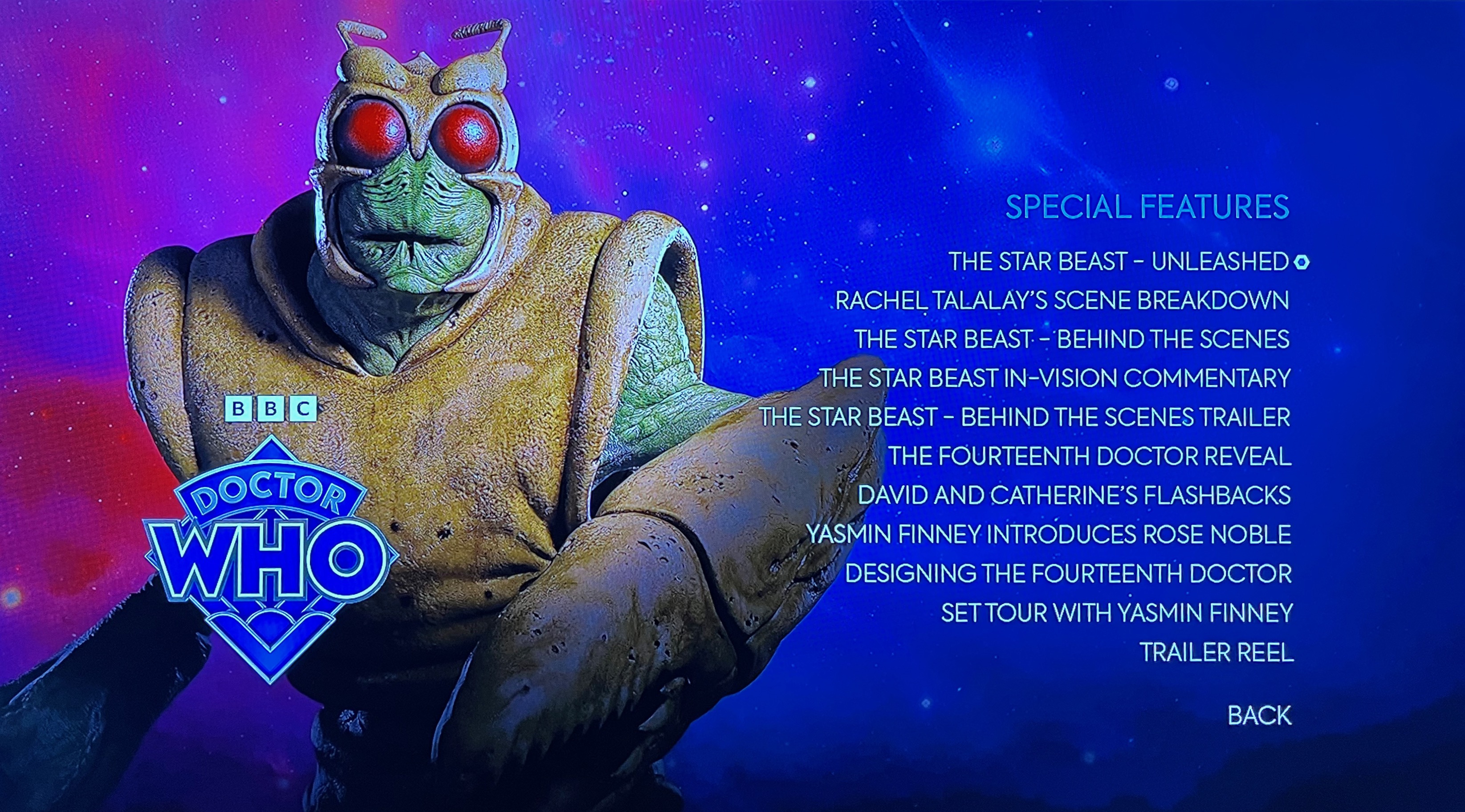


- Video Commentaries – Two of the episodes on the Blu-ray have in-vision commentaries, also available on BBC iPlayer as part of the Whoniverse collection, where you can see the participants in the corner of the screen, and it’s great to hear their insights and thoughts. Both of them feature David Tennant and executive producer Phil Collinson, who are joined by producer Vicki Delow for The Star Beast and showrunner Russell T Davies for The Giggle. There had been a few in-vision commentaries on the old DVDs for Matt Smith’s era, but they were converted to audio for his Blu-ray sets, so this is the first time we’ve had visual commentaries on the Doctor Who Blu-rays.
- Doctor Who Unleashed – At long last we get a dedicated series of behind the scenes episodes again, like we did with Confidential in the old days. They’re good fun and very interesting, featuring lots of making-of material and interviews. And we even get the full half-hour editions in this Blu-ray set, not cut-down versions like we used to get for Confidential. The series is hosted by Steffan Powell, who gets to have a bit of work experience in each episode when he meets some of the unsung heroes in the crew. I also like the fact that there are clear spoiler alerts before they give previews of the next episode in case you want to avoid them. You can find all of the Unleashed episodes on BBC iPlayer, as well as the older episodes of Confidential.
- Behind The Scenes – These additional making-of features, lasting between 9 & 15 minutes each, cover a few aspects of each episode in more detail, so they’re worth watching as they don’t repeat things from Unleashed. They can also be found on Youtube, for The Star Beast, Wild Blue Yonder & The Giggle.
- Scene Breakdowns – These are also interesting little features, lasting between 4 & 6 minutes each, where the director of each episode talks us through the preparations and filming techniques used in some key scenes, namely the Doctor’s arrival in Camden (including a section deleted from the final edit), the complexities of filming the Not-Things with David & Catherine, and the bi-generation with David & Ncuti.
- David Tennant – There are some brief but nice extras featuring David, including the filming of his regeneration from Jodie (2½ minutes), the costume design for the 14th Doctor (1 minute), and a tour of the Tardis set (4 minutes). He also joins Catherine to flashback over their past adventures (4½ minutes), which is a nice little recap for new viewers, and there’s an amusing 30-second scene where the two of them chat whilst he’s wearing his oversized arms.
- Other Insights – Also on the discs and on Youtube are a 3-minute tour of Rose Noble’s shed (with actor Yasmin Finney & Assistant Set Decorator Verity Scott showing us Rose’s homemade toys and sketchbook), a 4-minute video diary by David Tennant’s stand-In (who helps the crew to set up shots in the green screen studio), and a 5-minute feature with Neil Patrick Harris about becoming the Toymaker (where we see his versatility in filming a variety of different scenes and hear how much he enjoyed being in the show).
- Character Introductions – These are rather pointless blink-and-you’ll-miss-them features of less than a minute each, where Yasmin Finney, Ruth Madeley & Neil Patrick Harris introduce us to their characters Rose Noble, Shirley Bingham and The Toymaker respectively, while David & Catherine also introduce the Not-Things. There’s nothing to learn from these if you’ve already watched the episodes.
- Behind The Scenes Trailers – Each disc has a 90-second trailer for the main adventure, combining a few clips from the story with the cast and crew giving teasing comments about what it was like to film it. So there isn’t really any point in including them, as they don’t add anything of real interest.
- Trailer Reel – A 4-minute compilation of cinematic trailers that were broadcast to promote the anniversary specials, with a short early tease, a longer teaser trailer, the reveal of the episode names, and the full-length promo. I deliberately avoided watching any trailers in advance of the specials, and I’m glad I did, because it kept so much of it as a surprise. But they do make the trilogy look very cool.
Deleted Scenes
To mark the 61st anniversary of the show on 23 November 2024, the BBC have posted a collection of deleted scenes exclusively on Youtube, with previously unseen footage from The Giggle as well as several episodes from Season 1, with notes by Russell T Davies about why they were deleted. It’s a pity they’re not in the Blu-ray set, but at least we have them in some way for the sake of curiosity.
Conclusion
So that’s it for these specials. I really didn’t know what to expect, but I really enjoyed them. They’re totally mad stories, and a lot of fun because of it, with great drama, humour, returning characters, visual effects, music, etc. And I’m over the moon that David Tennant’s Doctor and Donna Noble were able to get back together for more adventures and have a happy ending to both of their storylines. I also love the disability representation of course, and their commitment to inclusion in general. And it looks like Ncuti Gatwa’s going to be an amazing Doctor, so I’m really looking forward to the next series.
But that isn’t all when it comes to the anniversary, because there have been lots of special programmes on TV, radio and online to mark the occasion, which I’m going to review in my next couple of posts. So I’ll see you soon for those. And in the meantime, you can look through a selection of behind the scenes clips, interviews, music and other random things that I’ve added to my Youtube playlist for the anniversary, of which there are just a few examples below.
Share this:


I have a few friends who watch this show.
LikeLiked by 1 person