
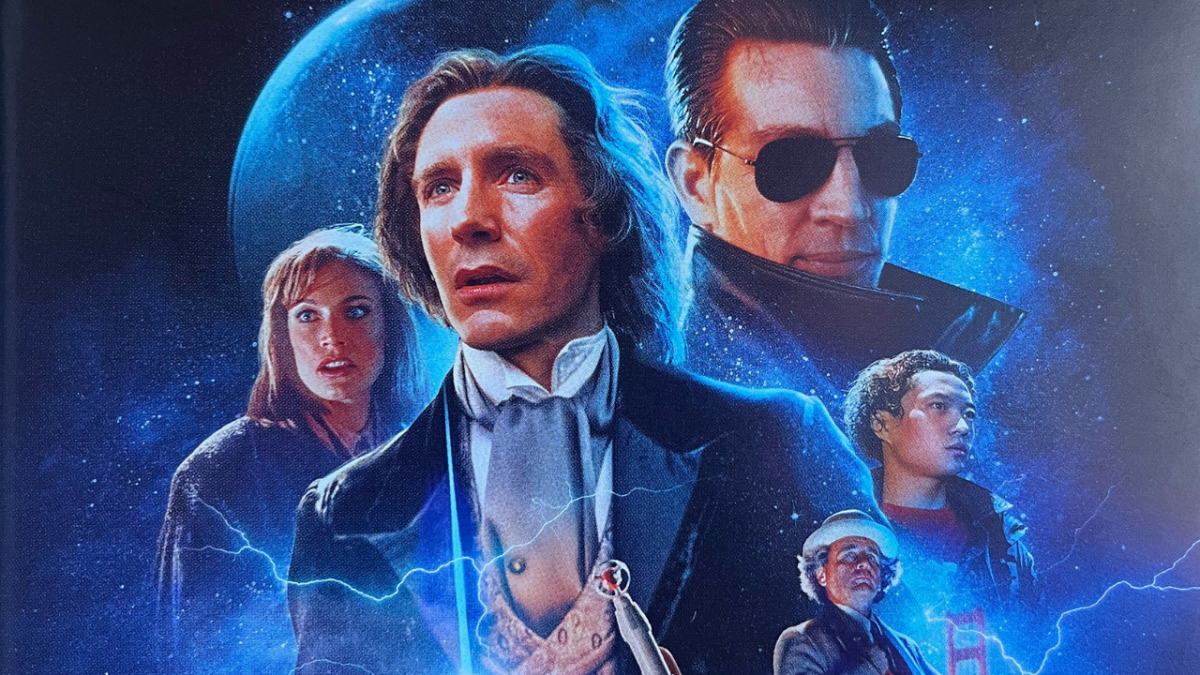
My interest in Doctor Who has mainly been confined to the Modern era from the 2005 reboot onwards, as that was when I first got into it, and I’ve been gradually revisiting and reviewing those series in recent years. It looks like I now have quite a bit of time to complete those reviews too, given that the show is going on hiatus again.
However, I have very little experience of the Classic era. I was still in my childhood for most of the Wilderness Years, when the programme was off air between 1989 and 2005, so it wasn’t a big part of my life growing up.
I did of course become aware of the show, particularly via a couple of charity specials that were broadcast on TV in the 90s, because it is a British institution that is deeply embedded in popular culture. It’s impossible to live here in the UK and not know about it. But I was too young to care. It was just one of those many old programmes that the adults used to watch, and it had long gone. And since getting into the Modern era, I’ve only seen occasional stories from the old days, either in their original form or via modern re-edits.
During its 16-year absence, however, there was an attempt to bring the show back in 1996, via a feature-length American TV pilot simply known as Doctor Who: The Movie, featuring Paul McGann as the 8th Doctor. A lot of fans in the UK liked it, but there wasn’t enough interest in the States to resurrect the show fully.
So it completely passed me by at the time. But I did eventually see it many years later, on Netflix in December 2013, when it was available there alongside a tiny selection of Classic era episodes that I also watched. I had taken the opportunity to check out those stories because of the 50th anniversary of the show – which means my first experience of Paul McGann had actually been his Night Of The Doctor mini-episode the previous month, showing his regeneration into the War Doctor. And as it happens I’ve recently seen that story again, having just rewatched the 50th anniversary specials during May. He also later made a cameo in The Power Of The Doctor in 2022 that I enjoyed.
12½ years on from my one and only viewing, therefore, I have no clear recollection of the film or whether I liked it. So buying the new 30th anniversary Blu-ray is a bit of a gamble for me, but a fascinating one too, as it’s my first proper deep dive into any Doctor Who story before 2005. It feels like I’m watching the movie for the first time again, and all of the special features (apart from the trailer for this release) are completely new to me, as I’ve never owned any previous editions.
So join me as I experience the movie in all its remastered glory and explore all the bonus material. I’ve also put together a playlist of highlights, music tracks, interviews, convention appearances, etc that you can look through too. I hope you enjoy!
Contents
The Movie
Blu-ray
The steelbook release of the movie was very limited edition and sold out really quickly, and included a disc with the movie in 4K that I can’t play anyway. So I got the cheaper standard edition instead, which is perfectly fine for my needs, I’m very happy with how it looks.
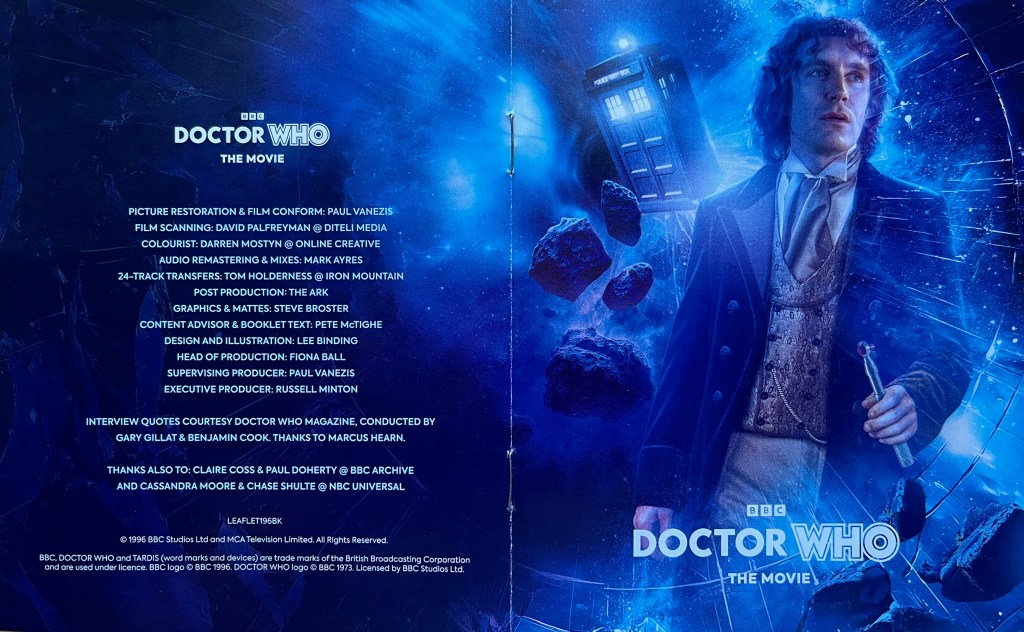
It has a cardboard sleeve that matches the design of the paper sleeve inside the Blu-ray case, showing Paul McGann surrounded by the other main characters on the front. However, the paper sleeve is also reversible, and on the other side is a design that matches the older Classic era releases, for those who want some consistency. That’s a really nice touch.
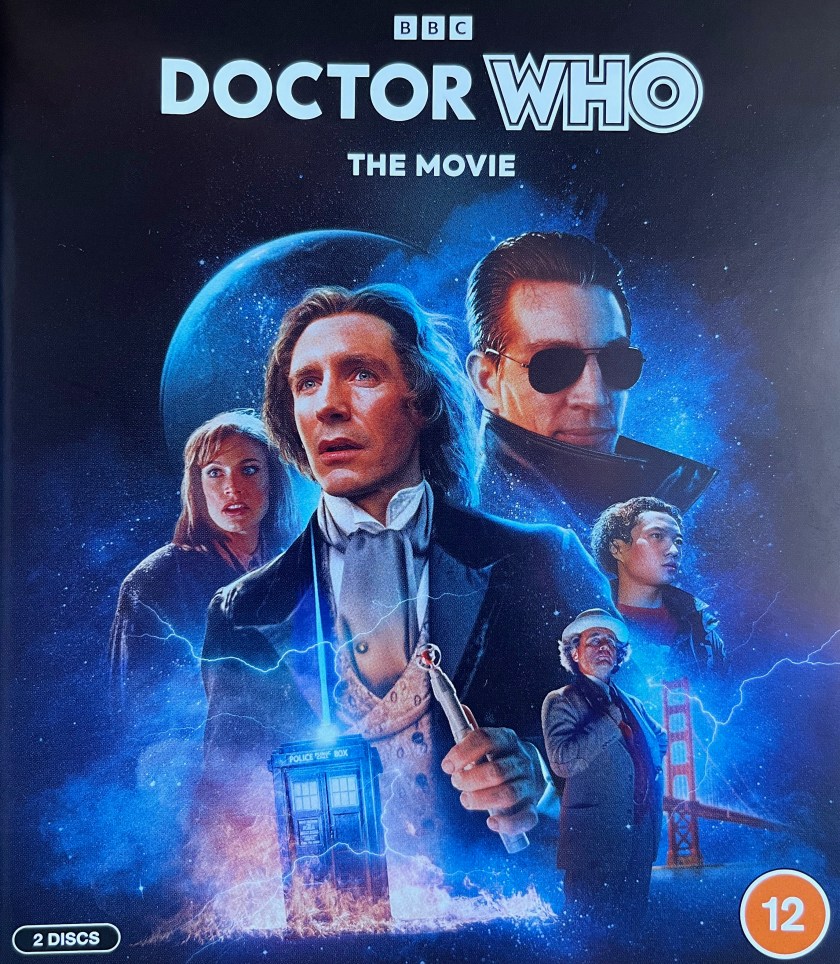
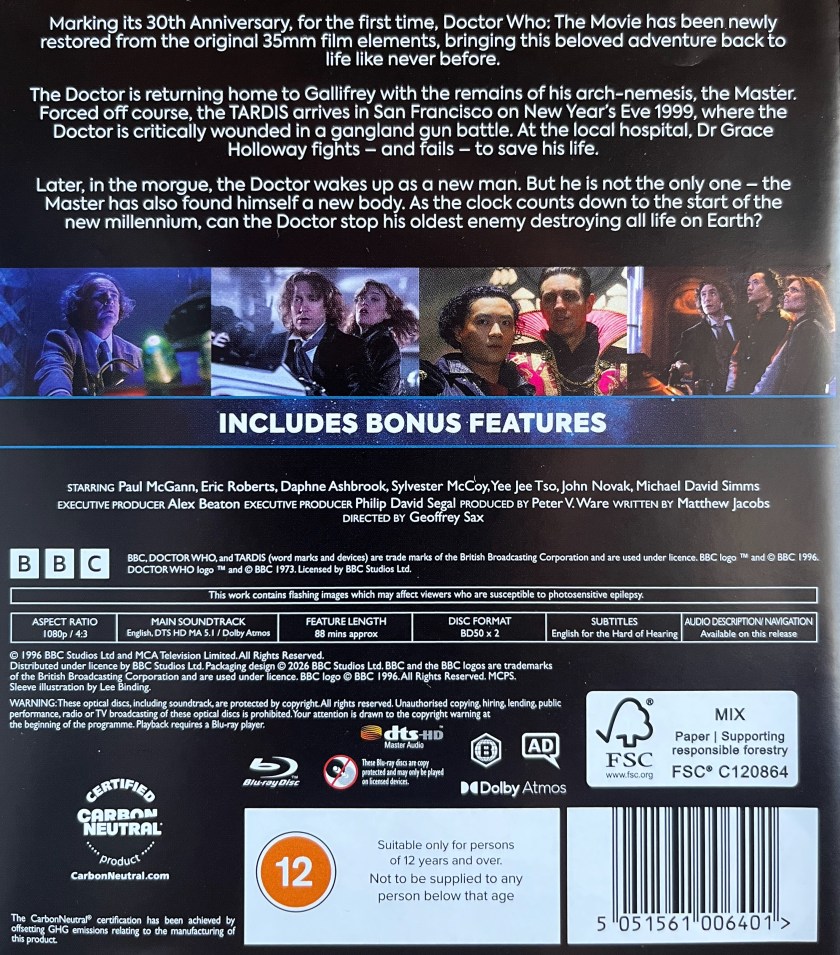
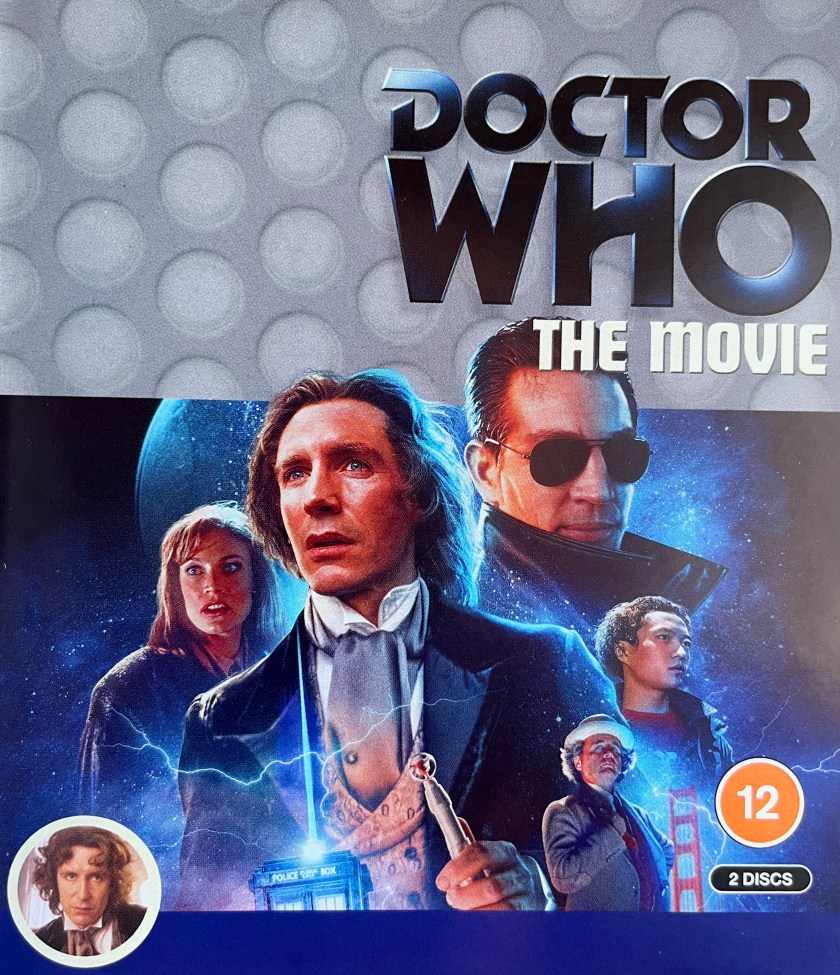
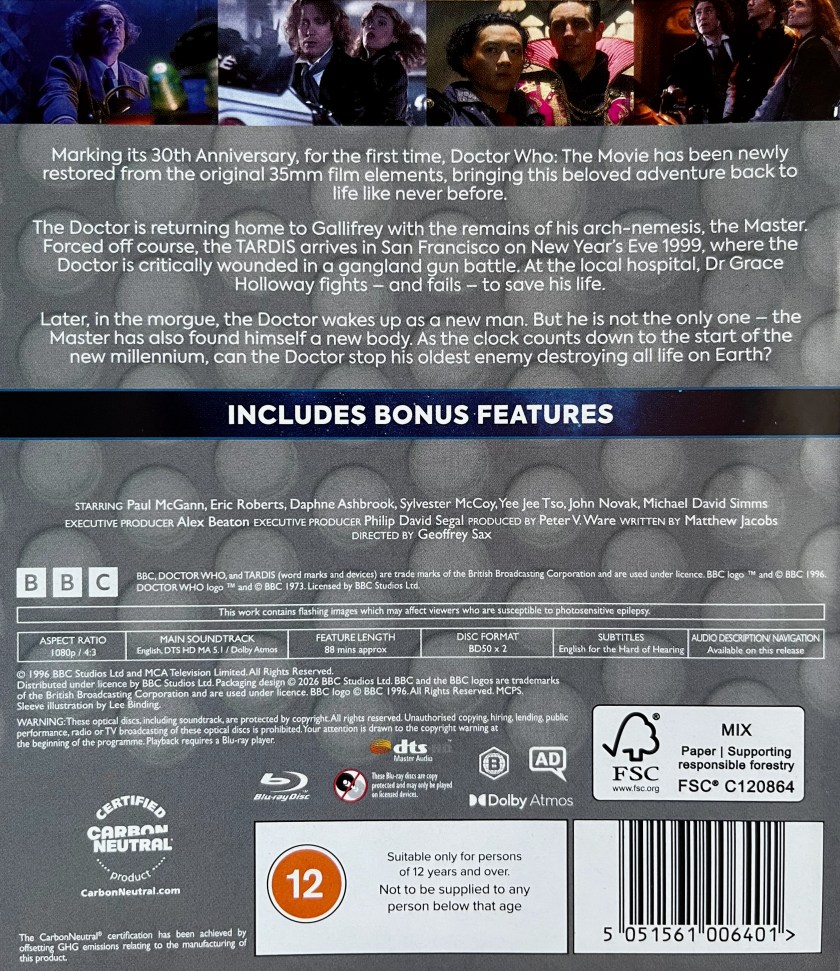
There are two discs in the set, the first containing the movie, the other presenting the special features. And there are 2 versions of the film on that first disc – the UK uncensored version and the USA broadcast version. They’re basically the same, but the USA version has a caption at the beginning to say it’s based on the BBC series, and there are 6 brief fade-outs where the ad breaks would have been. I understand that they’ve also corrected the difference in frame rates between the two versions, so they now both run at 24fps (the UK version had previously run at 25fps with pitch correction, as a result of its conversion from NTSC to PAL formats). I don’t have an old edition to compare it with, but there have been good reactions to it online.
The reason the UK version is marked as uncensored is because the original BBC broadcast was edited in response to the Dunblane massacre, to trim out most of the gun battle with Chang Lee, the 7th Doctor screaming as he dies on the operating table, and the moment when Chang Lee’s neck is snapped. That censored version is the one available on BBC iPlayer, but the movie is presented uncut on this Blu-ray.
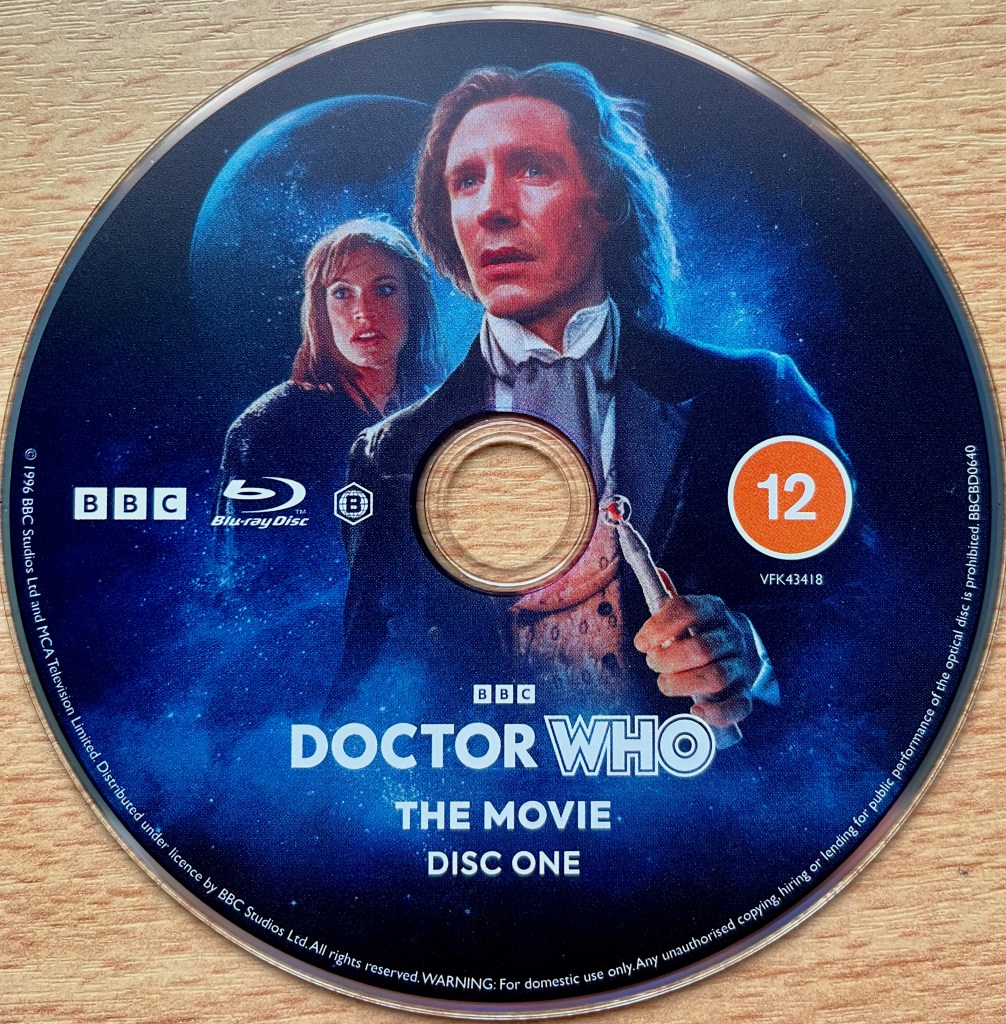
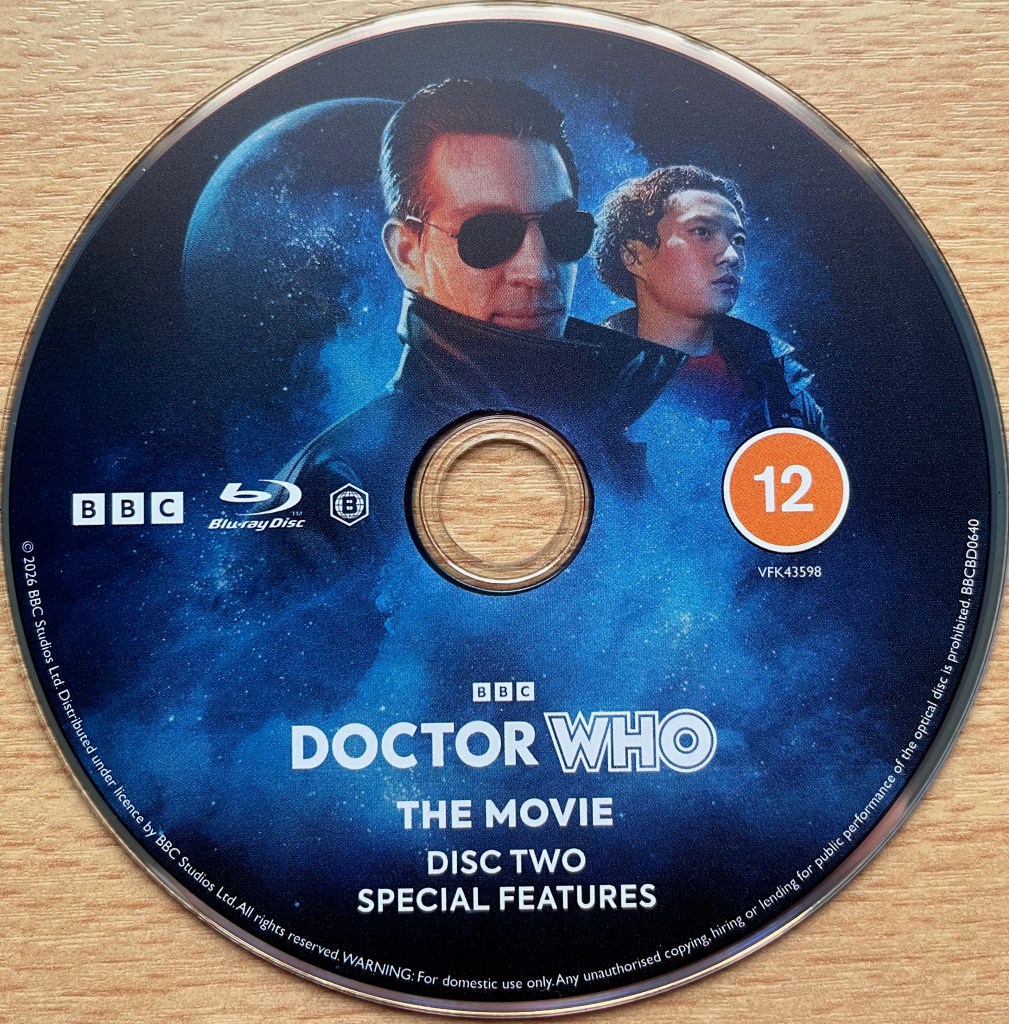
The film has been restored from its original 35mm elements, and it looks fantastic as far as I can tell, but being partially sighted I can’t give an in-depth analysis of it. You’ll have to look at other reviews if you want that kind of detail. But I was able to see well enough to enjoy it. Similarly on the audio front, I only have the capacity to use stereo, which sounds great to me, so I can’t comment on the 5.1 surround and Dolby Atmos tracks you can also choose from.
The menu on Disc 1 begins with an image of Sylvester McCoy next to a background of the universe, but then the Tardis smashes through the screen, the Doctor changes to Paul McGann, and through the smashed area we see footage of the Tardis and the Doctor emerging from his regeneration. The menu on the special features disc then begins with the eyes from the opening sequence, which transition into an image of Paul McGann in front of the same universe background, but this time he’s on the right and various characters from the movie drift through the space to his left. So it all looks pretty nice.
When selecting different sub-menus, it’s good that they pop-up seamlessly from the menu bar as they should on a Blu-ray, unlike some other Doctor Who Blu-rays that use the old DVD method of loading a separate screen for each sub-menu, which slows things down.
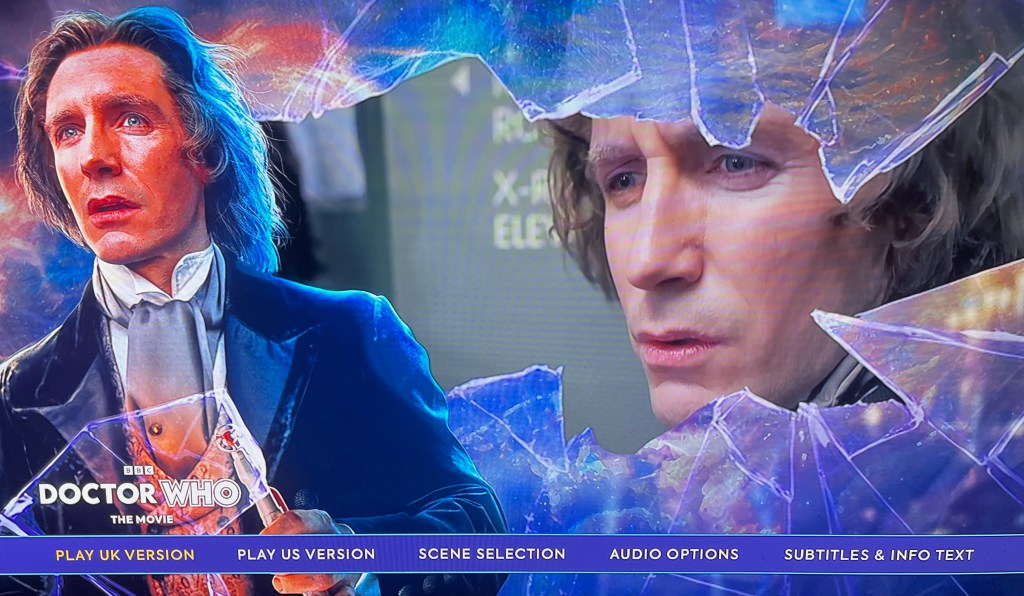
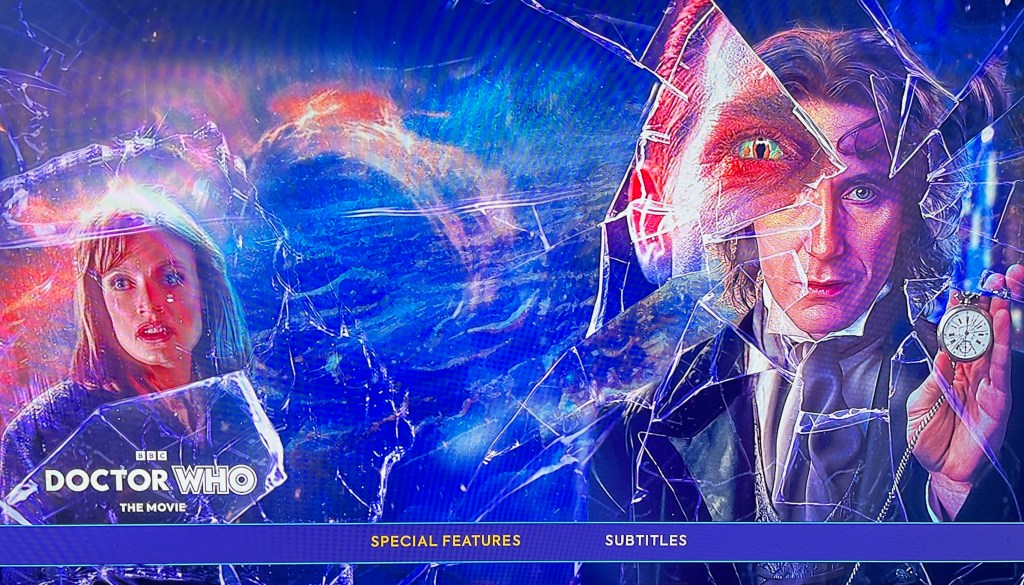
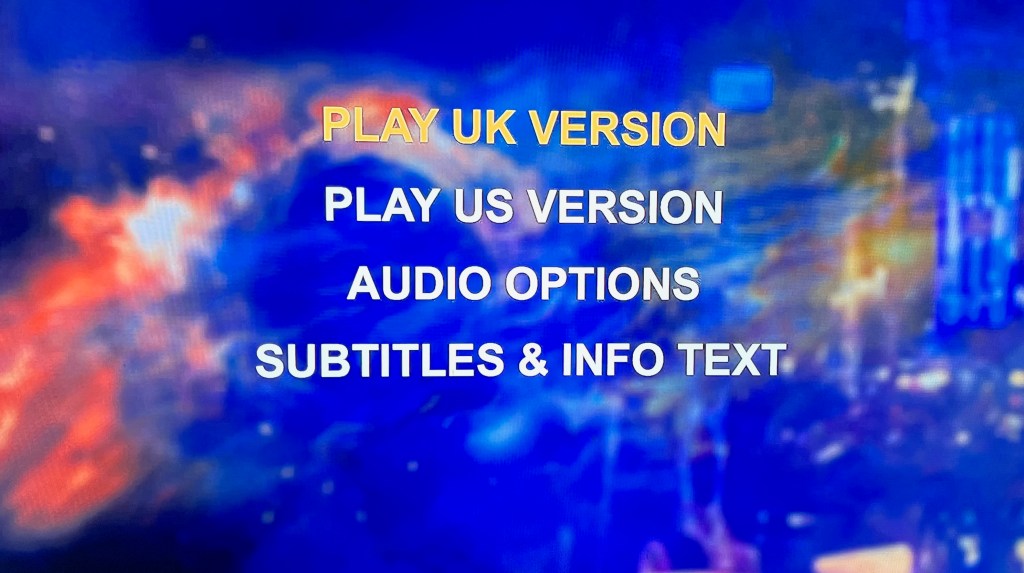
From an accessibility perspective, there are of course subtitles in English. But I’m particularly delighted to see that they’ve added audio navigation (with the menu options spoken by Sylvester McCoy) and audio description (for the UK version of the movie). This is consistent with what they’ve done for most of the modern series releases (with occasional frustrating exceptions), so I’m pleased they’ve continued doing that for those who need it.
That said, it isn’t always clear exactly what the options are. If you can read the text, which is large and bold, then it’s fine, but the audio doesn’t match it. On Disc 1, for example, he says “Play” for the UK version of the film, while for the US version he says “Play Special”, so that doesn’t make it obvious which one is which. I wouldn’t say the US version is special. Sure, the UK version is the best one, as it flows nicely without the ad break fade outs, and it’s the only edition on which the audio description will work, so it makes sense for it to be first. But I don’t know why he just can’t say “Play UK Version” and “Play US version”.
And then on the second disc, the bonus material is simply spoken as “Special Feature 1”, “Special Feature 2”, etc on each page of the menu, as there are so many features that there are multiple submenus to list them all. So if you can’t see the screen and have to navigate by audio alone, it’s pot luck as to what you get when you click on anything. This has been common practice for the extras on all of the Doctor Who releases that have audio navigation, as they probably record some generic audio that can be reused across multiple releases, before they know what will actually be on them. But then once they do know what the text needs to be on the screen, surely it can’t be that difficult for someone to record the audio for it. There isn’t a lot to say.
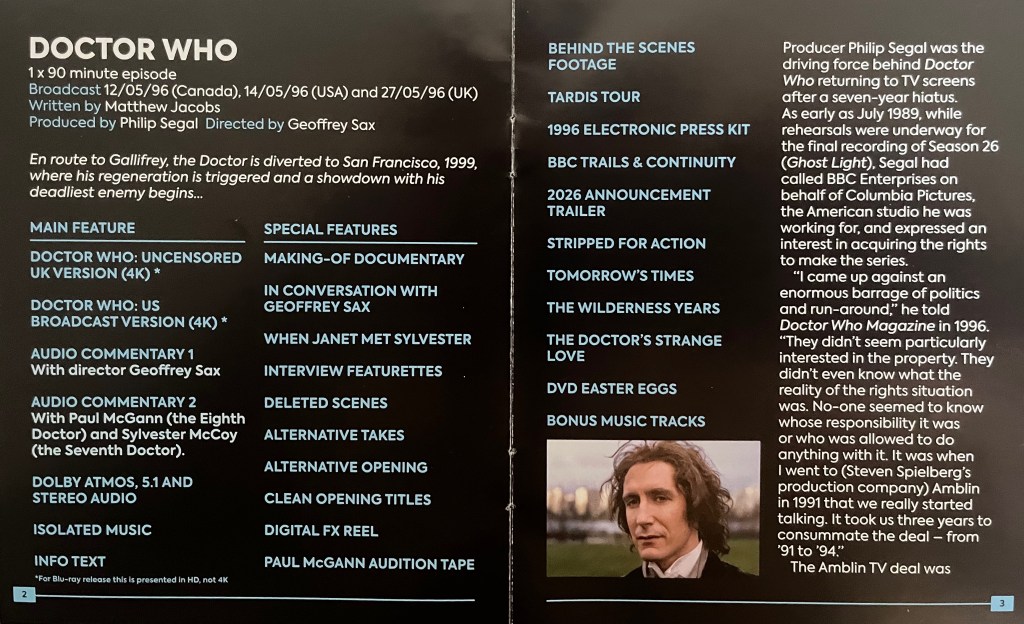
Finally, there’s also an 8-page booklet included with the set, which lists the contents of each disc and contains a short essay about how the film came about, how quickly it was filmed, and how well it was received by audiences. It provides a nice introduction without spoiling anything about the story, and there are a few nice photos alongside the text as well.
Story
Overview:
- First Broadcast – May 12 (Canada), 14 (USA) & 27 (UK), 1996
- Duration – 1 hour 30 minutes
- Links – BBC / Wikipedia / Tardis Wiki
- Novel – 1996 & 2021 editions by Gary Russell
Credits:
- Writer – Matthew Jacobs
- Director – Geoffrey Sax
- Executive Producers – Philip Segal, Alex Beaton & Jo Wright
Cast:
- 7th Doctor – Sylvester McCoy
- 8th Doctor – Paul McGann
- The Master – Eric Roberts
- Grace Holloway – Daphne Ashbrook (Doctor’s companion)
- Chang Lee – Yee Jee Tso (Master’s companion)
I’ll say right off the bat that I really enjoyed this. I didn’t have low expectations, but I kept them neutral out of uncertainty, and I was pleasantly surprised. I’m even a bit disappointed that it didn’t become a full series. Granted, I don’t think it’s as good as the revival by Russell T Davies with Christopher Eccleston as the Doctor, although I appreciate that I’m biased as that was my introduction to the show. And it does feel strange for a quintessentially British show to have an American feel to it, although there are occasional British references in there, including jelly babies that the Doctor gives out and a tourism poster advertising London behind the Tardis. Nevertheless, as a pilot it does stand up pretty well and shows a lot of potential, with Paul McGann (who is also British) fitting into the role of the Doctor very nicely, so it’s a real shame he only gets about an hour on screen.
I like how it starts with Sylvester McCoy’s Doctor though. Whereas the 2005 series began with the next Doctor straight away, giving new audiences an introduction to him from the companion’s perspective – which I think was a wise move because it was a major relaunch – here we actually see the final moments of the 7th Doctor for continuity. Not that it makes any difference to me, as I never watched his series, but I appreciate how it’s nice to have that connection for Classic era fans.
The Master has been executed by the Daleks, and the 7th Doctor is transporting his remains back to Gallifrey in the Tardis – which has an amazing interior, looking like a huge, ornately furnished room in a mansion with stairs and corridors leading off it, whereas other console rooms in the series have felt compact by comparison. There’s so much detail there, a lot of which I can’t see clearly with my eyesight, but I can see enough to appreciate the scale of it. And some of the details are shown more closely in one of the features on the bonus disc, which helps.
However, the Master isn’t completely dead, and he forces the Tardis to lose control, so it lands in San Francisco on December 30, 1999. As the Doctor emerges from his craft, he’s then shot dead by a gang who have been chasing a young man called Chang Lee. It’s very sudden, so it is a pity that Sylvester doesn’t get a big heroic send-off like some Doctors have, but at least he doesn’t regenerate immediately so we still get a little bit more time with him.
Chang Lee calls an ambulance so that the Doctor is taken to hospital, where there’s some confusion as the X-ray shows he has two hearts, and when Grace tries to operate on him, she gets lost because of his unique body structure. So they’re unable to save him, and they put his body in the morgue. There he regenerates into the 8th Doctor, emerging with confusion about who he is, and finds himself an outfit to wear.
Talking of regenerations, the movie makes a point of specifying that Time Lords can only have 13 lives in total, which has been mentioned before in the series. It’s rather a pointless element of the folklore really, given that it’s easy and necessary to work around it for the show to continue (as happened in Matt Smith’s final episode in 2013). But when it was first mentioned in the Classic era they had no idea it would continue to run that long.
He then stumbles upon Grace, who thinks he’s crazy but is eventually persuaded to take him back to her house, and his memory gradually starts to return as he talks to her.
The kiss they share was very controversial at the time, as the Doctor hadn’t really shown any interest in women before. But as someone who’s grown up with the modern series, where emotional connections are much more common, it doesn’t bother me in the slightest. Indeed, this very brief interaction, and the other friendly kiss they have at the end, are quite tame compared to the more blatant romantic overtones we’ve had in later series. And there isn’t a major focus on that element of their friendship in the rest of the movie, it doesn’t dominate or distract from the story at all.
But I totally understand why it would have been an uncomfortable shift in tone for long-term fans of the show at that time. And had the movie spawned a series, I can easily imagine them getting closer, potentially to the point of it feeling awkward or inappropriate. So I guess it’s easier to watch in hindsight knowing that it didn’t go too far, because they didn’t get the opportunity.
Another point of contention is the Doctor telling Grace that he’s half-human, because it contradicts what’s been said in the series before and since. So it’s open to interpretation, or can just be ignored as a throwaway comment in his attempts to make her feel at ease around him. Personally I think that he is all Time Lord, so in my mind he’s referencing the fact that he always looks human despite being of a different species, just to explain things more clearly to Grace, and to people in the audience who are unfamiliar with the show. He has a human exterior on his Time Lord body, much like he has a police box exterior on his time machine. It’s just an appearance that enables him to fit in.
The Master, meanwhile, leaves the Tardis in a snake-like ooze through the keyhole, hides in the ambulance transporting the Doctor, and then enters the home of the paramedic, Bruce, whereupon he takes over his body. I don’t think the Master in this film is as good as John Simm in the modern series, but he is still fairly menacing and a clear threat to the Doctor and the world.
However, the Master has run out of lives, so he needs to steal the Doctor’s remaining regenerations in order to continue. So he takes control of Chang Lee and gets him to open the Eye Of Harmony in the Tardis using a retinal scan. This in turn alerts the Doctor that the Master is after him, and helps to restore all of his memories. He also knows that if the Eye isn’t closed, reality will collapse, but the only way to stop it is by getting hold of an atomic clock. Luckily there’s a place in San Francisco that has one on display in preparation for seeing in the new millennium.
So, while trying to avoid capture by the Master – including a fun chase sequence on a motorbike – the Doctor and Grace are able to find a way to steal the clock and take it back to the Tardis, but he still needs to reverse time to a moment before the Eye was opened in order to save the world. The Master is able to possess Grace and capture the Doctor though, and it looks like the Master might be able to get the Doctor’s remaining lives after all.
Grace does of course save the day in the end and the Master is thwarted. Chang Lee then returns the items he had stolen from the Doctor, so they leave on good terms, but Grace turns down the Doctor’s offer to travel with him. She could have been an interesting companion ultimately, although as with the Master she isn’t in the same league as those who followed in her footsteps (Rose, Martha, etc).
The end of the film then mirrors the start, with the 8th Doctor continuing to read The Time Machine by H. G. Wells that his predecessor had been immersed in, before the record he’s listening to ominously starts skipping on the word “Time” again. The credits then roll, and in the UK version they’re followed by a caption in memory of former Doctor Jon Pertwee, who had died a week before the British premiere of the film.
So all in all, while it’s impossible to know how a full series might have panned out based on these 90 minutes alone, it is enjoyable, with a good mix of drama, action, jeopardy and humour, and Paul McGann manages to make the role his own despite the limited time available. So I’m very glad I’ve been able to add it to my collection at long last, it is a story I’ll watch again.
Music
The music in the film was primarily composed by John Debney, but there was also additional music by John Sponsler and Louis Febre. Debney did produce a soundtrack album in 1997, but it was a limited edition for promotional use only, and the full score would only later be released as part of a 50th anniversary box set. I don’t own those albums, which have long since gone out of print anyway, but there is an option to hear the full isolated score on the Blu-ray, which is very cool, and all of the tracks from the anniversary box set have been unofficially shared on Youtube.
Obviously the key piece of music is the theme tune, and this is a very unusual arrangement as it begins with the middle eight. But I quite like it, as it has a good driving rhythm to it, and for some reason I like the little piano counter-melody that pops in near the end too. The visuals accompanying the opening theme are nice as well, as we fly through a vortex of varying colours in space, dodging asteroids along the way, before seeing the Tardis at the end as it passes close to us.
The rest of the score is suitably atmospheric. I wouldn’t rate it as highly as Murray Gold’s music in the modern era, but it does work very well, and feels a little bit reminiscent of an action film now and again. My favourite pieces include the music from the scene where the 7th Doctor is shot, his regeneration into the 8th Doctor, the city scape, the big chase sequence, and the opening of the Eye Of Harmony.
There are a few songs in the movie as well, but they’re not included on the soundtrack album or the isolated score on the Blu-ray. However, they are among the extras on the special features disc, as noted in the next section.
Extras
There are a ton of bonus features in this set, with multiple tracks you can enable during the movie itself, plus 6 hours of video and audio material on the second disc.
Most of the extras from previous releases have been carried over, and some new ones added. In terms of what isn’t here, The Night Of The Doctor hasn’t been included (as that’s in the 50th anniversary set I already have), while the features omitted from older editions include a documentary about the show’s connection with Blue Peter between 1989 and 2009 (which is the second part of Who Peter), a photo gallery and a PDF of Radio Times listings. But none of those are a big deal for me. I’m really happy with what we have here, it’s very comprehensive.
Commentaries & Info Text
As well as Stereo, 5.1 Surround and Dolby Atmos sound mixes for the movie, plus audio description and the isolated score as mentioned earlier, there are also 2 audio commentaries and a trivia track that you can turn on for the UK version of the film:
- Director’s Commentary (2001) – Geoffrey Sax isn’t overly chatty here, because he has nobody else with him to bounce off, so there are short gaps here and there. But he does give interesting bits of info about the different scenes, locations, special effects, difficulties they encountered, and so on, so it is worth a listen.
- Doctor’s Commentary (2009) – Paul McGann & Sylvester McCoy reflect on their experience making the movie and give their reactions as they watch it back, with Nicholas Briggs steering the discussion. It’s very engaging and interesting, and they’re clearly glad they did it even though it wasn’t commissioned for a full series in the end.
- Info Text (2010) – This subtitle track by Niall Boyce displays a wide variety of facts and trivia, including when and where scenes were filmed, some other TV shows and movies the actors have been in, original ideas that were changed or dropped, how things were specified in the script, how some of the effects were achieved, some of the more glaring plot holes, references to old stories and previous Doctors, and so on. It’s very interesting, and thankfully easy enough for me to read most of the time. You can tell it’s a little bit out of date, as it says Paul McGann didn’t appear on the show again, but otherwise it’s still accurate.
Documentaries
- The Seven Year Hitch (2010, 53:54) – Although listed as a “Making of” documentary, this is actually a fascinating look at the complicated series of events that took place after the show ended in 1989, as Philip Segal relentlessly pursued his dream to produce Doctor Who in America. He never gave up despite the many ups and downs and barriers he had to contend with, including the BBC’s dislike of the show and a separate Doctor Who movie being proposed by another company. The script for the movie he eventually made also had to be completely changed, with many interested parties sticking their noses in with their own preferences, and lots of well-known names were considered for the role of the Doctor. So we’re very lucky the movie got made at all. The documentary features an extensive interview with Philip along with fellow executive producer Jo Wright, writer Matthew Jacobs, BBC controller Alan Yentob, and others. It really puts things into context nicely.
- The Wilderness Years (2010, 23:30) – This interesting documentary celebrates how fans of the show kept it alive in print, audio and video form during its 16-year-absence from TV screens, including Doctor Who Magazine, Virgin New Adventures, independent films by Reeltime Pictures and BBV Productions, and a new audiobook company called Big Finish.
- Stripped for Action (2009, 19:47) – This takes a look at the development of the comic strips for the 8th Doctor, mainly in Doctor Who Magazine but there were also some shorter strips in the Radio Times. Because Paul McGann had only appeared as the Doctor on screen once, it meant they had a lot of freedom for story-telling, as they didn’t have to worry about interfering with the continuity of the TV series. I’ve never seen the comic strips, but it’s still interesting to get an overview of them from the people who worked on them, as they were clearly quite significant at the time, including the Doctor’s first gay companion (Izzy) for example.
- Tomorrow’s Times (2010, 10:49) – Nicholas Courtney (who played Brigadier Lethbridge-Stewart in the Classic era) presents a variety of quotes from critics and reporters about the movie, taken from newspapers and other publications at the time. It’s a bit of a pointless extra really, as I couldn’t care less what any of them have to say. I know what I think of the movie, and that’s the important thing.
Interviews
- Geoffrey Sax in Conversation (2026, 1:02:01) – Matthew Sweet interviews director Geoffrey Sax about his extensive career, and it’s surprisingly interesting considering it’s an hour long, because it’s a very fluid conversation with lots of nice stories and anecdotes. So we learn a lot about his work in theatre, advertising, TV news, documentaries, light entertainment, comedies and dramas. That includes a section about casting and filming the Doctor Who movie of course, which is good, and if you stick around during the credits there are a couple of bonus clips about how he was invited to be part of the 2005 reboot as well. But beyond that, I also enjoyed hearing about how he worked with future Doctor Christopher Eccleston on a TV adaptation of Othello and Rik Mayall on political sitcom The New Statesman, as well as other big stars he encountered from Bob Hoskins to Halle Berry.
- Memories (2026, 1:00:39) – Three 20-minute interviews, where Daphne Ashbrook (Grace), Eric Roberts (the Master) and Yee Jee Tso (Chang Lee) reflect on their time working on the movie. They’re very nice to watch, as they all have fond recollections of the experience. Eric is joined by his wife Eliza Roberts, who played his fictional wife Miranda in the film (when he was playing Bruce before the Master possessed his body).
- When Janet Met Sylvester (2026, 40:56) – Janet Fielding played Sylvester McCoy’s companion Tegan in Doctor Who, but then later became a theatrical agent, and Paul McGann was her client when the movie was being developed. So she and Sylvester are reunited here for a friendly catch-up, where they reflect on their acting careers. I didn’t get into this much, as they talk about a lot of people and productions I know nothing about – including Ken Campbell, who they pay tribute to as he discovered Sylvester and later gave Janet work as well. So it takes them half an hour to get to the movie, and even then they don’t say a lot about it, as he wasn’t in it much. They also mention his video diary from the time, called Bidding Adieu, where he and Paul McGann were interviewed by Mark Gatiss. You can download the documentary for £10.99 and the full interview for £1.99. I haven’t bought it personally, as I’ve never watched McCoy’s era (so I don’t need to watch his farewell diary to it), and I’m perfectly happy with the treasure trove of extras on this Blu-ray (which this should have been included with really). But I expect big fans of the 7th Doctor will be well aware of that little film.
- The Doctor’s Strange Love (2010, 17:11) – Simon Guerrier (who has written several Doctor Who novels) and Joseph Lidster (who has written for Torchwood and The Sarah Jane Adventures) analyse the movie with comedian Josie Long (a big fan of the show who I gather has spoken about it on several other Classic era releases). While they’re all nice people, I didn’t get any value from this extra at all, as sometimes they’re just stating the obvious, and as with the critics feature mentioned earlier, it’s of no concern to me what they think. So it’s just a filler extra rather than anything essential.
- Philip Segal Interview (2001, 9:01) – This was previously hidden as a DVD Easter egg, and sees executive producer Philip Segal talking about why Doctor Who is a significant part of his life. He also shares his thoughts about making the movie, including the aspects he’s most proud of and things he would have done differently in hindsight. Inevitably it does repeat some points made in the Seven Year Hitch documentary above, but it’s still interesting.
- Matthew Jacobs’ Interview Extract (2010, 2:04) – This is also an old DVD Easter egg, where writer Matthew Jacobs shares his earliest memory of Doctor Who as a child with his dad in the 1960s, which is a nice little story. Incidentally, he also made a documentary in 2022 called Doctor Who Am I, which is available to rent on Amazon, Youtube and other platforms, and can be bought on Blu-ray. I haven’t watched it, but I have seen trailers and other information, so I know it’s about Matthew himself, and about the response of the American fanbase to the movie, with a lot of material from conventions. And there are little interviews with some of the stars of the film along the way. So it’s not about the actual making of the movie, just the legacy it’s left in the States, and therefore it doesn’t grab my interest personally.
Behind The Scenes
- Behind The Scenes (4:48) – A nice selection of clips, without narration over the top, showing some of the preparations and filming for the alley gunfight scene, the big chase sequence, and Eric’s contact lenses being fitted for when Bruce becomes the Master.
- Philip Segal’s TARDIS Tour (1996, 2:35) – Philip explains what the Tardis is, for those who aren’t familiar with it, before showing us the design of the console and some of the props that decorate the huge space, which are nice to see in closeup.
- Paul McGann’s Audition Tape (1995, 7:41) – Further proof that Paul would have made a great Doctor in the long term, as he plays out a few different scenes (which aren’t from the film). He has great energy and emotional range.
Alternative Footage
- Alternative Opening Sequence (1:59) – The opening of the film, using the same visuals but with narration by the Master instead of the Doctor, saying how he wants the Doctor to take his remains back to Gallifrey. It’s a good variation, but I think having the Doctor speaking works better.
- Clean Opening Titles (1:59) – The opening of the film without any narration or on-screen text, so you can fully appreciate the visuals and the music.
- Deleted Scenes (1:17) – Three short clips featuring the Master and Chang Lee that didn’t make the cut. They’re mostly insignificant, but one moment involving the guards at the New Year’s Eve party helps to explain their state when the Doctor and Grace encounter them later.
- Alternative Scenes (1:25) – Two different takes of moments with the Doctor and Grace, one where he shouts “Puccini!” when he recognises her in the lift, and the other from the big chase scene where the crowd shouts “Give him the keys!” when they’re trying to commandeer the policeman’s motorbike. The latter in particular is amusing.
Visual Effects
- 1994 VFX Tests (0:50) – A basic rendering of the logo and vortex for a possible version of the opening titles, and a monster that expands in size.
- 1996 VFX Work In Progress (2:33) – Clips of various effects before they’ve been fully completed, in order to show their development, including the vortex from the opening titles, the Tardis dematerialising, people appearing in the Eye Of Harmony, the Master entering Bruce’s body and the Master’s face morphing with the Doctor’s.
- 1996 Digital Effects And Evaluation Tests (11:15) – A long sequence of CGI demonstrations, including variations for the opening of the film, the Master’s snake-like form as it hunts down Bruce, and green screen compositing to make people appear in the Eye Of Harmony.
Promotion
- 1996 Electronic Press Kit (15:27) – Fox’s 4-minute promo video that shows clips from the film, fleeting glimpses behind the scenes, and interviews with several of the people involved. That’s followed by the stand-alone, extended footage of the same interviews without any music over the top. It basically involves them explaining what Doctor Who is for those who aren’t aware, giving brief outlines of the main characters, and saying how great the movie is. So it’s not an essential extra, but it’s interesting to see how they promoted it over in America.
- BBC Trails (1:02) – Two trailers for the movie before it aired on BBC1 and they certainly make it look good.
- Announcement Trailer (1:49) – The trailer for this new remastered Blu-ray, narrated by Sylvester McCoy. It’s quite fun.
Audio Tracks
- In A Dream by Pat Hodge (3:53) – This stock library track is the relaxing song that the Doctor listens to on his record player, until it starts skipping on the word “time” in the film.
- Ride Into The Moonlight by Loud & Clear (3:28) – This catchy rock song plays during the New Year’s Eve party at the hospital.
- All Dressed Up (2:01) – An upbeat country song from the party.
- Auld Lang Syne (0:45) – A short instrumental of this traditional piece to mark the New Year.
Finally, for reference and completeness, the opera song that Grace listens to is Un Bel Di (One Fine Day) from Madame Butterfly by Puccini. But that’s not included among the extras, and I wouldn’t listen to it in full even if it was, as I’m not a big opera fan.
Charity Specials
In addition to the movie, there were also a couple of charity specials that were shown during the 1990s, which served as my introduction to the Doctor’s world growing up. So it feels appropriate to quickly mention them here as well.
Dimensions In Time
This special was produced for Children In Need in 1993 to mark Doctor Who’s 30th anniversary. The first part was broadcast during the telethon itself, with the conclusion on Noel’s House Party the following evening. This crossover with Eastenders featured Jon Pertwee, Tom Baker, Peter Davison, Colin Baker & Sylvester McCoy reprising their roles as the Doctor, along with several of their original companions.
A phone vote was held after Part 1, to decide which Eastenders character would save the Doctor in Part 2, and those calls raised £101,000 for Children In Need. The special also tried to have a 3D feel using special glasses (which are useless to me with my dodgy eyes) and camera movements spinning around the characters (which is a bit dizzying to look at).
Dimensions In Time has never officially been released in any video format, as everyone involved gave up their time for free, on condition that it was never repeated or sold for profit. So we can be grateful that a few fans have shared their own recordings and edits for posterity, including a 30th anniversary edition on Youtube that includes trailers, outtakes and rushes.
The Curse Of Fatal Death
This special from 1999 was a brilliant parody made for Comic Relief in 1999, and is also available on Youtube. It didn’t feature any of the original Doctors or companions, but had a very impressive cast nonetheless, with Rowan Atkinson playing the Doctor, Jonathan Pryce as the Master, Julia Sawalha as companion Emma, and regenerations of the Doctor played by Richard E. Grant, Jim Broadbent, Hugh Grant & Joanna Lumley.
It’s a lot of fun, and has a lot of significance to the main series as well. It was written by Steven Moffat, who went on to become a writer and showrunner in the modern revival from Series 5 onwards, and made occasional little references back to the sketch in his stories. It was also the only live-action special made between the movie and the revival, it featured effects by The Mill (who later worked on the new series), it marks Roy Skelton‘s last performance as the longest-serving voice of the Daleks, and it has the first instance of a female Doctor (Joanna Lumley). Executive Producer Richard Curtis also wrote a proper episode later on (Vincent and the Doctor), while Richard E. Grant went on to play the Great Intelligence in Series 7.
It was released on VHS in September 1999, and later sold digitally via the UK iTunes store. It was also repeated on UK Gold during the 40th anniversary celebrations in 2003, and is available for free on the Comic Relief Youtube channel. It’s never had a DVD release unfortunately.
Apart from the movie and the charity specials, the only other things I’ve seen from the Wilderness Years are the unofficial spin-off Downtime, and the Russell T Davies children’s dramas Dark Season and Century Fall, all of which I’ve previously mentioned in my first post about The Sarah Jane Adventures. Maybe one day I’ll look at some of the other bits and pieces from that period.
Conclusion
All in all, I’m very glad I bought this new Blu-ray. I don’t rate the movie as highly as the revival that followed 9 years later, but it’s still good entertainment, and there’s a great mixture of bonus material accompanying it. It’s clear that Paul McGann would have been an excellent Doctor if a series had been commissioned, and I know that he’s recorded a lot of books for Big Finish in that role to make up for it, with more on the way. So maybe one day in the distant future I’ll hear some of those.
Next on my Doctor Who journey, however, I’ll be revisiting Peter Capaldi’s time in the lead role, which I’m looking forward to as I haven’t watched his episodes for a while. I’m not going to do that straight away, as there are a bunch of other things I want to catch up with first, which have no relation to this show, so that will give me a bit of a break. But I will get on to his series a bit later this year.
Share this:


One thought on “Doctor Who Review – The Movie (30th Anniversary Blu-ray)”