
Now that the most recent series of Doctor Who is out of the way – and I’ve just updated that review with details of its Blu-ray steelbook release – and as there’s going to be a big gap until the next series while the BBC decide what to do, I’m going to continue rewatching the earlier series of the modern era.
I’ve already reviewed all of the series and spin-offs from Russell T Davies’ first stint as showrunner, so it’s time to move on to the fifth series overseen by Steven Moffat, which aired 15 years ago in 2010. Hard to believe it’s that old already.
With a new showrunner, Doctor, companions, Tardis and theme tune, this was another fresh start for the programme, and it worked really well. So I hope you enjoy my deep dive into it, and there are plenty of videos on my Series 5 playlist you can dig through too.
Contents
Introduction
A New Era
Series 5 heralded a big new era for Doctor Who, led by Steven Moffat as the new showrunner. He had already written 6 episodes during Russell’s reign, some of which had won awards, including a couple of BAFTA accolades for the brilliant Blink, which is a particular fan favourite (and is also relevant to one of the stories in this series). And he had also been responsible for the hilarious Comic Relief spoof in 1999 called The Curse Of Fatal Death, which I mentioned in my Series 1 post. So, like Russell, he’s a huge Doctor Who fan.
More importantly, we’re introduced to Matt Smith as the 11th Doctor, whose choice was quite a surprise given that he was the youngest ever person to play the role at just 26, and the fact he was relatively unknown. But he had such magnificent energy and talent, presenting a perfect balance of light and dark as he showed his capabilities for humour, madness, drama, action, authority, emotion and more. He’s instantly likeable and really does feel like an old, wise, knowledgeable Time Lord inhabiting a younger man’s body and having fun in the process, thereby giving the impression of someone who loves a good time but has wisdom beyond his years. So he made the part his own, but was clearly still the Doctor we know and love, with interesting layers to his personality.
There are new companions too, with the fun, feisty, sassy and sexy Amy Pond (played by Karen Gillan, who had previously appeared in the Pompeii episode of Series 4) and her somewhat nervous yet very clever and fiercely loyal boyfriend Rory Williams (played by Arthur Darvill). They’re both brilliant as well, and go on quite an epic journey with the Doctor. It’s clear that Matt, Karen and Arthur had a blast filming the series together, judging by the behind the scenes material, and their chemistry really comes across in the episodes. The new Tardis they travel in together is also really nice, being very bright and colourful inside with lots of details to look at.
And then there’s a new title sequence as well, with a completely fresh take on the theme tune by Murray Gold. It takes a bit of getting used to at first, as it’s very different to the versions we had in Series 1-4, and I wouldn’t say it’s as good as those. But it does quickly grow on you and works very well indeed. And the visuals accompanying it are beautiful, with the Tardis dodging lightning in the vortex.
Unfortunately we’re now in a period where the closing credits were only allowed to be 30 seconds long, so we don’t get to hear the middle eight. But the full theme tune is on the soundtrack album, which altogether has a very generous 63 tracks, helpfully presented in episode order (plus 2 bonus tracks on the iTunes edition that I have). It also has a nice booklet, even with the digital edition, where Murray gives a foreword plus some brief notes on the music for each episode. He also notes that it’s the second double album, as the previous one for David Tennant’s specials had gone down well, and it is certainly wonderful to have so many tracks. So as we go along in this post I’ll mention relevant pieces of music that I particularly like, because Murray does a stellar job once again.
So all in all, Matt’s era really does feel unique and distinctive compared to those before and after him, yet it all remains absolutely true to the spirit and continuity of the show. He fits into the Whoniverse perfectly.
Blu-ray Releases
In the original Blu-ray set from 2010 that I used to own, the 13 episodes and relevant extras are spread across 5 discs, with a 6th disc reserved for cut-down versions of Doctor Who Confidential and trailers. It also had a lenticular cover, so by moving it from side to side the artwork shifted slightly. And there was a little booklet containing a foreword by Steven Moffat, a nice piece of comic-style artwork of the Doctor and Amy, little synopses of each episode, and a list of special features on each disc.
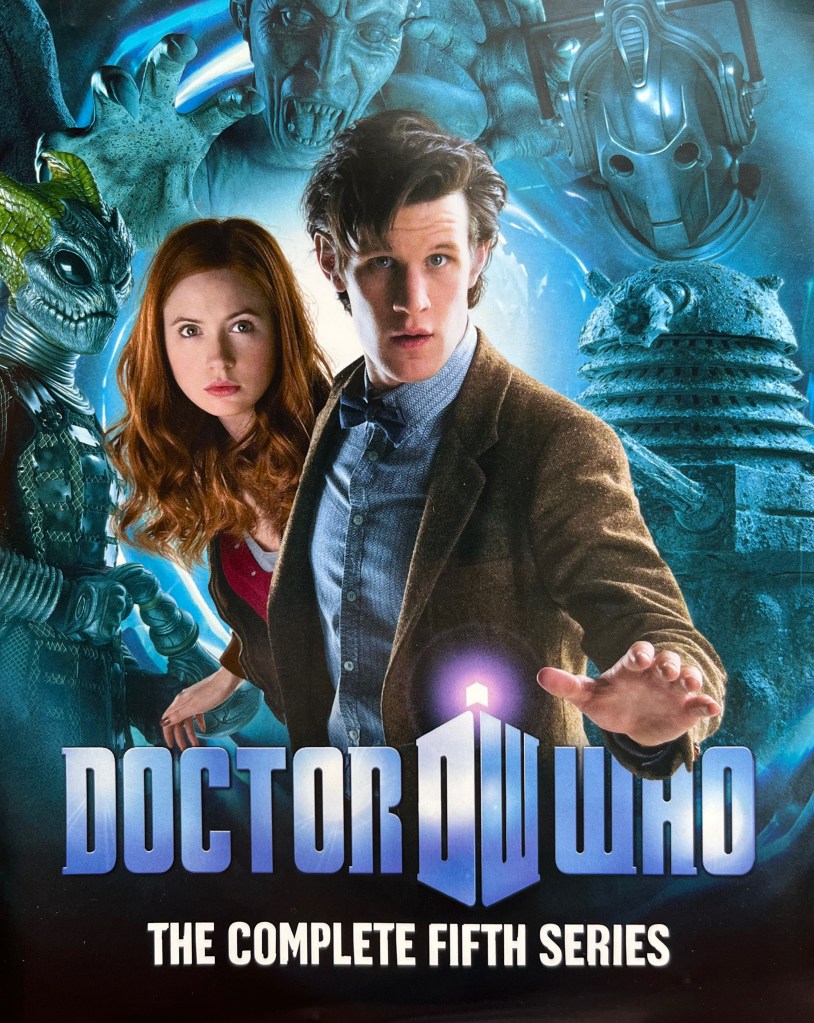


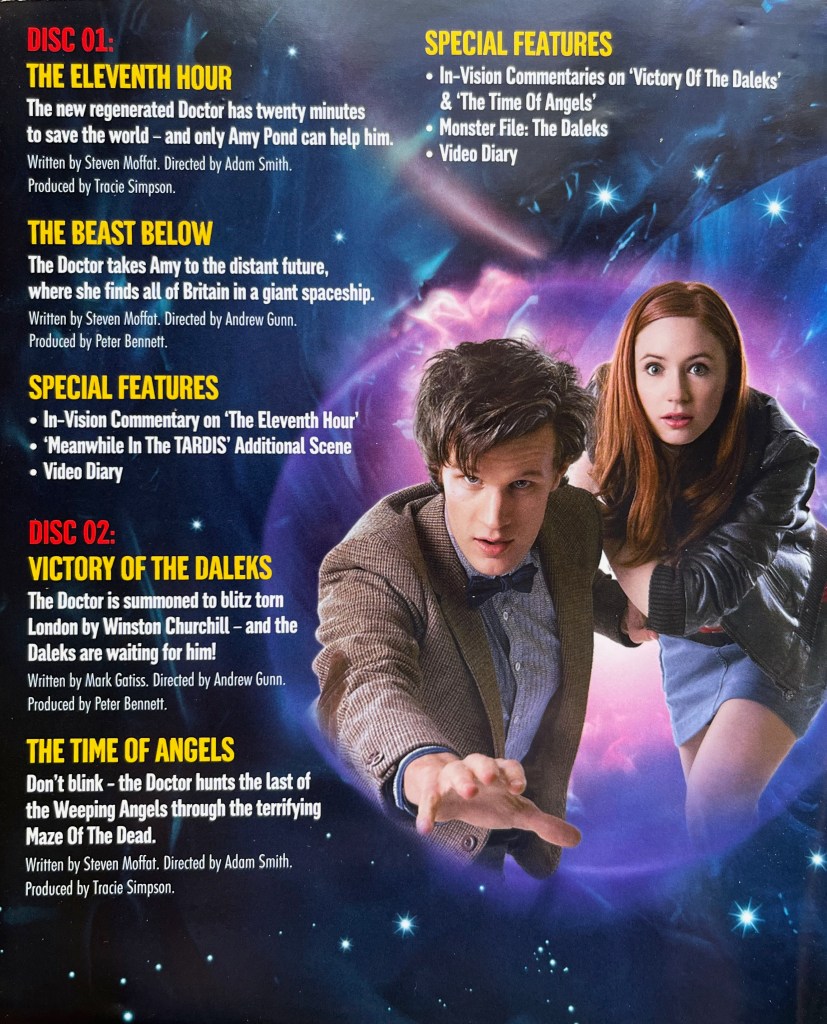


However, in the Blu-ray steelbook set I now have, released in 2020, the 13 episodes and relevant extras are on just 3 discs, with a 4th disc for Confidential and trailers.
The difference lies in the fact that there were in-vision commentaries in the 2010 release, which have been converted to audio only here, allowing them to save a lot of space. It obviously doesn’t have a lenticular cover now either, and instead of a booklet there’s a flimsy flyer as has become standard, with a promotional photo on one side and a list of the disc contents on the other. So I’ve kept the cover and booklet from the old set for posterity, but I haven’t bothered keeping the discs. As nice as it is to see the participants during the commentaries, it’s not essential, so I’m quite happy to have them in audio form and save space with fewer discs.


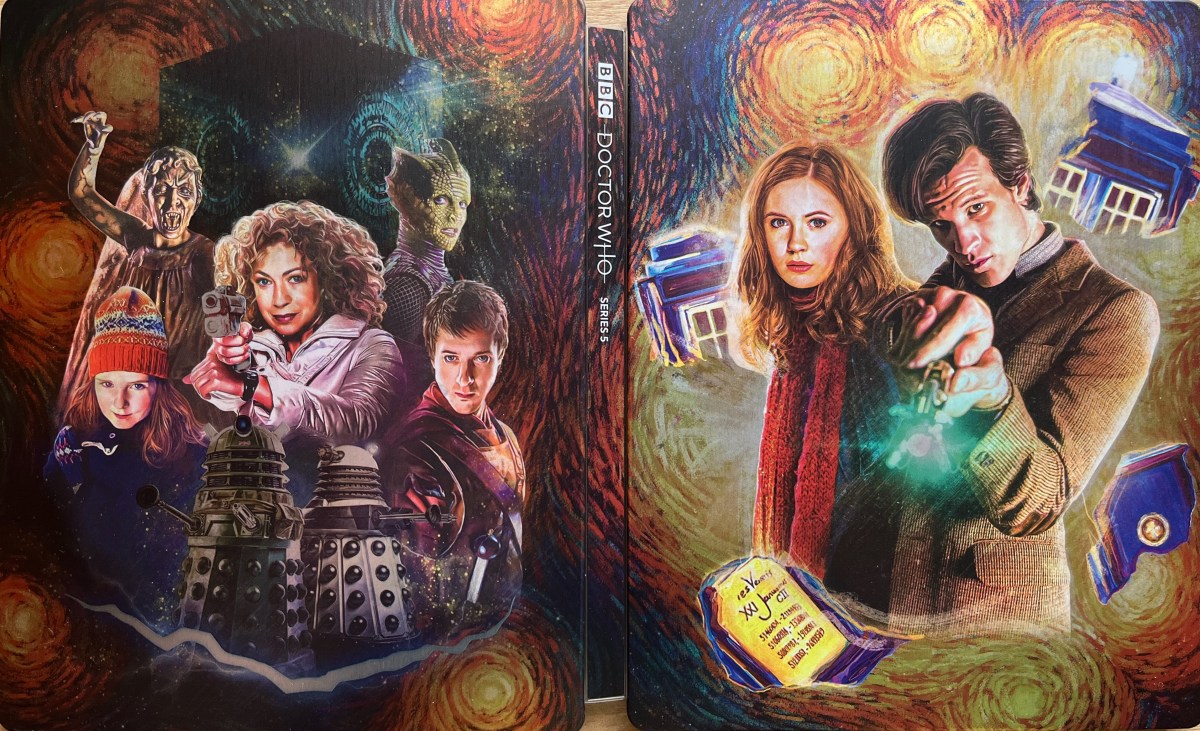
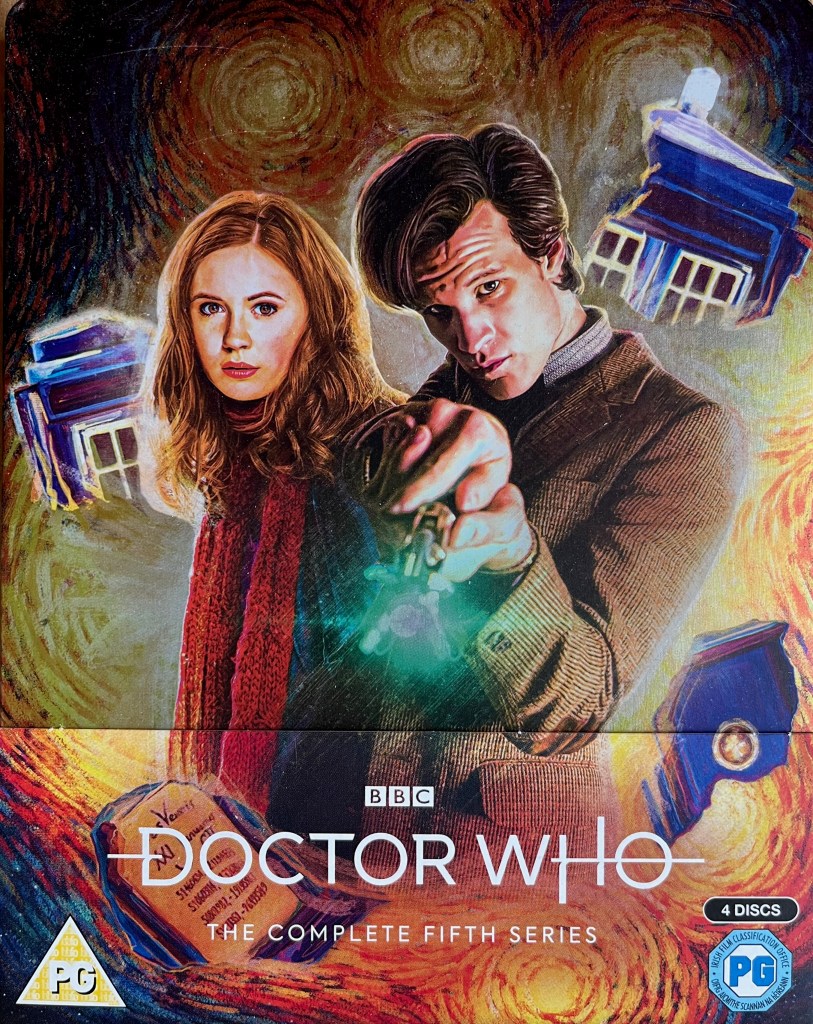
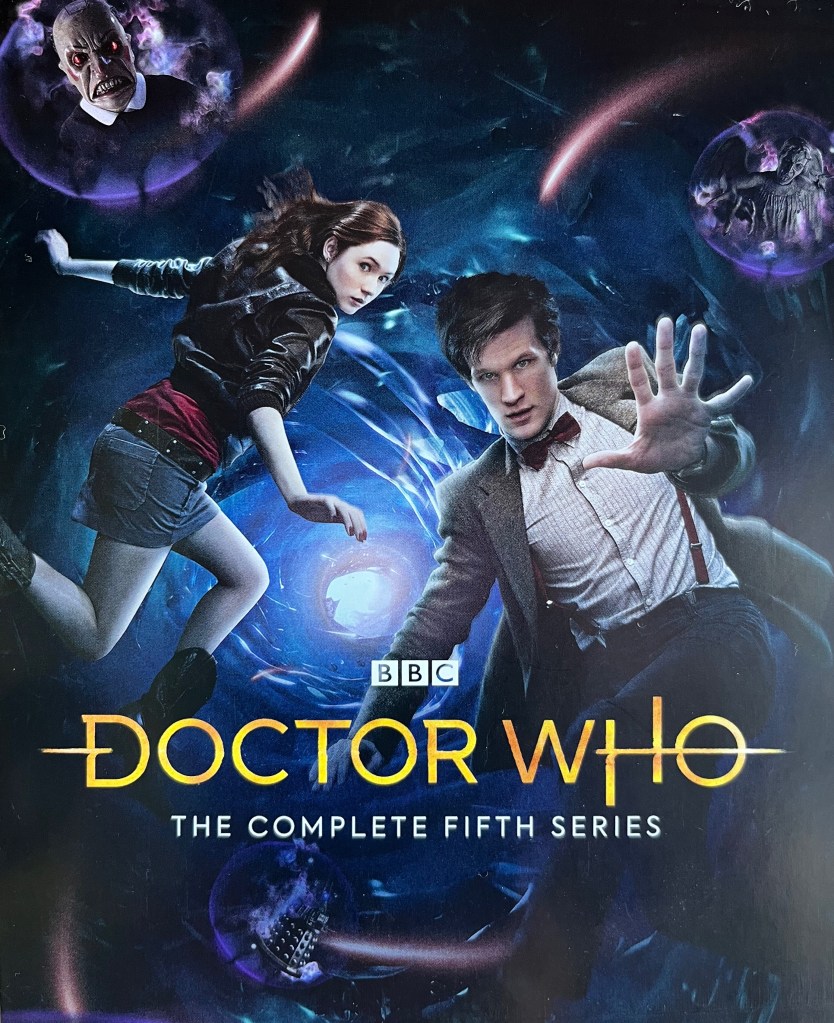
The cover of the steelbook set has beautiful artwork of course, as they all do, with the Doctor and Amy on the front, while we see River, Rory and various aliens on the back. But it is a bit disappointing that the outer pocket sleeve and internal leaflet both use the version of the Doctor Who logo from Jodie Whittaker’s tenure, rather than the one that was actually used for Series 5. This has been a frustrating trend with Doctor Who re-releases, using the logo from the year of the Blu-ray’s publication rather than the actual series that’s on the discs. It might seem picky, and I know it’s a desire by the BBC to ensure consistent branding for merchandise they bring out each year, so it’s not the end of the world. But it still feels very out of place to have the wrong logo.


A bigger let-down is that there’s no audio description or audio navigation in the Blu-ray set, which only becomes available from the next series. It is a real shame those features are absent considering they were on the original releases (with audio description from Series 1 onwards and audio navigation from Series 2). But audio description is available for every episode on BBC iPlayer at least (and sign language too), so you can enjoy them that way if need be.
Interestingly, in the behind-the-scenes Doctor Who Confidential series that accompanies Series 5, they do actually talk about audio description in Episode 8 (from 34:10 on iPlayer), as part of a longer section about how episodes are edited and made ready for broadcast. So it’s great to see audio describer Jo Sykes explaining what it is and how it’s added to the episodes, as it helps to raise a bit of valuable awareness about it.

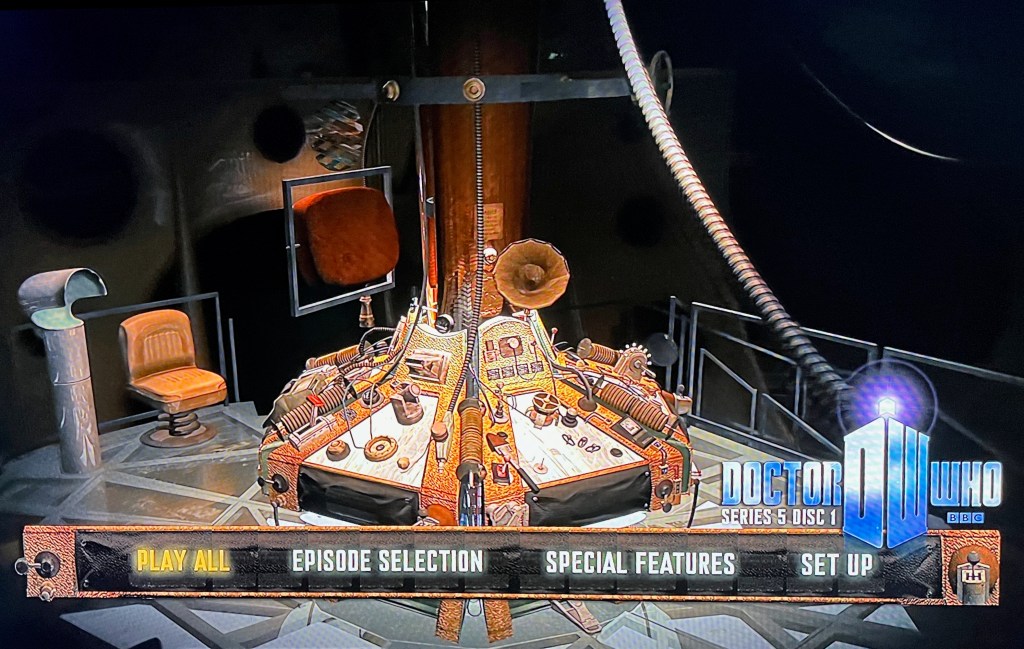
For those of us who can see the animated menu though, it does look pretty nice, being set inside the new Tardis. To begin with the Tardis monitor shows images from the episodes contained on the disc, viewed from different angles, but then the menu zooms out to give us a rotating 360-degree view of the console. The monitor isn’t used on the Confidential disc though, so it just goes straight to the console there. And before you get to the menu, it’s nice to discover that the copyright and logo screens are skippable, which doesn’t often happen on DVDs and Blu-rays, so that lets you get to the action much more quickly.


Episodes
Overview
Series 5 consists of 13 episodes, the first of which is an extended 65 minutes long, then the rest are 45 minutes each, until we get to the two-part finale, for which the episodes are 50 & 55 minutes. There’s no Christmas special this time, because the specials preceding this series marked David Tennant’s departure, but the longer first episode makes up for that a little bit.
Altogether the episodes cover 10 stories (7 single episodes and 3 two-parters), of which 4 stories are written by showrunner Steven Moffat, and the others have a different writer for each one, including a tense two-parter written by future showrunner Chris Chibnall and a beautiful single episode by legendary screenwriter Richard Curtis. There are also a number of recurring story beats throughout the series that are established in the first episode.
1. The Eleventh Hour
- Writer – Steven Moffat
- First Broadcast – 3 April 2010
- Links – BBC / Wikipedia / Tardis Wiki
This extended 65-minute episode deserves an extended review, because it’s an absolutely brilliant opener to the series that lays the key foundations for the other episodes to come. It features lots of action, humour, sweet moments and a superb soundtrack, as the Doctor and Amy both establish their characters and the connection between them really effectively. We also meet Rory too, but he doesn’t get his chance to shine just yet.
I like how the very beginning mirrors the start of Christopher Eccleston’s and David Tennant’s first episodes (Rose and The Christmas Invasion) by panning from the Moon to Earth and zooming in. It’s a nice little nod of recognition to the previous era, and makes things feel consistent. Then the out-of-control Tardis zooms across London, with the Doctor clinging on to the outside and nearly coming a cropper on Big Ben (as if that poor clock hadn’t suffered enough in the Aliens of London episode in Series 1). Murray’s score for this sequence (Down To Earth) is suitably epic as well.
London of course looks gorgeous at night, but Steven Moffat is quite open in the audio commentary about the fact that it looks wrong, because it shouldn’t have the Millennium Dome or the London Eye in it. They were opened in 2000, but as the episode establishes a 14-year gap in total between the Doctor’s initial arrival and Amy boarding the Tardis in the present day (2010), the Doctor must have first met her in 1996 (which is confirmed during the finale), meaning the Tardis fell through time as well as space after the regeneration.
But you don’t really notice or care about that, especially if you watch the episode for the very first time without knowing the specifics of the timeline until later, and also because it’s just a very cool sequence anyway. And there could be other explanations as well. For instance, the 10th Doctor left Earth in 2005 after going back to see Rose, so maybe the Tardis was flying over London that year, meaning the visuals are accurate, but then fell through time to 1996 before its crash landing. Nothing in the episode suggests otherwise, and if the Tardis isn’t behaving properly then it’s perfectly possible.
Anyway, the Doctor crashes into the garden of a little girl called Amelia Pond, played absolutely wonderfully by Caitlin Blackwood – a cousin of Karen Gillan herself, which explains the close resemblance, although the two of them had never actually met until the read-through for the episode. It’s incredible to think that Caitlin had never acted before this, as you wouldn’t know otherwise. She’s just so adorable and fun, and tugs at the heartstrings as well, which is no mean feat for an adult actor to pull off, never mind a child making their debut, and in such an iconic show.
The way that Amelia reacts to the Doctor is great, enjoying the arrival of this mysterious stranger despite her bemusement at his weird behaviour, as it makes her feel a lot less lonely, and it’s someone who could possibly help her with the voices she can hear through a strange crack in her wall. Murray Gold’s theme for Little Amy reflects this too, combining beautiful motifs for her cheerfulness and wonder with occasional elements of tension and unease. There’s a fairytale-like feel to her life and her home, and she does have a magical charm to her.
As for the Doctor, he’s still recovering from his regeneration, which was rather a powerful one given that it destroyed the interior of his Tardis. So he’s still trying to get used to his new body, he doesn’t have his time machine while it rebuilds itself, and his sonic screwdriver is also temperamental before giving up on him altogether. Yet despite all of that he still has to save the world somehow, so he can’t just rest in bed for a while like the 10th Doctor did. It all makes for a very interesting and often amusing story.
When it comes to his new body, of course, one of the funniest and most memorable scenes is where he tries different foods before settling on fish fingers and custard, which is again scored nicely by Murray. It’s a nod to a scene involving Tigger in the book The House at Pooh Corner by A.A. Milne, and it really sets the tone for the humorous side of the series, demonstrating the talent that Matt has for comedy. And the Doctor Who team have had more fun with it since then, celebrating Fish Fingers & Custard Day in 2013 by challenging people to make something creative out of those foodstuffs. There was also a callback to the scene much more recently, at the end of Boom in Ncuti Gatwa’s first series in 2024, which was a lovely surprise.
And no, I’ve never tried fish fingers and custard personally. I know many people online have, and I would guess it doesn’t taste too bad, as both of those things are nice on their own. But I’ve never had the temptation to buy those items just to give it a go.
Anyway, the Doctor takes a real shine to Amelia straight away, partly because she’s just so cute and isn’t fazed by him, partly because he’s been on his own for a while so it’s nice to make a new friend, and partly because he’s intrigued by the crack in her wall that she’s worried about, because it’s actually a crack in the universe, and opening it reveals a big eye looking for someone called Prisoner Zero.
Before he can deal with that though, he needs to fix his Tardis as it’s still in trouble from the crash landing. So the Doctor promises to be back in 5 minutes and flies off, with Amelia eagerly packing a suitcase and waiting for him in the garden, to a lovely piece of music called Can I Come With You?. And you feel so sorry for her, because you know he won’t be back. In fact, he disappears for 12 years!
During that time, as we learn in the episode, Amelia has been obsessed with thoughts of the “Raggedy Doctor”, as she calls him. She’s been drawing and making things in relation to him, and telling other people the story about meeting him, but nobody has believed her, and she’s seen 4 psychiatrists.
We later got an extra insight into this period of Amelia’s life during the first Covid lockdown, when Steven Moffat wrote a bonus scene that was posted online. Caitlin returned as the voice of Amelia, narrating a lovely letter about the Doctor, with several mentions of Rory too, and there are beautiful illustrations accompanying it, So it’s a nice addition to the story.
So when the Doctor does eventually return and explores the house again, he’s knocked out by a cricket bat, and wakes up to find himself handcuffed to a radiator with a young policewoman looking at him – the now adult Amy, who has shortened her name from Amelia and become much more feisty and self-assured. And yes, she does look sexy, I have no shame in saying that, especially as the very first shot that introduces her shows off her figure very nicely, starting at the legs and slowly moving upwards. There are a few little things in this episode for the adults in the audience, with that being one of them, along with the revelation that she’s a kissogram and a later joke about deleting a guy’s internet history.
The Doctor is surprised enough to discover that it’s Amy. But he also learns that Prisoner Zero is a shape-shifting alien who has been using a perception filter to hide in a secret room in Amy’s house, and that the Atraxi who are chasing the convict are threatening to incinerate the planet if he doesn’t give himself up.
So once the Doctor has persuaded Amy to let him go, the two of them head off into the village so he can try and sort things out, with Amy still less than trusting of him. For the two of them it ultimately leads to a delicately scored and filmed scene where he returns an apple to her with a carved face in it, that she’d given to him the first time they met. While she’s waited over a decade to see him again, for the Doctor it’s only been a matter of hours, so the apple is still as fresh as the day she handed it to him. That pivotal moment between them is shot in slightly slow motion, with a lens flare that comes across as well, and it beautifully encapsulates the connection that forms between them.
That’s just one of many examples where a lot of thought has gone into the visuals in this episode, with another being a clever stop-frame photo sequence, which is used to show the Doctor’s thought process as he analyses the scene in front of him. He hones in on Rory, who is the only person taking a photo of something different to everybody else. And that’s because Rory is a nurse who has been witnessing strange behaviours amongst coma patients in the hospital, whose appearances Prisoner Zero is replicating out on the streets. So Rory is getting photo proof that a duplicate of one of the patients is outside, as his boss (played by Nina Wadia) doesn’t believe him.
Knowing that time is running out, the Doctor then hacks into a video call with a panel of experts, including an amusing guest appearance by astronomer Patrick Moore. I love the music underpinning this scene – The Sun’s Gone Wibbly – which is one of my favourite tracks on the album, with a great pace and rhythm that builds to a triumphant conclusion.
Incidentally, watching from the sidelines in that scene is another great guest star – Annette Crosbie, best known as Mrs Meldrew in One Foot In The Grave of course, who appears a few times in this episode. And talking of sitcom stars, it’s fun to see the cameo by Perry Benson as the ice cream seller, who I’ve enjoyed seeing in Oh, Doctor Beeching! and You Rang, M’Lord?.
But perhaps the biggest guest is award-winning actress Olivia Colman, who plays a mother that Prisoner Zero takes the form of when falling into the Doctor’s trap (which involves setting all the counters in the world to zero, with a track on the album bearing that name). Before being taken by the Atraxi, however, Prisoner Zero warns the Doctor that they didn’t open the crack in the universe. Instead, she leaves him with the ominous message that the Pandorica will open and silence will fall, thus establishing more key narrative points for the series that pay off later.
So the Atraxi take the prisoner, but the Doctor isn’t satisfied that they’re just going away, because he wants them to stay away. So he orders them back and addresses them directly, while he works on putting together his new outfit. He gets them to look at the aliens who have tried to take over Earth and who has been responsible for defeating them every time, which means we see all of the Doctor’s previous incarnations before Number 11 walks forward to announce that he now holds that title. With his tweed jacket, braces and bow tie, he looks eccentric and very cool, and it really suits him.
It’s a strong entrance for this new iteration, because you know he’s right. You can feel that his journey throughout the episode has led to this moment of confident realisation and authority. The Doctor has found himself again, and you’re reassured that the universe is in safe and capable hands. It’s made all the more brilliant by the music track entitled I Am The Doctor, one of the greatest pieces of music Murray Gold has ever composed for the show, and I would go as far as to say the best theme for any of the Doctors. It’s a glorious, uplifting piece, notable for having its main melody in 7/4 time while some other sections are in 4/4, and it recurs frequently throughout the series in various ways, as do some other motifs we hear during this episode.
The Doctor then rediscovers his Tardis and takes it for a spin, again promising to come back for Amy – but this time he inadvertently leaves her behind for another 2 years! Hence it’s taken 14 years altogether, including the previous 12-year absence, before he finally invites her on board to travel with him. He also assures her that he is indeed a madman with a box, which is the title of another lovely bit of music that plays when he flies off for his initial test drive. The snapping of his fingers to open the doors is a nice nod back to the Silence In The Library two-parter from Series 4, also written by Steven Moffat, as the Doctor was shown that trick by River Song, who we meet again later in this series.
We then enter the Tardis with Amy, a magical moment that’s suitably scored by Murray, and it does look amazing, with lots of colour, a wide variety of bits and bobs on the console from a bell to an old typewriter, and multiple levels that make it a bigger and more versatile space than it was before. The Doctor gets a brand new sonic screwdriver as well.
While Amy is persuaded to travel with the Doctor, however, she is still keen to get back for the next day as well. She doesn’t tell the Doctor why, dismissing it as just ‘stuff’, but as they fly off we’re shown some of the drawings and models she’s made of the ‘Raggedy Doctor’, before seeing the wedding dress hanging up in her wardrobe. The Doctor isn’t entirely honest with her either though, saying that he just wants her company as he’s been a bit lonely, but he’s also keen to find out more about the crack in the universe that he saw in her bedroom. The episode then concludes with a tantalising trailer for the rest of the season before the credits roll.
So there’s a huge amount packed into this story. As Steven Moffat acknowledges in the behind the scenes Confidential episode, he had quite a challenge on his hands. He had to make his mark when launching this new era of the show by introducing a new Doctor, new companion and new Tardis, in a way that was entertaining and made the show feel refreshed yet still the same, retaining the current fans and drawing in new ones.
But he pulled it off wonderfully. The story is a great way of bringing everything together, and there are several elements set up for the rest of the series, including the crack in the universe, the Pandorica, the Silence and Amy’s wedding.
2. The Beast Below
- Writer – Steven Moffat
- First Broadcast – 10 April 2010
- Links – BBC / Wikipedia / Tardis Wiki
Before watching this episode, the Blu-ray includes an additional 3-minute scene called “Meanwhile, In The Tardis…” as a bonus feature, which should be watched first. While not essential to the main plot, it’s a very amusing scene where Amy bombards the Doctor with questions about the Tardis and himself, and he explains things like the faulty chameleon circuit. Then the Doctor opens the doors to show her that they’re now in space, and playfully pushes her out. That explains why Amy is seen floating outside the Tardis in her nightie, enjoying the bliss of zero gravity and the infinite starscape, with the Doctor holding on to her leg so she doesn’t float away, after the opening titles of The Beast Below.
Once she’s back inside, they discover that they’re floating above a huge starship containing the entire population of the UK (well, except Scotland, we later learn, who decided to have a ship of their own, which is an amusing reference to the independence debate). They, along with the rest of planet Earth, had to vacate their home, and are flying through space to find somewhere else to live. The ship is divided into different areas for different counties and cities, and even key locations like Oxford Street, and there are lots of little details that are fun to spot, many of which are pointed out in the Confidential documentary.
When the Doctor and Amy land though – with Amy still wearing her nightie – they soon discover that all is not well (as if that needs saying for a Doctor Who episode). The Doctor is mystified to discover that the ship appears to be travelling through space without an engine, there are mysterious figures called Smilers locked in cabinets who turn their heads to show more scary and serious expressions if someone is disobedient, and a little girl is crying quietly with nobody paying her any attention.
The Doctor and Amy split up to find out more, and Amy refuses to let any warning signs keep her out of areas she shouldn’t be in. But this leads to her being knocked out, and she wakes up in a booth, where she’s presented with a video and a difficult choice. The video explains what’s really happening on the starship, and if enough people hit the Protest button, it will come to an end, with disastrous consequences. But by hitting Forget, your memory is wiped of the revelations – and Amy chooses that option, so is unable to tell the Doctor what’s happening when he finds her. But it becomes apparent that she filmed a video before pressing it, urging herself to get the Doctor away from the ship.
As the Doctor investigates the booth, Amy learns that he’s the last of the Time Lords. And then his curiosity leads to him pressing the Protest button to see what happens, which results in the two of them falling through the floor and landing in a disgusting mess, which turns out to be a creature’s massive tongue. And the only way out is to make it vomit them out. It’s not big on dignity, as the Doctor says, but it’s very funny, and in the Confidential episode you can see that they had a lot of fun filming it.
They’re then met by a confident, gun-wielding lady called Liz 10 – i.e. Queen Elizabeth The 10th, who rules the ship. The Doctor had met her earlier while Amy was looking around, but now we learn much more about her. She’s played marvellously by Sophie Okonedo, who was awarded an OBE in that year’s birthday honours, and a CBE in the 2019 New Year Honours, for services to drama. She’s also won a Tony Award and been nominated for many other major accolades, so she’s another very big star to have on the show. It’s not her first time appearing in a Doctor Who story either, as she had previously played the Doctor’s companion Alison Cheney in the 2003 animation Scream of the Shalka.
The other big guest star in the episode – playing Hawthorne, the head of the ship’s government – is Terrence Hardiman, well known to many as The Demon Headmaster, one of my favourite shows from my childhood. He later played King Sitric in a Big Finish audio play called The Book of Kells, involving the 8th Doctor. Terrence sadly died a couple of years ago, on 8 May 2023.
So when the Doctor, Amy and Liz 10 meet Hawthorne, they discover the truth about how the ship is being powered – by a Star Whale that’s being tortured to keep moving. Liz 10 learns some hard truths about herself in the process, and the Doctor is forced to make an impossible choice to resolve the situation, one which makes him angry, particularly with Amy for trying to stop him.
But it’s Amy, with her view of humanity that the Doctor doesn’t possess, who realises the solution and stops him from making a catastrophic mistake. It’s the key moment that cements her worth and importance as the companion, both to us and the Doctor, truly earning her place on the Tardis in such challenging circumstances. And when they do get back on board, they get a phonecall that leads them into the next episode. Unbeknownst to them, however, we see that the strange crack from Amy’s wall is on the side of the starship.
So it’s another solid episode for the Doctor and Amy’s first adventure together. And In terms of music, the most significant piece in this episode is the debut of Amy’s Theme, a truly beautiful composition that accompanies her from this point onwards. Beyond that, there are 3 other tracks on the album that are more dramatic or emotional – 2 in the main tracklisting (the episode’s title track and A Lonely Decision), along with a bonus track in the iTunes edition called Impossible Choice.
3. Victory Of The Daleks
- Writer – Mark Gatiss
- First Broadcast – 17 April 2010
- Links – BBC / Wikipedia / Tardis Wiki
Having travelled to the future in the previous episode, our heroes now find themselves called to the past, landing in the Cabinet War Rooms in London in the middle of World War II. Writer Mark Gatiss is given a tour of the real location in the Confidential documentary, which is really interesting, and it’s a museum I really ought to visit one day.
When they land, the Doctor and Amy meet none other than Prime Minister Winston Churchill himself, played with a great mix of authority, bravery and humour by Ian McNeice. He’s another actor who had previously starred in a Big Finish Doctor Who audio story, namely Immortal Beloved, and he later joined them again for a box set called The Churchill Years. In this episode he uses the motto that the real Churchill allegedly said everyday – “Keep buggering on!” – which is pretty famous, as even King Charles used it recently with some fellow cancer patients. I’m slightly surprised they were allowed to use the word “buggering” in a family show, even though in this context it doesn’t have a rude meaning to it, because I know how overly sensitive some people can be. But I’m glad they kept it in, as it suits the character and the situation perfectly.
Churchill is quite eager to show the Doctor their new secret weapon called Ironsides, invented by Professor Bracewell (Bill Paterson), which he is convinced will win them the war. But the Doctor is rather alarmed to say the least when he discovers that they’re actually Daleks, who are behaving in a surprisingly subservient manner, even offering people cups of tea. Churchill refuses to believe how evil they really are, which ultimately sends the Doctor into a frenzied rage, attacking one of the Daleks to try and provoke it. It’s the angriest we’ve seen him yet this series, much more so than with the difficult choice he had to make in the previous episode. Matt Smith has certainly grasped the opportunity to demonstrate his acting range in these opening stories.
But of course it’s a trap, and when the Doctor tells the Daleks who he is and what they are, his ‘testimony’ is transmitted to a spaceship orbiting the planet, where it helps to trigger the Progenitor, a device containing DNA that enables them to cultivate a new race of Daleks. The Doctor boards the spaceship and threatens them with a Jammie Dodger, pretending it’s a Tardis self-destruct button, before he witnesses the new Daleks as they emerge.
The new Paradigm Daleks, as they’re called, are much bigger than their predecessors, and come in a variety of bright colours. And it’s safe to say they caused a lot of controversy at the time, which is acknowledged in the audio commentary. Children liked them, but many adult fans of the series were dead against them. So there were tweaks made in later years, and over time the more popular Daleks from before took centre stage again. Personally, I do agree the redesign was too radical and the colours do look strange, but the new Daleks serve this story perfectly well and I don’t despise them. Like any civilisation it’s natural for the Dalek race to experiment and adapt in its attempts to survive, so of course they’re going to try different looks.
The Daleks aren’t attacking people on Earth though. Instead, they want to help the humans destroy themselves, by transmitting a signal from their ship that turns on all the lights in London, illuminating the city like a beacon to the Nazis in the middle of the night. Professor Bracewell, however, is actually an android created by the Daleks and thus has superior scientific knowledge to normal humans. So he figures out how they can stopped.
That leads to a really cool dogfight with Spitfires in space, as the pilots attempt to take out the transmitter dish on the Dalek ship. They eventually manage to do so, and the Doctor urges the pilots to destroy the ship – only for the Daleks to give him another frustrating dilemma. It’s a golden opportunity for the Doctor to destroy the Daleks once and for all, but they’ve planted a powerful bomb inside Bracewell that will destroy Earth if the Doctor doesn’t stop it. So of course he has to let the Daleks go, much to his annoyance.
The Doctor then tries to get Bracewell to override the bomb by thinking of how human he is, even if that means focusing on negative thoughts about tragic experiences to fire up his emotions. But once again it’s Amy who figures out the best approach, and the Doctor is able to work with her to stop the explosion. The two of them are becoming a pretty good partnership by this point.
That said, however, the Doctor is now very concerned about Amy, because somehow she doesn’t remember the Daleks invading Earth before. She would have been alive to witness the events that took place in the Stolen Earth finale of Series 4, and couldn’t possibly have missed them, yet she has no recollection of any of it. And then when the Tardis departs, the mystery crack is on the wall behind it.
So it’s another really good episode, even if the new Daleks do look rather odd. As noted in the commentary, it could easily have been spun out into a two-parter, and perhaps it should have been. But in just 45 minutes it is an exciting, fast-paced adventure. It really does feel like a mini war movie, and the soundtrack reflects that with its powerful orchestral score. It’s represented on the album by the tracks A Tyrannical Menace, Victory Of The Daleks and the particularly epic Battle In The Sky, plus a bonus track in the iTunes edition called Emotions Get The Better Of Him.
4 & 5. The Time Of Angels / Flesh And Stone
- Writer – Steven Moffat
- First Broadcast – 24 April & 1 May 2010
- Links (4) – BBC / Wikipedia / Tardis Wiki
- Links (5) – BBC / Wikipedia / Tardis Wiki
Having had so much success with his Blink masterpiece in Series 3, of course Steven had to bring the Weeping Angels back for this series. They’re particularly scary and difficult monsters to defeat, because they’re solid rock statues when being observed, but they’re lightning fast when you take your eyes off them, even for a split second. In Blink it was established that if they touch you, they throw you back in time, forcing you to live to death in the past, while feasting off the time energy you’ve lost in the present. In this story they just kill people outright instead, but the manner in which they get to them is still the same, so they’re no less scary.
In addition, this story also marks the return of River Song, played by the marvellous Alex Kingston. She first appeared in another of Steven’s adventures – the Silence In The Library two-parter from Series 4. She’s a time traveller like the Doctor, but she and him keep meeting at different points in their time streams, so never in the right order. Because of this, River keeps track of their meetings in her Tardis-blue journal, which therefore contains details of the Doctor’s future that he’s unaware of – and in that Series 4 story she mentioned the crashed Byzantium spaceship that they’re now visiting in this series.
The Doctor finds her very unnerving because of that, when he’s so used to being the one who knows everything – although the one thing he does know is how she’s going to die, because he saw it happen in his previous meeting with her. So there’s a very unique and fascinating dynamic between them. And they have such brilliant chemistry together, whichever Doctor she’s appearing on screen with. It is very awkward for him sometimes, but he has a lot of admiration for her too, even if he doesn’t like to show it. And he always comes running whenever she calls, even though he tries to insist that he can’t always be there for her.
We learn a bit more about her in this story too, when it’s revealed that she’s been in prison for killing a “good man”, implying the Doctor, which is dealt with in the next series. And talking of Series 6, it also contains a huge revelation about River’s identity, which makes rewatching Series 5 all the more interesting, because it puts a whole new spin on her interactions with certain people.
Anyway, River makes a suitably big entrance to get the Doctor’s attention here, by planting a message (scored by the track River’s Path) that he finds in a museum, leading him back 12,000 years to rescue her in space, which is a very cool scene. She then demonstrates that she can fly the Tardis better than he can, even stopping it from making the usual noise when it lands, which irritates him. It’s also funny to see Amy teasing the Doctor about him and River being like a married couple.
They then follow the Byzantium spaceship that River had been investigating, and discover that it has crash landed on a planet. So she summons some troops – a group of clerics led by Father Octavian (Iain Glen) – to help her and the Doctor hunt for and destroy a Weeping Angel that’s been held in a vault on the ship.
They check a short piece of looping video of the Angel that was recorded on CCTV, but when Amy is then left alone with the recording, the Angel moves and appears to come out of the screen towards her. She’s rescued of course, but isn’t completely out of danger, as she soon finds dust coming out of her eye. Then later she’s fooled into thinking that her hand has turned to stone, until the Doctor bites it to prove otherwise (and Matt deliberately bit Karen for real to get the best reaction, so her shriek of surprise is genuine!).
The dangerous journey through the caverns (represented by the tense album track The Time Of Angels) doesn’t end well for a few of the clerics, and it becomes apparent that all of the statues are Angels, even if they don’t have the traditional weeping appearance. The Doctor and the gang then end up trapped in one particular section of the cave, with no way of climbing up to the spaceship they can see high above, and Angels converging from all sides.
The Doctor, however, has been communicating with one of the Angels, who is talking to him using the voice of Bob, one of the victims. And in one of those rare instances where we see the Doctor brandishing a gun, he gives a defiant speech – one of the most iconic and memorable of Matt Smith’s entire run – warning that they should never put him in a trap, before firing at a gravity globe floating in the air. Whether we should have actually seen what he was firing at is debatable, as it could have been kept as a mystery, and even in the commentary Steven Moffat isn’t sure. But it’s a fantastic cliffhanger to the first part nonetheless, because of the way it builds, the Doctor’s angry determination and the music that swells to the final moment.
So it was a great shame – again as discussed in the commentary – that the BBC completely ruined the tension of the cliffhanger on the original broadcast by overlaying a colourful banner advertising the talent show Over The Rainbow, with a dancing animation of presenter Graham Norton! It didn’t affect the transmission on BBC HD, for those fans lucky enough to have that channel, but the millions of viewers on BBC One saw it.
Subsequent investigation found that the trail was inadvertently put on screen 20 seconds too early. But at the time, fans were incensed – quite rightly to be fair – and there were 5,600 complaints, as a result of which the BBC apologised. Charlie Brooker also had an explosive rant about it on his comedy panel show You Have Been Watching (where Chris Addison also mocked the new Daleks). Graham was a good sport about it though to be fair, referencing the incident on his chat show by displaying a similar banner where he was exterminated by a Dalek.
This wasn’t the first time that Graham had inadvertently interrupted Doctor Who either, as his voice was heard during the very first episode of the reboot back in 2005, when Rose was exploring the basement of the department store. However, he did finally get to appear in the show properly earlier this year, during Ncuti Gatwa’s second season, when a hologram of him appeared in The Interstellar Song Contest. So it was great to see him finally get a role.
Anyway, the second part is then all about Amy really. Although the group get out of the trap in the cliffhanger, allowing them to board the Byzantium spaceship, it doesn’t stop the Angels chasing them, and Amy involuntarily starts uttering a countdown while they desperately try to get away, which Bob tells the Doctor the Angels are doing just for fun.
Her life then dwindles, and the Doctor figures out that because she looked into an Angel’s eyes, it’s got into the visual cortex of her brain and is killing her. So the only way to buy them time is for Amy to close her eyes. It temporarily stops the Angel inside her mind, but she’ll die if she opens her eyes again for more than a second. It’s a nice switch from the usual concept of having to keep looking at the Angels all the time, and is just as scary, if not more so.
The Doctor has to leave Amy for a while though, so that he and River can go to a flight deck on the other side of the ship, which involves passing through a special forest that serves as an oxygen factory. They leave the clerics to look after her, but the crack from Amy’s wall appears and starts emitting a bright light, and when any of the clerics go to investigate it, they’re erased from time and forgotten about by their colleagues. So the remaining clerics go to check it out themselves, thinking nobody else has done it yet, and meet the same fate. So Amy is left on her own.
We learn, therefore, that the crack is spewing out time energy, and anyone who gets caught by it disappears from existence and was never born. So even the Angels are afraid and are trying to get away from it. But it means that Amy has to get away from it too, by crossing the forest to the flight deck with her eyes closed. The Doctor, talking to her through a communicator device, has to be quite stern with her to make her move sometimes, given that it’s the most terrifying thing she’s ever had to do. And he’s frustrated in general as he tries to fix things, yet again having moments of anger. Amy’s journey doesn’t go smoothly though, as she has to pass through a group of Angels and then trips over, losing the communicator.
It all works out fine in the end of course, thanks to a bit of help from River Song, and the Angels make a crucial misjudgement that enables the Doctor, Amy and River to get away. The Angels fall into the time energy, with the crack forced to close as a result, and as they now never existed, the Angel in Amy’s mind is also cleared, so she can use her eyes normally again. River Song also departs, but promises that she’ll see the Doctor again when the Pandorica opens. She’s referring to the series finale, but in her timeline she’s already been through it.
Amy then gets the Doctor to take her home on the day they left – which he manages to get right this time – and she reveals her impending marriage the next day. But because she’s also been through such a harrowing experience, only to be saved by this young handsome Doctor, she also tries to get amorous with him! It’s very funny to watch his naivety and awkwardness over her seduction (although some miserable viewers did complain about it). But he also has the unsettling revelation that the date of her wedding matches a date code he ascertained from the crack’s time energy. So he bundles her back into the Tardis to try and get things sorted out.
And so ends the first two-parter of Steven Moffat’s era, and it’s a cracker, I’ll give him that, with lots of action and scary moments. The Weeping Angels may not behave quite the same as they did in Blink, in that they don’t send people back in time, but they’re still very frightening given the way they’re able to approach their victims. It’s also fantastic to see River Song again, and it’s a really good storyline for Amy to get stuck into.
6. The Vampires Of Venice
- Writer – Toby Whithouse
- First Broadcast – 8 May 2010
- Links – BBC / Wikipedia / Tardis Wiki
There’s another “Meanwhile, In The Tardis…” scene on the Blu-ray that goes between the previous episode and this one, lasting 4 minutes. It’s a very amusing scene where Amy is still trying to seduce the Doctor a bit, and then learns about his many previous female companions, who we get fleeting glimpses of.
Then the main episode is where Rory gets his first taste of travelling with the Doctor – although it doesn’t get off to the most auspicious start, as the Doctor bursts out of a cake at Rory’s stag do and tells him that Amy kissed him, oblivious to the massive faux pas he’s just made. So that naturally causes some tension between the engaged couple during the episode, not just over that kiss, but Amy’s fascination at travelling with the Doctor in general, without involving Rory until now.
The Doctor is also a little bit peeved with Rory, incidentally, because be doesn’t mention how big the interior of the Tardis is relative to the outside, like most people do. So that’s quite amusing. It turns out that Rory has actually done some scientific reading since the Prisoner Zero encounter, so he’s not quite as shocked by things as some people might be.
Anyway, the Doctor wants the two of them to have a romantic holiday together, so he takes them to Venice in 1580. But as usual there’s trouble afoot, as they discover a school run by creatures who are rather like vampires, taking in girls so that they can suck out the human blood and replace it with their own, to provide companions for the males of their species residing underwater. When the Doctor confronts their leader Rosanna (Helen McCrory) about this later on, he learns that she and her fellow aliens ran from “the silence” and “the cracks”, and that their plan is to alter the weather to sink Venice underwater, in order for their race to take over.
So as you can imagine, there are plenty of tense moments as our heroes investigate and encounter these villains, who only look human when their perception filters are on, but without them they’re actually fish-like monsters. Amy even goes undercover with them at one stage, as if she hasn’t been in enough danger lately. But the Doctor naturally gets everything sorted out in the end, even if it means a treacherous climb up a spire in the middle of a big storm.
Throughout the experience Rory’s like a fish out of water of course, and proves that he hasn’t got any fighting skills whatsoever. But he’s still highly protective of Amy nonetheless, even giving the Doctor a well-deserved dressing down at one point for putting people in danger by making them want to impress him. So he can absolutely stand up for himself and Amy when it’s necessary. And the experience does bring him and Amy closer, as they’ve now shared in a uniquely dangerous situation together. So Amy asks the Doctor if Rory can travel with them a bit more, which he happily agrees to.
Altogether, therefore, while it’s probably the weakest episode of this series in relative terms, it is visually beautiful, and is a very nice way of bringing Rory on board, as we get to see how he reacts to being thrown into a perilous situation. He might not be the strongest person in mind or body at this point, but he’s still intelligent, brave and assertive when it counts, and overall a lot of fun. And we also start to see why he and Amy make such a great couple.
In terms of music, there are 5 tracks for this episode on the album, which aren’t particularly outstanding but they evoke the setting and atmosphere nicely. In particular, Cab For Amy Pond has a nice rhythm to it and a little nod to her main theme, while The Vampires Of Venice has a good mix of dramatic and calm moments.
And visually the episode is really beautiful as well, as you’d expect with a setting like Venice. It wasn’t actually filmed there – they used a town in Croatia instead – but Matt Smith joins writer Toby Whithouse for a very interesting tour of the real Venice, guided by a local expert, in the Confidential documentary.
7. Amy’s Choice
- Writer – Simon Nye
- First Broadcast – 15 May 2010
- Links – BBC / Wikipedia / Tardis Wiki
This story was written by Simon Nye, best known for creating the sitcom Men Behaving Badly, although this is obviously much cleaner!
It does feature one man behaving particularly badly though, called The Dream Lord. He’s played by the excellent Toby Jones, who I know for being the voice of Dobby in the Harry Potter films, and for playing subpostmaster Alan Bates in the true life drama Mr Bates vs The Post Office at the start of 2024. But he has hundreds of acting credits, he’s a hugely versatile actor.
Here he calmly and smugly taunts the Doctor, Amy and Rory as he sets them a challenge. He keeps making them fall asleep and then wake up again, alternating between two very different scenarios, with each containing their own unique dangers. They both feel real, but if they can work out which is the dream and save themselves in reality, then he’ll let them go, otherwise they’ll perish.
So on the one hand, a heavily pregnant Amy and a pigtail-wearing Rory are leading a happy life in the quiet country village of Leadworth and the Doctor comes to visit them 5 years after they stopped travelling with him. But all of the old people in the village actually have deadly alien monsters inside of them. In the other possible reality, however, the Tardis has lost power and is floating towards a cold star that will freeze all 3 of them to death.
It makes for a very interesting and tense story as the trio keep switching between the different situations, and it even generates some friction between them. It feels pretty obvious which one is the reality, but being Doctor Who you can never quite be perfectly certain.
It’s Amy who eventually makes the decision though, as Rory is killed in front of her in their country home and the Doctor is unable to save him. It’s another pivotal moment for her in the series, because despite any feelings she might have towards the Doctor, it makes her realise that it’s Rory she wants most of all. Sometimes you don’t realise what you’ve got till it’s gone. So she makes the decision to end things in that reality, because she can’t bear to live without him, and once the Doctor has made certain it’s what she wants, he fully supports her. It’s all quite moving, as Karen Gillan plays it really well.
They do wake up in the Tardis though, nearly frozen, and Amy is relieved to find Rory alive there as well. So the Dream Lord restores their power in order for them to fly away. The Doctor though, takes it upon himself to blow up the Tardis anyway, because he realises it’s also a dream.
They then wake up properly in the real Tardis, and discover that they had inhaled some powerful psychic pollen that had led to their collective dream state. The Dream Lord had therefore been a manifestation of the Doctor’s dark side that had been turned against him and his companions, which is a nice little twist at the end, and makes rewatching the episode even more interesting when you know that. Rory also learns about his death in the dream world, and Amy’s decision in response, and the two of them are brought even closer together. It’s really sweet.
Finally, the episode is represented by two tracks on the album – Wedded Bliss, a short piece with a ticking clock motif beneath the main melody, and This Is The Dream, which evokes the tension of the story.
8 & 9. The Hungry Earth / Cold Blood
- Writer – Chris Chibnall
- First Broadcast – 22 & 29 May 2010
- Links (8) – BBC / Wikipedia / Tardis Wiki
- Links (9) – BBC / Wikipedia / Tardis Wiki
This story, set in 2020 in a Welsh village, is all about a mining operation that’s attempting to see how far down into the Earth it’s possible to drill. But they unwittingly disturb a race of lizard-like Silurians, who were the original inhabitants of Earth long before humans existed, and they vow to get revenge on the ‘apes’ they perceive as invading them. So the Doctor has to try and avert a war and deaths, by getting the humans and Silurians to negotiate.
But of course, being a two-parter – and another great one at that – it gets pretty complicated and tense, and not everything goes to plan. And there’s a great cast of characters who drive the story along well.
By far the most recognisable star is Meera Syal, best known for her starring roles in the comedies Goodness Gracious Me and The Kumars at No. 42, though they’re not shows I ever got into personally. She plays the leader of the mining operation Nasreen Chaudhry very well, and she even gets to ride in the Tardis with the Doctor when he goes down into the centre of the Earth to talk to the Silurians.
The other particularly notable star is Neve McIntosh, though she’s not visually recognisable given that she’s in prosthetics as a Silurian. She plays Alaya, who is captured by the Doctor and Rory as a bargaining chip, given that the Silurians have taken Amy along with a guy called Mo and his son Elliot. The Doctor entrusts her welfare to the other humans while he and Nasreem go below ground, but Alaya is very good at getting under their skin as she talks to them, knowing that the success of the negotiations depends on her staying alive. Neve also plays Alaya’s sister Restac in the story as well.
Neve then returned in Series 6 playing another Silurian called Madame Vastra, who became a popular character, appearing several times between 2011 and 2014.
The aforementioned Mo, meanwhile, played by Alun Raglan, also gets a bit of a taste of life with the Doctor, through Amy. When she escapes from her confines in the Silurian world, she releases Mo as well, and they both go exploring to find answers, with Amy showing her skills and confidence in working things out that she’s learned from the Doctor. So that’s quite fun.
Mo’s dyslexic son Elliot (Samuel Davies) also deserves credit for being great as well, because before he’s captured he does a great job at helping the Doctor. The other major characters are then Tony (Robert Pugh), who gets infected by Silurian venom, and Ambrose (Nia Roberts), whose actions threaten to scupper the whole operation, much to the Doctor’s fury.
Fortunately there are good members of the Silurian race as well as the angry military arm of their civilisation, and peace reigns in the end. But that doesn’t necessarily mean a happy ending for our heroes.
As the Doctor, Amy and Rory prepare to board the Tardis, the crack appears in a nearby wall, now quite large and bright. Figuring it must be caused by an explosion, the Doctor bravely reaches in to find traces of shrapnel – only to be alarmed to find that the piece he grabs is from the door of the Tardis.
Not only that, but the angry Silurian Restac attempts to kill the Doctor by shooting him, but Rory dives in the way to save him and takes the hit instead. So unlike the dream in the earlier episode, poor Amy now gets to see him dying for real. Rory then gets grabbed by the time energy from the crack, forcing the Doctor to pull Amy away and into the Tardis for her own protection, despite her immense distress.
With Rory being erased from existence, his memory also appears to get erased from Amy’s mind, despite the Doctor’s best attempts to get her to cling on to the memory of him. And the Doctor feels awful about letting Amy down, because if he hadn’t stopped to investigate the crack and had got everyone into the Tardis, Rory would still be alive. So it’s a shock ending to the episode, that’s for sure. Ok, I knew it was coming this time, but it still hits hard nonetheless.
As for the music, there are 2 tracks for this story on the album, called Rio De Cwmtaff (which starts off cheerful but gets much more dramatic halfway through) and The Silurians (which also has plenty of drama in it).
10. Vincent And The Doctor
- Writer – Richard Curtis
- First Broadcast – 5 June 2010
- Links – BBC / Wikipedia / Tardis Wiki
This is a lovely episode that handles the sensitive subject of depression and suicide very well, while still incorporating adventure and humour. Only an esteemed writer like Richard Curtis could pull that off effectively, and it’s quite a coup for Doctor Who to get him on board.
The Doctor is treating Amy to a visit to a Van Gogh exhibition, where Bill Nighy plays curator Mr Black. But the Doctor spots a monster in a window of the painting The Church at Auvers, so they go back in time to meet Vincent himself – played by Tony Curran, who is fantastic in the role and naturally looks like the artist as well.
We see how Vincent was shunned by everyone around him, who think that he’s mad and don’t deem his work to be anything special. So he doesn’t have much confidence in himself either, and is quite surprised to see how keen the Doctor and Amy are, plus he finds himself attracted to Amy as well. But he allows them to come and stay with him for a night, where they’re enthralled by the many artworks he’s been working on.
As for the monster, it turns out that it’s invisible to most people – even the Doctor – but Vincent is able to see it, and so is the Doctor once he’s rigged up a special device to reflect its image to him. The Doctor then encourages Vincent to go and do the painting of the church so that the monster can appear there, but it’s not easy to convince him. There’s a moving scene in which he gets very upset and aggressive, and the Doctor is very gentle, compassionate and understanding towards him, as indeed he is throughout the whole episode. It’s clear just how much the Doctor cares.
During the showdown in the church we then learn that the creature is blind, and had been abandoned by the rest of its species. But Vincent accidentally stabs it with his easel, leading to another sad scene in which the Doctor comforts it during its passing, as it’s very afraid, while Vincent looks on, racked with guilt.
Vincent’s mood is settled down again, however, as he, the Doctor and Amy relax and look up at the night sky together. Then the Doctor takes him into the Tardis and transports him to the exhibition in the present day, to prove to him just how popular and beloved his work is in the future (something I’ve previously seen for myself on a very well attended audio described tour of his art).
It’s a really sweet gesture that moves Vincent to tears, and it’s a rare example in this series where a contemporary track is played, as the ballad Chances by Athlete is used to accompany their visit to the gallery, which suits the scene perfectly. Murray Gold has 5 tracks on the album from this episode as well though, with A Troubled Man and With Love, Vincent having a particularly emotional punch to them.
Amy’s hopes that such an experience will change history are short-lived though, as they learn that Van Gogh still committed suicide after all. But the Doctor has suitably comforting words for her, and a couple of Vincent’s paintings have changed, with the monster now absent from the church, and The Sunflowers being dedicated to Amy. It’s a nice little touch to end with.
So it’s a very well-balanced story that treats Van Gogh with the respect he deserves, and carefully deals with difficult and emotional subjects, while still having the humour and entertainment that you’d expect from Doctor Who.
11. The Lodger
- Writer – Gareth Roberts
- First Broadcast – 12 June 2010
- Links – BBC / Wikipedia / Tardis Wiki
The big star in this episode is James Corden, who really doesn’t get the respect he deserves from some people. Sure, I’ve never got into Gavin & Stacey on TV, but I did enjoy a lot of amusing videos from his Late Late Show online during the Covid lockdowns, and I also saw him live in a serious drama called The Constituent at The Old Vic in July last year, where he gave a genuinely excellent performance. And he’s great in this episode of Doctor Who as well, particularly in terms of the comedy, but also the emotional side of things too, and he has really wonderful chemistry with Matt Smith.
James plays a guy called Craig, and the Doctor turns up at his house after the Tardis dematerialises with Amy still on board (effectively making this is a companion-lite episode as she’s not in it much). The Doctor knows that something in the upstairs flat of the house is stopping the Tardis from landing properly, so he responds to Craig’s advert for a lodger as an excuse to stay there and investigate.
This means he has to try and behave like a normal human to fit in and not arouse suspicion, and there’s a lot of great humour to be had from that, with Amy trying to give him advice as he calls her on the Tardis. He also shows off his excellent football skills at one point (because Matt Smith is very good at it in real life) and the Confidential documentary accompanying this episode has a fun edition of Football Focus with a commentary and analysis of the match.
But eventually he has to admit to Craig who he really is, and as there isn’t time to talk it through, he does a couple of data dumps into Craig’s brain by headbutting him! He also does something nice for Craig as well though, by manipulating conversations with his friend Sophie (Daisy Haggard) to ensure that they eventually realise their love for each other, as Craig has been far too shy to confess his feelings.
As for the mysterious room upstairs, into which people have also been disappearing after being lured in via the home’s intercom, it’s actually an alien ship with a Tardis-like time engine inside. The emergency program on the ship has been bringing people in to see if it can find a suitable pilot, but humans aren’t enough for it. The Doctor, on the other hand, is a prime candidate, but Craig is able to save him. The Doctor then forces the ship to disappear, revealing that the house has only ever had one floor, but the ship gave the false impression there were two.
So after the heavy subjects explored in the previous episode, and the intense finale that’s about to follow, this a lighter episode with lots of funny moments. And because James Corden’s performance went down so well, he returned as Craig in a sequel episode called Closing Time in Series 6.
The ending of this story, however, also leads into the finale by showing the crack in the wall behind Craig’s fridge, while Amy discovers her wedding ring that the Doctor had tucked away in his jacket after Rory was wiped from existence, although she doesn’t seem to realise it’s hers. She can sense something’s wrong, but can’t put her finger on what.
The soundtrack album has a nice selection of 8 tracks from this episode, most of which are fairly short. They include Doctor Gastronomy (when the Doctor is cooking for Craig), A Useful Striker (a triumphant piece for the football match), A Painful Exchange (for the headbutting scene) and Kiss The Girl (the longest of the tracks, at 5 minutes long, that scores the dramatic scene on the ship).
12 & 13. The Pandorica Opens / The Big Bang
- Writer – Steven Moffat
- First Broadcast – 19 & 26 June 2010
- Links (12) – BBC / Wikipedia / Tardis Wiki
- Links (13) – BBC / Wikipedia / Tardis Wiki
Steven Moffat threw everything at this finale, ensuring his first series literally went out with a bang. And it pays off brilliantly, drawing together most of the story strands from the series to create a complicated but exciting adventure, while leaving enough up in the air to carry forward into Series 6. The episodes are slightly longer than usual, being 50 and 55 minutes respectively, and they even won the Hugo Award for Best Dramatic Presentation (Short Form) in 2011.
The beginning links us back to several characters from previous episodes, which is a lovely touch and instantly gives the story a sense of epic scale across time and space. A painting by Van Gogh of the Tardis exploding ends up in the hands of Winston Churchill, who calls River Song in her space prison in the future, who breaks out and steals it from a museum, meeting Liz Ten in the process. River then buys a vortex manipulator, which allows her to travel more freely and leave a message for the Doctor on the oldest planet in the universe. He in turn then travels back to 102 AD in Roman times to find her disguised as Cleopatra, where she shows him the painting.
From there, the Doctor, Amy and River head to Stonehenge, where below ground they discover the Pandorica, a huge and highly secure box designed to hold the most feared thing in the whole universe, with a transmission going out into space to tell everyone that the Pandorica is opening.
While the Doctor tries to work out what could possibly be inside it, Amy is attacked by a damaged Cyberman, fighting it off as courageously as she can until she finds herself trapped. But she’s rescued by a Roman soldier – who’s Rory! She’s been sedated by the Cyberman though, and doesn’t remember him anyway, so it’s not the big reunion Rory was hoping for.
The Doctor, however, does remember Rory, and the scene where they reunite is really funny, as it doesn’t dawn on the Doctor at first that anything’s amiss. And when it does finally click, there’s a great moment where the camera just focuses on Rory’s facial expressions as he waits for the Doctor to come back over to him, before they have an amusing conversation about how he could possibly be there.
It transpires that Rory is actually an Auton now, generated as a duplicate of his appearance and consciousness. So he thinks and acts like Rory, but is actually made of plastic with a gun embedded in his hand.
Scores of alien visitors then descend upon Stonehenge, including Daleks, Cybermen, Sontarans and many others. The Doctor gives a powerful, defiant speech to their ships floating up above him, which keeps them at bay for a little while.
Little does he realise, however, that it’s all been an elaborate trap, using Amy’s memories to lure him there, as River discovers to her horror. His enemies have all formed an unlikely alliance, because the cracks in space and time are destroying all of reality, and they’re holding the Doctor responsible. So there’s nothing coming out of the Pandorica – instead, they’re putting him in it! At the same time the Autons are switched into attack mode, so when Amy does remember Rory, their touching reunion is cut short when his programming overrides his will and he shoots her. And River is trapped inside the Tardis as it explodes. It’s a great cliffhanger to the first part, with even the music cutting out abruptly to signify the end of all reality.
The final episode then opens with a scene that mirrors the very first episode of the series, with young Amelia in 1996 praying by her bed, asking for help about the crack in her wall. But the Doctor doesn’t turn up this time, and there are no stars in the sky either – yet she knows what stars look like, as she paints them, to the frustration of her parents who think their daughter is mad. Amelia then receives a message to visit the local museum, where she sees the Pandorica, and a touch from her hand causes it to open – revealing adult Amy inside! It marks the first time that Karen Gillan has been in a scene with her cousin Caitlin Blackwood, as they didn’t cross paths in the first episode.
What then follows is a very amusing sequence of events where the Doctor jumps back and forth between times and locations to ensure that he can get out of the Pandorica, put Amy in there, get the message to Amelia, and even get the child a drink by stealing the one she was having earlier. It’s cleverly written and filmed, because we see certain things happening from just one perspective at first, without them making complete sense, then they’re revisited with fuller context later, so we as the audience are ahead of the game, able to put the pieces together. And the Doctor is made recognisable to us for these events by virtue of a fez, which rather suits him, and a mop he’s carrying. That way, it’s clear that it’s not just the Doctor from a random point in his timeline, but it’s specific to these moments.
Of course, the whole thing is a huge looping paradox, because the Doctor is outside the Pandorica arranging his own release from it. But because time and reality is falling apart, he’s quite prepared to break the rules and can be forgiven for doing so.
At the heart of all these events, Amy’s body has to be in the Pandorica for 2,000 years, so that Amelia’s touch in the museum can provide the matching living DNA to bring her back to life. Rory is adamant that the box has to be protected, and so guards it for that entire time, able to survive that long because he’s plastic rather than human. Devotion to the love of your life doesn’t get much greater than that, especially if you feel terrible for shooting them dead in the first place! There have since been a series of Big Finish audiobooks starring Arthur Darvill, revealing more about Rory’s life as The Lone Centurion during that period.
Meanwhile, the burning Tardis is acting as a sun, keeping Earth warm in the present day. And it’s keeping River alive inside by trapping her in a time loop, so the Doctor teleports in to get her out – though she shows her gratitude by shooting his fez to pieces, agreeing with Amy that it’s not a good look! The Doctor himself is then shot by a Dalek, but he knew it was coming as he saw himself falling down the stairs earlier, so he was ready for it.
The Doctor then gets back into the Pandorica and, after a very sweet and emotional farewell to Amy in particular, flies it into the heart of the Tardis explosion. That creates a second Big Bang, using the remnants of the universe contained within the Pandorica, thereby restoring reality. But it comes at a cost, as the Doctor sees his life in reverse while the cracks close around him. He knows that he’s got to be on the other side of them, outside of the universe, to ensure they close for good.
But he makes the most of the opportunity given to him as he goes back through his adventures. For instance, he talks to Amy in a scene that was actually part of the episode Flesh and Stone, urging her to remember, thereby revealing that it was this version of the Doctor saying it in that episode, not the earlier version that had left her on her own at the time. You can just see that he’s wearing his tweed jacket, which makes it distinguishable.
He then travels back to Amelia’s bedroom, and as she sleeps, he talks to her before he leaves through the crack in her wall, cleverly planting symbolism in her head that he knows will be triggered many years later at her wedding. It just takes a glance from River Song in the distance, the empty Tardis-blue journal and a casual remark from Rory to spark Amy’s memory, as she realises that the phrase “Something old, something new, something borrowed, something blue” perfectly relates to the Doctor, enabling her to bring him back to the real world.
Everyone then has a great time at the wedding disco, with the Doctor doing some very embarrassing dancing to Crazy Little Thing Called Love – and it’s fantastic to hear a Queen song in the show – before Amy and Rory embrace during James Morrison’s You Give Me Something. The episode then finishes with a few teasing threads for the next series that are yet to be explained – the mystery of who River Song is, the references to the Silence, and why the Tardis exploded.
A nice little touch at the very end is that when the Doctor, Amy and Rory set off for their next adventures, The Tardis flies into the distance under the credits, which it hadn’t done on the previous episodes. They’ve basically reused the visuals of the vortex and Tardis from the opening titles here, because the view dives into the bright orange section towards the end.
So altogether it’s an excellent finale to wrap up the series, bringing things together very effectively from the earlier episodes and having a lot of fun with it. I know some people see it as a bit too complicated sometimes, but I don’t think it’s difficult to follow, and I like the way it utilises lots of time jumps, as it feels right for the Doctor to do that.
And such is the epic nature of the finale that Murray Gold devotes no less than 22 tracks to it on the soundtrack album, lasting 42 minutes. They all set the tone and atmosphere perfectly, mixing drama, emotion and lighter moments really well. If I had to choose, I think my top 10 would be:
- River Runs Through It – This has a nice mixture of dramatic pulsing beats and more urgent moments.
- Who Else Is Coming? – This has an enjoyably epic feel to it.
- The Pandorica – I like the contrast between the jaunty beginning and the dramatic conclusion of this track.
- Words Win Wars – Unsurprisingly one of the best tracks, which accompanied the Doctor’s powerful speech.
- The Life And Death Of Amy Pond – The stirring cliffhanger music, another of my favourites.
- This Is Where It Gets Complicated – The dramatic music from when Amelia opens the Pandorica to reveal her future self inside.
- The Patient Centurion – A moving piece to reflect Rory’s loyalty as he guards Amy for two millennia.
- The Sad Man With A Box – An epic sequence consisting of the emotional farewell scene between the Doctor and Amy, the epic flight of the Pandorica into the heart of the Tardis explosion to cause the second Big Bang, the I Am The Doctor theme, and reversed effects as the Doctor’s timeline unravels.
- I Remember You – The big moment when Amy remembers the Doctor and brings him back to reality, which builds beautifully and naturally resolves with a reprise of I Am The Doctor.
- Onwards! – You can never have too many versions of I Am The Doctor, it’s such a perfect piece of music. So here’s another variant with additional percussion, providing a catchy, uplifting, triumphant end to the series as the trio set off on new adventures.
Extras
Audio Commentaries
There are 6 commentaries in the Blu-ray set. It’s a shame we don’t get them for every episode, like we used to for Series 1-4, but at least almost half of the episodes have them. It’s also a pity that Matt Smith doesn’t participate in any of them, but showrunner Steven Moffat and actress Karen Gillan appear in 2 each (one of them together), and Arthur Darvill joins Karen for the last episode.
In the original DVD & Blu-ray releases from 2010, they were in-vision commentaries where you could see the participants talking on screen – and that didn’t happen again until the 60th anniversary specials. But in the 2020 re-release they’ve been converted to audio only – which is a pity, but it’s not hugely necessary to have visuals for them either, so I don’t mind too much.
The commentaries are all good fun and very interesting in any case, and are provided for the following episodes:
- 1. The Eleventh Hour – Executive Producers Steven Moffat, Beth Willis & Piers Wenger.
- 3. Victory Of The Daleks – Writer Mark Gatiss, Dalek Voice Artist Nicholas Briggs & Dalek Operator Barnaby Edwards.
- 4. The Time Of Angels – Writer Steven Moffat & Actress Karen Gillan (Amy Pond).
- 6. The Vampires Of Venice – Writer Toby Whithouse, Director Jonny Campbell & Actor Alex Price (Francesco).
- 9. Cold Blood – Director Ashley Way, 2nd Assistant Director James DeHaviland & Actor Alun Raglan (Mo).
- 13. The Big Bang – Actors Karen Gillan (Amy Pond) & Arthur Darvill (Rory Williams) with Director Toby Haynes.
Doctor Who Confidential
This behind-the-scenes documentary series always gives a lot of great insights into the making of the show, examining every episode in detail. And during this particular series they also look at related aspects including tours of the actual locations in the stories, the editing process, the interactive adventure games, the science of time and space with Maggie Aderin-Pocock at the Royal Observatory, and promotional tours that Matt and Karen did together in the UK and America.
Sadly the final disc in the Blu-ray set only has cut-down versions of each episode, as is standard for these releases, lasting 3 hours in total, or roughly 10-15 minutes each. They’re still interesting if you want a general overview of the key aspects though.
But the full 45-minute versions are on BBC iPlayer in the Whoniverse collection, so I’ve watched those instead, as you get 6½ hours of extra material that way! I’m not a big fan of the new theme tune for Confidential compared to the earlier series though.
Other Blu-ray Extras
There are just over an hour and a half of additional bonus features in the Blu-ray set as well:
- Meanwhile, In The Tardis (7:27) – Here we get 2 nice bonus scenes that fill in the gaps between particular episodes, the first of which should be viewed just before The Beast Below, and the other before The Vampires Of Venice. I’ve therefore given them a quick mention in my reviews of those episodes above.
- Monster Files (41:12) – These features, lasting about 10 minutes each, take a closer look at the designs of the Daleks, Weeping Angels and Silurians, plus the Alliance from the finale, and briefly compare them with previous versions where appropriate as well. There is naturally some overlap with footage and interviews in Doctor Who Confidential, but there is additional material that makes them worth watching.
- Video Diary (28:58) – Split into 3 parts of 9-10 minutes each across the box set, this feature compiles clips from Matt’s, Karen’s and Arthur’s vlogs that they made while filming the series, which are very interesting and often quite funny. They clearly really enjoyed working on the show, and it’s great to see what it’s like behind the scenes from their perspectives. The third part is all from Matt’s perspective as he roams the set whilst they’re filming the finale, chatting to various members of the cast and crew.
- Outtakes (7:33) – A selection of bloopers from the filming of the episodes, and even a few from Confidential interviews, plus other general shenanigans on set. Some bits of it are quite amusing.
- Trailers (12:06) – A selection of teaser trailers (including a special promo with the Doctor and Amy flying through the vortex together), episode trailers, finale trailers and promos for the US & Canada.
In total, therefore, if you listen to all of the commentaries, watch the Confidential cut-downs and look at the other features, then going through all of the extra material on the Blu-ray will take you over 9 hours. If you watch the full episodes of Confidential on iPlayer instead, however, that goes up to over 15½ hours!
Website Extras
There are a couple of recurring features on the BBC website for Series 5, that are continuations of extras from Series 4 (but they didn’t carry on into later series). You can still find them on the pages for each episode, if you look under Clips, and go to “See all clips”:
- Big Questions – Here Matt, Karen and Arthur have fun answering a variety of questions inspired by the episodes. In a few of the videos, Matt and Karen answer questions together, and their banter is very amusing as they get on so well.
- Monster Files – Following on from Captain Jack’s Monster Files that accompanied Series 4, there are a few clips narrated by River Song for Series 5, as she tells stories about the Weeping Angels, Vampires and Silurians. But there is also a clip by Captain Jack relating to the Weeping Angels as well. Note that these are a completely different feature to the Monster Files on the Blu-ray, which are mini Confidential documentaries about the aliens.
There are also episode introductions, highlights, interviews, a set tour by James Corden, bits and pieces from the archives and more on the website, so it’s worth digging through all the clips to see what you discover. It’s rather a shame they’re not all on the Blu-ray set.
Spin-Offs
Sarah Jane Adventures
In October 2010, Matt played the Doctor in a Series 4 episode of The Sarah Jane Adventures called Death Of The Doctor. You can check out my review of that enjoyable episode in my earlier post about that lovely spin-off series starring the late, great Elisabeth Sladen.
Adventure Games
To accompany the series, the BBC also released five 3D-animated Doctor Who Adventure Games for free on the Doctor Who website between June 2010 and October 2011. They’re no longer available now unfortunately, but I did play the games back then, and quite enjoyed them too, as they were very well made. The stories would have made excellent episodes of the TV series too, featuring Daleks, Cybermen, a being called the Entity, the Vashta Nerada, Sontarans, and Guy Fawkes.
The animation by Sumo Digital was very good for its time, with lots of attention to detail and huge locations to explore, as they made the most of the fact that they weren’t bound by the physical and budgetary limits of the TV production. And the various tasks you had to complete required some exploration and thought, but weren’t impossibly difficult either, and there were little hints spoken by the characters or captioned on screen to give you a nudge in the right direction if necessary. Plus there were collectable items and Easter eggs to discover along the way.
For most of the time you controlled the Doctor, with Amy following unless he had left her to wait somewhere, but sometimes you got to control Amy instead. And having Matt Smith and Karen Gillan providing the voices of their characters, whose physical likenesses were also reproduced in the games fairly well, ensured it felt authentic and fun. And then Rory (voiced by Arthur Darvill of course) joined them in the 5th episode, which was the only episode in the so-called Series 2 of the games, but the longest and best of the lot.
The 4th episode of Doctor Who Confidential for Series 5 (accompanying The Time Of Angels) includes an interesting section from 15 minutes in, looking at how Matt and Karen’s appearances and voices were captured for these games, and the animators show how the characters were brought to life.
Matt and Karen also did a little bit of voiceover work for their characters in the Nintendo games Evacuation Earth and Return To Earth in 2010. I’ve never played those titles though, so I’ve only seen footage of them online, but they don’t look as good as The Adventure Games. Indeed, there have been lots of Doctor Who video games over the years, but apart from the free releases by the BBC, I’ve never played any of the others, hence I’m not reviewing them in these posts about the series.
Doctor Who Prom
The 2010 Doctor Who Prom, which took place on July 24 & 25, followed on from the success of the 2006 Celebration and 2008 Prom concerts, and two versions were broadcast on BBC Three in September that year. The first was an hour-long edit, which is on BBC iPlayer and was included on the standalone DVD & Blu-ray release for the next festive special (A Christmas Carol). But frustratingly it was omitted from the Series 6 box set that also includes that special. And then there was a more complete 90-minute version that’s no longer available, which annoyingly was only released in a limited edition Region 1 box set of Series 1-7. Plus there was a 25-minute episode of Doctor Who Confidential going behind the scenes.
Once again the BBC National Orchestra Of Wales, conducted by Ben Foster, show off their exceptional talents here. There’s plenty of material by Murray Gold from Series 5 of course, including I Am The Doctor, The Mad Man with a Box, Amy’s Theme, An Untimely Arrival from the first episode, The Pandorica Suite from the finale, music from other episodes and the latest version of the Doctor Who theme tune. But there are also a few great pieces from David Tennant’s era too, with Song Of Freedom, This Is Gallifrey and Vale Decem.
There’s also a great sketch by Matt Smith as the Doctor that’s very funny, as he involves a very lucky child from the audience to help him save the Royal Albert Hall from being destroyed. Various monsters from the show also roam amongst the crowd or appear on stage sometimes, and it’s fun to see adults and children alike getting excited or even a bit frightened by the sight of them all.
And all of that is mixed together with music by other composers, including Short Ride In A Fast Machine by John Adams and Overture from Portsmouth Point by William Walton along with the much more famous Mars from The Planets by Holst, O Fortuna by Carl Orff, and The Ride Of The Valkyries by Wagner. After all, it’s the perfect opportunity to introduce the young generation to the joys and variety of classical music. None of those pieces are in the 60-minute edit of the concert though, which is all pure Doctor Who.
Other Live Shows
The Prom wasn’t Matt Smith’s only appearance at a live event in 2010. He also appeared in the following shows:
- Doctor Who Live: The Monsters Are Coming! – This show took place at Wembley Arena for a few months from October, and saw a man called Vorgenson (Nigel Planer) trying to lure the Doctor to his travelling show by gathering some of his biggest enemies like the Daleks, Cybermen and Weeping Angels. Matt didn’t appear live on stage, as he was busy filming the TV series, but he contributed as the Doctor through pre-recorded footage on the big screen. I never went to this show, but it looks like fun from what I’ve seen online.
- Glastonbury Festival – Matt made a very cool surprise cameo with Orbital at Glastonbury, to help them perform their remix of the Doctor Who theme tune. He’s brilliant at getting the crowd cheering here, and is clearly having the time of his life. And once the beat kicks in it’s a pretty good remix (for which there’s a music video as well).
Conclusion
And on that note, my review of Series 5 is done and dusted, I hope you enjoyed it. Matt Smith is another excellent Doctor, and he has brilliant companions with him too, so I’m really looking forward to rewatching all of the other episodes in his era. Don’t forget you can check out my Series 5 playlist as well for hundreds of clips, including episode highlights, music tracks, reactions, interviews and various other bits and pieces. And I’ll be back soon for Series 6!
Share this:


 Well Eye Never
2 thoughts on “Doctor Who Review – Series 5”