

Recently I’ve started to binge-watch the modern era of Doctor Who again, given that the 60th anniversary is fast approaching. So following my extensive review of Series 1, where I also explained how I got into the show, it’s now time to move on to Series 2, by going through the Blu-ray Steelbook that I own.
This is the first series to feature David Tennant as The Doctor, and the second to be overseen by Russell T Davies as showrunner – which is significant given that they’re both returning in the same roles for this year’s anniversary.
David’s predecessor Christopher Eccleston is my favourite Doctor, because he was my first Doctor and he was absolutely brilliant in the role. But David Tennant is joint top of my list with him to be honest, as he was also excellent, as demonstrated right from the outset in this second series, where Billie Piper also returns as Rose Tyler. There’s such wonderful chemistry between David and Billie as their relationship progresses throughout the series, which makes the finale all the more moving.
So without further ado, and without all the preamble that I had to write for the first series, let’s get straight on with my review, for which there’s also an accompanying playlist of clips on my Youtube channel, and I hope you enjoy!
[Note: This post was edited in November 2023 to mention the new Whoniverse collection on iPlayer and the Series 1-4 & Specials box set, and in February 2025 to mention the new edit of Fear Her on iPlayer.]
Contents
Packaging
Blu-ray Steelbook
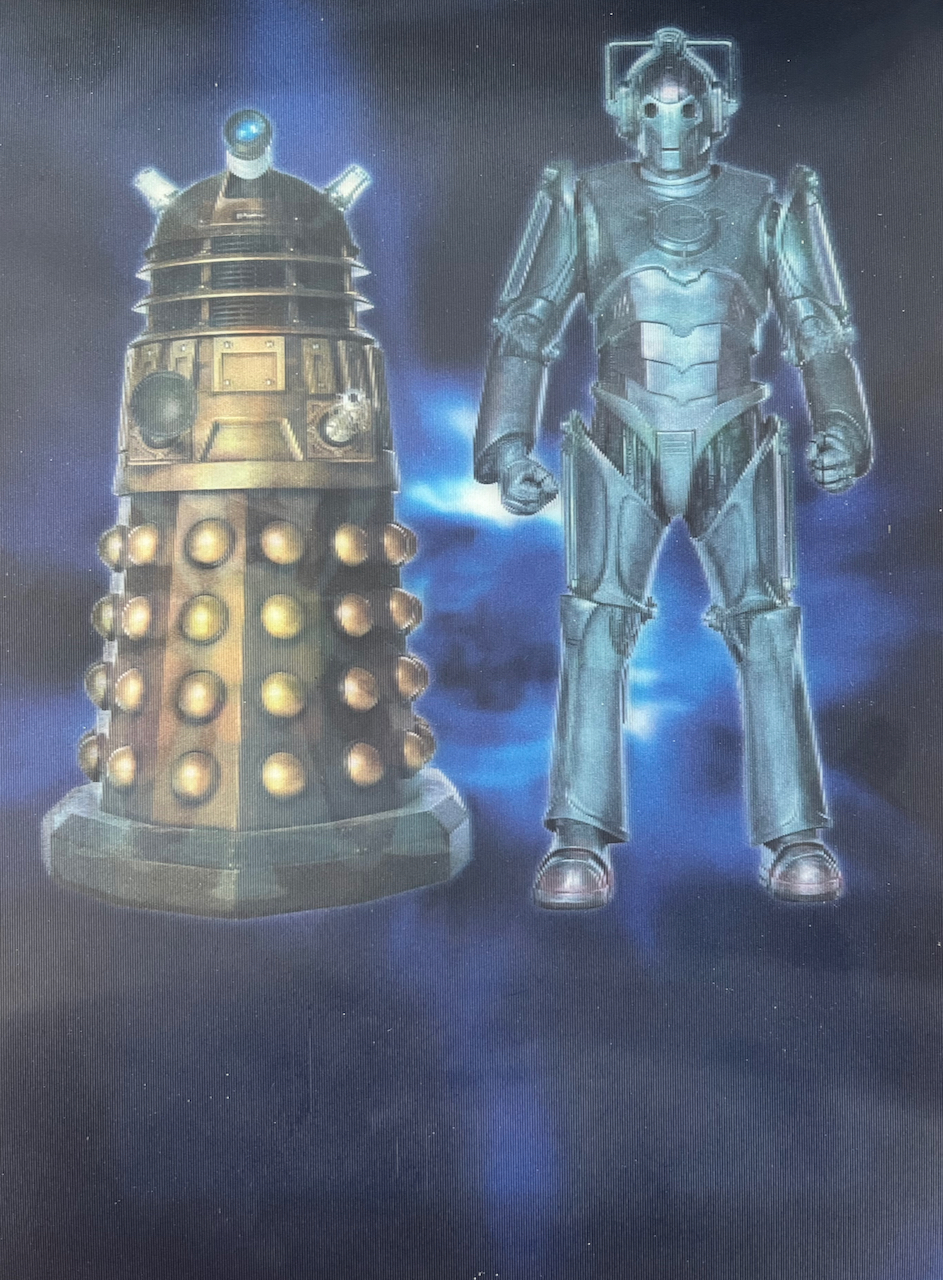
The steelbook for Series 2, released a few months after the equivalent for Series 1 in 2017, again has wonderful artwork on it, with the Doctor and Rose on the front, and the Daleks and Cybermen on the back.
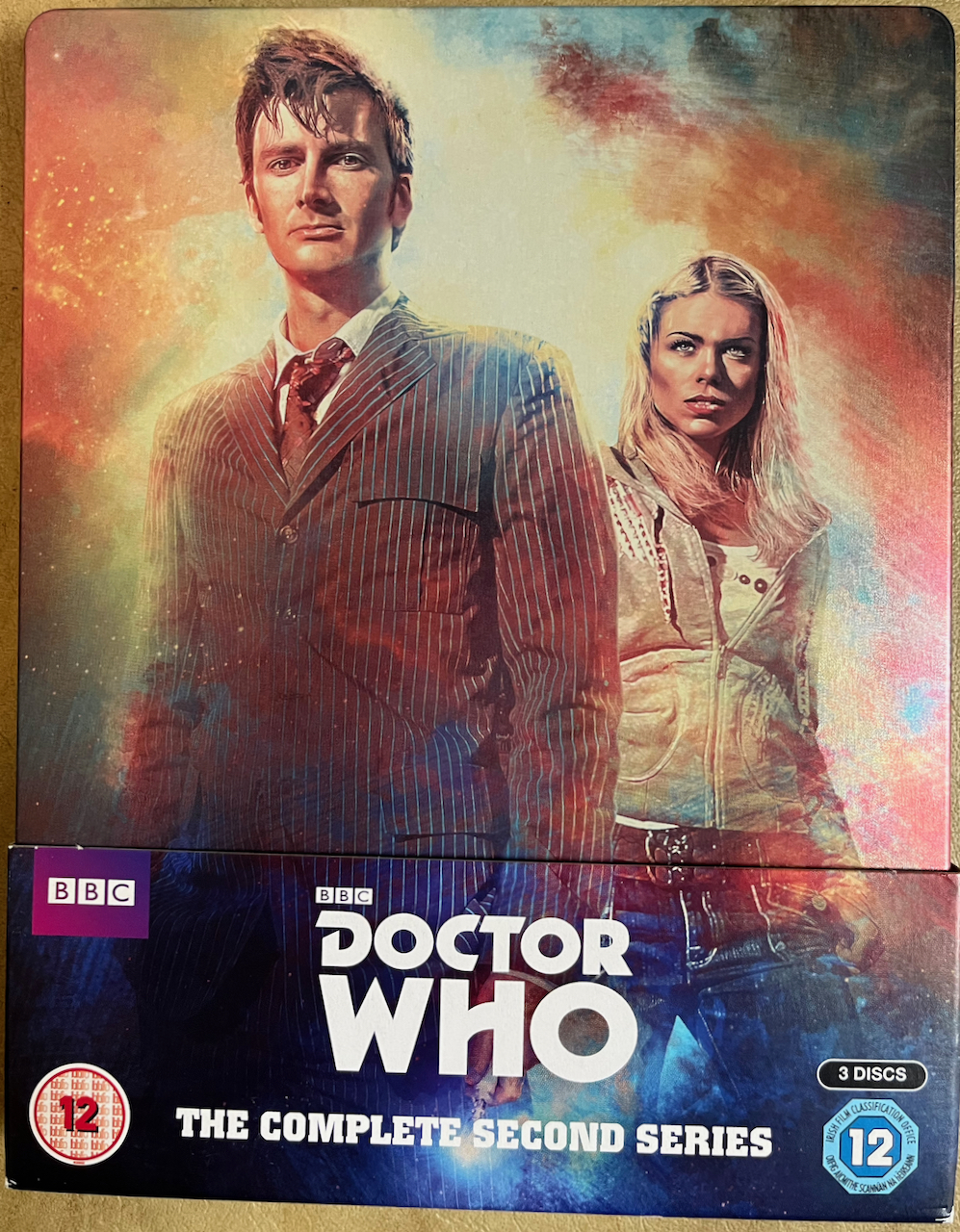
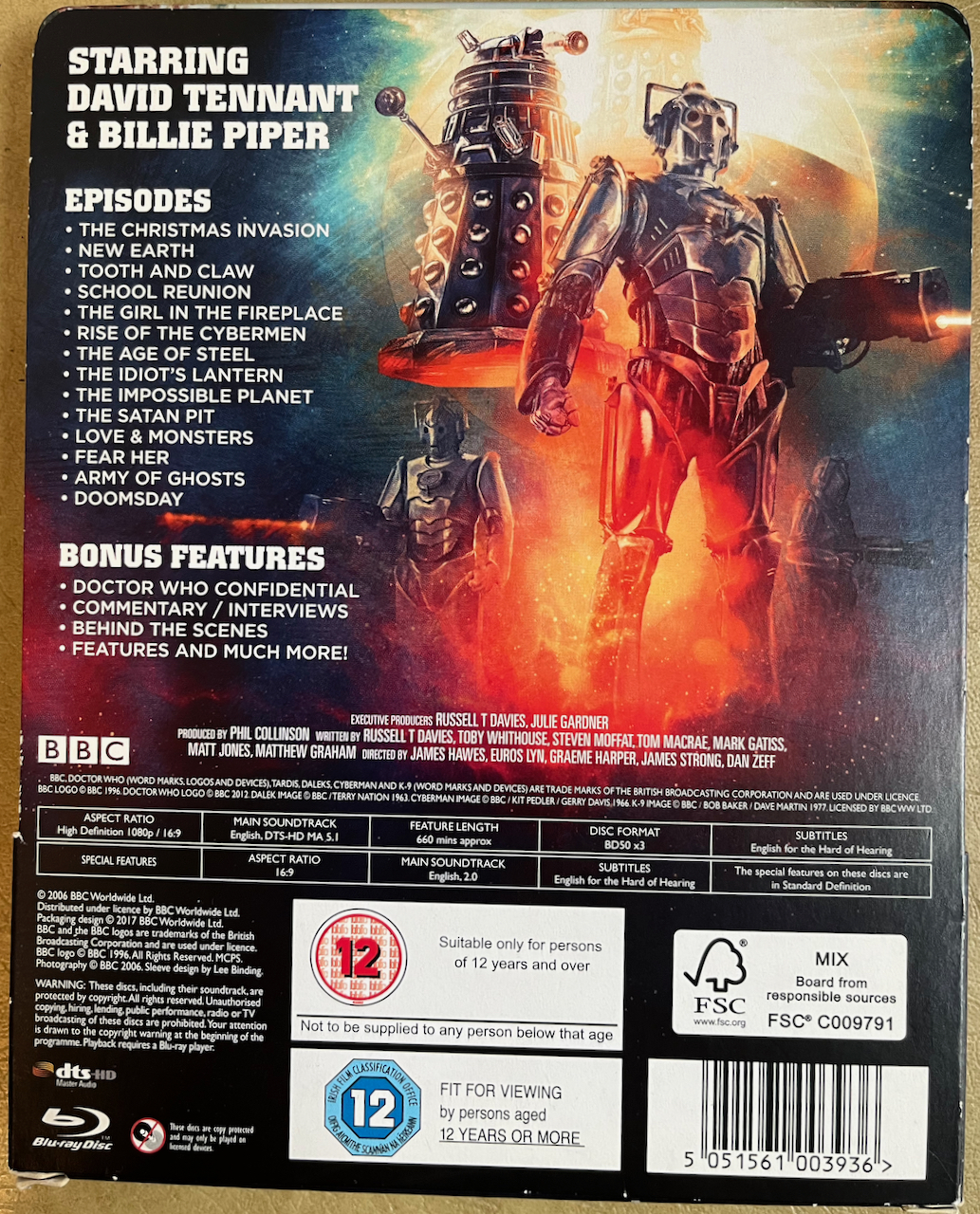
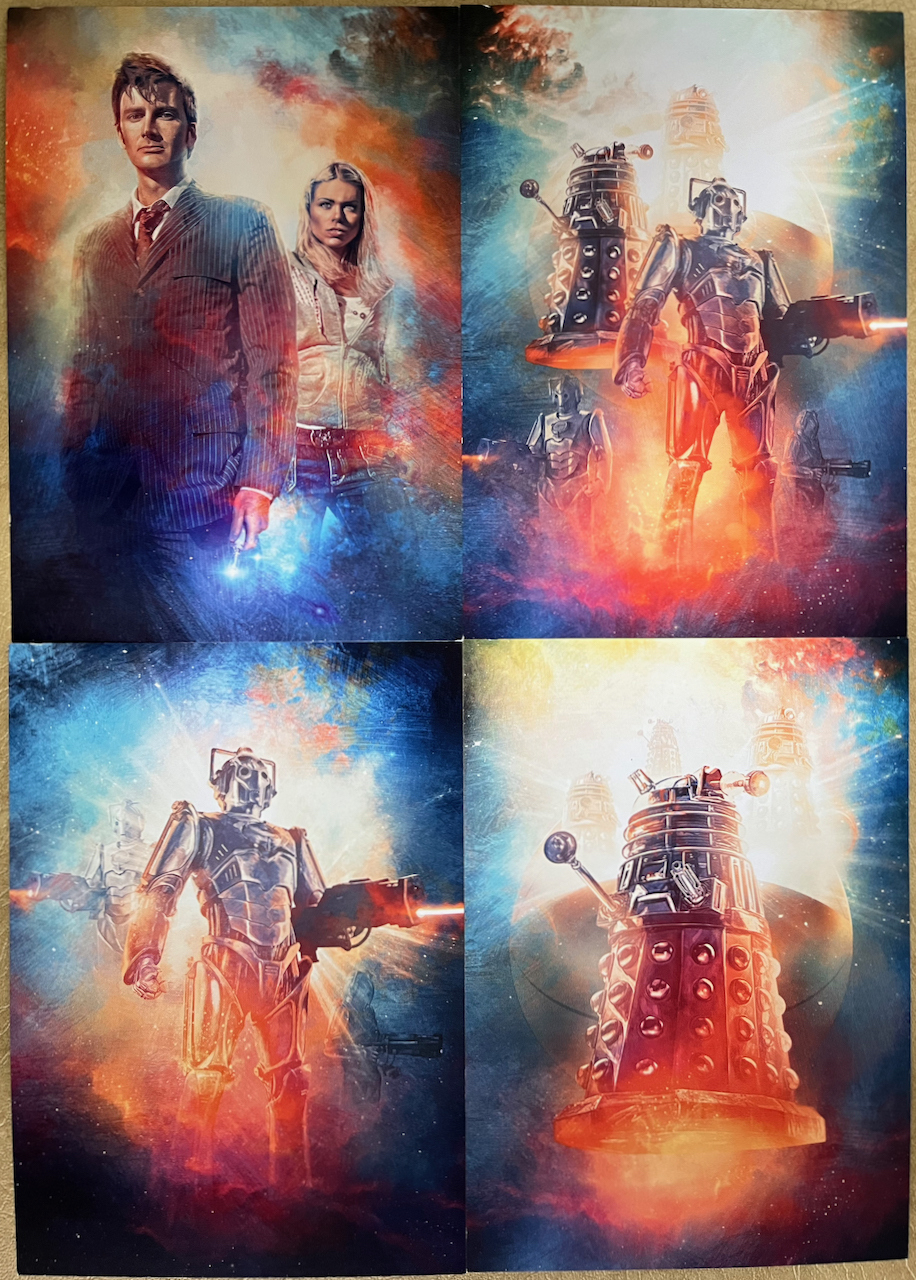
The 2 cover images are replicated on some cool postcards in the set, along with 2 further cards with artwork of a Cyberman and a Dalek. Each card also has a memorable quote from the series on the back.

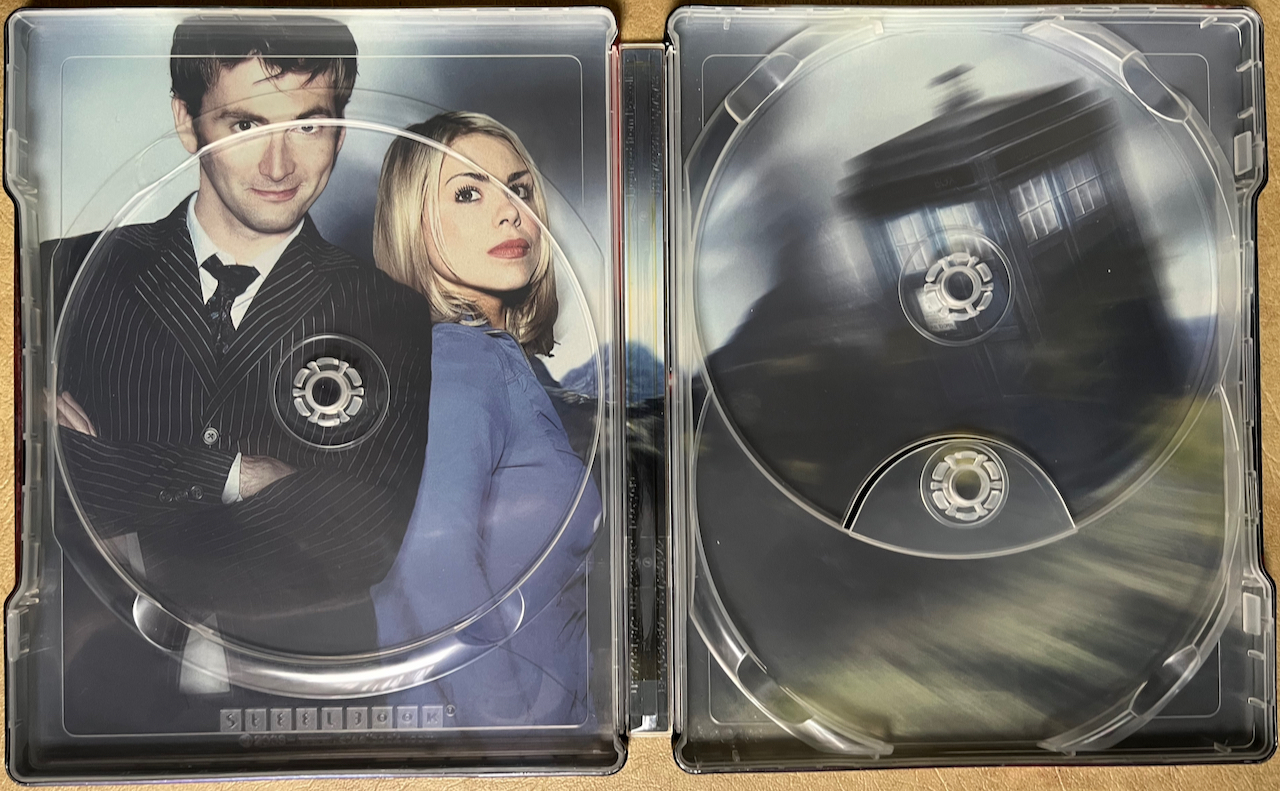
Inside the steelbook, behind the spindles for the discs, there’s a nice photo of the Doctor and Rose next to an image of the Tardis in flight. And the 3 discs themselves carry images of Sarah Jane Smith, a Cyberman and a Dalek.

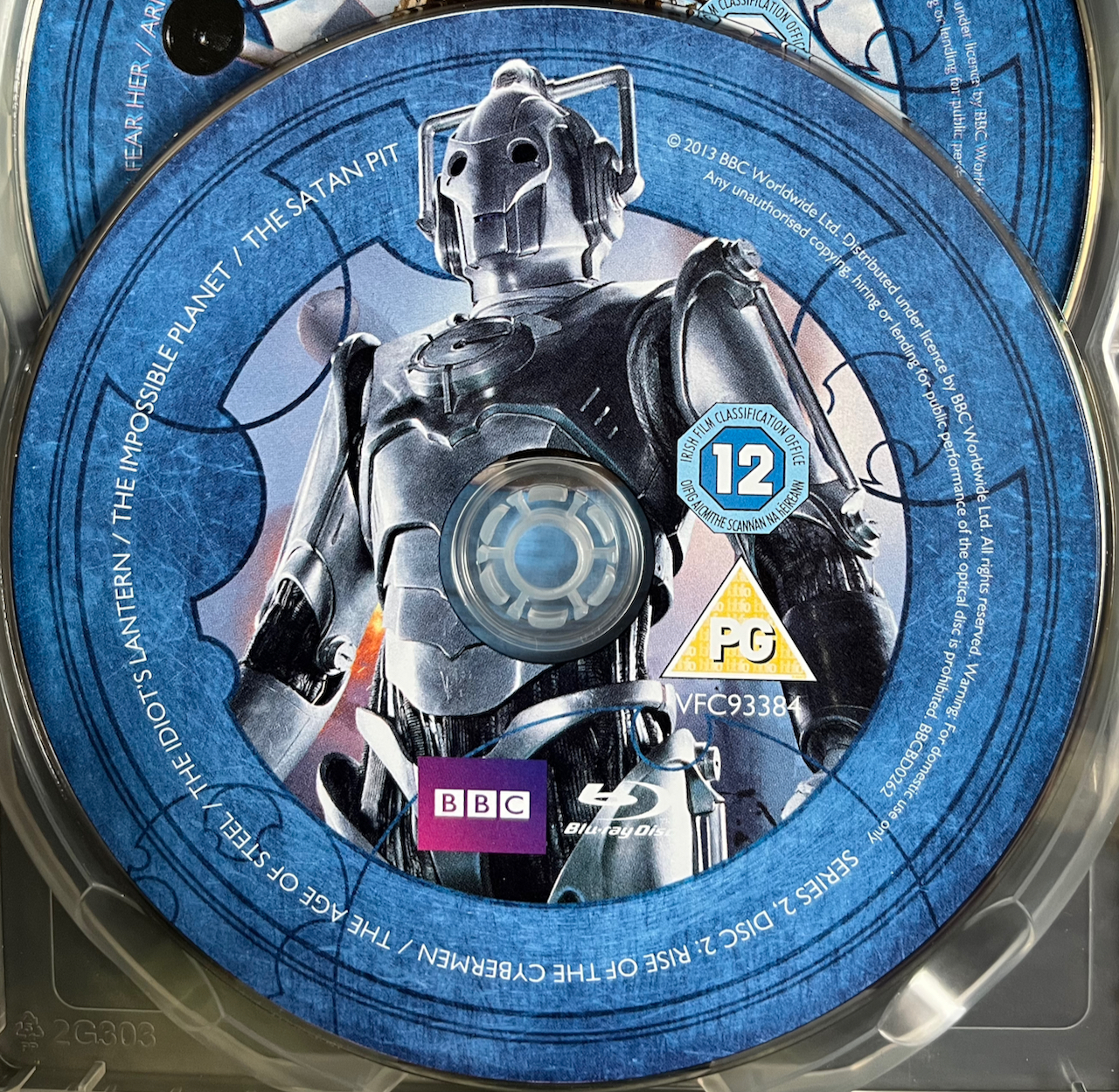
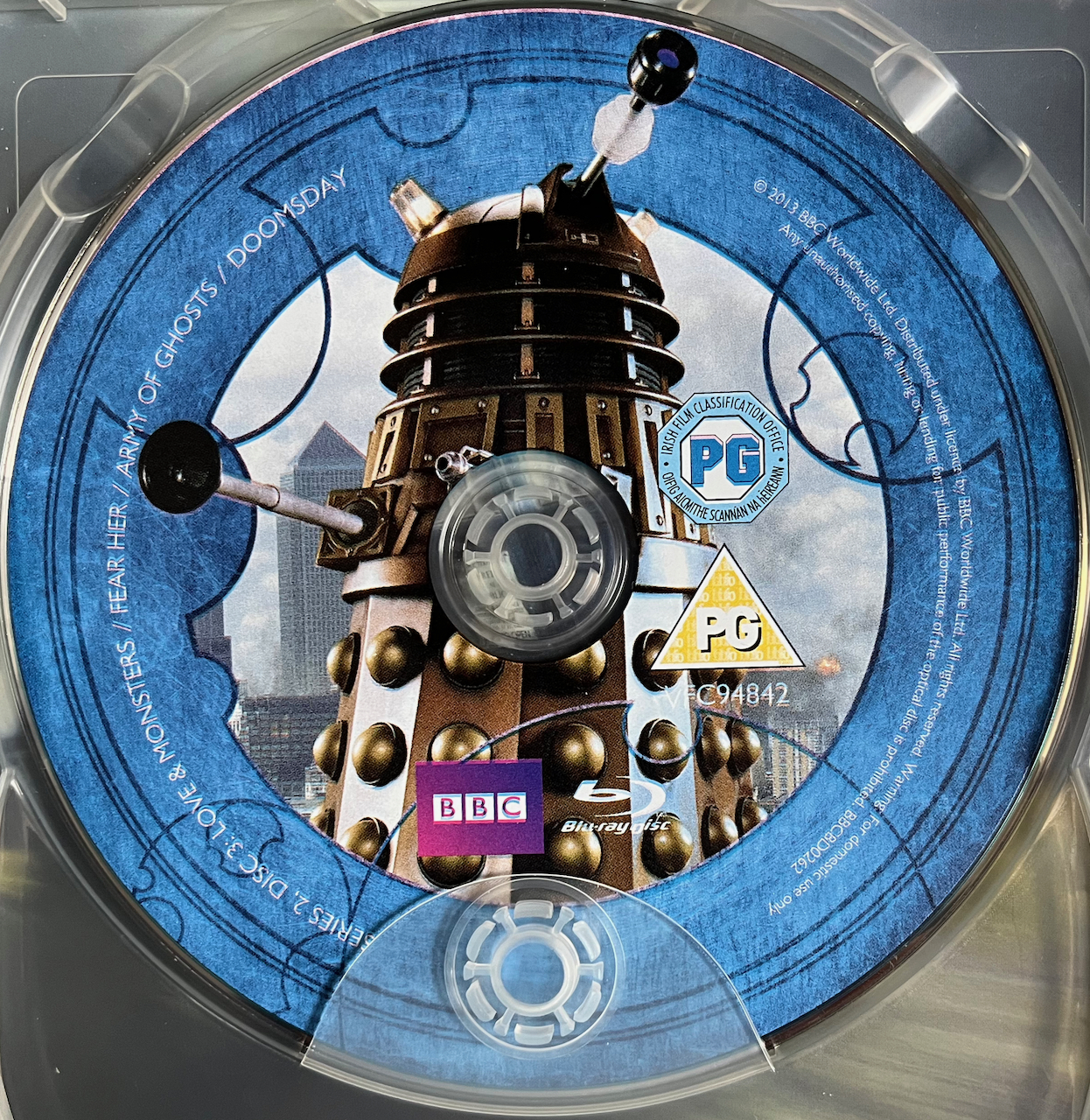
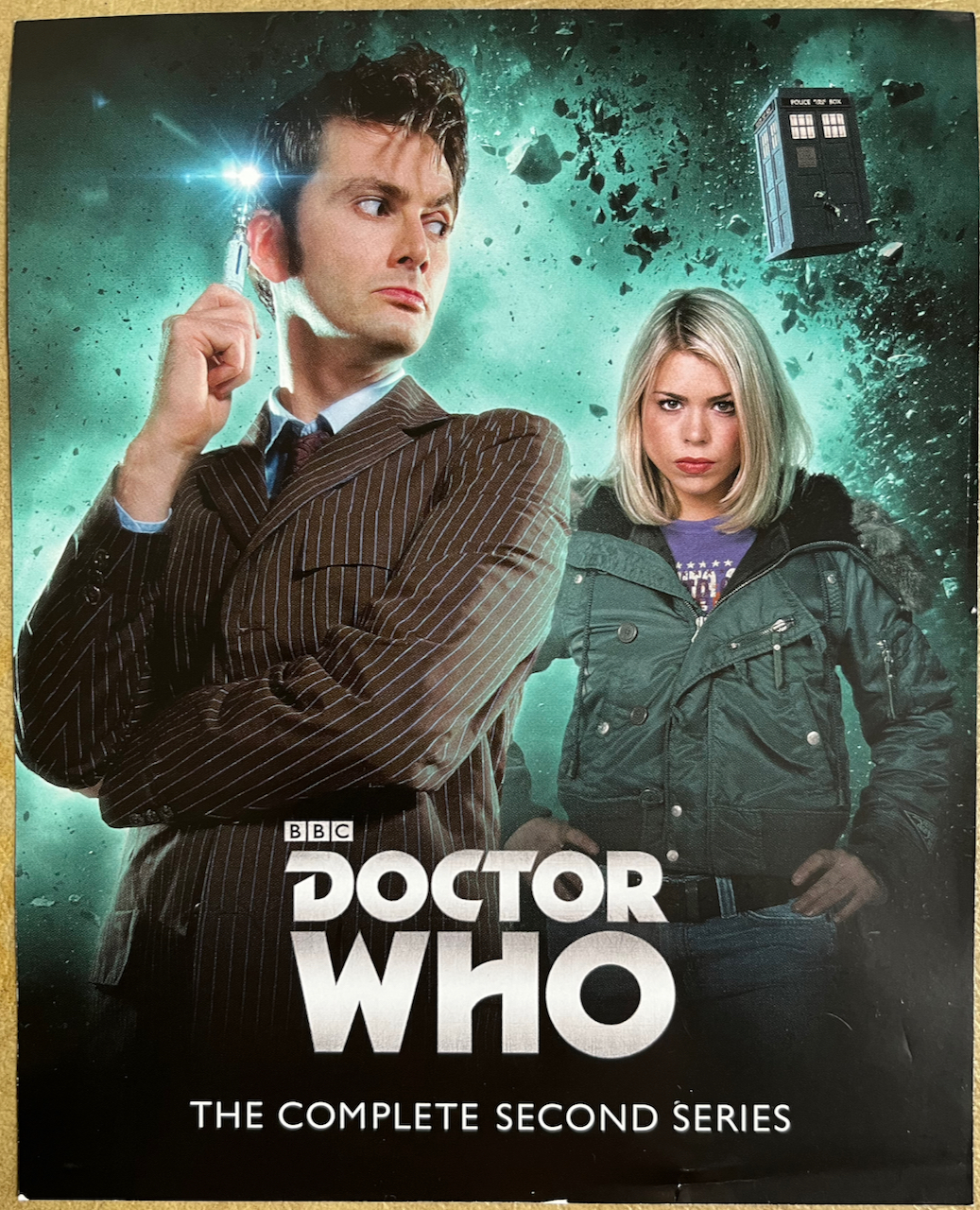
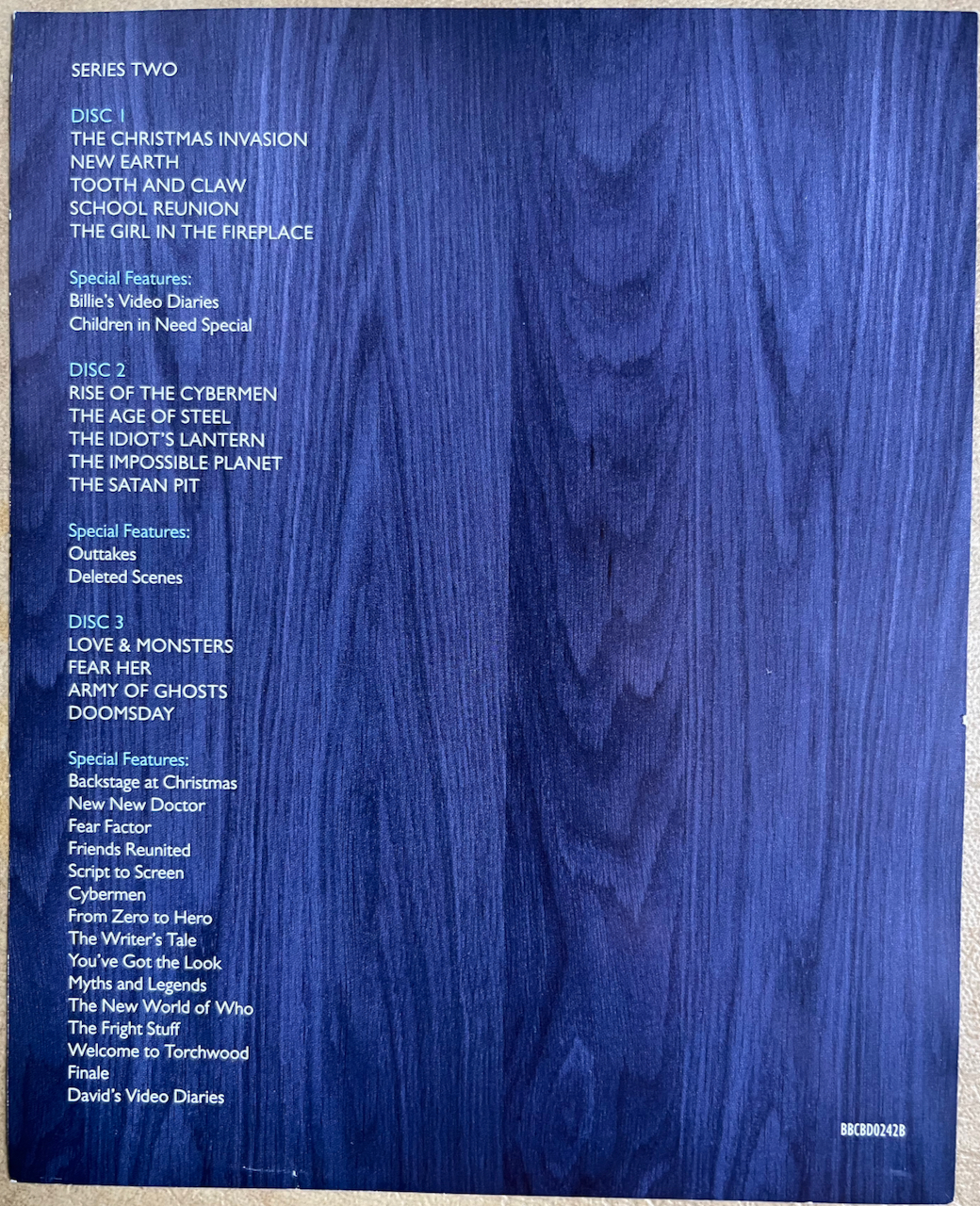
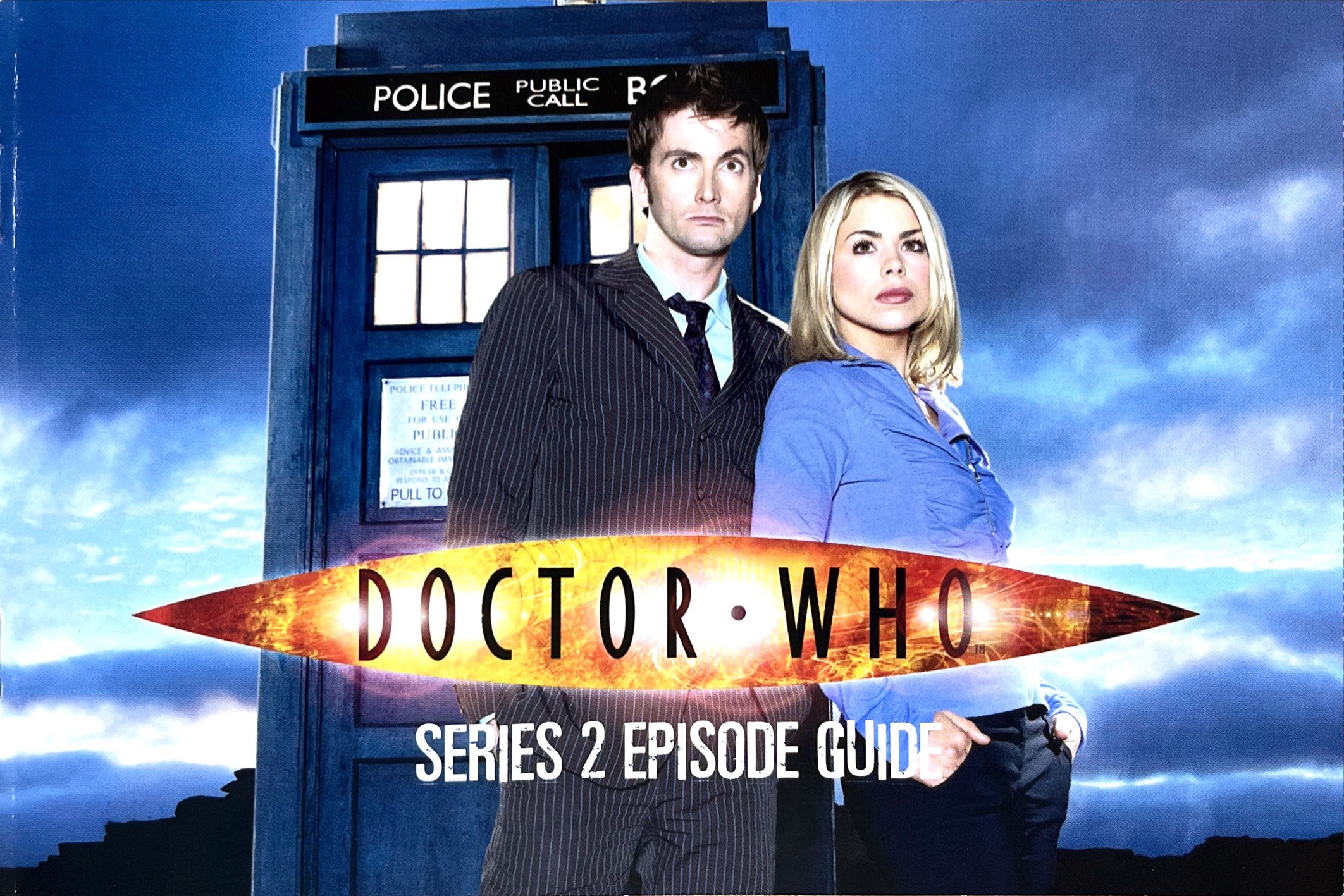
There’s also a flimsy little flyer included in the set, with a photo of the Doctor and Rose on the front, and a full list of the episodes and extras on each disc on the back. The text could easily have been bigger really, as it only takes up half the page.
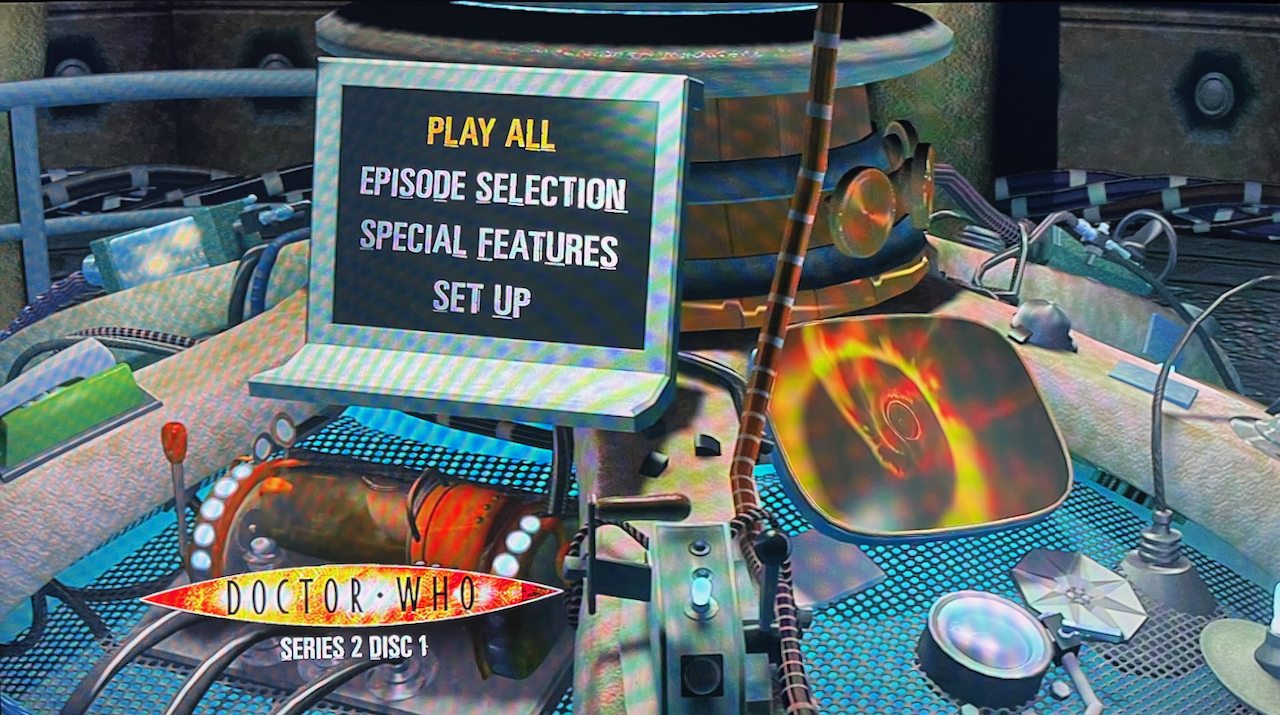
The menu for selecting the episodes and bonus features is identical to Series 1, taking us through the time vortex with the theme tune before settling in front of the Tardis console. Which isn’t a bad thing, it’s a very cool opening for the disc.
Old DVD Release
The Blu-ray is nicely put together, but the old DVD release was better in some ways. For a start, it was available with lenticular packaging, so that you could tilt it to slightly change the images upon it, for example to make it look like the Tardis was flying. A bit of a gimmick, sure, and I can’t really replicate it in photo form for you to see, but quite cool nonetheless.

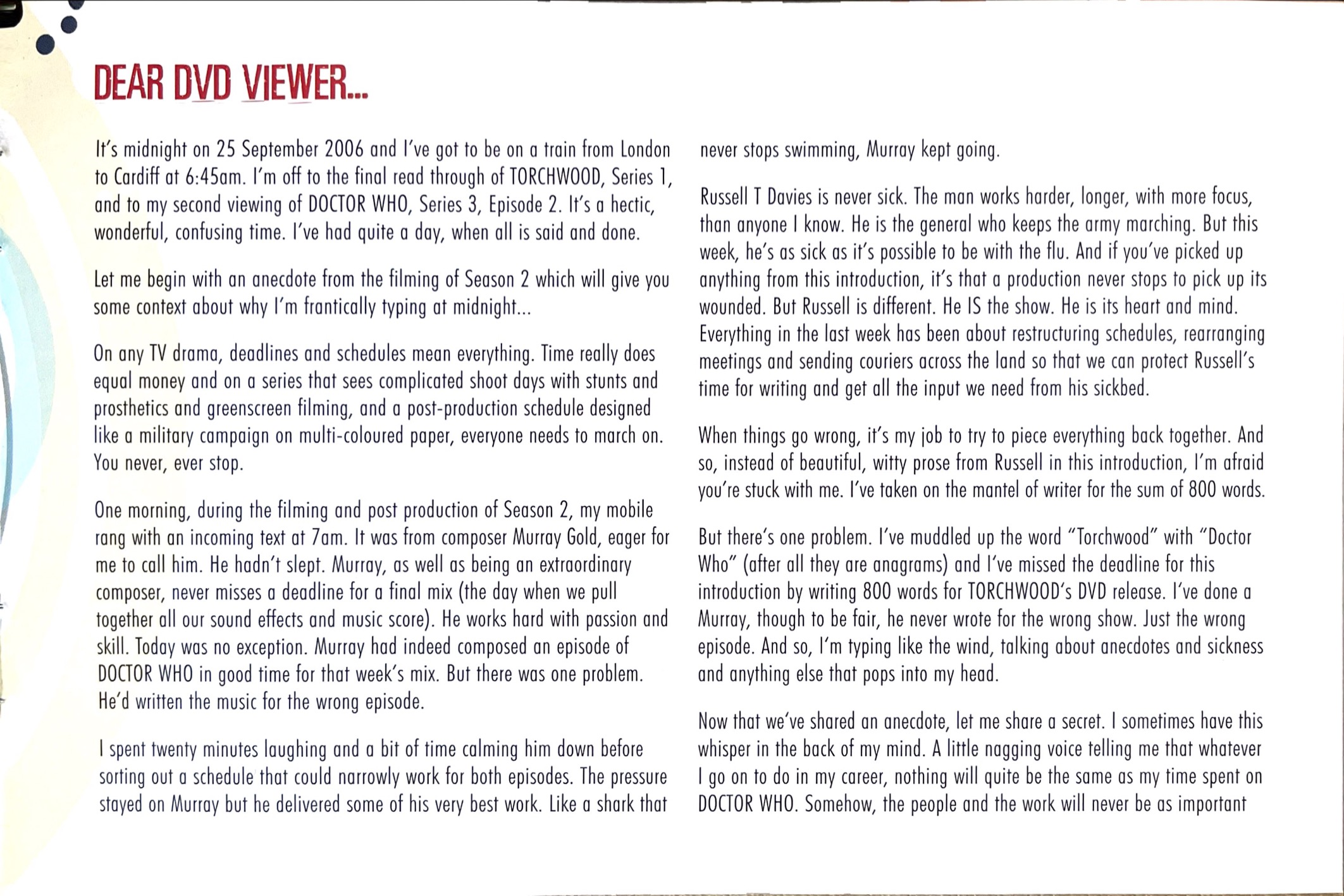
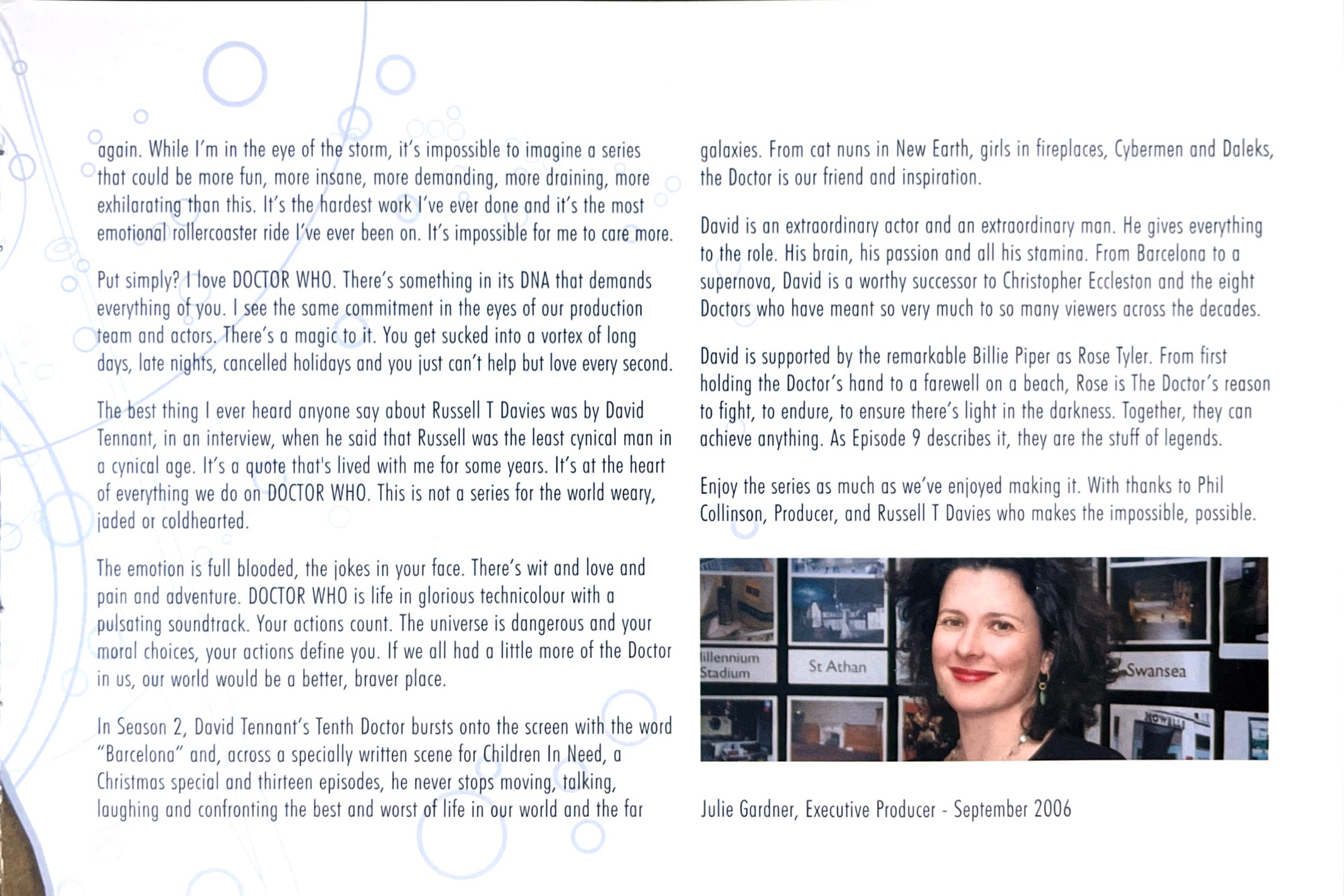
It also had a booklet with a foreword from Executive Producer Julie Gardner, some nice photos and artwork, and details of what was on each disc, including episode descriptions, credits, chapter points and extras. So I’ll be including some of the images from that book in this post. It is a shame they haven’t included booklets like that with the Blu-ray steelbooks, though I appreciate there isn’t room for anything too thick. And there are also slight differences in the extra features on the Blu-ray compared to the DVD, as I’ll mention later in this post.
The most significant and disappointing omission from the Blu-ray, however, is that there’s no audio description for the episodes or audio navigation for the menus. Audio description was available from Series 1 onwards on the DVDs, and is also provided for every episode on BBC iPlayer. Plus the DVD for Series 2 had been significant for the introduction of audio navigation, as a result of work between the BBC and the RNIB. This provided an accessible spoken menu system for visually impaired people, which the BBC continued to provide in later DVD releases for Doctor Who and a few other shows.
Unfortunately, both audio navigation and audio description aren’t included on the Blu-ray releases until we get to Series 6 for some strange reason, which is a great shame. So I’ll talk more about the audio navigation when I get to that series, as I’ll be able to include relevant screenshots then.
[November 2023 Update: The new Series 1-4 & specials box set includes audio description on every episode, but not audio navigation. It also corrects the conversion issue that causes the episodes to run 4% slower here, which I don’t notice anyway, and it fixes the Children In Need special. So I haven’t bought that new set, but it’s worth mentioning.]
Episodes
Overview
Series 2 consists of an hour-long Christmas special, followed by 13 regular episodes of about 45 minutes each. All of the episodes and extras are spread across 3 Blu-ray discs (compared to 6 for the original DVD release).
The episodes are upscaled from standard definition, as Doctor Who wasn’t being filmed in HD at this point, and they look and sound very good to me. But I don’t have the eyesight or general expertise to analyse that side of things closely, so I won’t be delving into those technicalities here. Other reviewers will have done that already.
Altogether the episodes cover 11 stories (8 single episodes and 3 two-parters), of which 5 stories are written by showrunner Russell T Davies, and the other 6 have a different writer for each one.
There’s also a loose story arc across the series, where we learn a bit about the history and mythology of Torchwood, which had briefly been mentioned near the end of Series 1, and later became the focus of its own spin-off series later in that year (2006). The name is an anagram of Doctor Who, and it was used as a production codename when filming the previous year’s revival of the series.
The music is again composed by the fabulous Murray Gold. But, instead of being synthesised like in Series 1, this time it’s orchestrated by Ben Foster, and played by the BBC National Orchestra Of Wales, which makes it sound even better. in particular, there’s a glorious new arrangement of the theme tune played over the closing credits of every episode in Series 2 & 3, and it includes the middle eight. That may seem like a small detail, but it’s a beautiful part of the theme, and it was never heard in Series 1, so it’s very satisfying to hear it restored in Series 2.
Many of the tracks from the series are featured in Murray Gold’s album of music from Series 1 & 2, sometimes in the form of re-recordings rather than the original broadcast versions, but they still sound great regardless. So I’ll be mentioning a few of those tracks during this post.
Mini-Episodes
Before we get into the main stories, it’s important to mention a few mini-episodes that were also broadcast to accompany the series, especially the first one:
- Children In Need Special: Born Again (18 November 2005) – This 7-minute short was written by Russell T Davies, and is included on the Blu-ray as an extra feature. It’s a direct bridge from the end of Series 1 into the Christmas special, so it should have been included at the start of The Christmas Invasion really, not tucked away as a charity sketch (but it was incorporated into the Target novelisation of that story). And it’s quite fun, as the Doctor explores his new body, while Rose tries to come to terms with him changing so drastically, though he proves it’s still him by reminding her of the first word he ever said to her (“Run!”). But as he changes course to take her home, the regeneration goes wrong, and the Tardis is set to have a crash landing, which is where the Christmas episode starts. The online version of the charity sketch was followed by a few amusing appeals by David and Billie, where they announced themselves as different people, but they’re not on the DVD or Blu-ray.
[November 2025 Update: The version included in the DVD & Blu-ray releases, including my steelbook, has actually been a rough cut, with a temporary music score and the omission of Tardis sound effects including the Cloister Bell. The correct version can now be seen on Youtube, as it’s finally been uploaded officially for its 20th anniversary, and I also understand that it can be found in the Series 1-4 & specials box set from 2023. The new Youtube version even adds the Born Again title for the very first time, which was the name given to the previously untitled special by the fans.]
- Attack Of The Graske (25 December 2005) – Written by Gareth Roberts, this was a fun little interactive episode, first broadcast on the BBC’s red button service, and then posted online for people to play. In the episode the Doctor invited you to be his companion to help him capture the mischievous Graske, so you had to solve little puzzles to help him out, and his responses depended on how whether you passed or failed. Sadly it wasn’t on the old DVD and isn’t on the Blu-ray either, and it’s no longer officially available online – but you can watch it on Youtube of course, where people have posted videos of the winning and losing variations, each lasting 14 minutes.
- Tardisodes – Written by Gareth Roberts, these were 1-minute prequels to each episode of Series 2, from New Earth onwards, available online and via mobile phones. They weren’t anything particularly special, but they added a nice bit of extra colour to each story. Sadly these aren’t on the DVD and Blu-ray releases, and there are no official versions online any more either. So we only have low quality copies that people have uploaded to Youtube. Tardisodes weren’t produced for any later series, but some short prequels were later made for Series 6.
Special: The Christmas Invasion
- Writer – Russell T Davies
- First Broadcast – 25 December 2005
- Links – BBC / Wikipedia / Tardis Wiki
This very enjoyable 1-hour Christmas special pays a nod back to the very beginning of Series 1 with the opening zoom in to Earth, and then continues on from the above Children In Need special with the Tardis crash-landing and the Doctor collapsing. It leads to one of those nice moments we get every now and again, where the title of the show appears in the script, as Jackie looks as his new appearance in confusion – “What do you mean that’s the Doctor? Doctor Who?”
From then on, the Doctor is out of action for about two-thirds of the episode, lying in bed in Jackie’s flat – apart from one brief moment of reawakening to save Rose, Jackie and Mickey from a murderous Christmas tree. It’s a brave move to keep the title character incapacitated for most of the story, but it serves to emphasise how even the best brains and mightiest forces in the world are unable to deal with alien invaders without his help. It thus allows him to be the superhero who saves the planet at the end, as I’ll get to in a moment. That additionally reassures Rose (and thus by extension the viewing audience) that she hasn’t lost the Time Lord she loves, as it understandably takes her a while to get used to the way he’s changed, and at one point she even thinks he’s died.
During his absence, however, the main person in charge is the new Prime Minister Harriet Jones, with Penelope Wilton making a wonderful return appearance in the role after the Slitheen story from the previous series. There’s a nice running gag as everyone she announces herself to, even the aliens, say they know who she is. And she does her best to exert authority in response to the Sycorax invasion, while also clearly fearful at what will happen without the Doctor’s help.
Plus we meet UNIT for the first time, who had been referenced but unseen in that earlier Slitheen adventure. At that time the acronym stood for United Nations Intelligence Taskforce – but, as I explained in my review of that 2-parter, the producers later changed it to the Unified Intelligence Taskforce after the BBC got into hot water with the United Nations. In any case, UNIT also have a catchy theme tune, which we hear when we see their HQ at the Tower of London. And talking of the score, the soundtrack album also contains a short dramatic track called Sycorax Encounter in relation to this episode.
But of course the Sycorax are too powerful for the human race to defeat by standard means. So, as noted earlier, the Doctor returns to save the day around 41 minutes into the episode, thanks to a spilt flask of tea that helps to reinvigorate him, as if the series couldn’t be any more British! It’s a great reveal, after Rose’s feeble attempt to confront them using names she’s learned from past adventures is met with derision by the Sycorax leader, who then suddenly speaks English when the Tardis is able to start translating again.
The Doctor’s interactions with his human friends and the Sycorax are very amusing and typically defiant, including a funny reference to The Lion King. David Tennant really stamps his mark as the Doctor here and is clearly having fun with it. And there’s a great sword fight on the exterior of the spaceship, with the clever use of a satsuma to finish the job.
The Doctor’s hand being chopped off and then regrown from his still-active regeneration energy was just a bit of fun at the time, adding to the humour of the episode. But we would later learn that the dismembered hand was picked up and preserved by Captain Jack Harkness, and it goes on to play an important role in the Torchwood spin-off as well as Series 3 & 4 of Doctor Who. So it cleverly becomes quite a major plot device in itself.
We also see the angrier side of the Doctor as well, when Harriet Jones orders Torchwood to destroy the departing spaceship after the Sycorax have surrendered. He is incensed by her murderous actions, and uses 6 words to her assistant to sow the seed that ultimately brings her down – “Don’t you think she looks tired?” It wouldn’t be the last time we see Harriet in the show though.
Things end on a cheerfully festive note though, of course. In particular, the great Song For Ten – the first original song written for the rebooted series – plays while the Doctor picks his new signature look from the huge Tardis wardrobe, where you can see references to the outfits of all the previous Doctors if you look closely enough.
The song in the episode is performed by Tim Phillips, which is great and works very nicely, but I do personally prefer the album version sung by Neil Hannon, which has a different and extended arrangement (though I know that’s a controversial opinion among the fanbase). Maybe it’s because it’s the version I’ve heard the most as it’s in my music collection, but I just think the longer version is enjoyably upbeat yet also very moving, because it really encapsulates the relationship between The Doctor and Rose, celebrating its joys while also mourning the way it ends in the series finale. The tune also appears instrumentally in the score at various points throughout the 10th Doctor’s reign (including in the Series 4 specials), and the song was performed live at Doctor Who concerts by Gary Williams in 2006 and Tim Phillips in 2008.
The other little thing to mention about this episode is that, because the series was partly funded by the Canadian Broadcasting Corporation (hence they get a mention at the end of the credits for most episodes), Billie Piper recorded a few interstitials for CBC to introduce the episode and give teasing hints about Series 2 to the Canadian audience. This followed on from the introductions and ad bumpers that Christopher Eccleston had recorded for Series 1. These clips were never shown in the UK or included on the DVD & Blu-ray releases, and The Christmas Invasion was the last time CBC used the stars of the show like this.
1. New Earth
- Writer – Russell T Davies
- First Broadcast – 15 April 2006
- Links – BBC / Wikipedia / Tardis Wiki
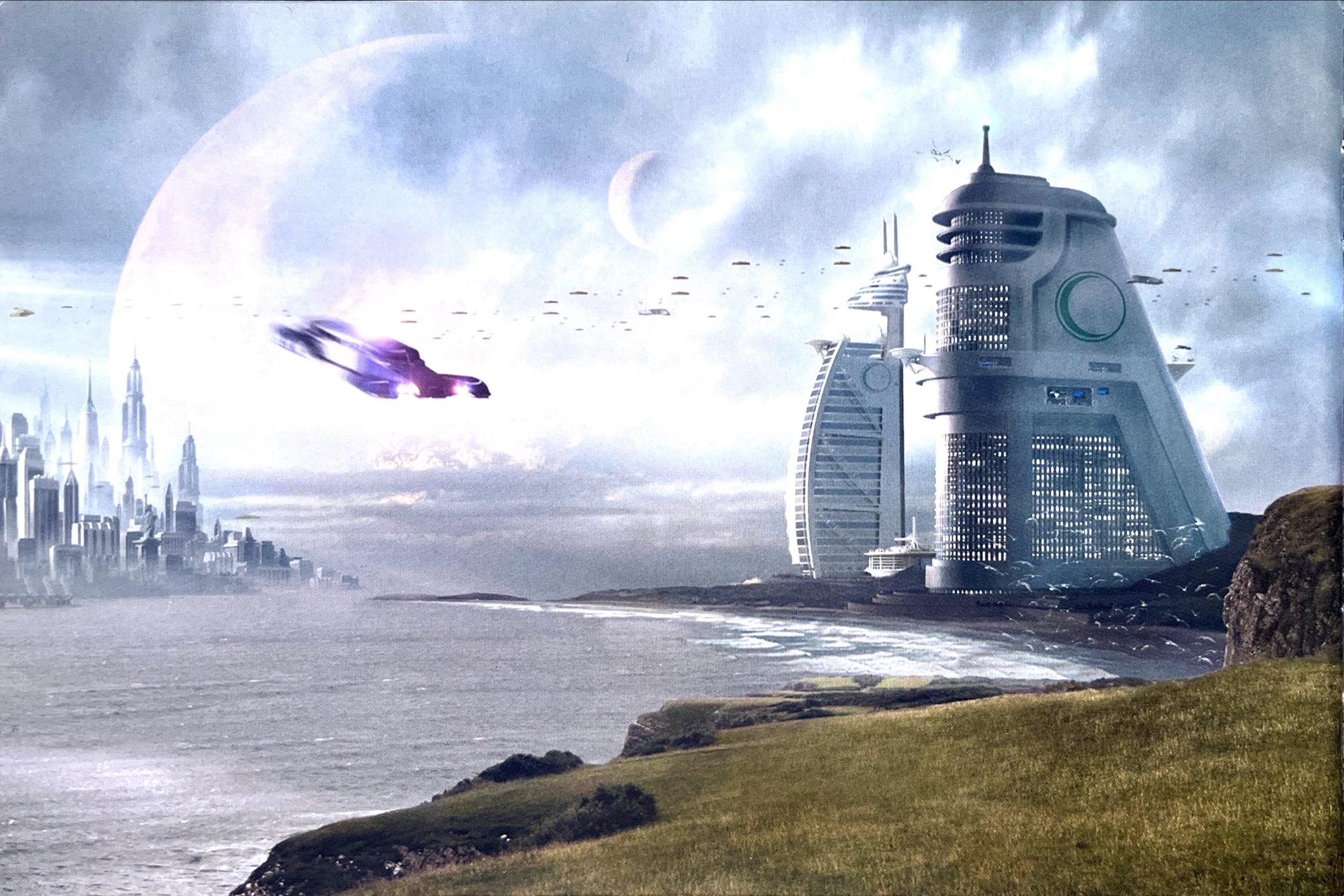
This fun episode is a follow-up to The End Of The World in Series 1, and sees the Doctor and Rose going to New Earth, a place created out of nostalgia after the original Earth was burnt up by the sun. There they encounter a hospital run by cat people (the Sisters of Plenitude), and in order to visit the wards they have to be disinfected in the lifts, which is a very funny sequence, as the Doctor is expecting it but Rose isn’t. It’s just an excuse to get Billie Piper wet, let’s be honest, but it’s very amusing.
However, Rose finds herself separated from the Doctor when the elevator takes her down to the basement, and she encounters Cassandra again, played by Zoë Wanamaker. She claims to be the last pure human, and had tried to kill all the guests that had gathered to watch the old Earth burn up in Series 1. She was just a piece of skin then, and was apparently destroyed, but she was saved using spare skin from her back (leading to a great “talking out of your…” joke from Rose).
Cassandra takes advantage of the situation though, with the aid of her slave Chip, and is able to transfer her mind into Rose, in order to explore the hospital and find out what the Sisters of Plenitude are really up to. And thus starts a lot of the comedy in the episode, as Cassandra explores Rose’s body (“Oh my god, I’m a chav!”), and then later the Doctor’s when she transfers into him. Billie Piper and David Tennant are really funny acting as the Cassandra-infused versions of themselves, with the Doctor being particularly camp!
The truth about the cat people becomes all too clear though. Initially it seems amazing that they can fix incurable diseases, until the Doctor discovers to his fury that they’re keeping specially grown humans as lab-rats, who have been infected with every disease possible. They’re also highly contagious, which causes panic when they get released – during which there’s a fun sequence where the Doctor and Rose/Cassandra ride down a lift shaft, accompanied by part of the catchy Westminster Bridge theme from Series 1 (which is used a couple of times in this episode). But the Doctor is ultimately able to cure everyone by combining the IV solutions for all the diseases with the disinfection showers in the lifts.
He also gives Cassandra a parting gift, despite all she’s done, by taking her back in time to a party, so she can give a compliment to her beautiful, properly human, younger self. At this point the mind of the older Cassandra is inside her slave Chip, who is dying and is of course unrecognisable to the younger Cassandra. So Chip collapses, effectively meaning that both he and the older Cassandra die in the younger Cassandra’s arms. This also creates a causal loop paradox, as the older Cassandra had created Chip based on the man she remembered complimenting her at the party, who was of course Chip himself.
Meanwhile the other notable character to feature in the episode is the Face Of Boe, a large human-like head known to be the oldest creature in the universe, who had also appeared in the same previous episode as Cassandra. He indicates to the Doctor that he’s going to reveal a big secret to him, on the next and final time they meet – which indeed he does in Series 3…
2. Tooth And Claw
- Writer – Russell T Davies
- First Broadcast – 22 April 2006
- Links – BBC / Wikipedia / Tardis Wiki
This is basically a classic werewolf story, about a man who turns into the beast under a full moon, before chasing and killing people. And there’s nothing wrong with that, because it has plenty of Doctor Who twists and set pieces that make it feel original, and a great score by Murray Gold.
Unsurprisingly, the wolf is of alien origin, having crash landed on Earth many years previously. It usually takes the form of a man’s body that it’s commandeered to be a host, but when it transforms into the wolf it looks really impressive, thanks to the excellent CGI work by The Mill.
Its sinister goal is to take over the world, creating its own empire by biting Queen Victoria and turning her into a werewolf as well. It lies in wait for her at the Torchwood Estate in Scotland, where it’s helped by a group of monks who have forcefully taken over the old building from the original staff. The monks are experts in martial arts, and there’s a very cool sequence at the start of the episode where they show off their skills. It’s filmed at a higher frame rate, to give it extra speed and intensity, and conversely allows for some incredible slow motion shots as well, just like a martial arts movie. Crouching Tiger, Hidden Dragon was one of the main influences for that scene.
Queen Victoria herself is played marvellously by Pauline Collins, asserting a calm authority throughout, and also showing sadness when reminiscing about her husband Prince Albert. The Doctor and Rose are naturally excited to meet her. Being Scottish himself, David Tennant gets the opportunity to speak in a Scottish accent for a while here, as the Doctor tries to fit in, though it’s not quite as thick as his real life native accent. And Rose has a bet with the Doctor that she can make the monarch say she’s not amused, as per her famous catchphrase (although in truth it’s actually very unlikely that she ever said it).
Ultimately, of course, the werewolf is defeated, thanks to the Doctor making creative use of the Koh-i-Noor diamond that Queen Victoria is carrying. She then bestows titles on the Doctor and Rose in gratitude for their work – before banishing them from the empire, in disapproval of the death and terror that appears to accompany their lifestyle.
Finally, after the Doctor and Rose leave (amused by the theory that the Royal Family could secretly be werewolves), Queen Victoria proposes a new organisation that will look into, and defend the planet against, threats from other worlds. It is to be named after the estate they’ve just defended – Torchwood – and thus we come to understand the origin of this powerful institute.
So it’s a very enjoyable episode. And one other unrelated but fun moment comes at the beginning, when the Doctor and Rose are planning a trip to 1979 to see the legendary Ian Dury in concert, so the Doctor has a little sing along to Hit Me With Your Rhythm Stick! Of course, the Tardis went to the wrong location and was 100 years out on this occasion, but I hope they got to see him in the end.
3. School Reunion
- Writer – Toby Whithouse
- First Broadcast – 29 April 2006
- Links – BBC / Wikipedia / Tardis Wiki
This delightful episode effectively has 3 story elements to it – the aliens, the return of two old companions, and the addition of a new member to the Tardis crew.
In terms of the aliens, the Doctor and Rose have gone undercover in a school where the pupils have become very intelligent thanks to some special oil on their chips. The kids are being used as human computers to try and break the Skasis Paradigm, which would give someone the power to control all of time, space and matter – so everything in the universe, basically.
And the aliens who want this power are the Krillitanes, a composite race who cherry pick the best bits from whoever they invade. So they’ve evolved into terrifying creatures with huge wings, and there are some really cool shots of them flying down the school corridors. But they can also take on human form, as they needed to do to take over the school, which is particularly favoured by their leader, headmaster Mr Finch, played in a wonderfully sinister manner by Anthony Head. There’s a great scene where he and the Doctor confront each other across a swimming pool, they’re both so menacing in their own way. And Mr Finch even makes the Doctor slightly tempted by the idea of using the paradigm, because it would be an enormous and unstoppable power to have.
But, as is clear from that latter scene, the Doctor and Rose aren’t the only ones investigating the strange goings-on at the school. A certain journalist by the name of Sarah Jane Smith, played by the wonderful Elisabeth Sladen, is also there, ostensibly to do a profile on the new headmaster but actually to dig deeper. So when the Doctor is introduced to his former companion, the beaming smile and look of wonder on his face says everything about what a joyous moment it is. I never saw her old episodes, but even I know who she is, as she’s a massive part of the show’s history.
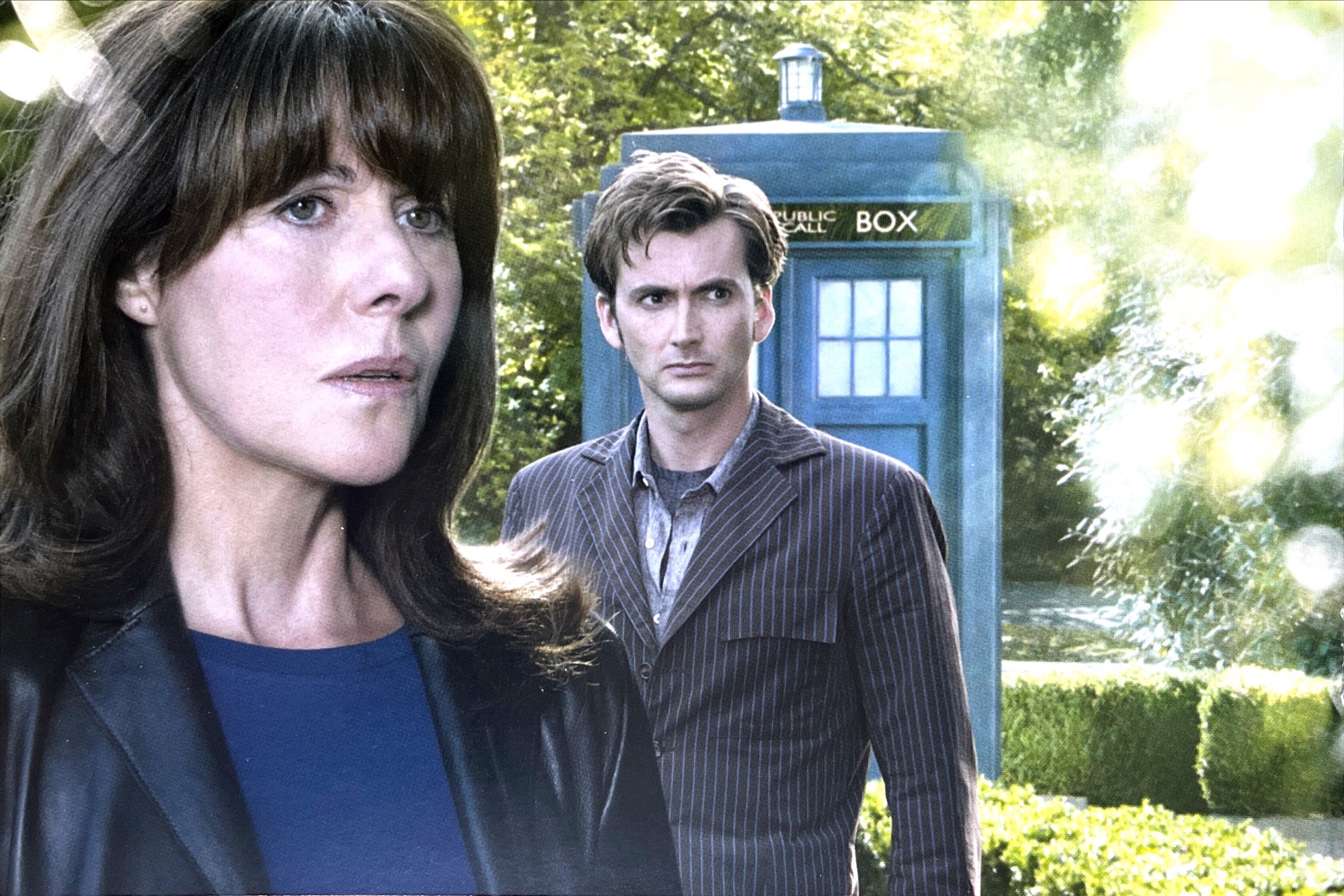
Of course, Sarah Jane doesn’t recognise him at first, as he’s regenerated numerous times since they last met. But when she finds the Tardis in the school gym, then the big reunion begins, one that’s has several emotional layers. After all, Sarah is overjoyed to see him, yet is upset that he left her behind and disappeared, so she’s desperate for answers. They therefore have a lot of catching up to do, and the scenes between them are excellent. The scene where they talk in the chip shop also has a snippet of Love Will Tear Us Apart by Joy Division playing in the background, which feels appropriate.
For Rose, this is the first time she’s met, or been aware of, any of the Doctor’s former companions, which sparks jealousy, questions and arguments – including a moment that leads to Mickey’s great line about the Doctor experiencing “every man’s worth nightmare” with “the missus and the ex”. Rose and Sarah Jane do bond in the end though, once they start comparing notes about their respective adventures with the Doctor.
Even more importantly, for her character’s benefit and to lay a seed for the series finale, Rose learns the valuable lesson that she will be left behind one day. As the Doctor explains when she confronts him, he will outlive her, so he will have to move on alone at some point. And at the end of the episode, Sarah Jane reassures Rose that she should stick with him and enjoy her travels, because “some things are worth getting your heart broken for.”
Sarah Jane’s adorable, clever and often amusing robot dog K9 is also there, who the Doctor is able to repair, and K9 helps to save the day in the end by sacrificing himself. You wouldn’t think a farewell scene with a robot dog could be moving, but it is. It’s little details like the bow of its head and the twitching of its antennae ears that sell it. And it’s really sweet that the Doctor rebuilds him at the end.
And then there’s Mickey, who called the Doctor and Rose in to begin with, as he had his own suspicions about the school. He starts off by being just a lookout, and realisation dawns on him that he’s just waiting around for orders like K9 – “I’m the tin dog!” But then he gets his chance to help save the day later on, even if it takes K9 a few attempts to make him realise what he has to do. During an action sequence that is superbly scored with pounding action music by Murray Gold (that annoyingly isn’t on the soundtrack album), he drives a car through the locked doors of the school, and unplugs the computers so the children can be freed of their brainwashing and run outside before the school explodes. It’s not the first time Mickey’s been heroic – he blew up Downing Street by hacking into a missile system in Series 1 of course – but this is his first act in person. It’s the start of a personal journey that sees him doing much bigger things later in the series.
Consequently, having had a proper taste of what’s out there, and keen to get involved more now he knows he can be useful, he asks the Doctor if he can travel with him. Interestingly, the Doctor can see that Rose is less than thrilled at this prospect but, urged on by supportive words in Mickey’s favour from Sarah Jane, he accepts Mickey’s request, clearly keen to test him out. Mind you, Rose’s reluctance isn’t apparent in the next episode anyway – it just gets ignored as if they quickly kissed and made up, because Steven Moffat didn’t know about the ending of this episode, so it doesn’t become a major plot point.
Sarah Jane is also invited to join them, but turns it down, as she’s too old to run around like that, and can do better work on Earth. So she heads off with K9, but it’s not the last we see of her. She reappears in Series 4, by which time she was also starring in a spin-off show made for children called The Sarah Jane Adventures. I have seen some of the episodes from that, including the ones with special appearances by David Tennant’s and Matt Smith’s Doctors, but I haven’t watched all of them. I will watch them all soon though. The show ran for 5 series, until Elisabeth Sladen’s sudden and sad death from cancer in April 2011. So she is very much missed, and it’s lovely that she was able to reappear in Doctor Who after so many years away from the series. She & K9 even appeared on Blue Peter to talk about her return to the show for this series, and she spoke to BBC Norfolk about how it led to the Sarah Jane Adventures.
[November 2023 Update – On BBC iPlayer you can watch The Sarah Jane Adventures, and an earlier 1981 pilot show called K9 & Company, as part of the new and extensive Whoniverse collection.]
4. The Girl In The Fireplace
- Writer – Steven Moffat
- First Broadcast – 6 May 2006
- Links – BBC / Wikipedia / Tardis Wiki
I have mixed feelings about this episode, I must admit, as it’s really strong from the Doctor’s perspective and visually stunning, but it’s somewhat let down in relation to the lack of story for the companions.
To his delight, the Doctor gets to meet a French lady called Reinette – aka Madame de Pompadour (played by Sophia Myles) – because a spaceship from the 51st century is using enormous amounts of power to open time windows to various parts of her life in the 18th century. The ship is run solely by maintenance androids with clockwork mechanisms in their heads, who have formed the erroneous belief that Reinette’s brain is what they need to finish repairing their ship, but it has to be at a precise point in her life. Why they need a brain becomes disturbingly apparent in the latter half of the episode, and why they’re targeting hers specifically only becomes apparent in the very last scene.
So during the story the Doctor passes through the time windows into Reinette’s life, beginning with her fireplace when she’s a child, forming an unusual friendship with her as a result. To him there are only minutes passing between each encounter, but to her it’s several months or years every time. So she’s fascinated and enamoured by this handsome, witty, brave, protective stranger, so much so that she cannot resist kissing him when he first meets her as an adult – leading to a funny moment where he responds to a challenge from a member of the palace staff that “I’m the Doctor, and I just snogged Madame de Pompadour!” And she manages to read his mind while he looks into hers, leading her to ask: “Doctor? Doctor Who?” So there’s great chemistry between them, and he instantly becomes very fond of her too, because she’s intelligent and stunningly beautiful.
The Doctor then saves the day, by crashing through a mirror on the back of a horse that had wandered on to the spaceship, which traps him in historical France without his Tardis or companions. But he knew that would happen, and his feelings for Reinette means he has no hesitation in taking such action. But she has a surprise for him, showing him a path back to where he came from. Upon verifying that it works, the Doctor then returns to say goodbye, only to find that time has shifted again and he’s too late, as she has died at the age of just 43, and he reads a loving, pleading note that she’s left for him. It’s unusual to see the Doctor visibly heartbroken, but it’s not for the last time this series either. So the Doctor goes on quite an emotional journey in this episode, though there is still plenty of opportunity for humour as well.
Incidentally, to mark the 14th anniversary of the episode during lockdown in 2020, and to tug at the heartstrings even more, Sophia Myles returned to her role of Madame de Pompadour to read another lovely letter to the Doctor, again written by Steven Moffat.
Rose and Mickey, on the other hand, don’t really contribute much to this episode, and stay on the spaceship most of the time. Rose does get a little scene in France with Reinette, forewarning her of when the Doctor will come to save her life, and follows Reinette as she steps through the time window on to the spaceship. It is quite the sight to see a lady in a lavish 18th century dress on a futuristic vessel like that. Rose then later stands in silent thought on the spaceship, shedding a tear when she thinks the Doctor is stuck in France. And she clearly cares that the Doctor is deeply sad at the end, and Mickey has to pull her away to give him space to read the letter he was given.
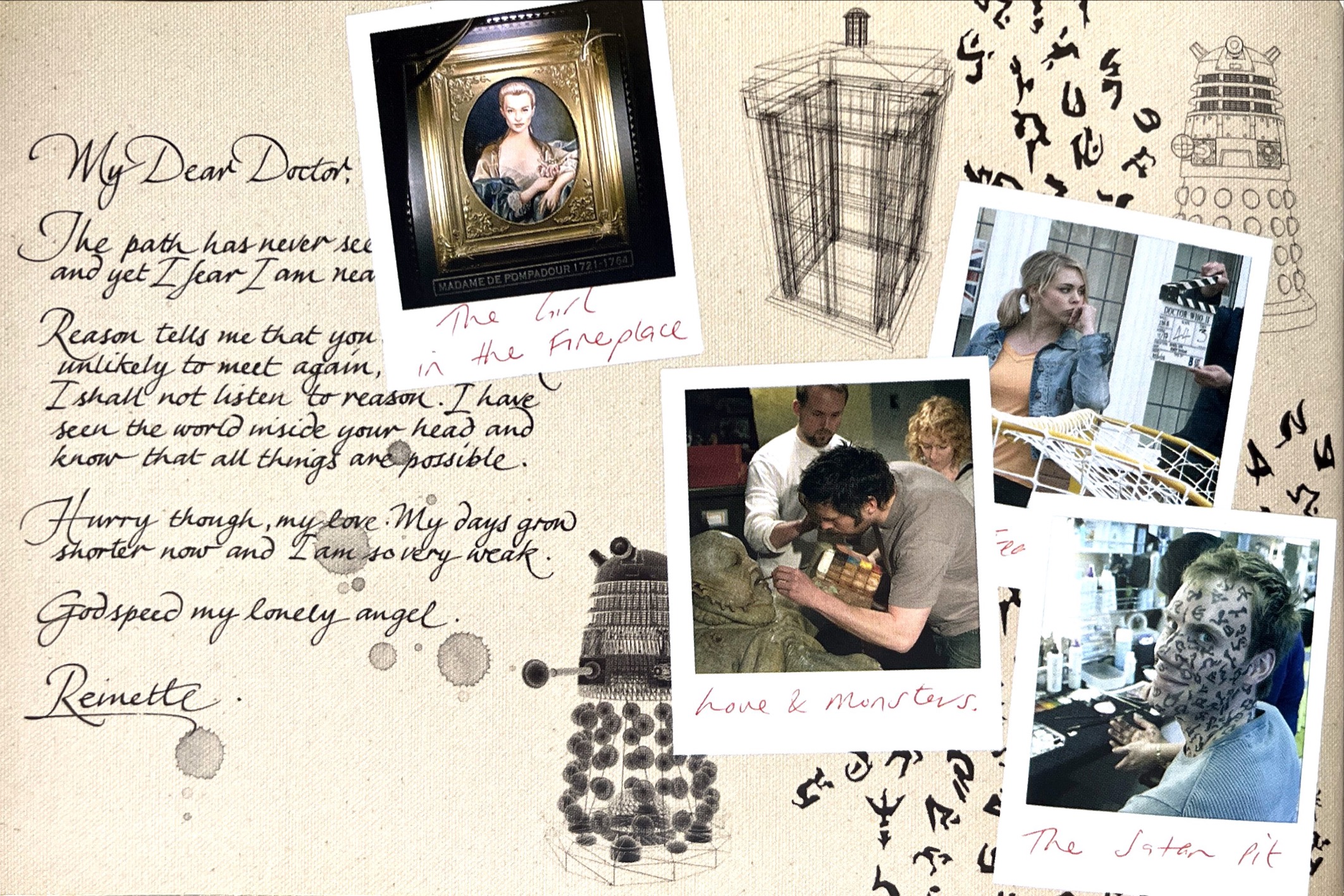
But while Rose misses the Doctor, he doesn’t seem concerned about leaving Rose and Mickey stranded on the spaceship, either when he knows his actions will have that outcome, or even after he’s done it, which seems very much at odds with his feelings about Rose, the caring reassurances he’s given her before and his reaction to events in the series finale. So it does feel a bit strange. If he knew Rose and Mickey were going to be stuck in the middle of deep space, why didn’t he at least set the Tardis to take them home, like he did for Rose at the end of Series 1? Unless he did it without it being made explicit, as Rose and Mickey didn’t seem to be panicking about how to get home.
Rose is also perfectly happy to have Mickey alongside her from the outset, despite her deep discomfort with him becoming an extra companion at the end of the previous episode. And that’s because Steven Moffat was unaware of how the School Reunion episode was due to end when writing this one, as he mentions in the podcast commentary. So that erroneous continuity feels odd. And Mickey himself is back to ‘tin dog’ mode again, just following along behind Rose. He simply marvels at everything he sees, and panics when he and Rose are captured by the androids at one point (where a comically drunk Doctor saves them), but that’s about it. There isn’t really anything for him to do.
So at its heart this episode is really nice, with fantastic scenes between the Doctor and Reinette, exquisite visuals of the French palace, royal costumes, the spaceship and the inner workings of the androids, great stunt work with the horse (achieved by impressive CGI composition, as the horse isn’t actually in the ballroom and David isn’t really on the horse), and a lovely music score (illustrated by the Madame De Pompadour track on the soundtrack album). But there’s nothing for Rose and Mickey to really get their teeth into – although the next story more than makes up for that, with Mickey in particular going on a hugely transformative journey.
5 & 6. Rise Of The Cybermen / The Age Of Steel
- Writer – Tom MacRae
- First Broadcast – 13 & 20 May 2006
- Links (5) – BBC / Wikipedia / Tardis Wiki
- Links (6) – BBC / Wikipedia / Tardis Wiki
This belter of a 2-parter is one of those that feels like a movie, with its epic and emotional story, heavyweight casting, great action sequences, impressive CGI & powerful music. And it has a huge impact on Mickey’s life most of all, as well as Rose.
As a result of the Tardis somehow falling out of the time vortex and seemingly perishing when it crash-lands, the Doctor, Rose and Mickey find themselves stranded in another dimension on a parallel version of Earth. And all is not well, as there’s an uprising of a new race of Cybermen, consisting of human brains transplanted inside robotic suits, who want to ‘convert’ everyone to be like them. They really do come across as formidable foes, with their costumes, robotic voices, conversion machines, ruthless ‘deletion’ of anyone who refuses to obey, and Murray Gold’s incredible music for them. There’s also another interesting musical choice at one point, incidentally, when The Lion Sleeps Tonight by Tight Fit is used to drown out people’s screams when they’re being converted!
The Cybermen on this parallel world have been developed by businessman John Lumic, played magnificently by the late, great Roger Lloyd-Pack – widely known for many roles including Trigger from Only Fools & Horses, Owen in The Vicar of Dibley, and Barty Crouch Sr. in Harry Potter and the Goblet of Fire (in which David Tennant played Barty Crouch Jr.), among his many other film, TV and stage credits. Roger was keen to accept the part as soon as it was offered, and explained in another interview that he based Lumic on the American defence chief Donald Rumsfeld. The fact that Lumic was already written as a wheelchair user was also fortunate, as Roger broke his leg shortly before filming!
Lumic has to forcibly impose his cyber creations on the world, as he can’t get approval from the authorities. That includes the President of Great Britain, portrayed by another esteemed actor, Don Warrington, who many will recognise as Philip from Rising Damp, but like Roger he has an extensive career beyond that. So when those 2 actors square off against each other in this story, it’s brief yet powerful.
Mr Lumic owns many companies other than Cybus Industries though, one of which is a health drink company called Vitex, run by a certain Pete Tyler (Shaun Dingwall). Rose’s father died during a very moving episode in Series 1, so when she discovers this parallel, and more successful, version of him, she’s defiant about going to see him, despite the Doctor’s stern objections. But even the Doctor becomes keen to see him and Jackie Tyler when their connection to events becomes apparent. There isn’t a parallel version of Rose though (they’ve simply called their dog Rose instead). So Pete becomes a big part of the action from then on, and it’s great to see him back in the series. Jackie also has some great moments, but she is unfortunately ‘converted’. However, her death opens a door in story terms that is made use of later in the series.
But it’s Mickey who has the biggest character development given his surprising discoveries. Like Rose, he too discovers a living version of a dead relative, when he meets his blind grandmother. The guilt of her passing, after the had tripped on a stair carpet he never got around to fix, has stuck with him ever since, so to be able to see her again, even though she’s not his original gran, hits him really hard.
A bigger shock still, however, is his doppelgänger Ricky, who is a member of The Preachers. While most of the population are in the grip of Cybus Industries, thanks to the earpods that feed information directly into their brains and ultimately coerce them to walk to the Cybermen conversion centres, The Preachers are a small but determined group of freedom fighters, who are determined to bring Lumic down and release the world from his enslavement. And Ricky is one of them, along with Jake Simmonds (Andrew Hayden-Smith) and a lady called Angela Price who goes by the pseudonym Mrs Moore (Helen Griffin).
Actor Noel Clarke deserves a lot of praise for his performances in these episodes. Despite Mickey and Ricky looking and sounding identical, he’s able to make them easily distinguishable by their body language (such as Ricky scowling) and the way they talk. And having to play both parts in scenes where they meet will have taken a lot of time and effort.
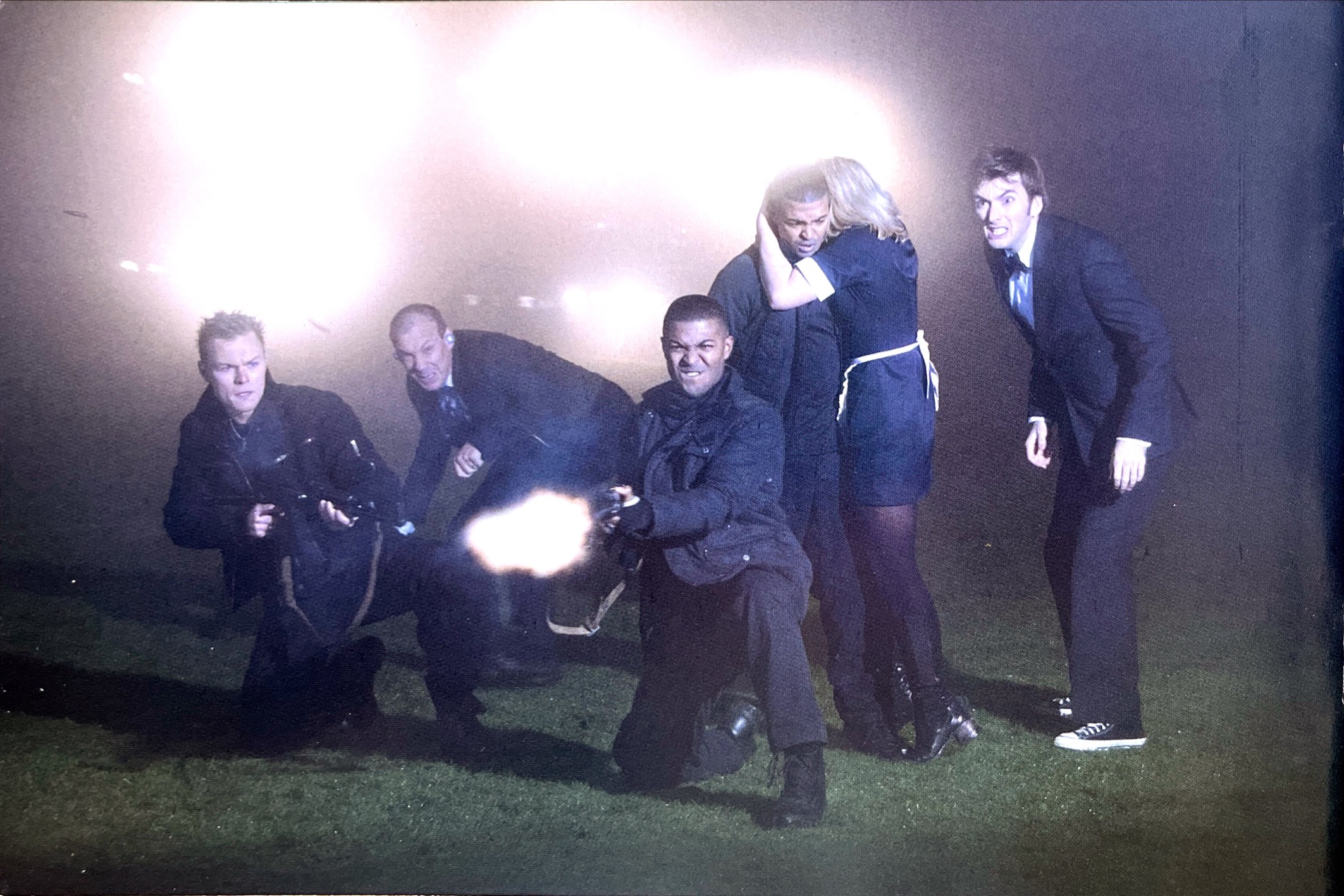
Furthermore, from the moment Ricky dies, you can see Mickey’s demeanour change as the story continues. He feels compelled to honour Ricky’s heroism, and has a long-held desire to prove himself as more than a spare part (“the tin dog”) to the Doctor and Rose, so he steps up with determination to save the world.
And you can see the Doctor gains a lot more respect for him when he notices Mickey’s new attitude, bravery and capabilities, to the point where he surreptitiously addresses Mickey through a security camera feed during his showdown with Lumic (who by then has been converted into the Cyber Controller), instructing him on how to bring down the Cybermen.
That involves disabling the emotional inhibitor, so the human mind inside the Cyberman awakens to the horror that has befallen them, as The Doctor had earlier discovered in a well-written and heartbreaking scene where he has to put one of the victims to sleep to put them out of their misery, as they cannot be saved. And there’s another sad moment where a newly-uninhibited Cyberman catches sight of themselves in a mirror and cries out in distress. It adds a whole new dimension to the Cybermen to be reminded of the living minds imprisoned inside them.
With that job done, Mickey then uses the zeppelin he and Jake have commandeered to rescue the Doctor, Rose & Pete from the exploding Battersea Power Station as they’re chased by the Controller – now converted into the Cyber Controller – with Mickey telling Rose “I’m coming to get you”, echoing the line uttered by the 9th Doctor in the previous series (who used to call Mickey by the name of Ricky, interestingly).
Of course, it’s only the Cybermen in London that have been defeated. There are others around the globe on the parallel world that need dealing with. But after the deaths of Ricky and Mrs Moore, Jake is the only surviving member of The Preachers, and Ricky’s gran has nobody left to support her. So Mickey makes the difficult but natural decision to stay put, in a world where he feels he has a much greater purpose, even though it means he can never return to his original world and see Rose again once the dimensional barriers are closed. It leaves Rose distraught, but Mickey knows her affections for the Doctor are greater than for him. And the Doctor fully understands and accepts his decision, telling the original Jackie Tyler on his return to our Earth that Mickey has “gone home”. It’s all quite moving.
But of course it’s not the last we see of Mickey or the parallel Pete Tyler in this series, or Cybermen. Their story will be continued. Talking of which, the brilliant cliffhanger at the end of Rise Of The Cybermen in this two-parter is notable, because it jumps straight into the credits with a “To Be Continued” caption (the first time that’s ever appeared in the entire history of the show), and there isn’t a trailer for the second part (because the episode was already too long to allow for it). So instead, we get a butchered edit of the theme tune over the credits, that has awkward cuts into the middle eight and the ending.
But they do fix that for the cliffhangers in the two-parters going forward, whereby they jump straight into the credits with the unedited theme, and then run the preview trailer over the middle eight, thus allowing people to see the credits and then switch off if they don’t want spoilers (which I do, as I like to be surprised).
7. The Idiot’s Lantern
- Writer – Mark Gatiss
- First Broadcast – 27 May 2006
- Links – BBC / Wikipedia / Tardis Wiki
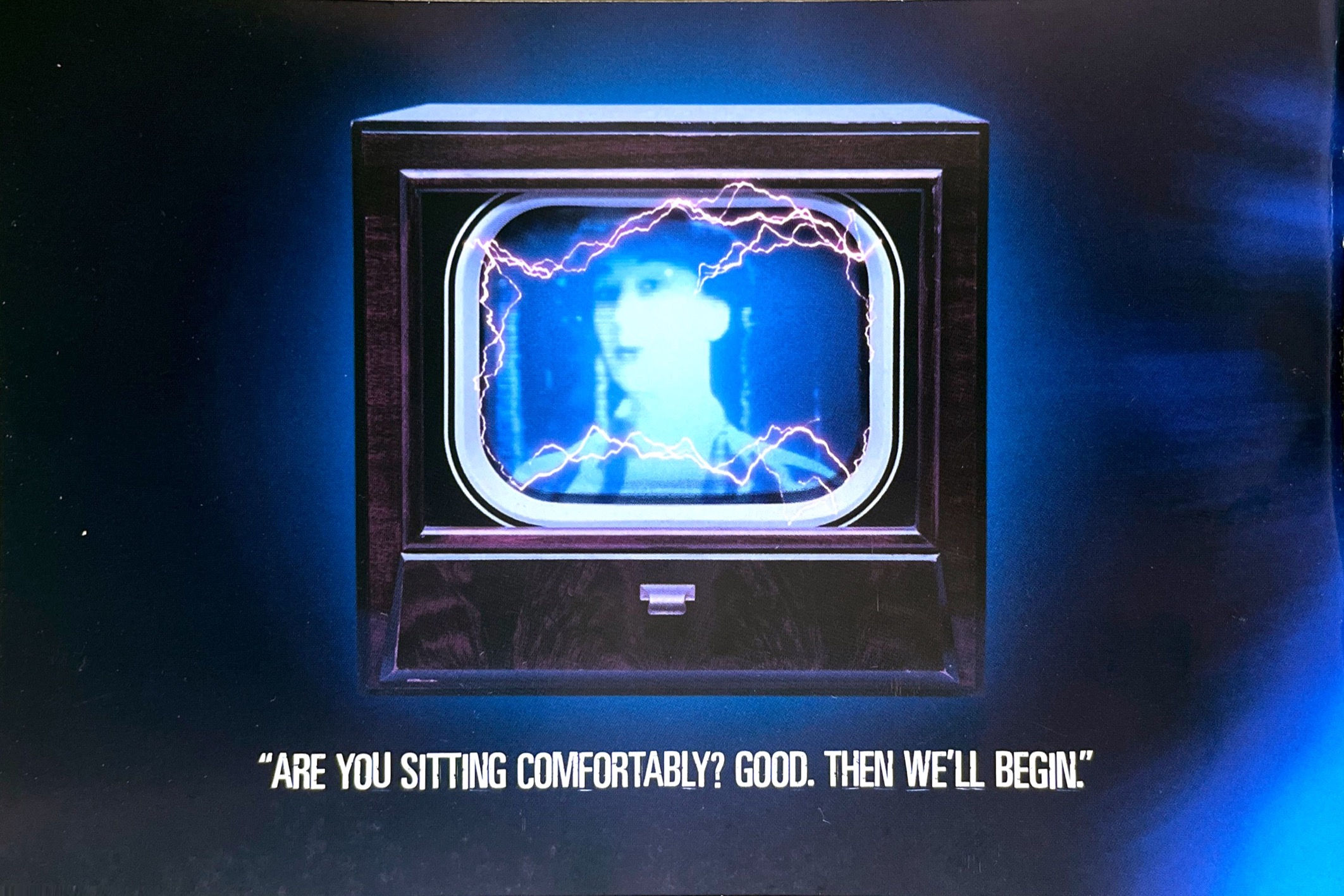
It’s well known that watching too much TV can potentially be bad for your health and rot your brain. But in this episode, the Doctor and Rose discover that it can have a much more sinister and disturbing effect.
Our heroes land in Muswell Hill, instead of New York as they’d planned, in the year 1953, to find the local residents gearing up to celebrate the Queen’s Coronation. Rose is suitably attired for the period, in a nice dress with a big pink skirt, while the Doctor drives out of the Tardis on a cool blue Vespa moped, which they use to get around during the first half of the episode.
A local family soon grab their attention, due to young lad Tommy (Rory Jennings) trying to warn the Doctor about people becoming monsters before being subdued by his abusive father Eddie (Jamie Foreman). So the Doctor and Rose pose as royal inspectors (with the aid of his psychic paper) to gain access to the property, which is quite an amusing scene. But things take a dark turn when they discover the family’s grandmother (Margaret John) has been shut away upstairs, barely conscious and having lost her entire facial features. And she is quickly captured by men who burst in and take her away, much like several other people have been.
As the Doctor and Rose split up to investigate further, Rose finds a local electrical shop, where Mr Magpie (Ron Cook) is practically giving his sets away at ridiculously low prices, to ensure everyone can watch the big event. And she soon suffers the fate that has befallen many others when her face is also rendered completely blank, and she’s dragged away to join the other victims. And when the Doctor sees her in this state, rage surges through his veins, and he will stop at nothing to save her.
The face thief turns out to be the Wire, an alien being who has infiltrated TV signals by projecting the image of a female presenter on screen, played by the marvellous Maureen Lipman (who was delighted to be in the show). By zapping viewers as they watch her, the Wire is able to consume the energy from their brains to stay alive. But in order to escape the airwaves and regain physical form, she needs to take in a lot more all at once. And what better time for a televisual feast than when millions of people are gathered around their sets for a once-in-a-lifetime historical event? Hence she controls Mr Magpie’s actions to ensure as many people have TV’s as possible.
The Doctor saves the day by climbing a transmitter at Alexandra Palace to stop Mr Magpie and the Wire, with the aid of Tommy down on the ground, whose father Eddie is then kicked out of the house by emboldened mother Rita (Deborah Gillett), though there’s a nice touch when Rose encourages Tommy to run after his Dad at the end.
So it’s another fun episode all in all, and a relatively lighter story compared to the more intense ones featured in the two-parters before and after it. There’s lovely music as usual too. And even the general filming style is a nice contrast to the rest of the series, with the heavy use of Dutch camera angles, along with bright colours that are very different from the dark territory the Doctor literally finds himself in for the next adventure.
8 & 9. The Impossible Planet / The Satan Pit
- Writer – Matt Jones
- First Broadcast – 3 & 10 June 2006 (Notice the dates? These 2 episodes about a devil-like beast were broadcast either side of 6/6/06.)
- Links (8) – BBC / Wikipedia / Tardis Wiki
- Links (9) – BBC / Wikipedia / Tardis Wiki
This two-parter isn’t as life-changing for our central characters as the other double-headers in this series, though of course it threatens to be. But it’s scary and dark and visually impressive, with a good mixture of characters, a great musical score and plenty of action. And it’s thought-provoking too, as the Doctor quite literally takes a leap into the unknown, and encounters something that by the end remains an unknown even to him.
It comes about when the Doctor and Rose land on an exploration base in deep space, on a rocky planet that is somehow orbiting a black hole without being sucked in. But something is already harming the crew and the base, and before long the Doctor loses his Tardis – which leads to an enjoyably awkward conversation with Rose about him having to settle down and live a normal life, if they ever get back to a planet where they can do so that is. We get one of the strongest indications yet of Rose’s feelings about him, when she suggests they could even share a house together.
But their domestic situation is quickly swept aside by the evil force they have to worry about, one that has been awakened as a result of the space explorers drilling deep into the rocky planet to find out what’s keeping it in orbit around the black hole. Whatever it is claims to have been around since before the universe, as impossible as that seems to the Doctor, though it is clearly so old that even the Tardis couldn’t translate its writings before it disappeared.
The mysterious entity (voice by Gabriel Woolf) is unseen most of the time, but possesses crew member Toby (Will Thorp) so that he can kill his colleague Scooti (MyAnna Buring). That leads to a heartbreaking but beautifully shot scene of her floating outside the base, which was actually filmed underwater, as explained in the podcast commentary. Although nobody truly knows what a black hole looks like, and the commentaries reveal there was quite a lot of discussion about it amongst the production team, the CGI visualisation of it here is beautifully rendered and it certainly feels real.
And it also gets into the minds of the Ood, a weird-looking slave race with tentacles coming out of their mouths, who communicate telepathically with their own kind, or vocally with others via special sphere they carry around (their words spoken by Silas Carson). The Ood are normally docile and polite, but when they’re taken over by the beast here their spheres are used to electrocute people instead, and that leads to an big chase sequence in the second part, through maintenance shafts and along corridors. It’s also interesting to learn in the commentary with Russell T Davies that the original drafts for the story used the Slitheen instead of the Ood, which would have made it very different!
The Doctor, however, joins crew member Ida, to take a lift down into the centre of the planet, which looks stunning (and marks the first time ‘New Who’ has filmed in a quarry), and they soon get trapped there. So with no way back up, the Doctor bites the bullet and delves down further still, into a deep and seemingly endless pit.
There’s a lovely conversation between him and Ida before he makes his decision to take the big drop and see where he ends up, if he even survives, as they talk about their spiritual beliefs. The Doctor even tries to give Ida a message for Rose, but can’t quite bring himself to say the words (a difficulty he encounters again later in the series finale). Incidentally, given her desperate determination to get the Doctor back and keep everyone else safe, Rose has the confidence back on the base to take on some semblance of the Doctor’s role in his absence, by spurring on the crew to find solutions, so she’s clearly been learning from him. And she has a lot on her mind, considering the beast’s voice has told her she will die in battle very soon, and everything that it’s said about the other crew members is true…
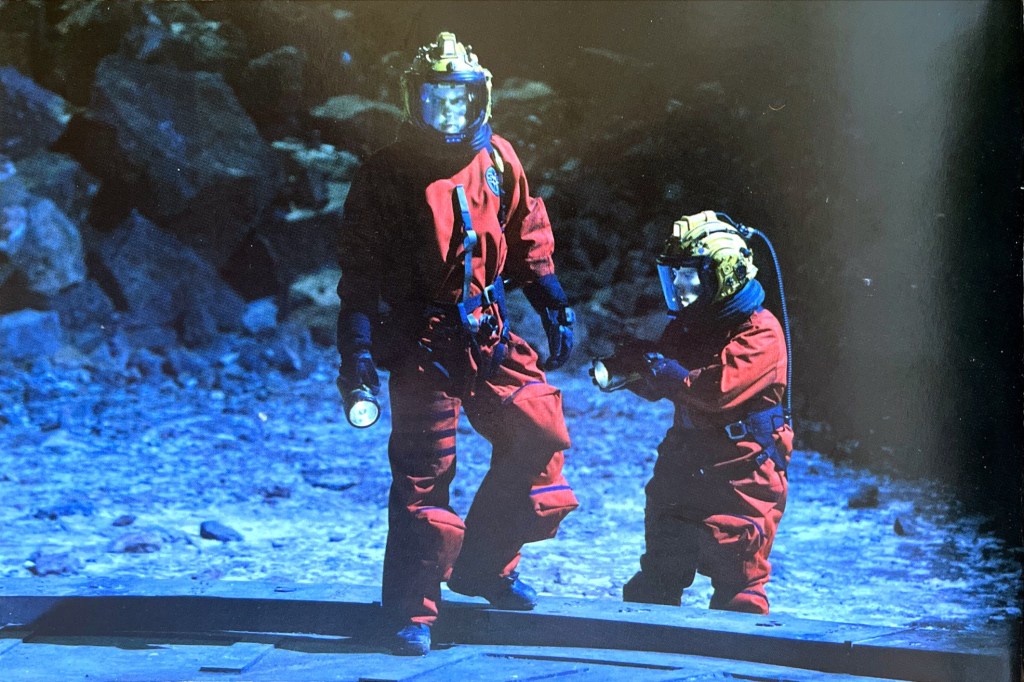
Anyway, what the Doctor encounters is a monster (an incredible CGI creation) that he’s never come across before and which remains a mystery to him at the end. It’s very rare that he can’t fully explain something, but this is one such case. Could it really the devil itself? That question is left wide open, and deliberately so. I don’t think it is Satan necessarily – it could just be an ancient creature that has preyed on other beings, projecting itself into their minds to exploit their vulnerabilities and naiveties, enabling it to convince and control them. But you can’t really be sure either. Any explanation is valid, it’s up to the viewer to decide, and that’s the beauty of it. Having some mystery is good, we don’t need to know everything.
What does become clear, however, is that it’s in a cleverly designed prison – hence the tricks it plays using its mind, because it’s impossible to escape in physical form without dying. But the Doctor now knows what to do to stop the creature. And if he does it, then it means sacrificing Rose as well as himself – yet he has faith in Rose, and rightfully so, plus he has the convenient good fortune of discovering the Tardis in the beast’s chamber. So everything works out fine in the end. But it’s certainly a dramatic conclusion to the story.
All in all, therefore, it’s a chilling couple of episodes that will really frighten some people, with a brilliant cliffhanger in the middle – which this time establishes the pattern of having the preview trailer for the second part after the credits, so the theme tune and middle eight can be played properly.
10. Love And Monsters
- Writer – Russell T Davies
- First Broadcast – 17 June 2006
- Links – BBC / Wikipedia / Tardis Wiki
This is the so-called ‘Doctor-lite’ episode of the series, in which the Doctor and Rose have minimal involvement. The addition of a Christmas special to an already tight production schedule meant that two of the stories had to be shot simultaneously with different film crews – a process called double banking – to ensure that 14 episodes could be completed in the time previously allocated to 13. So in this case, David & Billie were busy working on episodes 8 & 9. There was more double banking in later series as well, including Blink from Series 3 (one of the best stories the show’s ever done), and Turn Left in Series 4 (which took out the Doctor and focused on the companion). But I’ll get to those in later reviews of course.
This story isn’t up there with Blink or Turn Left by any means, but it’s still alright, especially it gives us an important look into the impact that the Doctor has on people’s lives, for better or worse.
It’s about a group of people who find each other through their fascination with the Doctor, either because they’ve met him or because they’ve seen him popping up time and time again. And we’re introduced to them through a video diary by Elton (Marc Warren). He had seen the Doctor in his house as a child, and was surprised to recognise him in a photo as an adult.
Some internet digging then leads him to the rest of the group, consisting of:
- Ursula, played by Shirley Henderson, who I recognise as Moaning Myrtle from the Harry Potter films, and more recently Frances Drummond from Happy Valley. Elton quickly develops a fondness for her.
- Bridget, played by Moya Brady, who I remember as Front Desk Officer Robbie Cryer (the niece of Sergeant Bob Cryer) in The Bill.
- Bliss, played by Kathryn Drysdale, who was Louise in the BBC sitcom Two Pints Of Lager & A Packet Of Crisps.
- Mr Skinner, played by Simon Greenall, who (like Marc Warren) hasn’t had any major roles in shows or films I’ve enjoyed before, but is a good actor.
The group meet regularly and get on really well, naming themselves LINDA (the London Investigation ‘N’ Detective Agency). And their sessions go from being just about the Doctor to more laid-back social affairs, with music, cooking, art, story readings, etc. Elton in particular has great taste in music, being a huge fan of Jeff Lynne and his band ELO, so during the episode we hear snippets of Mr Blue Sky and Turn To Stone, plus the LINDA group members perform a bit of Don’t Bring Me Down. Bliss also sings The Riddle Song (I Gave My Love A Cherry) to her friends at one point, and they all sing Brand New Key by Melanie together (a tune that many will recognise from the Combine Harvester parody by The Wurzels).
But their fun is brought to an abrupt end by the arrival of Victor, played well by comedian Peter Kay, who had originally been offered the role of Elton but wanted to play the baddie. Victor is a sinister stranger who takes over the group and conscripts them into helping him locate the Doctor, using information he’s gleaned from the Torchwood files (some of which have been corrupted by a Bad Wolf virus).
This leads to Elton witnessing the Doctor and Rose as they’re chasing an alien, which actually opens the episode to draw us in, before Elton explains what led up to it. That alien isn’t named in the episode, but Russell T Davies called it a Hoix for the credits, as it had to be given a name of some sort, and it has since reappeared in both Doctor Who and Torchwood.
Elton then meets Rose’s mother Jackie, who amusingly tries to flirt with him, by getting him to do all sorts of handyman jobs around the house, playing Regresa a Mí (Unbreak My Heart) by Il Divo and spilling red wine on him so he has to get undressed. But she quickly turns angry when she discovers he’s using her to try and get to Rose. It’s good to see how Jackie is living life in her daughter’s absence, and how protective she is of her, as it is an important part of the overall story and she hasn’t featured a lot in this second series.
But as members of the group start to mysteriously disappear, Victor’s true self and purpose becomes apparent. We see him reading a newspaper with the headline “Saxon leads polls with 64 per cent” (a sneaky reference to events planned for Series 3), before he reveals himself to be a hideous monster that absorbs people into its body, and which Elton decides to call an Abzorbaloff.
It was designed by 9-year-old William Grantham, who won a Blue Peter competition to create a monster for the show, with the winners announced by David Tennant. He spoke about it at the time for Doctor Who Confidential, and on its 10th anniversary in 2016 he had a brief chat with Who Chaser about it.
He later discussed it in more detail on VoteSaxon07’s channel in 2019, and then again during lockdown in 2021 with a retrospective on his own channel and an interview with Bigger On The Inside. In 2021 he also animated and directed a mini-sequel called The Genuine Article, with Elliott Crossley voicing the Doctor, impressionist Jon Culshaw as the Abzorbaloff son of Peter Kay’s monster, and Youtuber James ‘Kinnundo’ McKinnon as a Krakanord, along with a lady called Liz Arista Klein voicing an intercom.
It’s a strange concept for a monster, with people’s faces sticking out of its skin and talking after they’ve been absorbed, and it has certainly divided opinion among the fanbase. But I’m pretty neutral on it to be honest. It’s certainly more silly than scary, so it’s not one of my favourite villains, but it’s been visualised really well and Peter Kay gives it his all, so I don’t despise it either. Indeed, it’s nice to have a bit of light relief and general variety in the show, especially after the darkness of the previous 2-part story. And let’s face it, it’s far from the only silly monster in Doctor Who – we had the farting Slitheen in the previous series for a start, and there’s an amusing reference to that in this episode when the Doctor confronts it.
Yes, the Doctor and Rose do turn up for a short scene at the end. Rose initially tells off Elton for upsetting her mum, but once the Abzorbaloff is defeated, she comforts him over the loss of Ursula, whom he had only just plucked up the courage to ask out on a date before she was absorbed, and for the moving revelation about why the Doctor appeared in his house as a child. And while he can’t do anything about the latter, the Doctor is able to do something about Ursula, unusual though it may be. So it’s a sweet ending to this strange story. It is the weakest of the series, but it still works well, if you don’t take it too seriously and enjoy it for the light-hearted entertainment it’s meant to be.
11. Fear Her
- Writer – Matthew Graham
- First Broadcast – 24 June 2006
- Links – BBC / Wikipedia / Tardis Wiki
Intriguingly, this episode replaces a story written by Stephen Fry that was ultimately never produced, because it was deemed too expensive to make. What we’ve ended up with instead is highly unlikely to be as good as Fry’s 1920s idea, and apparently hasn’t been a popular episode with some of the fanbase. But, while the series does have some much better episodes, I still think it’s alright, because again it’s something a bit different, and thus fun because of that. In particular, it taps into one of Doctor Who’s strengths, taking something ordinary and making it scary – a child’s drawings in this instance.
A young girl called Chloe Webber (played with great maturity and gravity by Abisola Agbaje) has been possessed by an Isolus, which got separated from its family when it fell to Earth, and as such is desperately lonely. So it attempts to produce a new set of friends, by getting Chloe to sketch images of people she sees – who then vanish from the world and end up trapped in her drawings.
And that’s what the Doctor and Rose discover when they land in her street. There’s a great little gag when the Tardis first lands, as the Doctor discovers it’s the wrong way round and the exit is blocked, so he has to dematerialise and then make a second landing to get it right. They’re excited because it’s the day of the 2012 Olympics opening ceremony in London, but soon learn about a few children who have gone missing, and see a cat vanish as well (after the disobedient feline eventually did what the production team wanted!). Plus they get attacked by a scribble monster when Chloe gets one of her drawings wrong and scrubs it out.
Interestingly, as they delve into all of this, there’s a throwaway line from the Doctor that catches Rose (and the viewers) completely by surprise – “I was a dad once.” It’s rare that the Doctor mentions his family, so it’s certainly intriguing. We know, for example, that he has a granddaughter (Susan Foreman), as she travelled with his first incarnation. More recently, in The Empty Child the 9th Doctor responded to Dr. Constantine’s remark “Before the war, I was both a father and a grandfather” by saying “I know the feeling.” And in Smith & Jones (the first episode of Series 3), the 10th Doctor tells Martha Jones that he once had a brother, though “not any more”. But of course analysis of his family gets a lot more complicated than that, and it’s certainly not something I’m going to go into!
Anyway, it doesn’t take long for the Doctor and Rose to realise that Chloe is somehow involved with the missing children in her road. So they delicately talk to her and her mother Trish (Nina Sosanya) and learn about what’s going on, with the Doctor putting Chloe to sleep for a short while so he can talk to the Isolus directly. He can’t persuade it to change its ways though, and ultimately disappears into a drawing himself when Chloe draws him and the Tardis. The entire stadium of people watching the opening ceremony of the Olympics also disappear, much to commentator Huw Edwards‘ bewilderment, and the Isolus then sets about getting Chloe to draw the entire world to satisfy its social cravings.
[February 2025 Update: In light of the shocking revelations about Huw Edwards making indecent images of children, the BBC removed the episode from iPlayer in August 2024 so they could edit him out. It’s taken them 6 months, but the episode is now back online, with Becky Wright as the commentator saying the same dialogue, and the credits have been updated accordingly. You can still hear Huw faintly at one point, but they’ve done the best they can. It appears they’ve also used the 2023 upscaled HD Blu-ray version to do the new edit, making this the only episode from before 2009 that’s been uploaded as a high definition remaster rather than the standard definition original.
It’s up for debate whether it’s best to scrub people out of history like this, or leave them in but add a disclaimer so that people can make up their own minds. But as this is a family show, I can see why they’ve done it, and it’s only a minor voiceover part, so it doesn’t matter who plays it. And long-term fans like me still have the original version on Blu-ray anyway. The BBC will have a much bigger headache trying to edit future documentaries about major news events like the Queen’s death where Huw was a major face of the coverage.]
Rose is of course very upset at being separated from the Doctor, initially getting angry with Chloe before quickly accepting its not her fault. But with the Doctor moving in his own drawing, he’s able to give Rose a hint. As a result, she commandeers a council worker’s pickaxe to dig out the tiny spaceship that got buried in the fresh tarmac laid in the street, and tosses it into the Olympic torch that is fortunately being carried past that day. And so the Isolus realises it can return to its family, and leaves Chloe, returning everyone to their physical form.
There is, however, one last drawing, of Chloe’s late, abusive father, which has also come to life and is threatening to come and hurt her. But she and her mother send him packing by singing the Kookaburra song, which had been used earlier in the episode to calm Chloe down.
So all’s well that ends well. And even Rose’s distress at the Doctor not returning with everyone else is set aside when she sees him on TV using the Olympic flame to light the cauldron in the stadium, giving the Isolus all the power it needs to fly off.
But as the fireworks go off at the end to celebrate the Olympics getting underway, and Rose remarks that the foes they encounter will never be able to separate them, the Doctor has a deep unease. There’s been a lot of foreshadowing in recent episodes, including the Satan-like beast telling Rose she’ll die in battle, and Elton wondering how long it will be before Rose and Jackie pay the price of having the Doctor in their life. And now the Doctor can sense that a storm is approaching. Plus the ominous trailer that follows – using Rose’s Theme instead of the main theme tune – indicates that she’s about to tell her last story…
12 & 13. Army Of Ghosts / Doomsday
- Writer – Russell T Davies
- First Broadcast – 1 & 8 July 2006
- Links (12) – BBC / Wikipedia / Tardis Wiki
- Links (13) – BBC / Wikipedia / Tardis Wiki
This epic two-parter is one of my absolute favourite series finales, because it has lots going on, builds on elements laid down throughout the past two series, ties up some loose ends and gets very emotional.
The introduction alone creates a lot of tension and intrigue, as Rose proclaims it’s the story of how she died, even though to say that in the past tense means she must clearly still be alive. So something tragic is clearly going to happen to her, but it isn’t clear what.
The story is basically a follow-up to the first 2-parter in this series (episodes 5 & 6). It centres around millions of ghosts that have been popping up all over the world, with such perfectly timed regularity that the general public have learned to accept and embrace them. But their presence actually heralds great danger. They’re appearing because of the Torchwood Institute, based in Canary Wharf and run by Yvonne Hartman (Tracy-Ann Oberman). The organisation discovered the ghosts, along with a mysterious ship they can see that all of their high tech equipment says doesn’t exist, and they’ve figured out how to make the ghosts appear and disappear.
The Doctor soon figures it out though, explaining that the vessel and the phantoms are from the Void, the dead space between dimensions. But with some of the ghostly beings having already secretly transferred in advance, they’re able to manipulate Torchwood’s employees and systems to manifest their entire race in full physical form.
So in the spectacular cliffhanger at the end of the first part, it’s revealed that they’re all Cybermen, everywhere on the planet. The ghosts had just looked like ordinary people but, as the Doctor reminds us, “a footprint doesn’t look like a boot.” And he also underscores the gravity of the situation by observing: “It’s not an invasion, it’s too late for that. It’s a victory.” But then there’s a further twist, as the ship has nothing to do with the Cybermen, but in fact carries a quartet of Daleks, much to the horror of the Doctor and Rose.
There are lots of other nice little touches and points of interest within the first part as well. For instance, one particular Torchwood employee, Adeola Oshodi, is played by Freema Agyeman, who went on to play the next companion, Martha Jones, in Series 3. The similarity in appearance was explained by saying that the two characters were cousins. It’s also fun to see Peggy Mitchell banning a ghost from the pub in Eastenders (alongside cameos from people in other TV shows), the Doctor musing on wanting to say Allons-y more, Rose pointing out to him that he’s accidentally kidnapped her mother, his little reference to Ghostbusters, the heroic return of Mickey Smith, and the sound of Cybermen stamping during the credits. There are so many memorable details like those throughout both episodes.
The second part then has even more packed into it, as the Doctor tries to figure out how to put things right. The Daleks and Cybermen facing off against each other for the first time ever is brilliant to watch and often quite amusing, such as the Daleks saying “This is not war, this is pest control.” Likewise the first confrontation between the Doctor and the Daleks is good fun as well. The mysterious Genesis Ark turns out to be a clever piece of Time Lord design, used with evil intent by the Daleks. The parallel world Pete Tyler meeting our universe’s Jackie Tyler is very sweet considering they’ve both lost their respective partners, so it’s great to see them reunited in a sense. We hear that Harriet Jones is the president of the parallel Earth. And overall the story strides along at a good pace, ramping up the tension throughout.
But of course it’s Rose who is the centre of the story ultimately. She has no fear about facing the Daleks this time, much to their surprise, taking glee in telling them that the Doctor is there and that she destroyed their Emperor. And when carrying out his final plan, the Doctor tries to send Rose to the parallel world on purpose for her safety (along with our world’s Jackie and Micky, and the parallel world’s Peter and Jake). But of course Rose is having none of it, and returns to help the Doctor, even though closing the breach would mean she could never see her mother again, who would be stuck on the parallel world.
However, while all of the enemies are sucked back into the Void – apart from one Dalek who does an “emergency temporal shift” to escape – Rose, as a consequence of one last heroic act on the world’s behalf, is unable to hold on tightly enough, and to the Doctor’s horror she plummets towards the dimensional chasm. She is thankfully saved by Pete, who transports her to the parallel world just before the breach is closed.
What follows is an incredibly moving ending, with the Doctor and Rose separated, seemingly forever. We’ve got to know the characters so well and see their relationship develop so strongly, that to see them split up like this feels very unfair. Sure, it perhaps doesn’t tug at the heartstrings quite as much as when it first aired, given that I’ve seen it so many times, and because there was some degree of resolution when their characters did eventually cross paths again at a later date. But even so, it still moves me quite a bit, because ultimately they won’t be able to properly travel together any more, and I still greatly miss that.
So their final performances here are really beautifully done. First we see them pressing themselves against the walls of their respective worlds, as they seem to sense one another across the Void. And then the Doctor manages to find one final crack in reality, which is just about to repair itself, through which he can project himself to say goodbye to Rose properly. The pivotal moment is of course when Rose declares her love for him and he just misses out on the opportunity to complete his reply, leaving him with a tear-stained face in the Tardis as Rose breaks down on the beach of the aptly named Bad Wolf Bay. That gets me every time, it’s such a sad moment.

And the whole sequence is elevated even further by the Doomsday theme – which, like many of Murray Gold’s music tracks, has different arrangements for the TV broadcast and the album version, both of which are great. It’s such a beautiful piece, with its memorable bassline and Melanie Pappenheim‘s haunting vocals. It also brings Rose’s journey full circle, as we initially heard the vocal melody when she entered the Tardis for the first time in Series 1. And the tune later appears again in Series 4, as a short and powerful variation is played at the end of The Stolen Earth, when the Doctor regenerates into himself, though it’s quite easy to miss with the speech and effects over it and the overall drama of the cliffhanger.
So it’s one of Murray’s very best pieces from the entire series, and indeed his score throughout the whole two-parter is absolutely sublime, including the use of the Torchwood leitmotif that would later become familiar from the spin-off series, along with the themes for Rose, the Daleks, the Cybermen & The Lone Dalek (the last minute of which plays just after the Doctor vanishes, leaving him and Rose in tears). As great as the writing, acting, effects, etc are, the score really contributes so much too, and the show would feel very bland and empty without it.
As a quick aside, there are some nice cover versions of Doomsday out there too. I particularly like the rock version by Borna Matosic, which was filmed at the actual location (Dunraven Bay) that was used as Bad Wolf Bay. They’ve also produced an awesome version of the theme tune and renditions of some other tracks from the series. But I’ve included some other versions on my Series 2 playlist as well. And while we’re talking about random internet finds, there are amusing parodies by Joe Vevers of scenes from the episode, for the Daleks meeting the Cybermen and the Doctor’s farewell to Rose.
Anyway, right at the very end, the Doctor then says “What?” in confusion 4 times (which would become a bit of a running gag), when a bride suddenly pops up in the Tardis out of nowhere, who I’ll talk about more in my Series 3 review of course. It can seem quite jarring to some after the high emotion that’s immediately preceded it, and also baffling the first time you see it, when you have no idea who Donna is. But it is an amusing moment, and the nature of the Doctor’s life often means he doesn’t have time to mourn properly, as things are always moving on and surprising him. So it makes sense and makes you curious about tuning in for the Christmas special.
However, as a different way of looking at it, Youtuber DoctorBlue has made a very effective alternate ending that runs the credits immediately after the Doctor is seen crying, with the glorious ending of the Lone Dalek theme playing over them, so that Donna appears as a post-credits scene. You could legitimately argue that this is a better way of finishing it, as it somehow feels even more moving, while adding a bit of breathing space and giving the impression of time passing before the surprise ending. Or if you don’t like Donna appearing at all, there’s another edit by When Teddy Bears Attack which concludes with the Doctor on his own and plays the Doomsday theme over the credits. But I prefer the Doctor Blue option, I think it works better.
In any case, the scenes of Rose’s farewell and the bride’s appearance were kept extremely secret, even from most of the production team, with only the bare minimum of people involved, who got copies of the script at the last possible moment. And for everyone else, preview copies of Army Of Ghosts didn’t include the cliffhanger revealing the Daleks, and no preview tapes of the entire Doomsday episode were sent out either. Dalek Sec did appear on stage at the 2006 BAFTA Television Awards, but the audience probably just took it as a bit of fun to see a Dalek, rather than it being a major clue. So it’s very impressive that they managed to keep the ending a secret, because that’s really not easy to do.
Extras
Audio Commentaries
Every episode has an audio commentary on the Blu-ray. On the original DVD, 5 of these were in-vision, where you could see the participants talking in the corner of the screen. They’ve all been converted to audio-only on the Blu-ray, but that doesn’t really matter, as you don’t need to see them. It’s still a shame they weren’t replicated here though.
There were also bonus commentaries released online as podcasts, which are still available on the BBC’s pages for the Christmas Invasion and the main episodes of Series 2 (under the Clips section in each case, where you may to go to “See all clips” to reveal them). I’ve linked to each of them in the list below. I also have my own copies of the podcasts from when they were originally released as MP3s. Video versions of a few of them were also released online as part of the 2006 Adventure Calendar.
In any case, pretty much all of the commentaries are fun and interesting to listen to. Several of them feature David Tennant, which is brilliant, and there’s a great selection of other contributors, my other favourites being the people at the top – Russell T Davies, Phil Collinson & Julie Gardner – because they’re all so passionate about the show and see everything that goes on.
The weakest commentaries tend to be when it’s just a group of actors without anyone from the production team, as they’re not as experienced at commentaries and don’t know all the technical secrets, so often they just end up telling us what’s happening in the story and reacting to what they’re seeing. But they’re still nice, friendly chats with some fun anecdotes and trivia here and there. Noel Clarke (Mickey Smith) is also quite good at leading the conversations he’s involved with and prompting the others when things go quiet. And the Doomsday commentary with David Tennant and Billie Piper is a very good one to finish with.
The one anomaly with the podcast commentaries is that they have a slightly shorter running time than the episodes on the Blu-rays. That’s because the Blu-ray episodes actually run slightly slower than the original versions (as was also the case for Series 1), due to the differences in the frame rate. The shows were filmed in SD at 25 frames per second, and released that way on DVD, but the Blu-ray conversion process doesn’t allow for that. So they had to be slowed down by about 4% to 24fps, with the audio pitch-corrected (for both the episode soundtracks and the DVD commentaries) so it didn’t sound odd.
It sounds like a bad thing, and a few fans online hate it. And sure, it would be nice to have the episodes as originally intended. But that said, in all honesty, I don’t notice it, and nor do many other people, as it’s such a small change that doesn’t cause any major problems as far as I can tell. The episodes still look and sound amazing, so I would only notice if I played the Blu-rays alongside the old DVDs (which I no longer have). So it’s nothing to worry about really. It just means I have to briefly pause the podcasts every so often if I’m watching them with the episodes, when they’re referring to a moment that hasn’t quite happened on screen yet, in order to keep them reasonably synchronised. Or I’m happy to just listen to the podcasts on their own anyway, as they work perfectly well like that too.
[November 2023 Update: The new Series 1-4 & specials box set has fixed the slowdown issue, so the episodes run at the correct speed. But as I don’t notice the slowdown anyway, I haven’t bothered upgrading to that new set.]
So, with all that said, the participants in the commentaries are as follows…
- The Christmas Invasion:
- Blu-ray & Podcast – Writer Russell T Davies, Producer Phil Collinson & Executive Producer Julie Gardner. This was in-vision on the DVD edition.
- New Earth:
- Blu-ray – Director James Hawes, Visual Effects Producer Will Cohen (from The Mill) & Executive Producer Julie Gardner.
- Podcast – Actor David Tennant, Writer Russell T Davies & Producer Phil Collinson. This was also made available in-vision on the BBC website as part of the Adventure Calendar, as can be seen on Youtube.
- Tooth & Claw:
- Blu-ray – Writer Russell T Davies, Visual FX Supervisor Dave Houghton & Supervising Art Director Stephen Nicholas.
- Podcast – Actors David Tennant (The Doctor) & Derek Riddell (Sir Robert) with Script Editor Simon Winstone. This was also available in-vision on the BBC’s Adventure Calendar.
- School Reunion:
- Blu-ray – Actor David Tennant (The Doctor), Writer Toby Whithouse & Executive Producer Julie Gardner.
- Podcast – Actor Eugene Washington (Mr Wagner), Producer Phil Collinson & Script Editor Helen Raynor.
- The Girl In The Fireplace:
- Blu-ray – Actors David Tennant (The Doctor) & Sophia Myles (Madame De Pompadour) with Producer Phil Collinson. This was in-vision on the DVD edition.
- Podcast – Actor Noel Clarke (Mickey Smith) & Writer Steven Moffat.
- Rise Of The Cybermen:
- Blu-ray – Actors Noel Clarke (Mickey Smith), Camille Coduri (Jackie Tyler) & Andrew Hayden-Smith (Jake Simmonds).
- Podcast – Makeup Effects & Prosthetics Designer Neill Gorton & Prosthetics Supervisor Rob Mayor (both from Millennium FX) with Director Graeme Harper.
- The Age Of Steel:
- Blu-ray – Actors Paul Kasey (Cyber Leader), Voice Artist Nicholas Briggs (Cybermen) & Director Graeme Harper. This was in-vision on the DVD edition.
- Podcast – Actors Noel Clarke (Mickey Smith), Camille Coduri (Jackie Tyler) & Shaun Dingwall (Pete Tyler).
- The Idiot’s Lantern:
- Blu-ray – Actor David Tennant (The Doctor), Production Designer Edward Thomas & Special Effects Technician Charlie Bluett (from Millennium FX).
- Podcast – Actor Ron Cook (Mr Magpie), Makeup Designer Sheelagh Wells & Costume Designer Louise Page.
- The Impossible Planet:
- Blu-ray – Actors David Tennant (The Doctor) & Shaun Parkes (Zachary Cross Flane) with Visual Effects Producer Will Cohen (from The Mill). This was in-vision on the DVD edition.
- Podcast – Actor MyAnna Buring (Scooti Manista), Director James Strong & Underwater Cameraman Mike Valentine.
- The Satan Pit:
- Blu-ray – Actor Ronny Jhutti (Danny Bartock), Director James Strong & Editor Mike Jones.
- Podcast – Executive Producer Russell T Davies, Location Manager Gareth Skelding & Concept Designer Peter McKinstry.
- Love And Monsters:
- Blu-ray – Actor Camille Coduri (Jackie Tyler), Director Dan Zeff & Executive Producer Julie Gardner.
- Podcast – Writer Russell T Davies, Producer Phil Collinson & First Assistant Director Susie Liggat.
- Fear Her:
- Blu-ray – Writer Matthew Graham & Executive Producer Julie Gardner. The original DVD booklet says that actor Nina Sosanya (who plays Trish) is also in the commentary, but she isn’t. Maybe she was originally meant to be but couldn’t make it.
- Podcast – Actor Abisola Agbaje (Chloe Webber), Director Euros Lyn & Second Assistant Director Steffan Morris.
- Army Of Ghosts:
- Blu-ray – Actors Noel Clarke (Mickey Smith), Tracy-Ann Oberman (Yvonne Hartman) & Raji James (Dr Rajesh Singh). This is mainly just them explaining the story to us, and even to each other to a degree. But there is an interesting remark from Noel, who thinks that one day there might be a non-white Doctor or a female Doctor. And of course both have happened since, with 2 female Doctors (the white Thirteenth and black Fugitive incarnations), along with a black male Doctor (the Fifteenth) coming soon.
- Podcast – Writer Russell T Davies & Concept Designer Matthew Savage.
- Doomsday:
- Blu-ray – Actors David Tennant (The Doctor) & Billie Piper (Rose Tyler). This was in-vision on the DVD edition, of which there are snippets on Youtube. This is the only commentary Billie appears in, unfortunately, but it’s a fun one, as the two of them get on so well. They have a good laugh together as they watch the episode and reminisce about filming it.
- Podcast – Writer Russell T Davies, Executive Producer Julie Gardner & Producer Phil Collinson. This was also available in-vision on the BBC’s Adventure Calendar.
Other Blu-ray Extras
[Updated in November 2023 to refer to the Whoniverse collection on iPlayer.]
Apart from the commentaries, there are over 4½ hours of other special features on the Blu-ray:
- Doctor Who Confidential – 14 editions, lasting over 2½ hours, going behind the scenes of every episode and giving insights into the making of the series as a whole. These are roughly 10-minute cut-down versions of the original half hour shows that were broadcast on BBC Three (and the full episodes are thankfully now available on BBC iPlayer as part of the new Whoniverse collection). The main omissions here are the clips and discussions relating to the Classic era, along with some details about the making of the current episodes that they didn’t have room for. Which is a shame, but they’ve kept in the most important stuff for the box set, and they are still fun and interesting. The first episode here is Backstage At Christmas, which was originally on the Series 1 DVD in 2005 as a teaser for what was then the upcoming Christmas special. It makes much more sense to have it with Series 2 though, so I’m glad they’ve moved it here on the Blu-ray (especially as it’s an episode that’s not on iPlayer). That Christmas episode is narrated by Simon Pegg, as per the rest of the first series, while all the others here are narrated by Mark Gatiss.
- David Tennant’s Video Diaries – 26 instalments of his personal insights into making the show, lasting over 1½ hours. These feel very intimate and are fascinating to watch, as he clearly loves making the show, but he’s also honest about the hard work and pressure that the job entails, and the delays that occur for various reasons during production. Along the way we get to see lots of great clips from the filming of the series, plus photo shoots they had to do, his appearance on Blue Peter, switching on the Christmas lights in Cardiff with Billie, watching the Christmas special with his family, and Billie’s birthday, among other things.
- Billie Piper’s Video Diaries – Unlike David, Billie didn’t record much, so we only get 4 minutes of footage here. But it’s still nice, as we get to see the filming of the school explosion, a look inside the makeup truck, and continuity photos for the Christmas special (of the Doctor, Rose and Jackie). She does also make several appearances in David’s diaries, inevitably.
- Children In Need Special – Discussed earlier with the mini-episodes.
- Outtakes – An 8-minute blooper reel, with a mix of cock-ups and general messing about. Even if the mistakes themselves aren’t hilarious, it’s still interesting to see the untreated raw footage, to get a sense of how things looked before any enhancements or effects were added. And there are also some deliberate CGI creature bloopers that The Mill animated for a laugh, the Cybermen & K9 playing together in public, and a Sycorax spoof of Bohemian Rhapsody. So it’s quite amusing.
- Deleted Scenes – 23 deleted or extended scenes, lasting 16 minutes, from most episodes in the series. Again it’s interesting to see the raw, unprocessed footage when special effects are involved. Most of the cut lines or scenes aren’t major losses, and were trimmed to fit the time slot or improve the pacing. But occasionally it’s a shame to lose things, such as the Doctor trying out alternative words for fantastic in the Christmas special, or the revelation that Jake and Ricky in the parallel world were in love with one another.
So that’s another decent spread of extra material. And there are a few other little bits and bobs, like videos, photos and artwork, on the BBC pages for each episode.
TV & Audio Spin-offs
- Doctor Who: A Celebration – This was the first ever concert of music from Doctor Who, performed by the BBC National Orchestra Of Wales (conducted by Ben Foster), and hosted by David Tennant, at the Wales Millennium Centre in 2006 in aid of Children In Need. A 90-minute film of the concert was broadcast on the BBC’s Red Button service, but it was never officially released, which is a great shame. However, there was an hour-long edition of Doctor Who Confidential called Music & Monsters, broadcast on BBC One alongside The Runaway Bride on TV, which went behind the scenes of the concert, and that’s on the Series 3 DVD & Blu-ray. Indeed, the concert itself included an exclusive preview performance of part of the score from that Christmas special. Following the success of this concert, there were a few Doctor Who Proms in later years as well, and edited versions of those did get official releases.
- Totally Doctor Who – This was a children’s TV programme that accompanied the second and third series of the show, including interviews with the stars of the show, behind the scenes access, and a Companion Academy for children to learn some essential skills for travelling with the Doctor. There are full episodes and clips on the Totally Doctor Who channel on Youtube (and since this post was published, all episodes were added to BBC iPlayer in November 2023).
- Audiobooks – As well as making guest appearances in later series of the TV show, Billie Piper has also returned to the role of Rose Tyler in some audio dramas by Big Finish. She’s taken part in the Tenth Doctor Adventures alongside David Tennant as the Doctor and Camille Coduri as Jackie Tyler. And she’s got her own series called Dimension Cannon, set in the aftermath of Doomsday where she tries to find the Doctor again, which also features Camille Coduri. as well as Shaun Dingwall as Pete Tyler and Mark Benton as conspiracy theorist Clive Finch (from Billie’s very first TV episode). You can listen to Billie being interviewed by Nicholas Briggs & watch an interview with Billie & Camille on the Big Finish Youtube channel. In addition, the character of Rose has also featured in some novels adapted into audiobooks by the BBC for their New Series Adventures, which you can download from Audible in their titles for the Ninth and Tenth Doctors.
Interviews & Conventions
Here are a few examples of interviews relating to the series, featuring David Tennant, Billie Piper and Russell T Davies:
- David on BBC Breakfast in December 2005 (second part here).
- BBC Wales Today segments featuring Russell in December 2005 and David & Billie in 2006.
- Newsround report for children featuring David, Billie & Russell.
- Jonathan Ross talking to David in 2005 as he prepares to start as the new Doctor, and Billie in 2006 after her departure.
- Billie on Top Gear in March 2007.
Billie has also spoken to fans at several conventions over the years, with and without David, and you can see several examples towards the end of my Series 2 playlist. David has also appeared on many other panels of course, but I’ll include some of those in the playlists for later posts. Billie’s the main focus here as this is her final full series, not counting later guest appearances.
Conclusion
And that’s it, I hope you enjoyed that in-depth exploration of Series 2. It was another fantastic series, that again won lots of awards like the previous one, quite rightly. After all the initial uncertainty about how things would be with a new Doctor, after Christopher Eccleston had been so brilliant in the role, David Tennant really made it his own and was superb, while Billie Piper continued to be amazing as Rose, and the relationship between them developed really nicely, hence the sadness when it came to end, and the joy when she returned later on. It’s great that her family and Mickey also got a nice ending, so they were all together. The story strands were all brought together nicely, such is one of the many strengths of Russell T Davies’ excellent writing, which was brought to life magnificently with the acting, music, special effects and the expertise of everyone on the production team.
Do check out my Series 2 playlist for all the clips I’ve mentioned above and more besides, including some unreleased music, additional interviews and other bits and pieces. And I will be back with my review of Series 3 soon!
Share this:


 Well Eye Never
12 thoughts on “Doctor Who Review – Series 2”