

Note: I received a complimentary ticket for this concert, but all opinions are my own.
Music is an incredibly powerful, immersive and varied medium that impacts us all in one way or another, irrespective of who we are. It’s certainly been a constant feature in my life, as I’ve always enjoyed listening to it, and when I was a kid I used to play it a bit as well, just for fun. Being unable to read sheet music didn’t matter, as I could memorise things with practice, and I enjoyed improvising too. I still think it would be cool to learn an instrument like the guitar or piano one day, if I had the time, patience and guidance.
So I know first-hand that being able to play and/or compose music is a great form of escapism that allows you to express yourself and be creative. But for many disabled people, it’s not only enjoyable and rewarding, it can be truly vital. It can enable them to communicate clearly, reveal their personality, share their ideas, demonstrate their talents, feel safe, increase their confidence and form connections with other people, in ways that would otherwise be difficult or impossible. Music is the magic key that can unlock so much.
Of course, that can be easier said than done, if there are instruments that are inaccessible, or if you can’t find other people to share things with and learn from. So it’s always nice to learn of ways that disabled people have been given the opportunity to fully engage with music, especially at a young age so they can carry it with them throughout their lives. And I had the privilege of seeing one such group perform last weekend.
Contents
The Orchestra
The National Open Youth Orchestra is the world’s first disabled-led national youth ensemble, where 70% of the musicians identify as disabled. This inclusive group was formed in 2018, and there are now 58 members in 5 regional ensembles in Birmingham, Bournemouth, Bristol, London and Cardiff.

The fact that it has both disabled and non-disabled musicians performing together demonstrates how music transcends all barriers, and that’s reflected in the name of their concert. There was an interesting video about the orchestra and the compositions that played a couple of times before the show started, which helped to put things into context.
The Concert
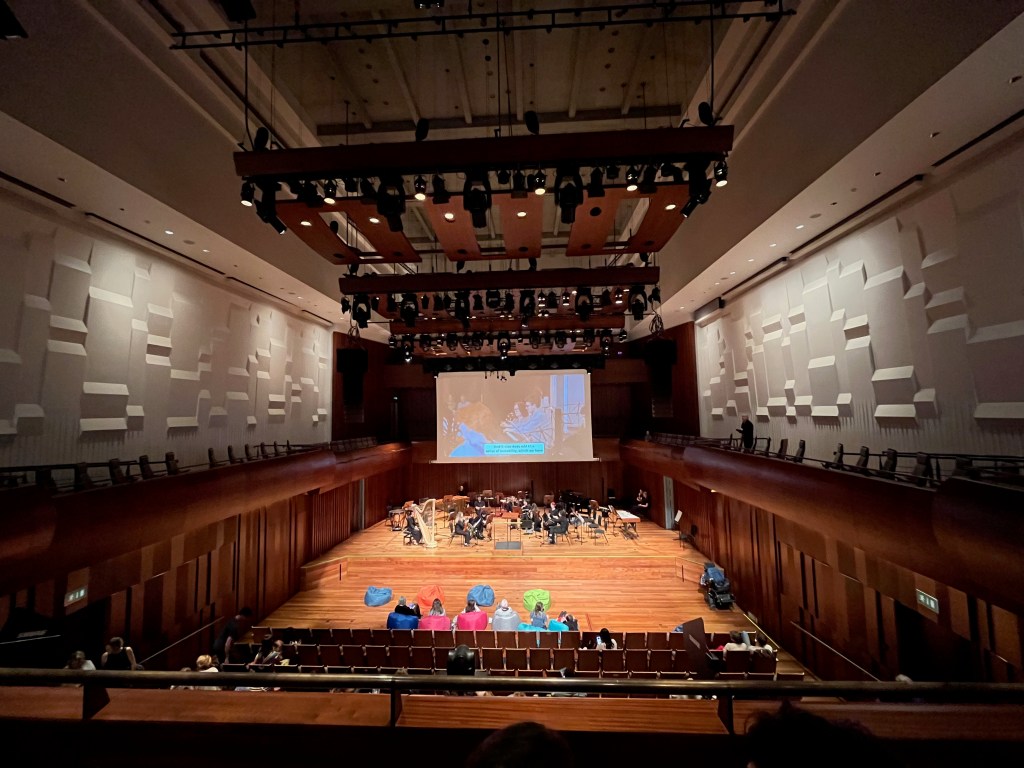
Ring Out!, with the tagline “No more barriers, just great music”, was put on by the orchestra’s London partner, the Guildhall School Of Music & Drama, at Milton Court Concert Hall last Sunday, and featured 16 very talented musicians.
It was a relaxed performance, so the house lights were left on, people were free to move around, there were beanbags at the front if anyone preferred to sit on those, and there was a chill-out area people could be taken to if they wished. And that worked very well. Everyone was very respectful and there were no distractions from the music.
There were also wheelchair spaces and standing seats available, and there was a BSL interpreter who signed all of the speech between the different pieces of music, which was great to see. The acoustics were very good in the hall as well, as I was sat high in the circle at the back and heard everything clearly.
The Music
I had absolutely no idea what to expect when I came into this concert, and all the pieces are completely new to me. But it was a very pleasant hour-long selection of music, with a good mixture of styles and textures to keep it interesting, including 2 world premieres among the 6 compositions:
- Barriers by Oliver Cross (arranged by Rhian Davies and Doug Bott) – Oliver is a disabled musician, and a former member of the orchestra. He wasn’t able to access or learn music in traditional ways, but that didn’t stop him performing and composing. This piece is quite clever because it has access built-in, by virtue of a modular structure that allows the instruments to be changed. So it was the perfect way to open the concert, and did engender a feeling of inclusivity as the different parts came together.
- Fragile by Yfat Soul Zisso (arranged by Liam Taylor-West) – This was the first world premiere in the concert, and reflects what it’s like for the beauty of nature to be destroyed by industry, so it’s deliberately unsettling in places. There’s stark juxtaposition between the gentle and harsher elements, yet they’re weaved together very effectively to remind us how industry can take over the environment in stages, creeping in bit by bit to start with. You can picture that kind of scenario quite vividly as you listen to it.
- Falling by Kate Whitley (arranged by Liam Taylor-West) – This was first commissioned by two other ensembles of disabled musicians – RNS Moves and BSO Resound. It has a nice falling scale motif that’s passed from one instrument to the next, so it builds really well.
- Ring Out! by Liam Taylor-West (arranged by Ellen O’Brien) – This was the other world premiere, centred around big piano chords that evoke the sounds of bells ringing from hilltops, as if passing a message between them. The rest of the instruments then get involved, and it all comes together nicely.
- Parlour Games by Meredith Monk (arranged by Julia Koelmans) – This is a good upbeat piece that has various layers, including a triplet motif shared between the cor anglais and saxophone, so the orchestra get to have a bit of fun with it.
- Behroozi by Lucky Chops (arranged by Ellen O’Brien) – This funky track by a band from New York has been adapted very well for the orchestra, and made for a catchy, joyful finale to the show.
So all credit to the members of the orchestra for a wonderful performance:
- Cass Alabaster – Violin & Viola
- Georgina Spray – French horn
- Holli Pandit – Harp
- Oscar Abbott – Vibraphone & Piano
- Luke Christian – Saxophone & Egg Shaker
- Evie Read – Clarion (more on this in a moment)
- Bethan Cole – Flute
- Charlie Hyde – Drums, Percussion & Timpani
- Alexander Davies – Marimba & Snare Drum
- Pea Pearson – Cor Anglais
- Connor Bates – Cello
- Rhys Stokes – Trumpet
- Raena Torane – Saxophone, Synthesizer & Piano
- Lilian Hopper – Oboe
- Ziya Haji – Bass guitar
- Francesca Shannon – Violin

The Tour
This was the first concert in a short tour that the orchestra are doing, and I can certainly recommend checking them out. It’s a lovely way to support young and upcoming disabled musicians, and so is buying their merchandise.
They’ll be performing at:
- Lighthouse, Poole on Saturday 10 May, 3-4pm (including a worldwide live stream, which will be available for 30 days afterwards)
- Hoddinott Hall, Wales Millennium Centre, Cardiff on Saturday 17 May, 3-4pm
- Birmingham Town Hall on Sunday 8 June, 3-4pm
These will all be relaxed performances with BSL interpretation, just like the concert I went to.
The Clarion
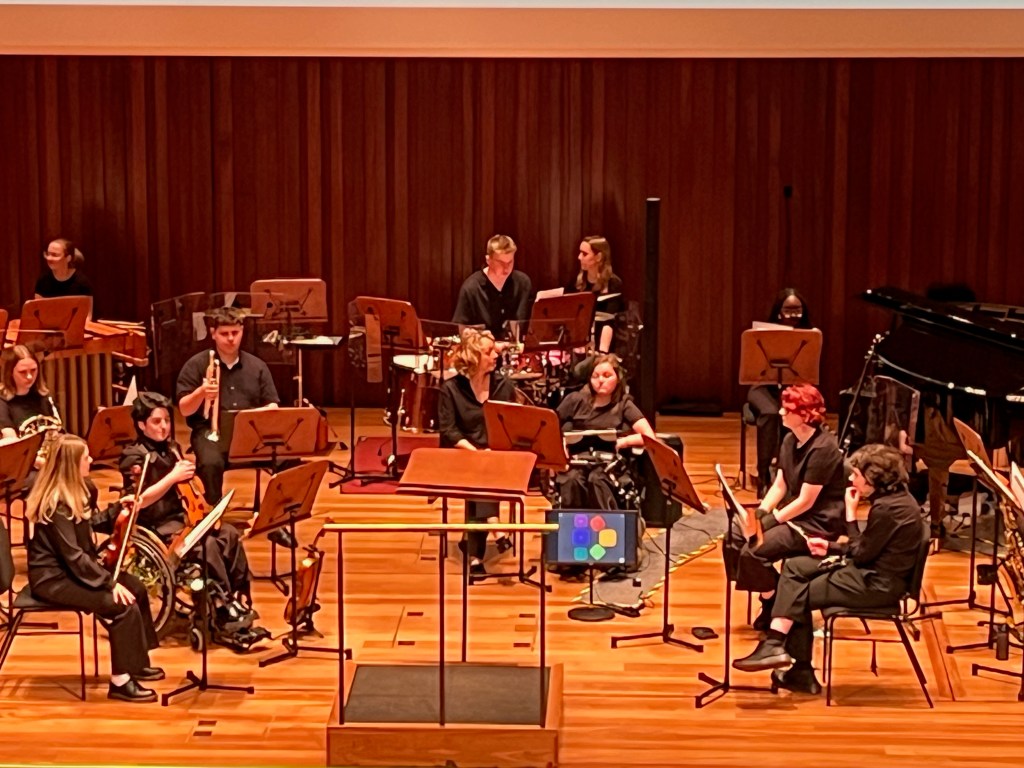
Before the show began, there was also an opportunity for people to try an accessible digital instrument called the Clarion, which one of the musicians (Evie Read) was playing in the orchestra.
It runs on iPads and Windows devices, and uses coloured blocks to represent the notes, which can be arranged in any way you like depending on your needs. You can also choose from a bank of 13 instrument sounds.

What’s more, you can play the notes either by touching the screen with your hands, or through head movements using a device called a head-mouse, or by moving your eyes using eye-gaze technology.
So it’s really clever, flexible and adaptable, granting access to music for lots of people who would never be able to use a conventional instrument.

Obviously it takes time and practice to make the most of it – I only looked at it briefly, so I didn’t have time to try and get a tune out of it. But I could clearly see its potential. And during the show, Evie had a copy of her screen facing out towards the audience, so we could observe what she was doing and how the arrangements of the blocks were changing for each piece of music.
So that was an interesting bit of technology I’d never seen before. You can find out more about it and download a free trial on the Clarion website.
The Venue
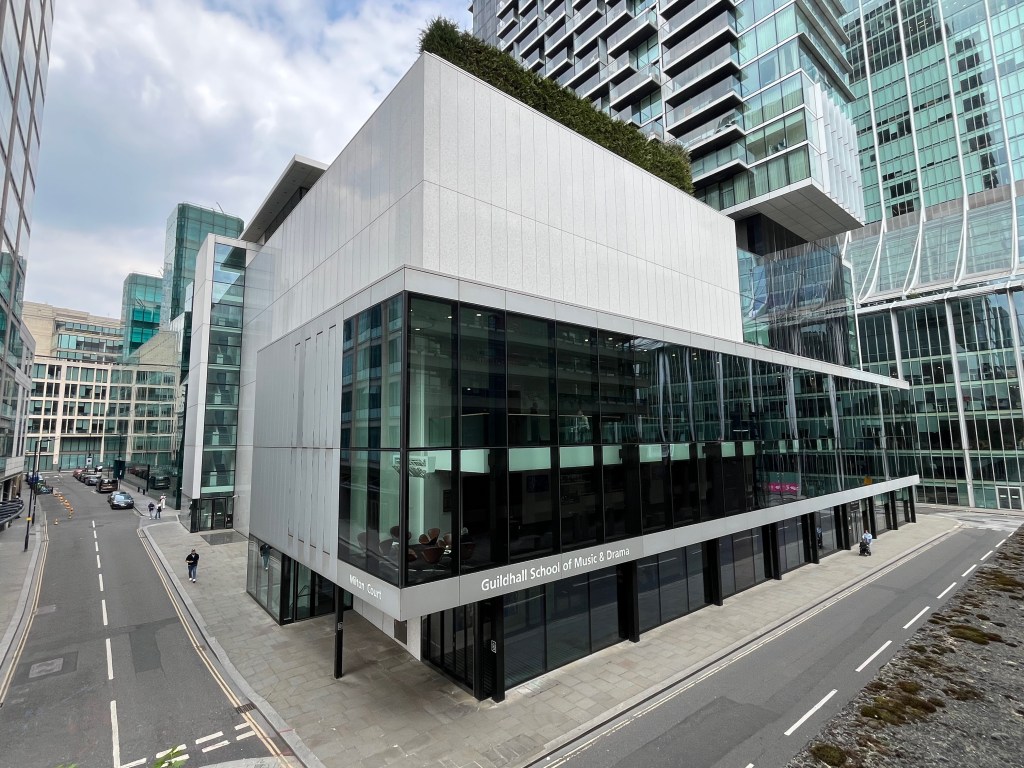
Finally, I must also give a shoutout to Guildhall School of Music and Drama, as the staff at Milton Court were all very welcoming and helpful, so thank you to them. It’s a nice venue, which is easy to get to as it’s just a short walk from Liverpool Street and Moorgate stations.
They also informed me that they put on a lot of concerts and other cultural events, most of which are free to attend, although things like plays sometimes have a small fee. So it’s worth taking a look through their What’s On list to see if anything takes your fancy at any of their venues.
Conclusion
All in all, it was a lovely concert by a wonderful group of musicians, so I’m glad I took up the opportunity to see them perform, and got to learn about some accessible technology in the process. Do check out the orchestra and support them if you can, and I wish them all the very best for the tour and their future endeavours!
Share this:


 Well Eye Never
One thought on “AD | National Open Youth Orchestra – Ring Out! Review”