

Note: I was given complimentary admission to this tour, for feedback and review purposes, but all opinions are my own.
For many people, art is already what they would consider immersive. A carefully considered and expertly crafted painting on a flat canvas has the power to draw you in, so that you’re totally absorbed by its people, places, fashions, creatures, scenery, history, objects, shapes, patterns, colours, messages, emotions, etc. Galleries with framed paintings on their walls have been successful for centuries with good reason, and will rightly continue to be so.
However, there is always scope to experience and enjoy the medium in alternative ways. Not only can it give even the most regular and fervent art connoisseurs a new perspective, but there are a lot of other people for whom it’s nothing short of vital to approach it differently, because they need assistance, encouragement or inspiration to fully appreciate and lose themselves in the masterpieces being presented to them.
For instance, as much as I love a good gallery, the fulfilment I can get from them as a visually impaired person tends to be very limited, hence I don’t go to them very often. On the few occasions I have wandered around such spaces on my own, where accessibility hasn’t been fully considered by the venue, it’s in the unfortunate knowledge and reluctant acceptance that I’m missing out on the full context of the pieces and cannot appreciate the finer details they contain.
I have, therefore, been delighted to take part in audio described tours at several museums and galleries since moving to London, which have really opened up this world to me and enabled me to engage with it more thoroughly.
But in late August I had a descriptive tour of Frameless that took it to another level, with its use of cutting-edge technology that showcases artworks in a way that I’ve never personally encountered before. The buzzword ‘immersive’ is being bandied around a lot in the cultural sector at the moment, and not always accurately judging by the reviews for some attractions, so I have felt uncertain about visiting such places. But for me Frameless very much lived up to that billing. And they have more audio described tours coming up, so I wanted to give some insight into what it’s like.
Contents
Access
Frameless is located just a short walk from Marble Arch. If you come out of the Tube station from Exit 1, on the north side of Oxford Street, you simply turn right and walk along, crossing the first side street (Great Cumberland Place), then follow the pavement around into Edgware Road at the next big junction. Frameless is shortly after the opening between the buildings on the right, the next door along from Wagamama.
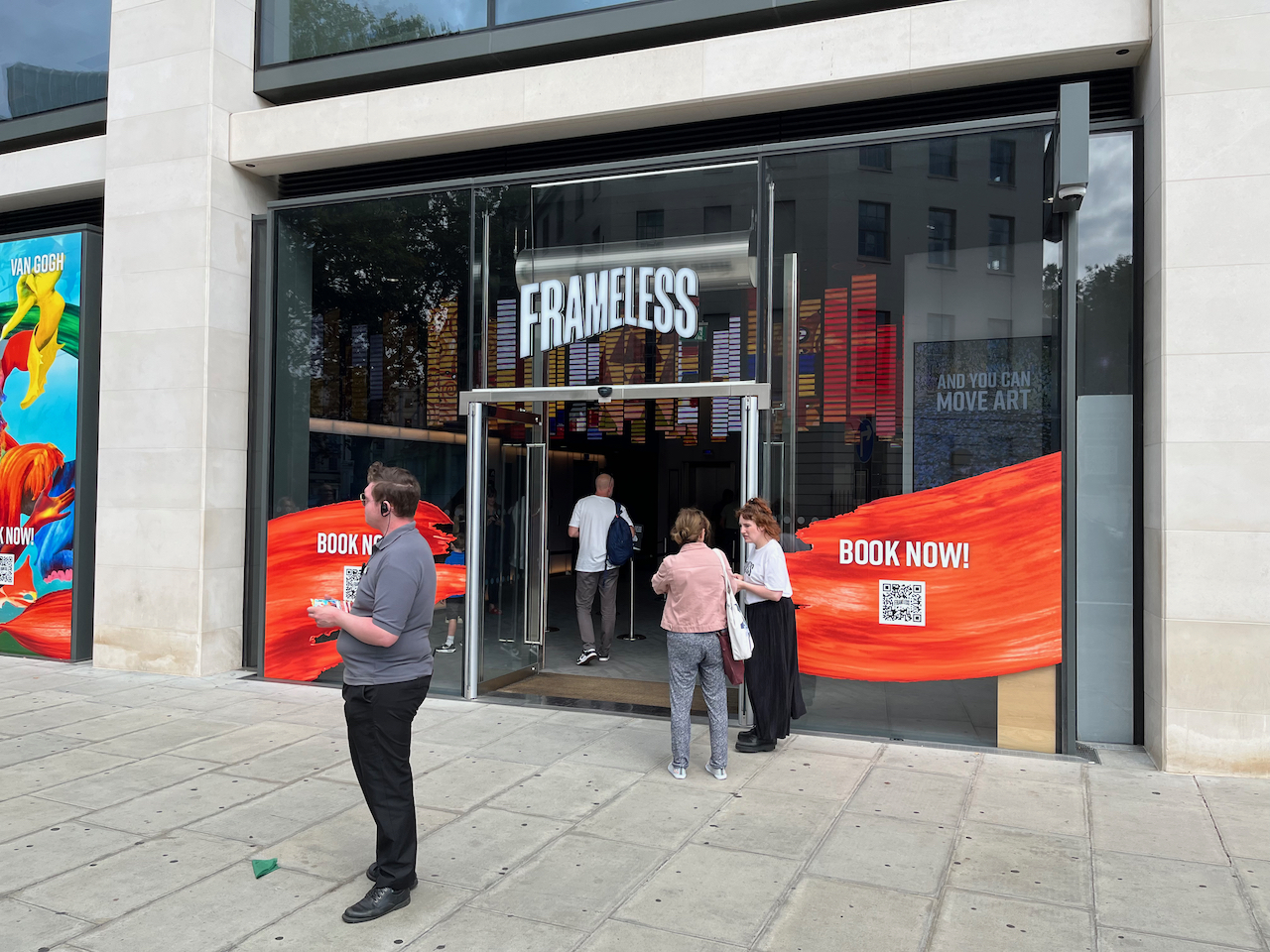
The experience takes place below ground level, so after checking in at reception you need to use the escalators or a lift to get down there (and you can only use the lift to get back up again). That brings you into a well-lit area with a café, toilets and a shop. I think the lighting around the escalators could be a little bit better, and the signage could be more prominent, which I included as part of the feedback I gave to them. But the staff were really friendly and helpful in any case, so I never felt lost.
Indeed, they don’t claim to be perfect, and they’re keen to receive feedback from anyone who visits, so they can learn how to make things as accessible and comfortable as possible. They already have extensive accessibility information on their website though, including an audio guide and audio description tour dates for visually impaired people, BSL tour dates and other information for the deaf and hard of hearing, easy read and visual guides, and details of their chilled experiences. It would be helpful to have links at the start to jump to the relevant sections of the page, but that small point aside it is very comprehensive. They also have a long list of general FAQs as well.
In this day and age there are still many places that aren’t prepared to share access information online, provide accessible experiences in person, or solicit feedback from disabled visitors, so all of that makes Frameless stand out already.
Audio Description
Audio described tours take place regularly, at least every couple of months. As noted on their access page, the next tours are on Saturday 7th October, Tuesday 19th December, Monday 12th February & Tuesday 2nd April. Tickets can be purchased in advance at £25 for adults and £15 for children, with group discounts for 4 or more people, and carers visit free alongside a paid ticket holder (proof of eligibility required). You can email access@frameless.com with any queries.
On each date, there are 2 tours provided. The morning tour is at 10:30am during their chilled session, where they have a lower capacity of visitors and a lower volume for the soundscape in each room. Then there’s an afternoon tour at 1:30pm when capacity and volume are at regular levels. I was on the afternoon tour for my visit.
Our audio describer was Jonathan Nash, who is a well-known voice to many visually impaired culture vultures in London like myself, and I had a lovely chat with him whilst waiting for the other attendees on our tour. During our conversation he told me about the impact that the gallery spaces had been having on some neurodivergent children, with examples of youngsters who were generally mute or immobile being triggered to verbalise or move around. Whether it’s because of the colours, animations, lights, music and/or other factors is unclear, but regardless it was amazing and heartwarming to hear those stories. Art in all its forms has beneficial impacts upon every single person in one way or another, whether we’re conscious of it happening or not, and being disabled or neurodivergent is certainly no barrier to that.
Because the soundscape in each room could sometimes get quite loud, Jonathan wore a headset with a microphone, carrying a tablet on which he could see information about each artwork, and we each listened to his audio description on a small device with headphones, on which we could adjust our volume as necessary. And that worked very well. But it’s great that AD tours are also available during chilled sessions where the volume is lower, as some attendees will certainly prefer that.
The visuals in each room run on a loop, so in each case Jonathan waited for an appropriate juncture to start talking us through the entire sequence. And so the tour took about an hour and a half as we went through everything, which felt like a good length without being too long. There was a suggestion by a fellow participant afterwards that one or two breaks could be included as well, which isn’t a bad idea really. But I was fine with a continuous tour personally, as I was finding it quite fascinating.
There were also benches in most of the rooms, though with the lighting being focused on the illuminated artworks I couldn’t see them on the comparatively dark floor space, as they blended in, so that was another aspect of the feedback I gave to them. i didn’t bump into them though, or the children who were moving around in each room with curious interest, as I was either following Jonathan, or just being slow and careful as I explored each space while listening to him. Again, such aspects may make a chilled tour preferable for some.
Anyway, Jonathan was very good at describing each space and the artworks that appeared, giving us a good overview as well as drilling down into some of the interesting details. That enabled me, with the vision I’m still fortunate to have, to focus on various aspects that I might otherwise have failed to notice or not paid close enough attention to, given the amount of imagery that you’re presented with. If I’d been exploring on my own without descriptions, I would have missed out on quite a lot.
The Galleries
The experience consists of 4 rooms. They’re accessed from a wide corridor, which has dark walls and flooring but was sufficiently lit for me to see where I was going, and indeed it has a nice lighting installation on the ceiling that’s worth looking up at. The name of each gallery is in large, bright lettering by each entrance, so it stands out.
There is also apparently a QR code on the wall before you enter each space, though I didn’t notice any of those, so they could stand out better, unless I missed them because I was focused on following Jonathan. Scanning them with your phone’s camera will take you to the online gallery guides, which give a general introduction to each room and credit the featured artworks. So, to save using the codes, you could also bookmark guide.frameless.com on your device before going (and various languages are available there). Obviously Jonathan was giving us that kind of information on our tour anyway, so we didn’t need the guides while we were there, but it’s still nice to have them as a reference to look back at later on.
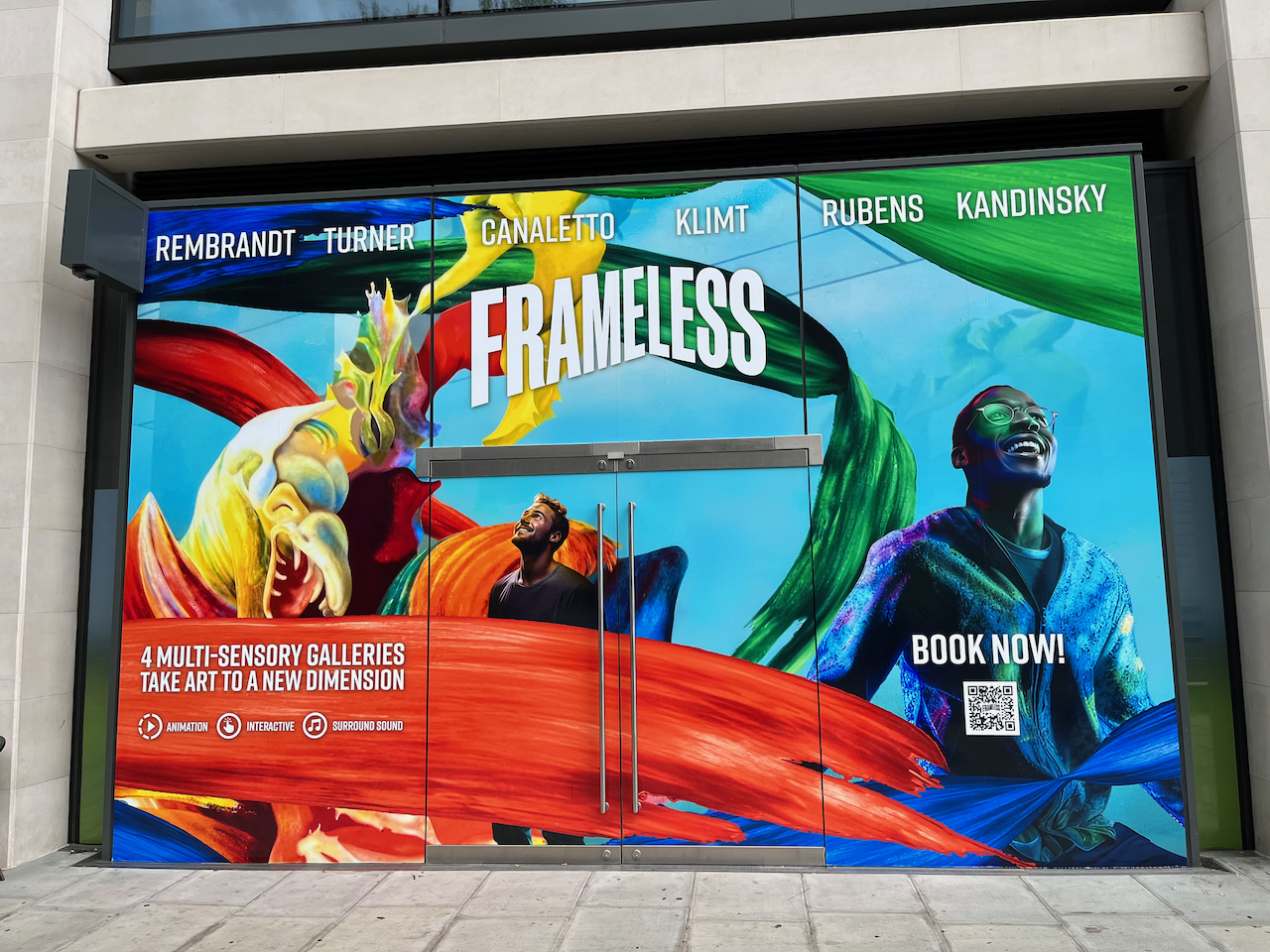
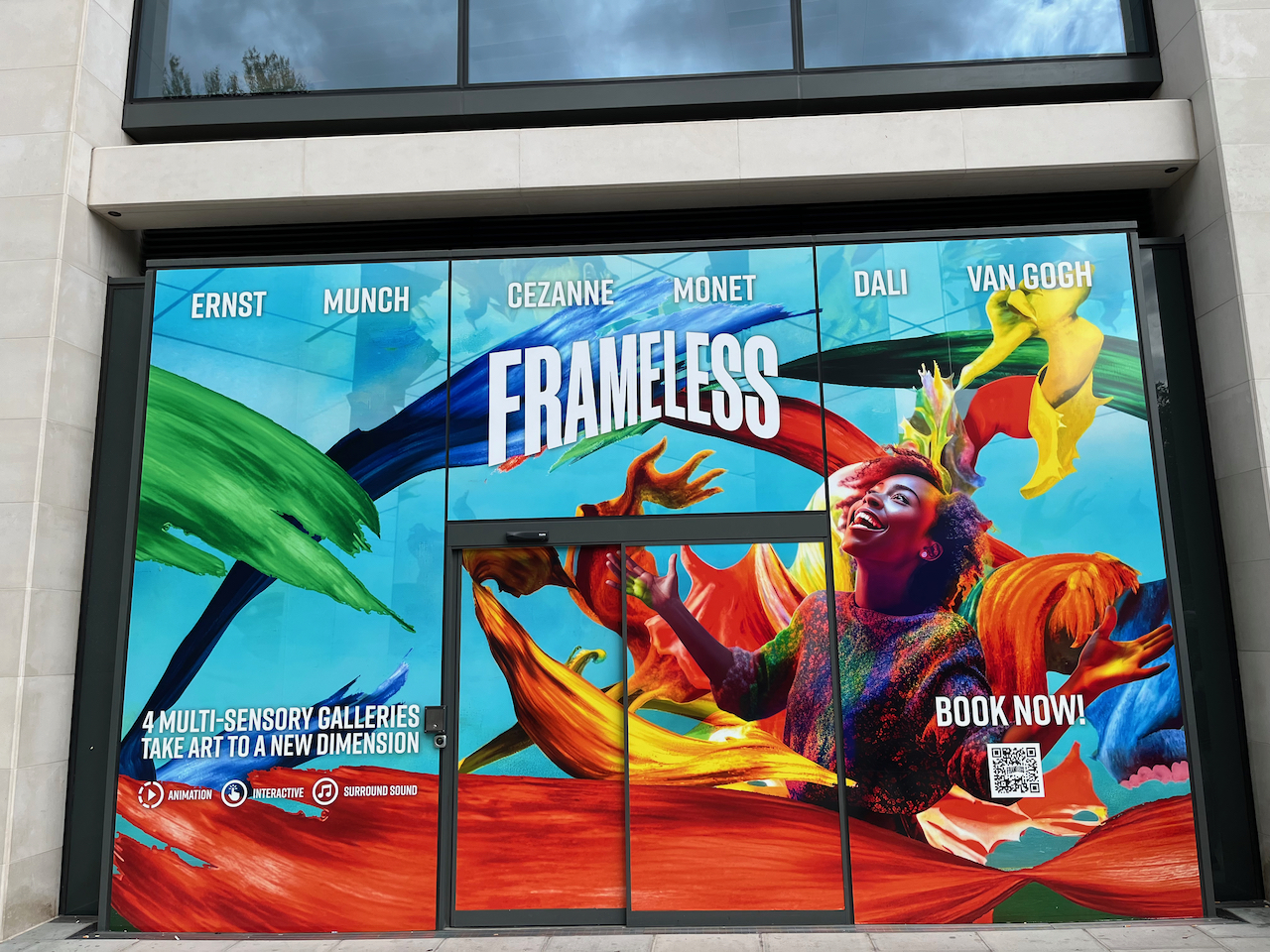
The rooms all use advanced projection and display technology, developed by Panasonic, to surround you with colossal, high-definition, animated artworks, some of which are very well-known (and they will change as time goes on). It’s really impressive given the size of each space, especially because the lighting is unobtrusive, it wasn’t glary or blinding (which I can be very sensitive to), and the amount of shadows produced by visitors is somehow kept to a minimum. There were only one or two fleeting moments where I had to avert my gaze from a light above or my shadow got in the way as I approached a wall.
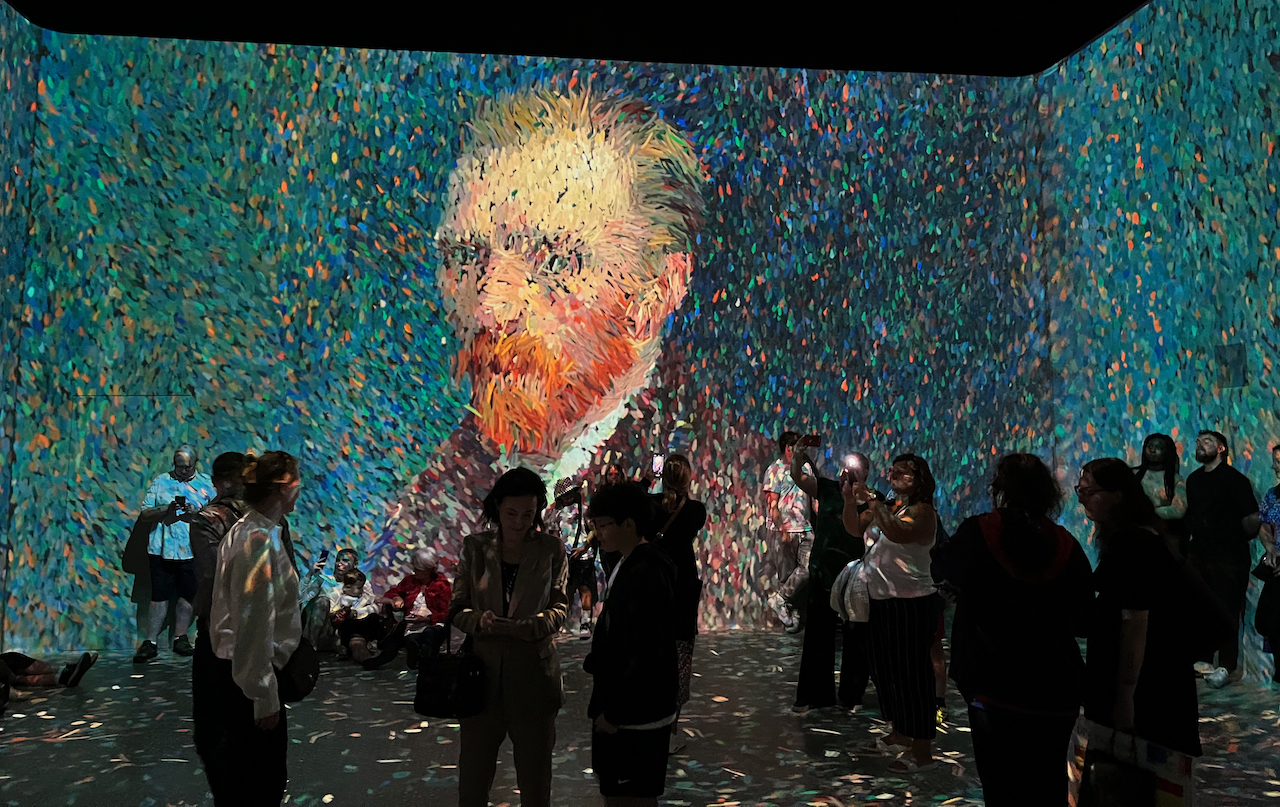
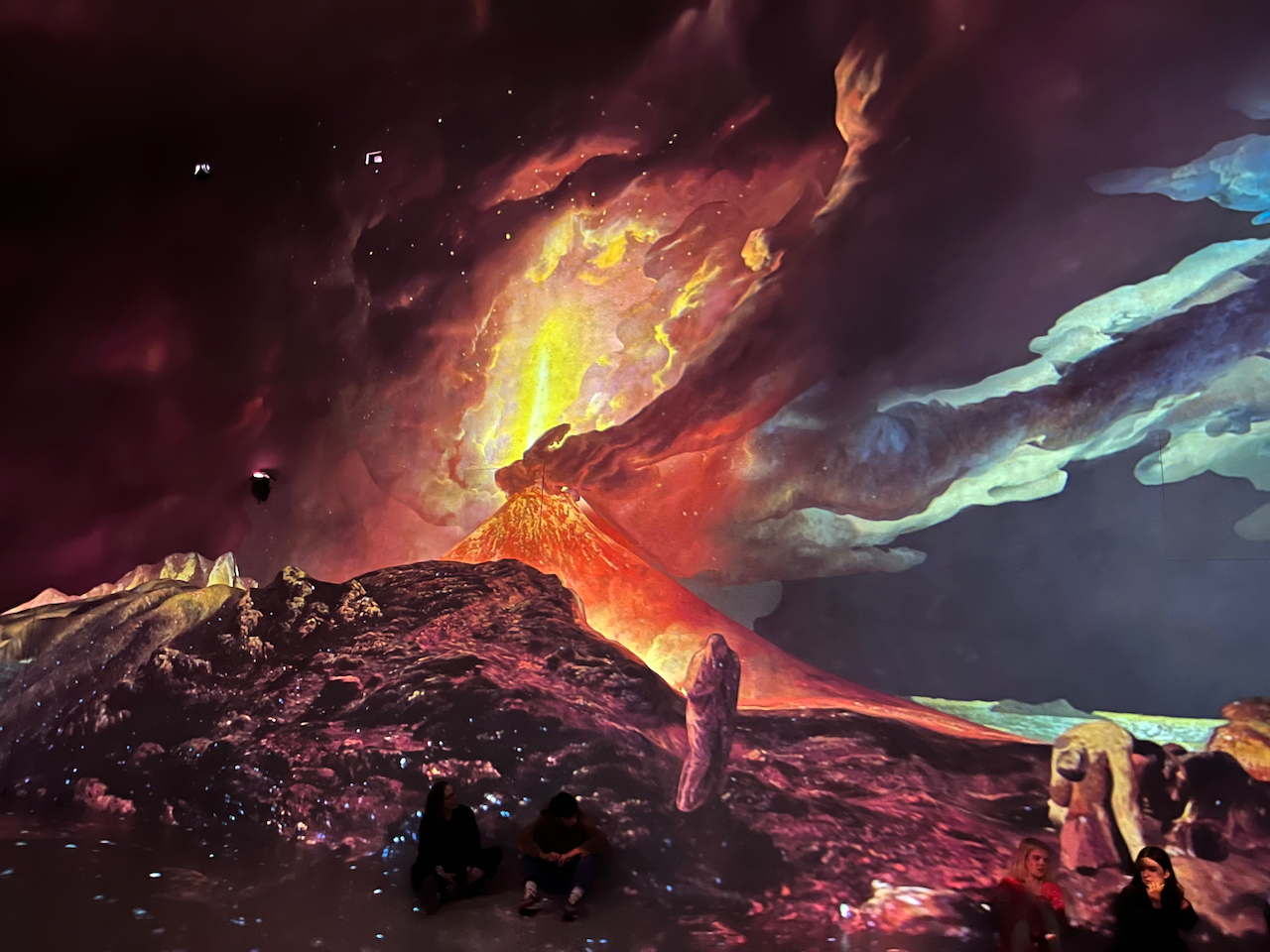
I didn’t take many photos, in part because I was just caught up in it all and wanted to make the most of it, but also because it’s very difficult to do it justice. However, I have included a few below, from a couple of the galleries, and there are several pictures on their website and social media pages of course.
In addition, the visuals are accompanied by a fitting and powerful mixture of original and curated music, both classical and contemporary, pumped through 158 state-of-the-art surround sound speakers. So you truly are enveloped from every possible angle by visuals and audio.
The galleries can be explored in any order. I was happy with the route we took, as outlined below, but there were equally valid alternative suggestions made during the subsequent feedback session. So in future tours the sequence may differ slightly, as well as the artworks changing every so often.
This is what we saw during my tour though. Click the links to see the guides, which each contain a full list of artworks:
- Beyond Reality – As implied by the name, this features artworks on the themes of alternate realities, dream worlds and surrealism. The Scream by Edvard Munch (with its iconic face), and The Persistence of Memory by Salvador Dalí (with the melting clocks), were the most recognisable images for me here, but they’re all quite fascinating. The artworks completely fill the walls and the floor, with further depth added above and below you by the use of mirrored trenches that you can walk on around the perimeter, and the huge mirrored ceiling high above. It’s a bit like you’re floating rather than walking in the middle of the pieces, it’s quite something. The music in this room is composed by Chip Hammond.
- Colour In Motion – For me this felt like the cleverest room in terms of the technology involved. At regular intervals the walls go blank, but on the floor are thousands of digital elements floating around like confetti, which you can sweep and kick towards the walls to form the next piece of impressionist art, including a self-portrait of Vincent Van Gogh, and The Waterlily Pond: Green Harmony by Claude Monet. I have no idea how it’s done, but the motion sensing technology is remarkably accurate considering the large number of people in there, all moving around in different directions. It was very responsive to me, as I had fun clearing pathways while looking around. The music in this room is an original score by Nick Powell.

- The World Around Us – By far the largest of the four rooms, here you’re surrounded by gigantic projections of landscape artworks, ranging from the serenity of The Rainbow Landscape by Peter Paul Rubens and the pretty Piazza San Marco by Canaletto, to the dramatic Christ in the Storm by Rembrandt van Rijn and the intense Vesuvius in Eruption by Joseph Wright of Derby. Whereas the other galleries use original music, these paintings are accompanied by a mix of 9 classical pieces curated by Ron Colvard, ranging in tone in the same way as the artworks. And such is the versatility of this large space that there are even immersive yoga classes held here once a month.
- The Art Of Abstraction – This room displays abstract art pieces on a maze of huge, slightly see-through, gauze screens that you can weave in and out of. The shapes, lines and colours of each piece therefore move around you across the different screens, so you see something different wherever you look, making them feel alive and giving them a kind of 3D effect. Combined with the original score by Nick Powell, it’s a very relaxing environment. So even though I’m not hugely into abstract art, I still felt very absorbed in this, and it was a nice way to come back down to earth after the relative intensity of the previous room.
Conclusion
I really didn’t know what to expect from an immersive gallery, but I was quite blown away here. The clever use of modern technology brings centuries-old artwork to life in a very exciting way, and the availability of audio described tours means I get to enjoy and experience it in the fullest way possible. It’s also wonderful that they’re keen to provide and promote access for as wide a range of visitors as they can, and are actively looking for feedback on how it can be improved.
So it is well worth a visit. You can find out more information on their website, and email access@frameless.com if you have any questions regarding accessibility and audio described tours. Thank you to Jonathan Nash for the tour I experienced, and to Frameless for inviting me along!
Share this:


 Well Eye Never
One thought on “AD | Frameless – Audio Described Tour”