

It’s been a few years since I went to the Science Museum before the pandemic, but I finally got back there recently to spend a nice afternoon looking around a couple of their exhibitions, one about science fiction and the other about the Covid vaccines.
I also downloaded the large print guides that are available via the Accessibility page on their website, and was therefore able to read them on my phone during my visit, so that was really helpful too. Now and again the order of objects presented in the guide wasn’t quite in the same order as I was looking at them, so I had to reorientate myself a bit, and use my monocular (my pocket telescope) to look at the small text on the labels to match them up to the book, but that wasn’t a major issue on the whole.
So here are little reviews of the two exhibitions I saw on my recent visit, with a selection of photos.
Contents
Science Fiction
The main thing I went to see was Science Fiction: Voyage To The Edge Of Imagination on the first floor, as it’s only open for a couple more months, until the 20th of August. It basically mixes props, costumes and concepts from science fiction with technology and ideas from real life science, to see how realistic sci-fi is or could be.
It’s quite a random selection of objects altogether, loosely organised in sections, and a lot of the sci-fi memorabilia items are replicas and models rather than originals, but it’s all nice to look at and some parts are quite interesting. As a big Doctor Who fan, I particularly enjoyed seeing a few Daleks (one in the museum lobby, one just outside the exhibition, and one in the gallery itself) as well as a Cyberman. Classic franchises like Star Trek, Star Wars and Alien are also represented, along with lesser-known films, publications and artworks.


The exhibition is also designed to feel a bit immersive, as it’s presented as if you’re going on a spaceship. You begin in a room where you go through the launch sequence – which is just some graphics and text on a screen in front of you, along with some sound effects, while the room doesn’t move or have any fancy lighting effects. So it’s a nice little gimmick to set the scene, though nothing particularly exciting necessarily.
But its main purpose is really to introduce you to ALANN (which stands for Algorithmic Artificial Neural Network), your AI guide for the exhibition. She appears on screens in each room that you enter to introduce them, and occasionally she says things that give you a bit of food for thought, regarding our increasing reliance on technology, and the impact it’s having on humans and the planet. Her words are always subtitled, and the online guide has full transcripts of her communications as well, which is good.
So after the ‘launch’ you then walk through the different rooms of the spaceship, which have appropriate lighting and a soundscape to make it feel more like a space environment. It does add a fun layer of originality and interest to the exhibition, and a lot of work has clearly gone into it. And as I knew that was a feature of the exhibition in advance, I did wonder how easy it would be for me to move around, expecting it to be quite dim in places. But actually the light levels were fine for me, without being too dark at any point, and there was lighting on the floor or walls when necessary to make it clear which way to go. So I was able to find my way through it all fairly easily. Others with more severe levels of sight loss will probably find it harder though, of course.
The only frustrating thing I personally found in terms of navigation was the rope barriers inside the museum entrance and in front of the sci-fi exhibition, because they’re so thin that I couldn’t see them to figure out which path to take around them. But thankfully a friendly member of staff outside the exhibition showed me which way to go when I got there.


As well as objects to look at, there are some film clips and animated explanations to look at, which are also subtitled (but not transcribed in the guide). A few of the videos have ear cups that you hold to listen with, so they’re nice and easy to hear. But some others just play their sound through a speaker next to the screen, which is sometimes too quiet to hear against the background noises in the exhibition, especially for those screens that are set back a short distance from the walkway, meaning I couldn’t get close to see or hear them properly, which was a shame. One example was a video about Tilly Lockey, a professional speaker, presenter, singer and model with bionic arms, which would have been interesting to watch as I’d never heard of her before. But there’s plenty of stuff about her online anyway, including her Youtube channel, where she has a vlog about the launch of the exhibition, along with her Instagram and Twitter profiles.
There are a few interactive elements in the exhibition as well, including a warp drive you can activate, a test to see how much of a cyborg you are, and an equation you can play with to estimate how many other planets might harbour life. Plus there’s a detour partway through the exhibition, where ALANN invites you to interact with an alien life-form in a large round room. I think the lights that float across the wall and ceiling, and the sound effects you hear, are meant to interact with you, but I couldn’t tell if it was responding to me as I walked around the space, or if I needed to do bigger movements to make it more obvious, or if it was just random. But it was nice anyway, it’s quite a relaxing space.

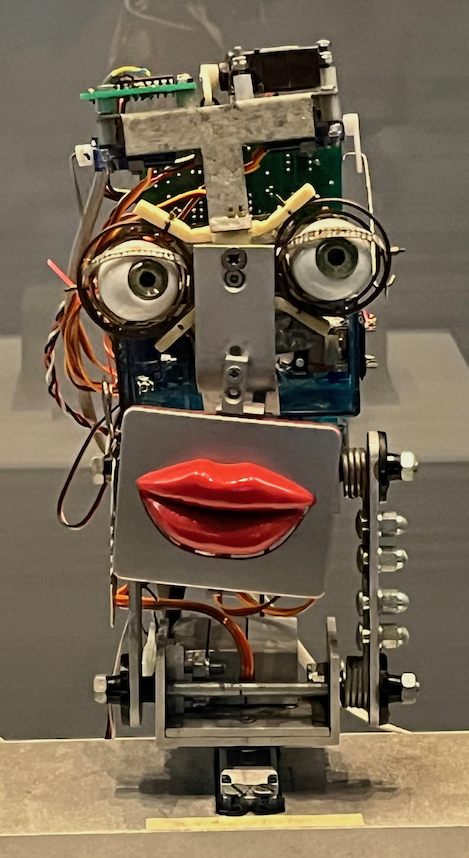


So overall the exhibition was well worth a look. I spent a good couple of hours in there, because I was able to read a lot of the labels in the guide I’d downloaded, and because I went on a weekday when children were still in school (one of the nice perks of working part-time!), so there weren’t many other people around.
It’s a paid exhibition, and you have to book a time slot for entry. Adults pay £13.50 (or £15 if you include a 10% charitable donation to the museum), and there are discounts for children, students, disabled people, the unemployed and seniors. So it’s a reasonable price for what you get, if you make the most of it and have a thorough look at everything. You can see more images from the exhibition on my Instagram here and here, and I’ll share a little bit of footage in the video for my June Favourites post in the coming week or two.
Injecting Hope
The other exhibition I visited was a free one called Injecting Hope: The Race For A Covid-19 Vaccine, which is open on the ground floor until June next year. It looks at how the scientific community pulled out all the stops, without cutting any corners, to produce safe and effective vaccines against Covid that helped us to get back to normal life again.
So it explains how viruses work and briefly looks at the impact that Covid’s emergence had on the world, before taking you through the development, trials, manufacturing and distribution of the vaccines. So it’s really interesting to get insights into all of that, and it’s great to see the amazing scientists and volunteers being recognised and celebrated. Even the Science Museum itself became a vaccination centre at one stage, so they rightly celebrate that here too.



Again there are a few film clips you can watch, which are subtitled – although, as with the Science Fiction exhibition, one or two of them were too quiet to hear, such as a video of Jonathan Van-Tam, which would probably have been quite interesting to listen to as he’s one of the advisors I came to really admire and trust during the pandemic. There are also a few screens you can interact with to get a bit of additional information, and there’s a tactile model of a Covid particle with its spike proteins.
So there was plenty to see, I spent a good hour looking through the gallery with the large print guide to assist me. You can see a few more photos from the gallery on my Instagram.
Conclusion
So that’s it for those two exhibitions, I hope you found that interesting. There are other new things at the museum I want to see as well, so I’m aiming to go back there again very soon – and a lot sooner than 3 years this time – because it’s always a fun place to explore!
Share this:


 Well Eye Never
One thought on “Science Museum – Sci-Fi & Vaccines”